ONE OF THE MOST BEAUTIFUL FIGHTERS OF WWII
By Keith Myles | km yles155@icloud.com
Photos by the author
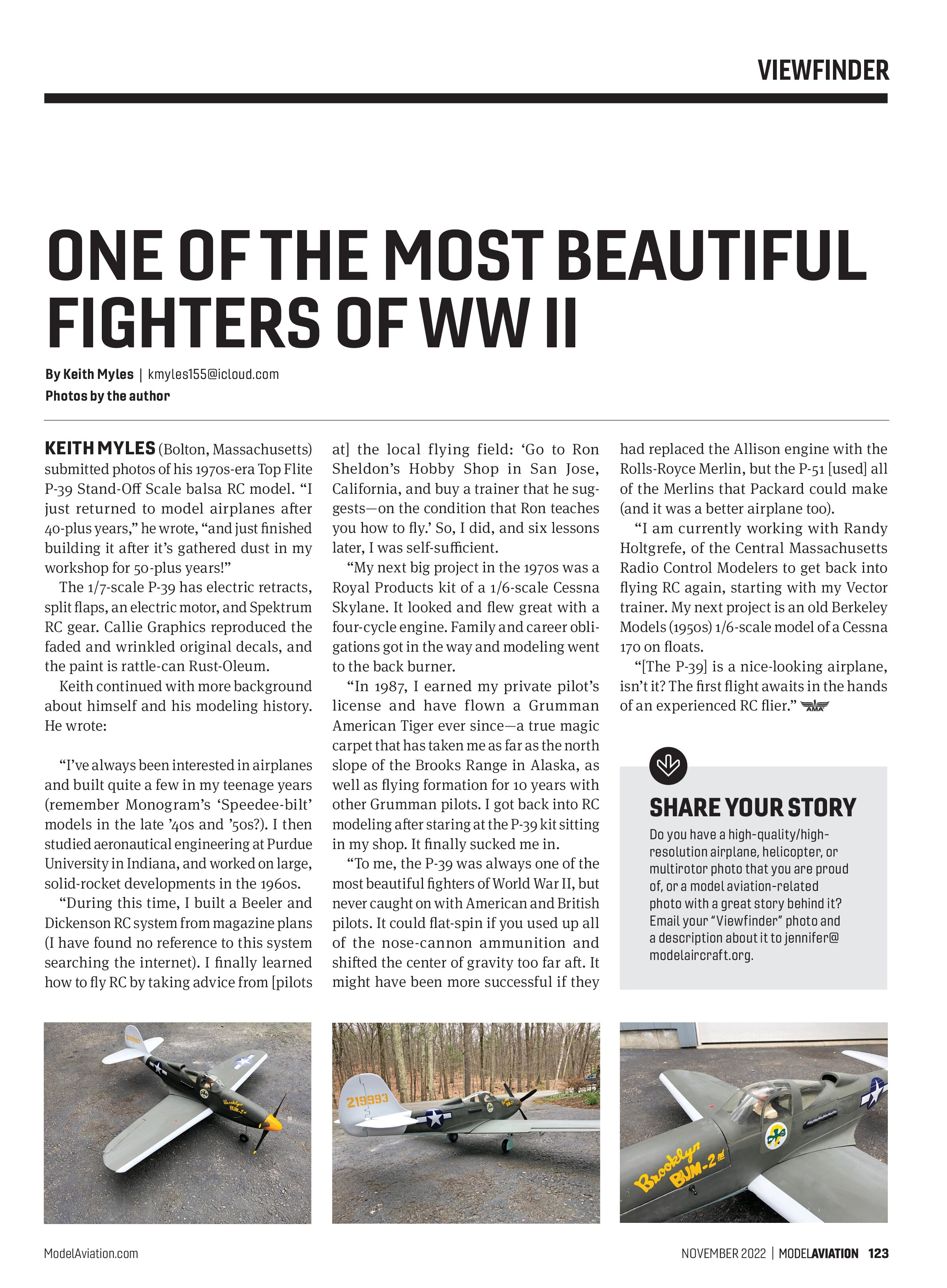
KEITH MYLES (Bolton, Massachusetts) submitted photos of his 1970s-era Top Flite P-39 Stand-Off Scale balsa RC model. “I just returned to model airplanes after 40-plus years,” he wrote, “and just finished building it after it’s gathered dust in my workshop for 50-plus years!”
The 1/7-scale P-39 has electric retracts, split flaps, an electric motor, and Spektrum RC gear. Callie Graphics reproduced the faded and wrinkled original decals, and the paint is rattle-can Rust-Oleum.
Keith continued with more background about himself and his modeling history. He wrote:
“I’ve always been interested in airplanes and built quite a few in my teenage years (remember Monogram’s ‘Speede e-bilt’ models in the late ’40s and ’50s?). I then studied aeronautical engineering at Purdue University in Indiana, and worked on large, solid-rocket developments in the 1960s.
“During this time, I built a Beeler and Dickenson RC system from magazine plans (I have found no reference to this system searching the internet). I finally learned how to fly RC by taking advice from [pilots at] the local flying field: ‘Go to Ron Sheldon’s Hobby Shop in San Jose, California, and buy a trainer that he suggests—on the condition that Ron teaches you how to fly.’ So, I did, and six lessons later, I was self-sufficient.
“My next big project in the 1970s was a Royal Products kit of a 1/6-scale Cessna Skylane. It looked and flew great with a four-cycle engine. Family and career obligations got in the way and modeling went to the back burner.
“In 1987, I earned my private pilot’s license and have flown a Grumman American Tiger ever since—a true magic carpet that has taken me as far as the north slope of the Brooks Range in Alaska, as well as flying formation for 10 years with other Grumman pilots. I got back into RC modeling after staring at the P-39 kit sitting in my shop. It finally sucked me in.
“To me, the P-39 was always one of the most beautiful fighters of World War II, but never caught on with American and British pilots. It could flat-spin if you used up all of the nose-cannon ammunition and shifted the center of gravity too far aft. It might have been more successful if they had replaced the Allison engine with the Rolls-Royce Merlin, but the P-51 [used] all of the Merlins that Packard could make (and it was a better airplane too).
“I am currently working with Randy Holt g refe, of the Central Massachusetts Radio Control Modelers to get back into flying RC again, starting with my Vector trainer. My next project is an old Berkeley Models (1950s) 1/6-scale model of a Cessna 170 on floats.
“[The P-39] is a nice-looking airplane, isn’t it? The first flight awaits in the hands of an experienced RC flier.”
SHARE YOUR STORY
Do you have a high-quality/high-resolution airplane, helicopter, or multirotor photo that you are proud of, or a model aviation-related photo with a great story behind it? Email your “Viewfinder” photo and a description about it to jennifer@modelaircraft.org.