Safety Comes First

IT’S JUST
ROUTINE,
MA’AM
By Dave Gee | safetycolumn@cs.com
SHARP FLIERS FOLLOW a routine when preparing a model aircraft for flight—the same steps, in the same order. These ingrained habits take over during minor distractions in the startup process. Interruptions to a routine are potential hazards, especially with more powerful engines or motors. When you must vary from your procedure, it’s time to be extra cautious.
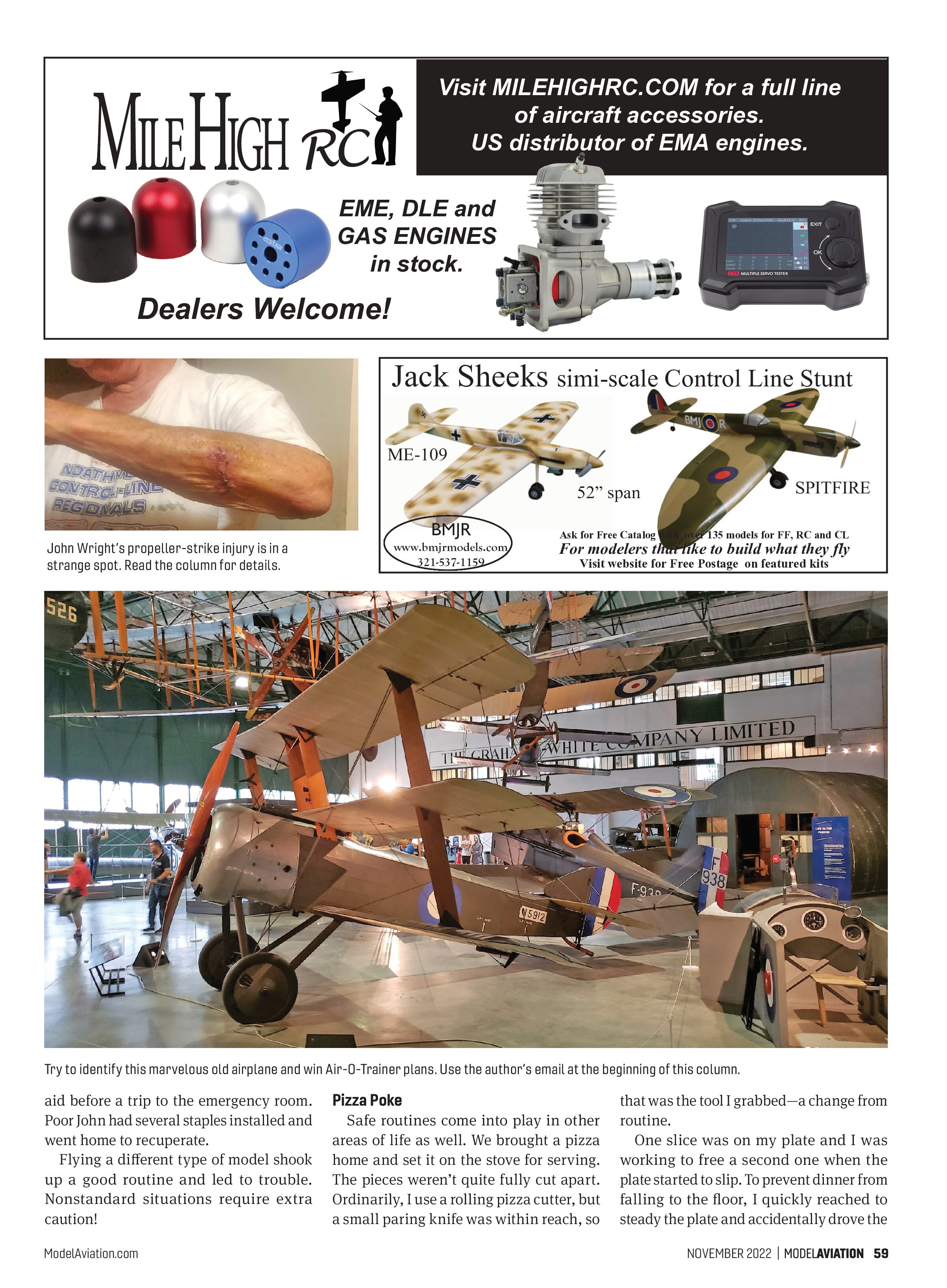
John Wright is an experienced Control Line (CL) flier who received an unpleasant demonstration of what can happen when we change our routine. I saw the photo of his injury and couldn’t understand how he had contacted a propeller with the underside of his forearm. He kindly called me to explain what happened and told me that I could share the story.
John likes big, powerful CL Stunt aircraft with long wingspans, but on this particular day, he was flying a much smaller Fox .35 engine-powered airplane in a special fun-fly race event. Both the pilot and helper were standing up during the starting process.
After the engine was running properly, John followed his usual routine of grabbing the wingtip wires and running them through his fingers on the way out to the control handle to verify that the lines were clear and unkinked. The change in his routine was that this model’s wingspan wasn’t the usual 64 inches; it was only 28 inches. This put the wingtip much closer to the spinning propeller.
John’s usual motions, which were perfectly safe with the larger airplane, didn’t allow enough clearance this time. His horrified helper couldn’t possibly react quickly enough to pull the model back, so the propeller cut gashed John’s arm. Everyone remained calm and the wound received proper first aid before a trip to the emergency room.
Poor John had several staples installed and went home to recuperate.
Flying a different type of model shook up a good routine and led to trouble. Nonstandard situations require extra caution!

Pizza Poke
Safe routines come into play in other areas of life as well. We brought a pizza home and set it on the stove for serving. The pieces weren’t quite fully cut apart. Ordinarily, I use a rolling pizza cutter, but a small paring knife was within reach, so that was the tool I grabbed—a change from routine.
One slice was on my plate and I was working to free a second one when the plate started to slip. To prevent dinner from falling to the floor, I quickly reached to steady the plate and accidentally drove the

little knife into the base of my thumb. Oops! Just like in a slasher movie, a lively spurt of blood began, keeping pace with my heartbeat. Well, that had to stop!
Making sure to avoid spraying the pie, I applied pressure to the wound and moved to the sink for evaluation. Sweet Diedra gave a wifely shriek and rushed over to help. We held the cut under cold running water, and then again put direct pressure on it with a folded paper towel. The actual wound was not very impressive, but the sharp blade had gone in deep. After keeping my arm elevated with pressure on the wound for 20 minutes, things stabilized and I could apply a dressing and finally eat some now-cold pizza.
A routine was altered and I got careless.
Postal Contest and Free Plans
Getting out of our routine isn’t always bad. Sometimes it can be fun! Most Model Aviation readers fly RC models, and some have never experienced the pleasure of building and flying an old-fashioned, rubber-powered rise-off-ground (ROG) model. These aircraft are not just for beginners. Even experienced modelers can learn a thing or two from adjusting a model for a smooth takeoff and stable flight.
Howard Littman designed a classic ROG model called Skinny Bomber. It has good looks and offers serious flight potential. His company, Howard Littman Model Aircraft, sells a laser-cut Skinny Bomber kit for newcomers and those who just enjoy an easy, fast build. Howard said that I could offer digital plans for free if you prefer to scratch-build one. Just email me at the address on the first page of this column and I’ll send the plans to you.
Start building one pronto because the Secret Sky Squadron is sponsoring an indoor/outdoor Postal Contest for Skinny Bomber pilots. The contest deadline is November 27, 2022. Flights can be made up to three weeks ahead of that date.
Outdoor flights can be hand-launched, but indoor entries must ROG. Ten flight attempts are allowed, with the two best flights as your score. Pilots up to age 18 will compete in the Junior/Senior class, while ages 19 and older are in the Open class. The details are on the website that is listed in “Sources.”
Air-O-Trainer, More Free Plans
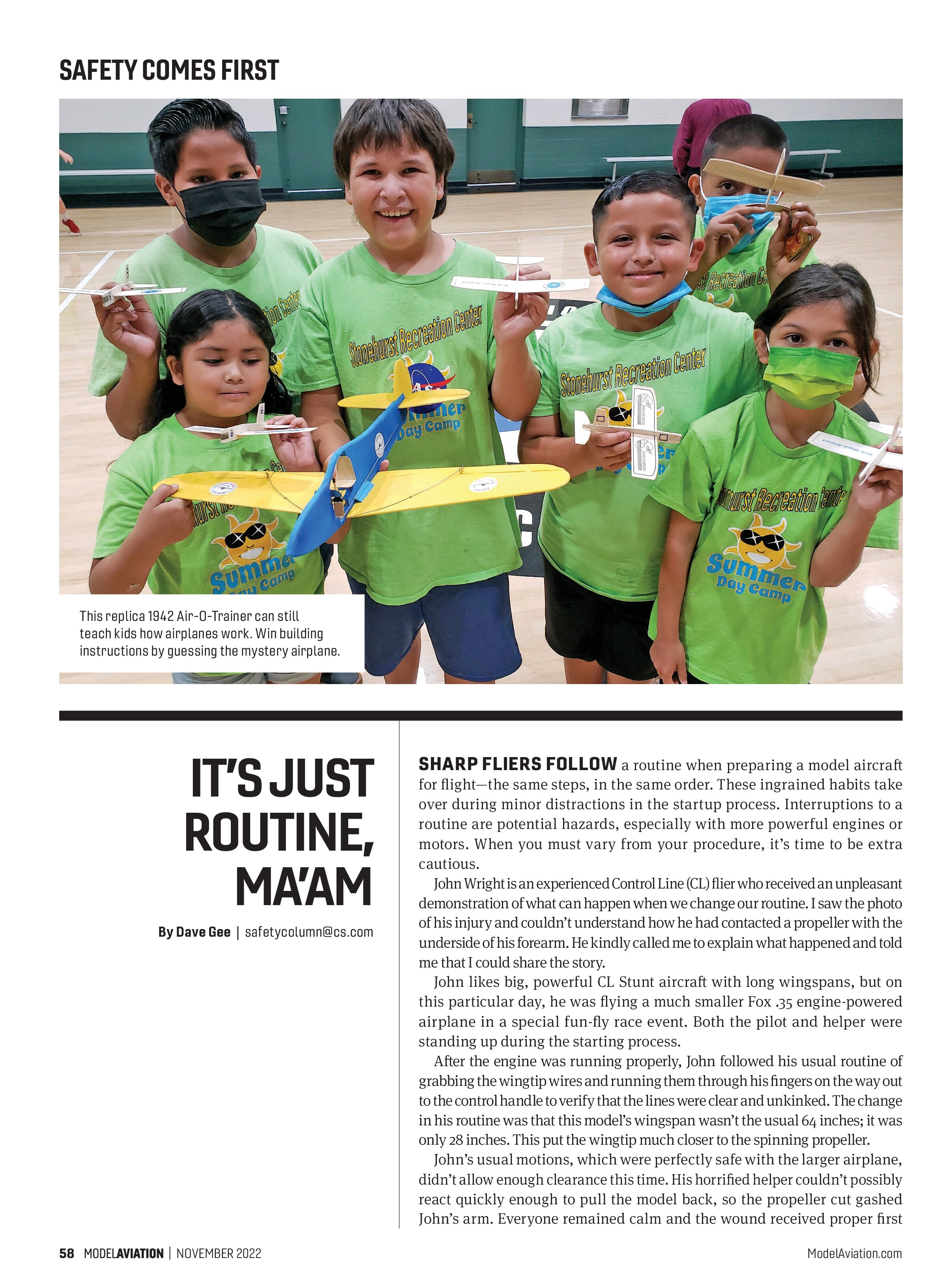
The Comet Model Airplane Company produced a lot of products besides flying model kits. During World War II, it released the Air-O-Trainer, which was designed to teach youngsters about the control systems of full-scale airplanes.
This nonflying model had a stick and rudder pedals that actually moved the tail surfaces and ailerons. Apparently, after playing with this thing for a few minutes, cadets would be ready to solo a P-39! I got outbid on an original 1942 kit, but I located enough photos and instructions to build my own reproduction.
It turns out that this thing is a lot of fun! A group of young summer camp aviators gave the Air-O-Trainer two thumbs up. The problem is that if you added electric power and a small RC system, this airplane would fly for real. Don’t tell anyone I said so … Take a guess at this month’s mystery airplane and, win or lose, you’ll receive instructions for building your own Air-O-Trainer. Please use my email at the beginning of this column.
Mystery Airplane
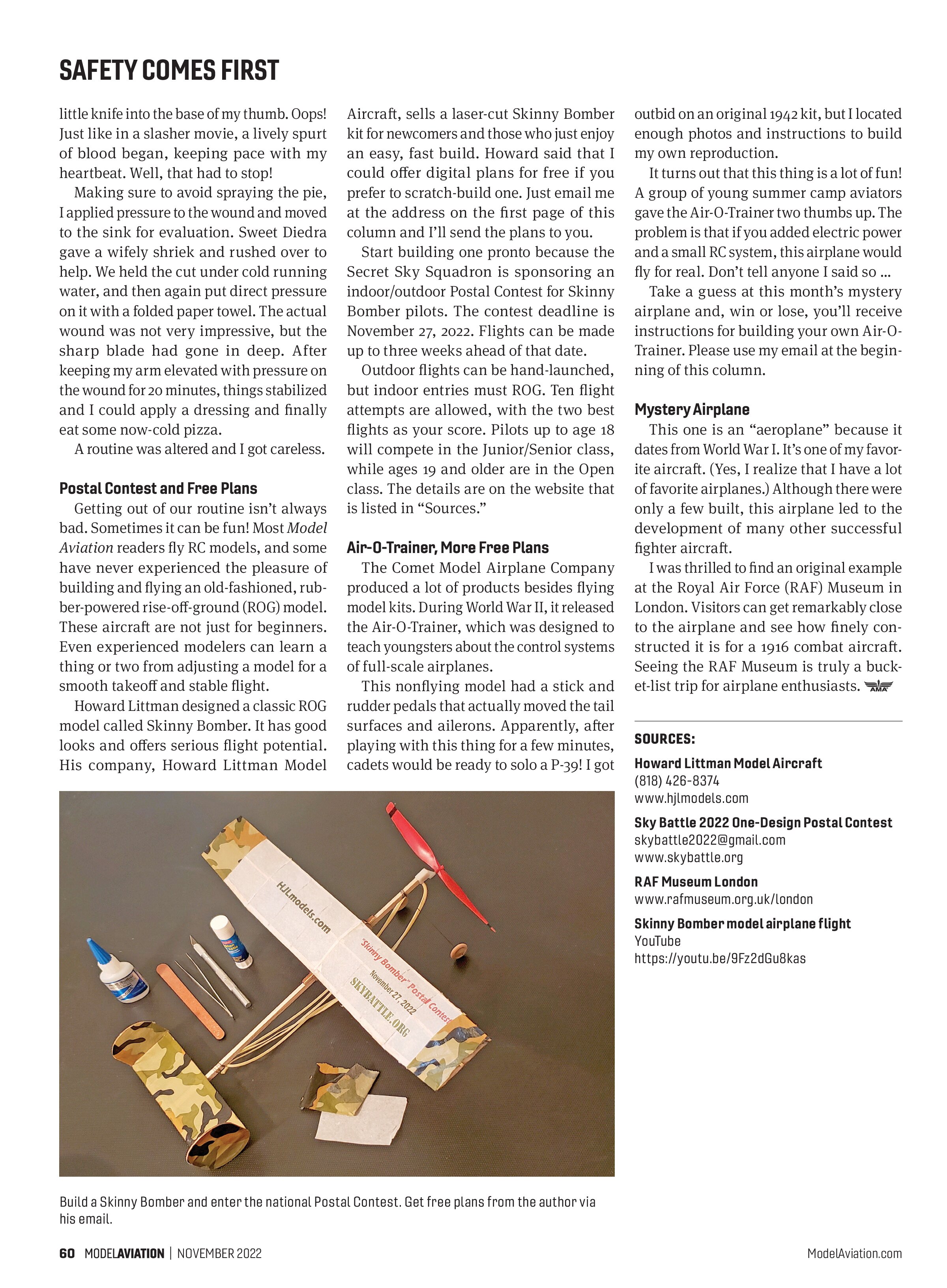
This one is an “aeroplane” because it dates from World War I. It’s one of my favorite aircraft. (Yes, I realize that I have a lot of favorite airplanes.) Although there were only a few built, this airplane led to the development of many other successful fighter aircraft.
I was thrilled to find an original example at the Royal Air Force (RAF) Museum in London. Visitors can get remarkably close to the airplane and see how finely constructed it is for a 1916 combat aircraft. Seeing the RAF Museum is truly a bucket-list trip for airplane enthusiasts.

Sources:
Howard Littman Model Aircraft
(818) 426-8374
www.hjlmodels.com
Sky Battle 2022 One-Design Postal Contest
skybattle2022@gmail.com
www.skybattle.org
RAF Museum London
www.rafmuseum.org.uk/london
Skinny Bomber model airplane flight
YouTube
https://youtu.be/9Fz2dGu8kas