PYLON RACING WORLD CHAMPIONSHIPS AND NATS
By Tim Lampe | tim.lampe@hotmail.com
TWO BIG RC PYLON RACING competitions happened this summer that, for most of the organizers/officials and some of the competitors, blended into a single, huge event.
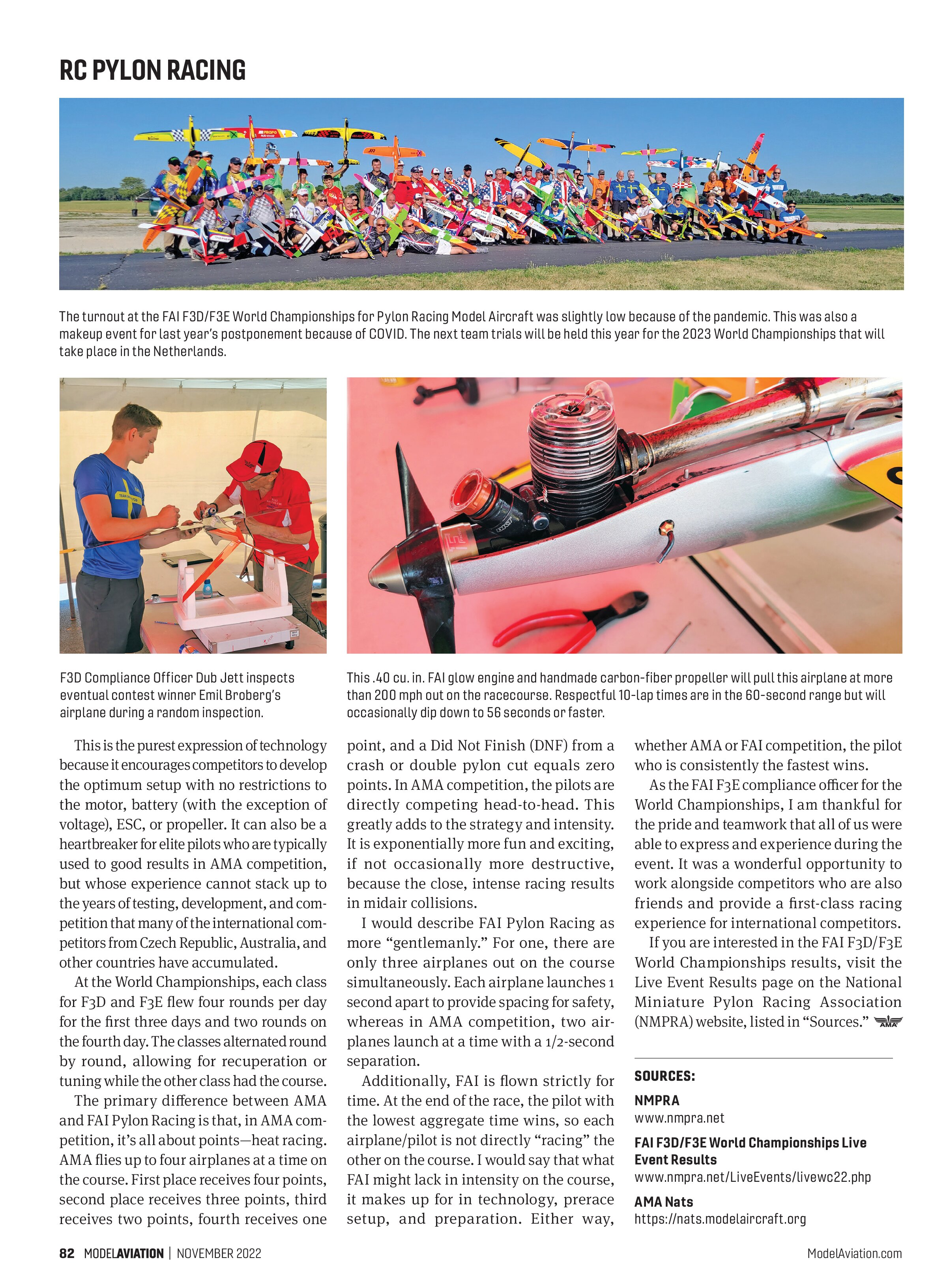
The 2022 FAI F3D/F3E World Championships for Pylon Racing Model Aircraft took place July 8-14, 2022, at the International Aeromodeling Center in Muncie, Indiana, and was almost immediately followed by the AMA RC Pylon Racing Nats from July 17-22. Although these are two entirely separate competitions, most of the officials and workers, as well as some of the competitors, stayed over from the World Championships and participated in the Nats, making for a long and exhausting grind that brought out the best in us.
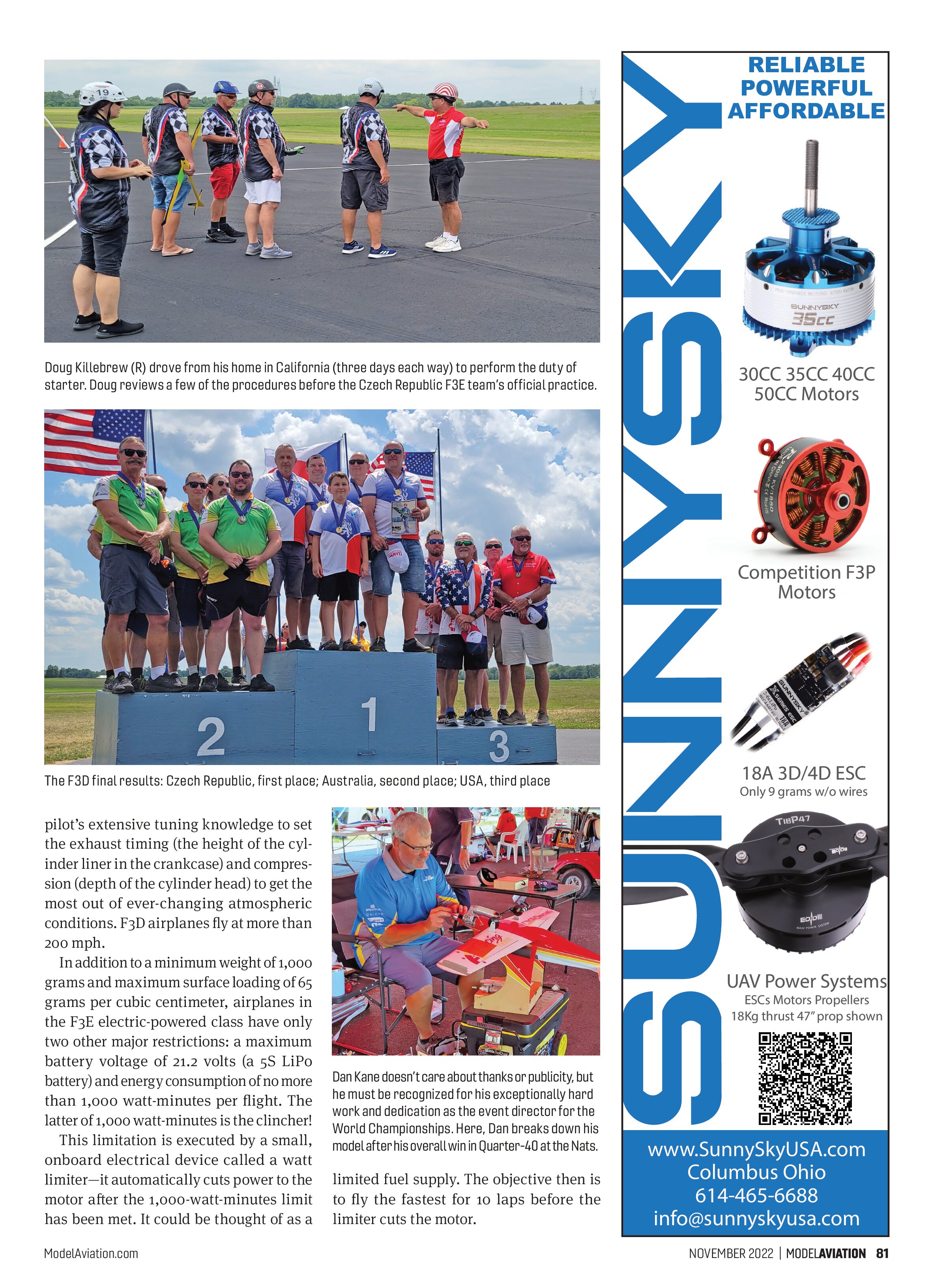
Many of the World Championships organizers and officials, such as Dan Kane, Mike Condon, Chuck Andraka, Doug Killebrew, Tom Melsheimer, and others, officiated, helped out, and/or competed in one or both events, camping out on location for practically the entire month of July.
Both competitions provided opportunities to renew relationships that were made at past events. Competitors at the World Championships might only see each other once every two years, and that’s provided that they have won a spot on their country’s team.
FAI RC Pylon Racing consists of two classes: glow and electric. The F3D glow-powered class uses .40 cu. in. engines that run on fuel with no nitromethane. These engines are the pinnacle of glow-engine technology, using cutting-edge metallurgy, the highest-precision machine tolerances, tuned pipes, handmade carbon-fiber propellers, and the


pilot’s extensive tuning knowledge to set the exhaust timing (the height of the cylinder liner in the crankcase) and compression (depth of the cylinder head) to get the most out of ever-changing atmospheric conditions. F3D airplanes fly at more than 200 mph.
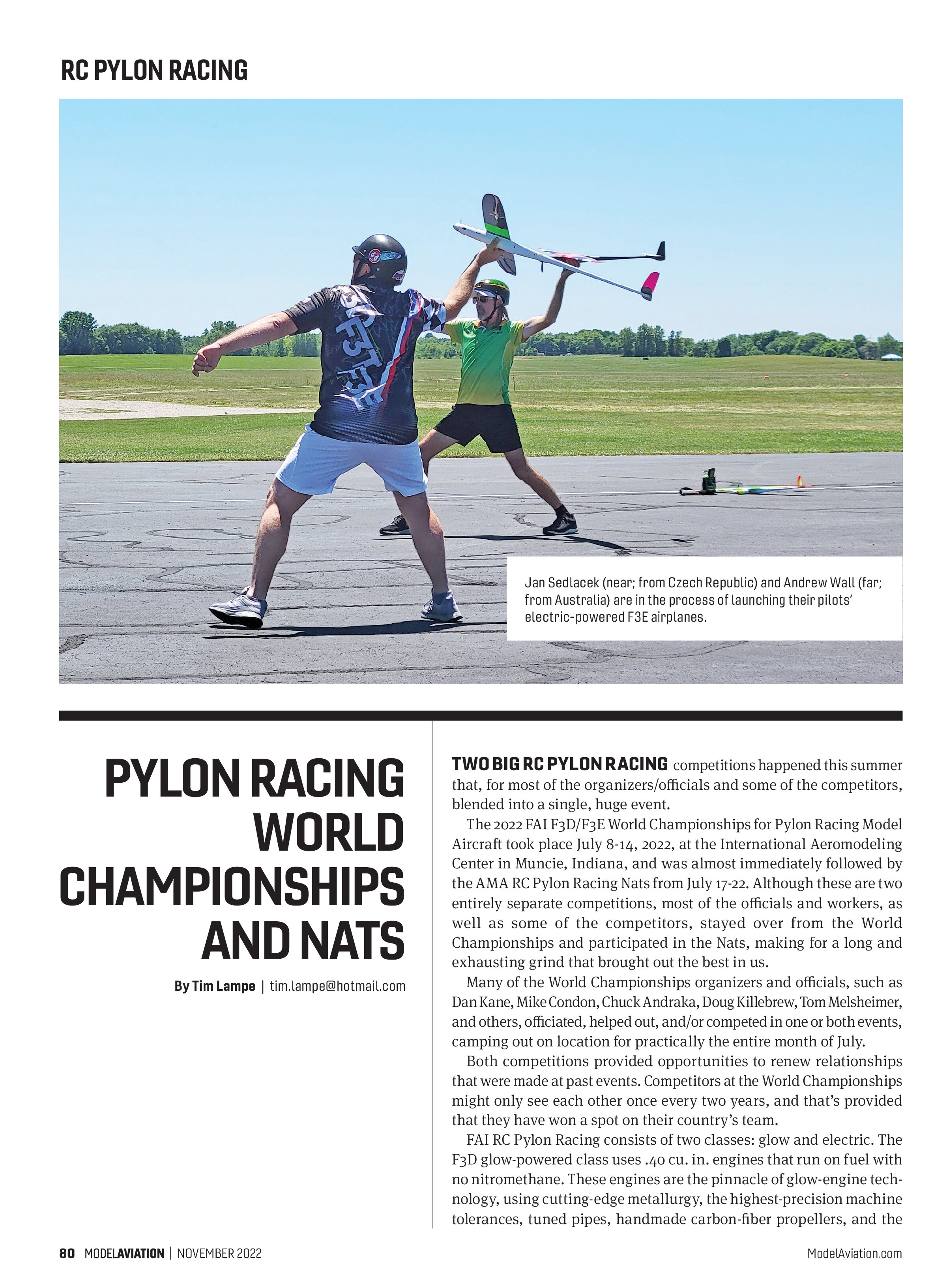
In addition to a minimum weight of 1,000 grams and maximum surface loading of 65 grams per cubic centimeter, airplanes in the F3E electric-powered class have only two other major restrictions: a maximum battery voltage of 21.2 volts (a 5S LiPo battery) and energy consumption of no more than 1,000 watt-minutes per flight. The latter of 1,000 watt-minutes is the clincher!
This limitation is executed by a small, onboard electrical device called a watt limiter—it automatically cuts power to the motor after the 1,000-watt-minutes limit has been met. It could be thought of as a

limited fuel supply. The objective then is to fly the fastest for 10 laps before the limiter cuts the motor.

The turnout at the FAI F3D/F3E World Championships for Pylon Racing Model Aircraft was slightly low because of the pandemic. This was also a makeup event for last year’s postponement because of COVID. The next team trials will be held this year for the 2023 World Championships that will take place in the Netherlands.


This is the purest expression of technology because it encourages competitors to develop the optimum setup with no restrictions to the motor, battery (with the exception of voltage), ESC, or propeller. It can also be a heartbreaker for elite pilots who are typically used to good results in AMA competition, but whose experience cannot stack up to the years of testing, development, and competition that many of the international competitors from Czech Republic, Australia, and other countries have accumulated.
At the World Championships, each class for F3D and F3E flew four rounds per day for the first three days and two rounds on the fourth day. The classes alternated round by round, allowing for recuperation or tuning while the other class had the course.
The primary difference between AMA and FAI Pylon Racing is that, in AMA competition, it’s all about points—heat racing. AMA flies up to four airplanes at a time on the course. First place receives four points, second place receives three points, third receives two points, fourth receives one point, and a Did Not Finish (DNF) from a crash or double pylon cut equals zero points. In AMA competition, the pilots are directly competing head-to-head. This greatly adds to the strategy and intensity. It is exponentially more fun and exciting, if not occasionally more destructive, because the close, intense racing results in midair collisions.
I would describe FAI Pylon Racing as more “gentlemanly.” For one, there are only three airplanes out on the course simultaneously. Each airplane launches 1 second apart to provide spacing for safety, whereas in AMA competition, two airplanes launch at a time with a 1/2-second separation.
Additionally, FAI is flown strictly for time. At the end of the race, the pilot with the lowest aggregate time wins, so each airplane/pilot is not directly “racing” the other on the course. I would say that what FAI might lack in intensity on the course, it makes up for in technology, prerace setup, and preparation. Either way, whether AMA or FAI competition, the pilot who is consistently the fastest wins.
As the FAI F3E compliance officer for the World Championships, I am thankful for the pride and teamwork that all of us were able to express and experience during the event. It was a wonderful opportunity to work alongside competitors who are also friends and provide a first-class racing experience for international competitors.
If you are interested in the FAI F3D/F3E World Championships results, visit the Live Event Results page on the National Miniature Pylon Racing Association (NMPRA) website, listed in “Sources.”
SOURCES:
NMPRA
www.nmpra.net
FAI F3D/F3E World Championships Live Event Results
www.nmpra.net/LiveEvents/livewc22.php
AMA Nats
https://nats.modelaircraft.org