RC COMBAT

RPM LIMITING
WITH AN ESC
GOVERNOR
By Heath Bartel | heath.bartel@gmail.com
MANY STREAMER RC COMBAT classes use an rpm limit as a method to equalize the amount of available power. When combined with a specified propeller, the resulting power systems will have the same thrust available regardless of what motor type is used. When flying with electric power, there are two main methods to limit the rpm.
The simplest method to meet the rpm class limits is to use a two-point linear throttle curve with a reduced maximum value. To determine the maximum value, I start by measuring the rpm at 100% throttle with a fully charged battery and an unmodified throttle curve. A well-sized power system will be capable of generating an rpm that is higher than the class rpm limit.
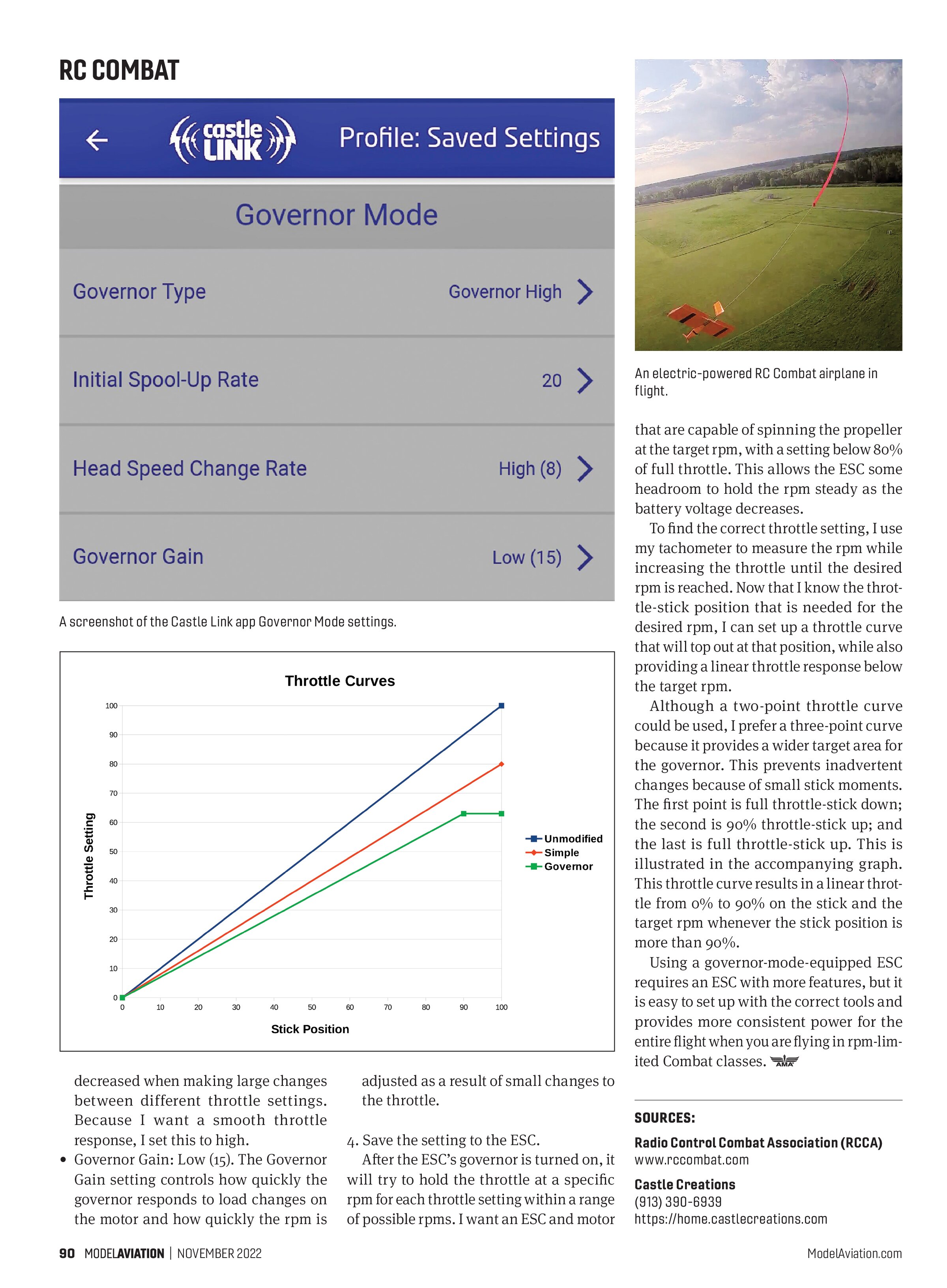
The Slow Survivable Combat (SSC) rules specify 17,500 rpm with an 8 x 3 Master Airscrew propeller. With my combination of motor and ESC, 17,500 rpm was achieved at 80% throttle and 21,000 rpm was achieved at 100% throttle. To meet the class specifications, I needed to reduce my throttle curve so that the top end is at 80% throttle, as shown in the accompanying graph. The result of the adjusted throttle curve is that at 100% throttle-stick up moment, the throttle is set at 80% and the resulting rpm is 17,500.
The advantage of this method is that I can use any ESC with a sufficient amp rating. The rpm is set with a fully charged battery so that I do not exceed the rpm limit at the start of the round. As the battery discharges, the voltage will be lower, resulting in a lower rpm. If I only use 70% of the battery capacity, the rpm decrease will be less than if I use 90% of the capacity, so the rpm loss can be reduced but not eliminated by using a larger battery.
I have observed a decrease of approximately 1,000 to 1,500 rpm between the beginning and end of a flight. For SSC, this represents a 6% to 8% decrease in power from the start of the round to the end of the round. The exact amount will vary depending on the ESC motor and battery that are used, but in all cases, the rpm will be lower later in the flight.
A more advanced method of setting the rpm is using an ESC with a governor mode. An ESC governor attempts to hold the rpm of the motor constant despite changes in the battery voltage or load on the motor. The governor feature works by translating a specific throttle-stick setting into a target rpm instead of a percentage of the full throttle. As the battery voltage decreases, the ESC will slightly increase the amps to keep the power supplied to the motor constant so that the rpm does not decrease.
Similarly, if the load on the propeller increases (for example, in a climb), the ESC will supply more power to the motor to keep the motor spinning at the specified rpm. Conversely, if the load on the motor is decreased (for example, in a dive), the ESC will reduce the power to keep the rpm consistent.
Using a governor-equipped ESC has two potential drawbacks. The first is that an extra setup step is required to activate the ESC governor mode. The second is that not all ESCs are equipped with a governor mode. Governors are commonly used by the RC helicopter community, so ESCs that are intended for use in helicopters almost always have a governor feature, while ESCs targeted exclusively for fixed-wing users do not often include it.
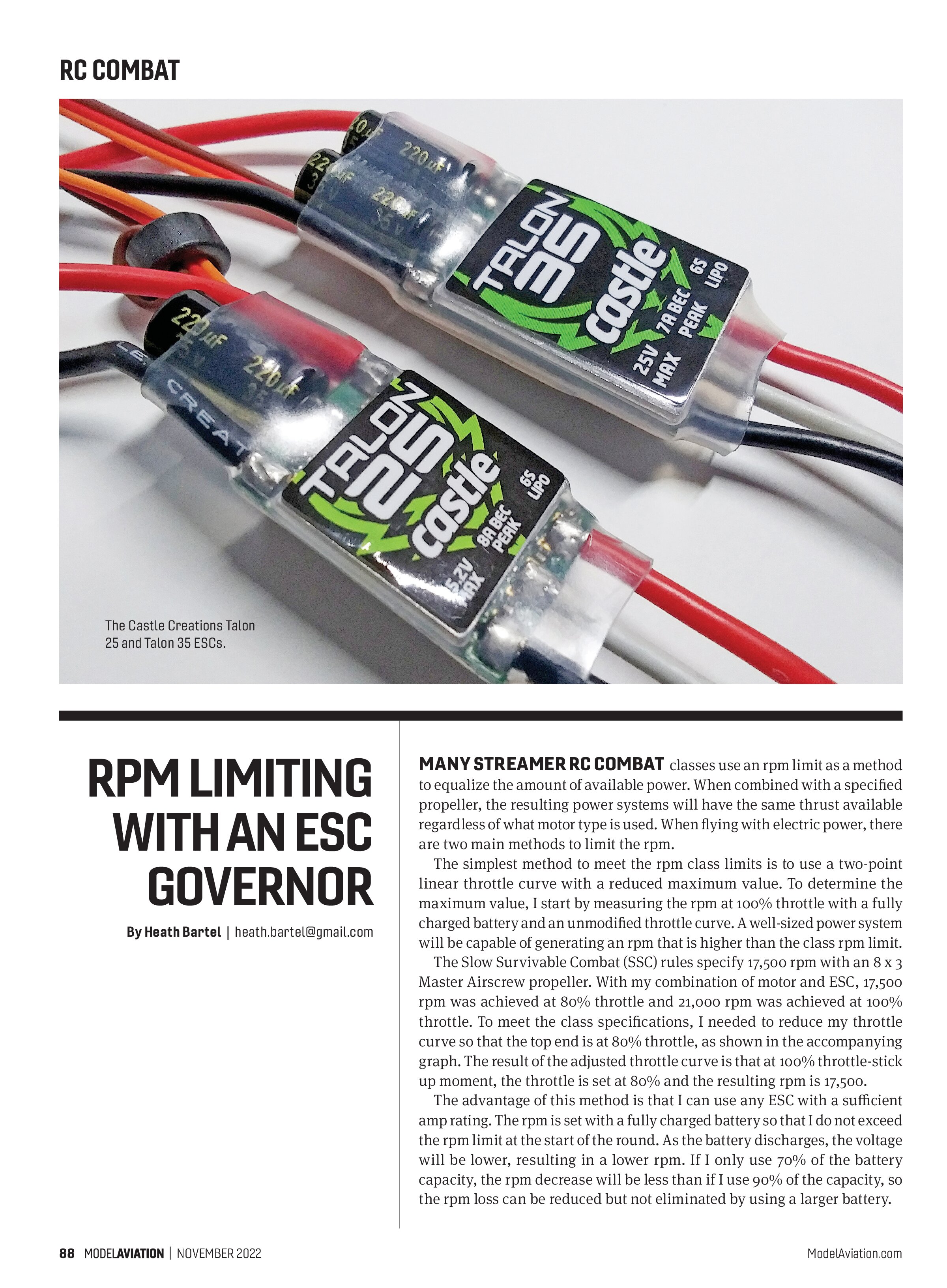
I prefer using Castle Creations Talon ESCs because they have an extensive feature set, including several governor modes. Castle Creations also offers a Bluetooth adapter that makes programming the ESC at the field easy using the Castle Link phone app. The app also features handy help pages with more information about each setting.

The process for enabling the governor mode on a Castle Creations ESC is as follows:
- Connect to the ESC.
- Under the Throttle category, change the vehicle type from Airplane to Control Line so that the governor mode settings are available.
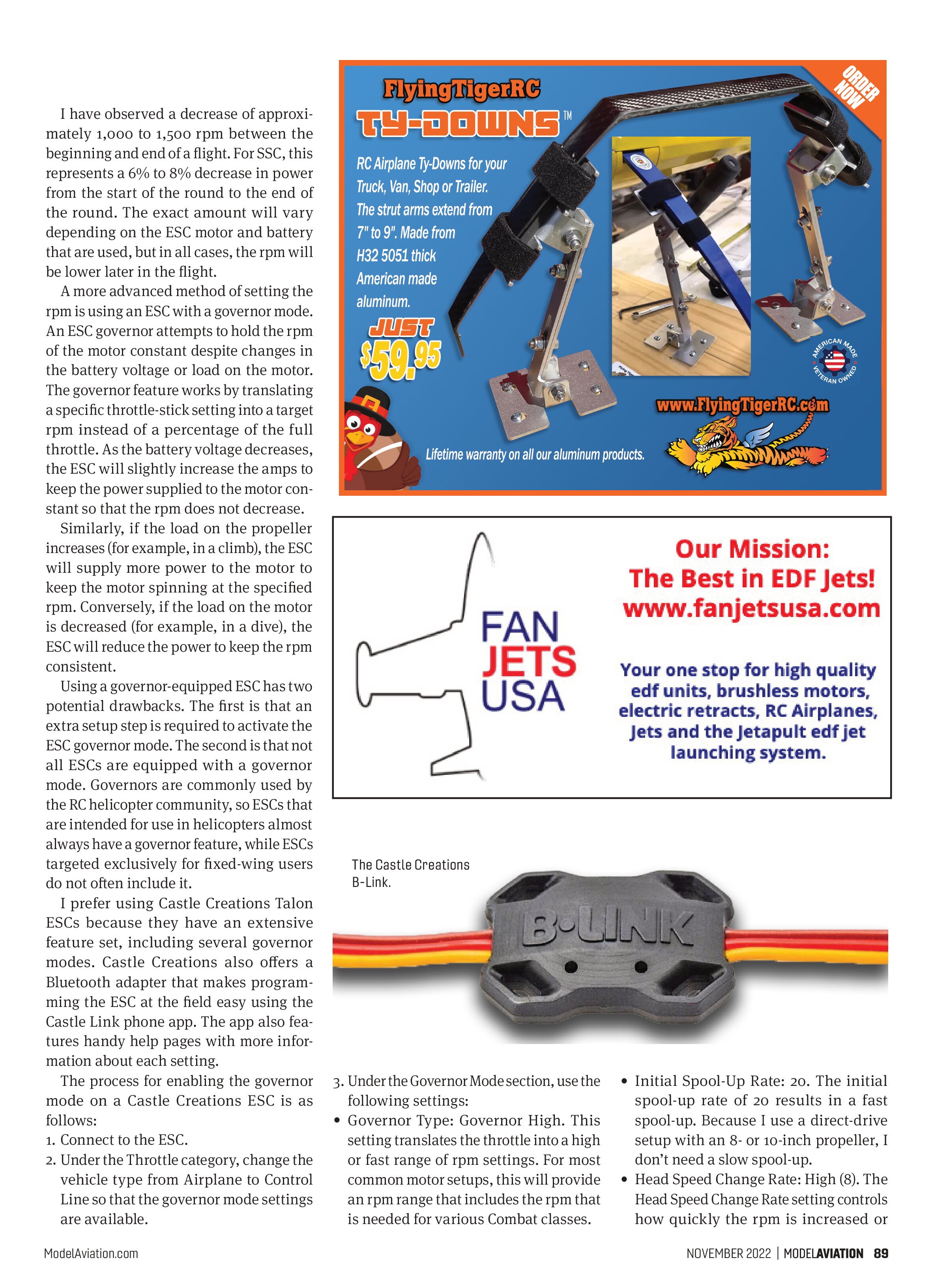
- Under the Governor Mode section, use the following settings:
- Governor Type: Governor High. This setting translates the throttle into a high or fast range of rpm settings. For most common motor setups, this will provide an rpm range that includes the rpm that is needed for various Combat classes.
- Initial Spool-Up Rate: 20. The initial spool-up rate of 20 results in a fast spool-up. Because I use a direct-drive setup with an 8- or 10-inch propeller, I don’t need a slow spool-up.
- Head Speed Change Rate: High (8). The Head Speed Change Rate setting controls how quickly the rpm is increased or
decreased when making large changes between different throttle settings. Because I want a smooth throttle response, I set this to high.
- Governor Gain: Low (15). The Governor Gain setting controls how quickly the governor responds to load changes on the motor and how quickly the rpm is adjusted as a result of small changes to the throttle.
4. Save the setting to the ESC.
After the ESC’s governor is turned on, it will try to hold the throttle at a specific rpm for each throttle setting within a range of possible rpms. I want an ESC and motor that are capable of spinning the propeller at the target rpm, with a setting below 80% of full throttle. This allows the ESC some headroom to hold the rpm steady as the battery voltage decreases.
To find the correct throttle setting, I use my tachometer to measure the rpm while increasing the throttle until the desired rpm is reached. Now that I know the throttle-stick position that is needed for the desired rpm, I can set up a throttle curve that will top out at that position, while also providing a linear throttle response below the target rpm.
Although a two-point throttle curve could be used, I prefer a three-point curve because it provides a wider target area for the governor. This prevents inadvertent changes because of small stick moments. The first point is full throttle-stick down; the second is 90% throttle-stick up; and the last is full throttle-stick up. This is illustrated in the accompanying graph. This throttle curve results in a linear throttle from 0% to 90% on the stick and the target rpm whenever the stick position is more than 90%.
Using a governor-mode-equipped ESC requires an ESC with more features, but it is easy to set up with the correct tools and provides more consistent power for the entire flight when you are flying in rpm-limited Combat classes.


SOURCES:
Radio Control Combat Association (RCCA)
www.rccombat.com
Castle Creations
(913) 390-6939
https://home.castlecreations.com