MICRO-FLYING
CO2 MOTORS
By Joe Malinchak | joemal@echoes.net

CO2 MOTORS HAVE BEEN AROUND for some time. They were used mostly for Free Flight models, but some of us started experimenting by using them in small RC aircraft.
Years ago, when we only had NiCd and NiMH batteries, CO2 power was a great, lightweight power source to use in our micro models. Gasparin CO2 Motors and Brown Junior Motors were the main distributors.
When LiPo batteries became available, electric power grew to be the most popular power source for micro RC. CO2 power, however, still holds a big place in my heart. The sound and the cool factor of CO2 power made me want to build a new airplane!
CO2-Powered Cartoon Scale L-4 Cub
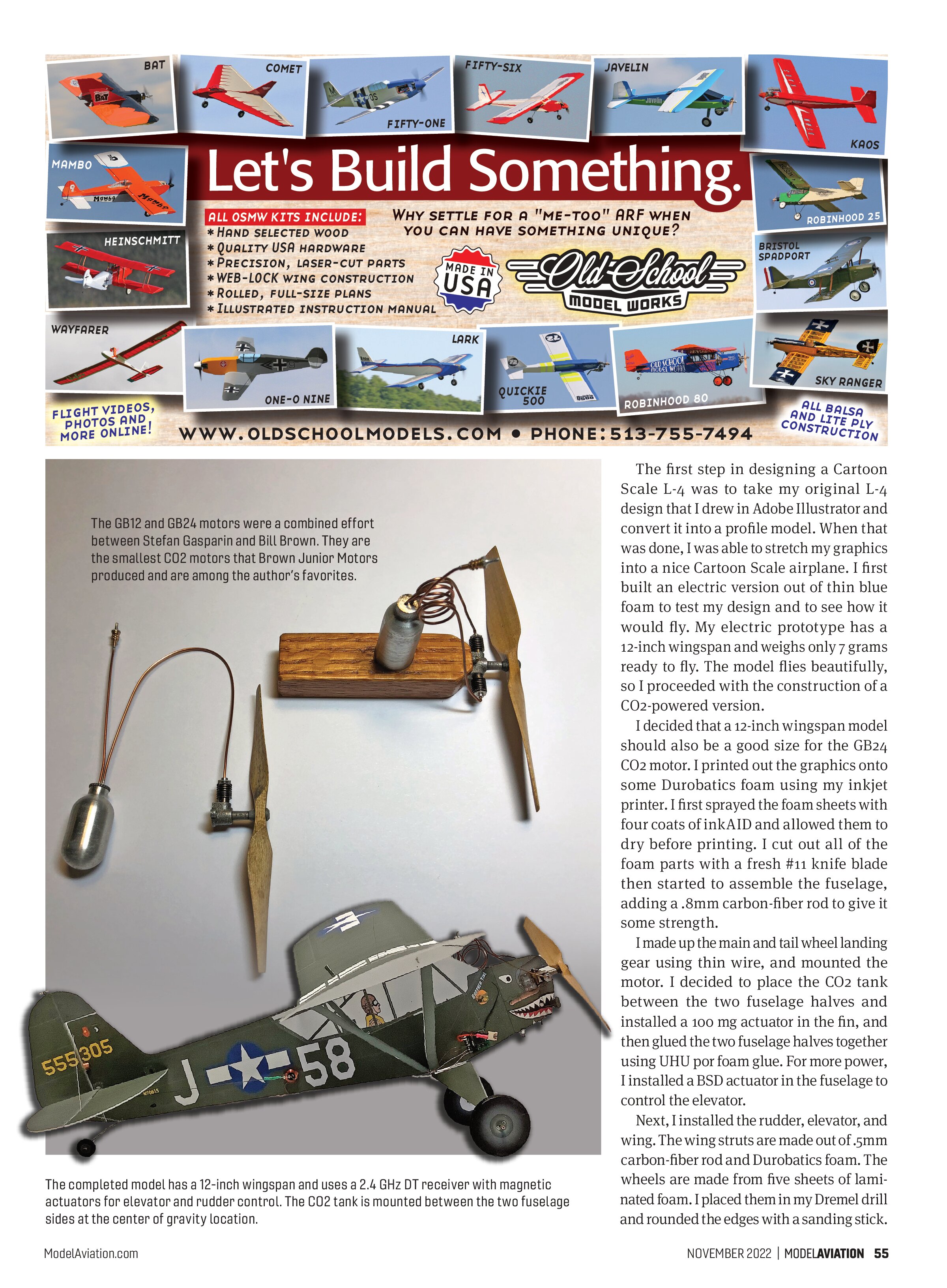
The GB12 was the smallest CO2 motor that Bill Brown produced, with a bore of 2.5mm and a stroke of 2.5mm. The GB12 was a combined effort between Bill and Stefan Gasparin. He also made a twin-cylinder version called the GB24.
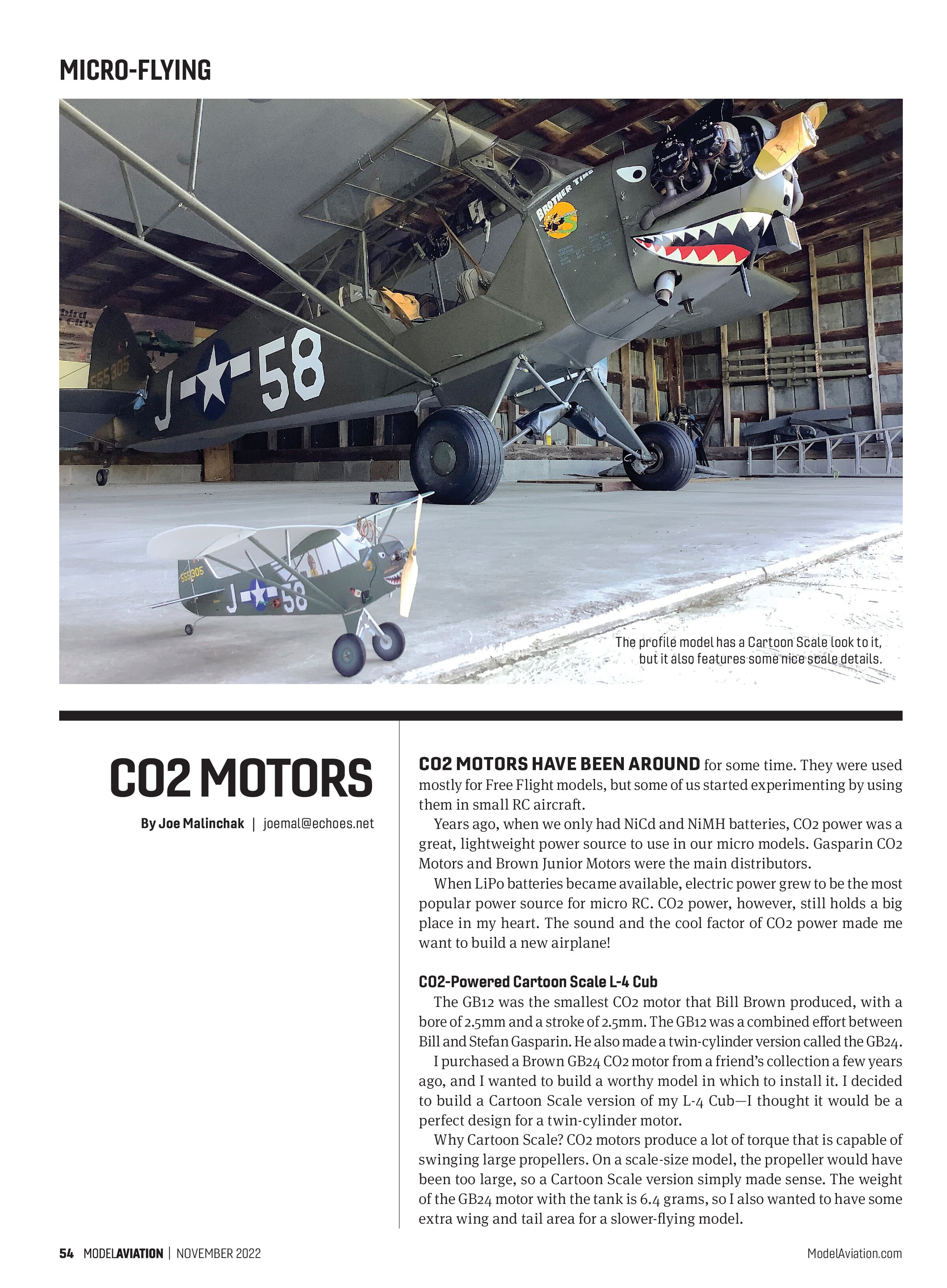
I purchased a Brown GB24 CO2 motor from a friend’s collection a few years ago, and I wanted to build a worthy model in which to install it. I decided to build a Cartoon Scale version of my L-4 Cub—I thought it would be a perfect design for a twin-cylinder motor.
Why Cartoon Scale? CO2 motors produce a lot of torque that is capable of swinging large propellers. On a scale-size model, the propeller would have been too large, so a Cartoon Scale version simply made sense. The weight of the GB24 motor with the tank is 6.4 grams, so I also wanted to have some extra wing and tail area for a slower-flying model.

The first step in designing a Cartoon Scale L-4 was to take my original L-4 design that I drew in Adobe Illustrator and convert it into a profile model. When that was done, I was able to stretch my graphics into a nice Cartoon Scale airplane. I first built an electric version out of thin blue foam to test my design and to see how it would fly. My electric prototype has a 12-inch wingspan and weighs only 7 grams ready to fly. The model flies beautifully, so I proceeded with the construction of a CO2-powered version.
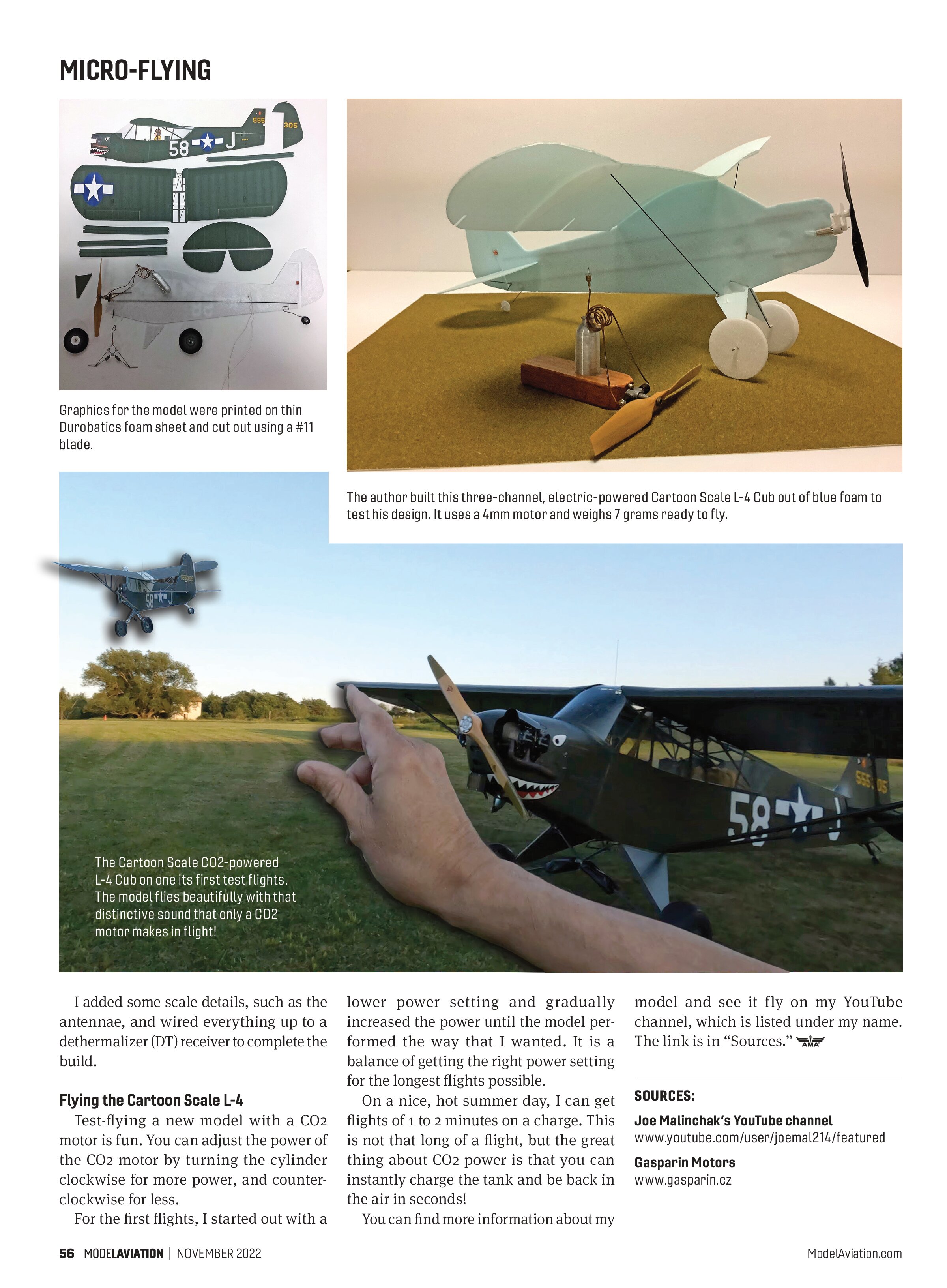
I decided that a 12-inch wingspan model should also be a good size for the GB24 CO2 motor. I printed out the graphics onto some Durobatics foam using my inkjet printer. I first sprayed the foam sheets with four coats of InkAid and allowed them to dry before printing. I cut out all of the foam parts with a fresh #11 knife blade then started to assemble the fuselage, adding a .8mm carbon-fiber rod to give it some strength.
I made up the main and tail wheel landing gear using thin wire, and mounted the motor. I decided to place the CO2 tank between the two fuselage halves and installed a 100 mg actuator in the fin, and then glued the two fuselage halves together using UHU por foam glue. For more power, I installed a BSD actuator in the fuselage to control the elevator.
Next, I installed the rudder, elevator, and wing. The wing struts are made out of .5mm carbon-fiber rod and Durobatics foam. The wheels are made from five sheets of laminated foam. I placed them in my Dremel drill and rounded the edges with a sanding stick.


I added some scale details, such as the antennae, and wired everything up to a dethermalizer (DT) receiver to complete the build.
Flying the Cartoon Scale L-4
Test-flying a new model with a CO2 motor is fun. You can adjust the power of the CO2 motor by turning the cylinder clockwise for more power, and counter-clockwise for less.
For the first flights, I started out with a lower power setting and gradually increased the power until the model performed the way that I wanted. It is a balance of getting the right power setting for the longest flights possible.
On a nice, hot summer day, I can get flights of 1 to 2 minutes on a charge. This is not that long of a flight, but the great thing about CO2 power is that you can instantly charge the tank and be back in the air in seconds!
You can find more information about my model and see it fly on my YouTube channel, which is listed under my name. The link is in “Sources.”
SOURCES:
Joe Malinchak’s YouTube channel
www.youtube.com/user/joemal214/featured
Gasparin Motors
www.gasparin.cz