FOCAL POINT
Interested in sharing your handiwork? Visit ModelAviation.com for submission guidelines.
Microaces Albatross D.V

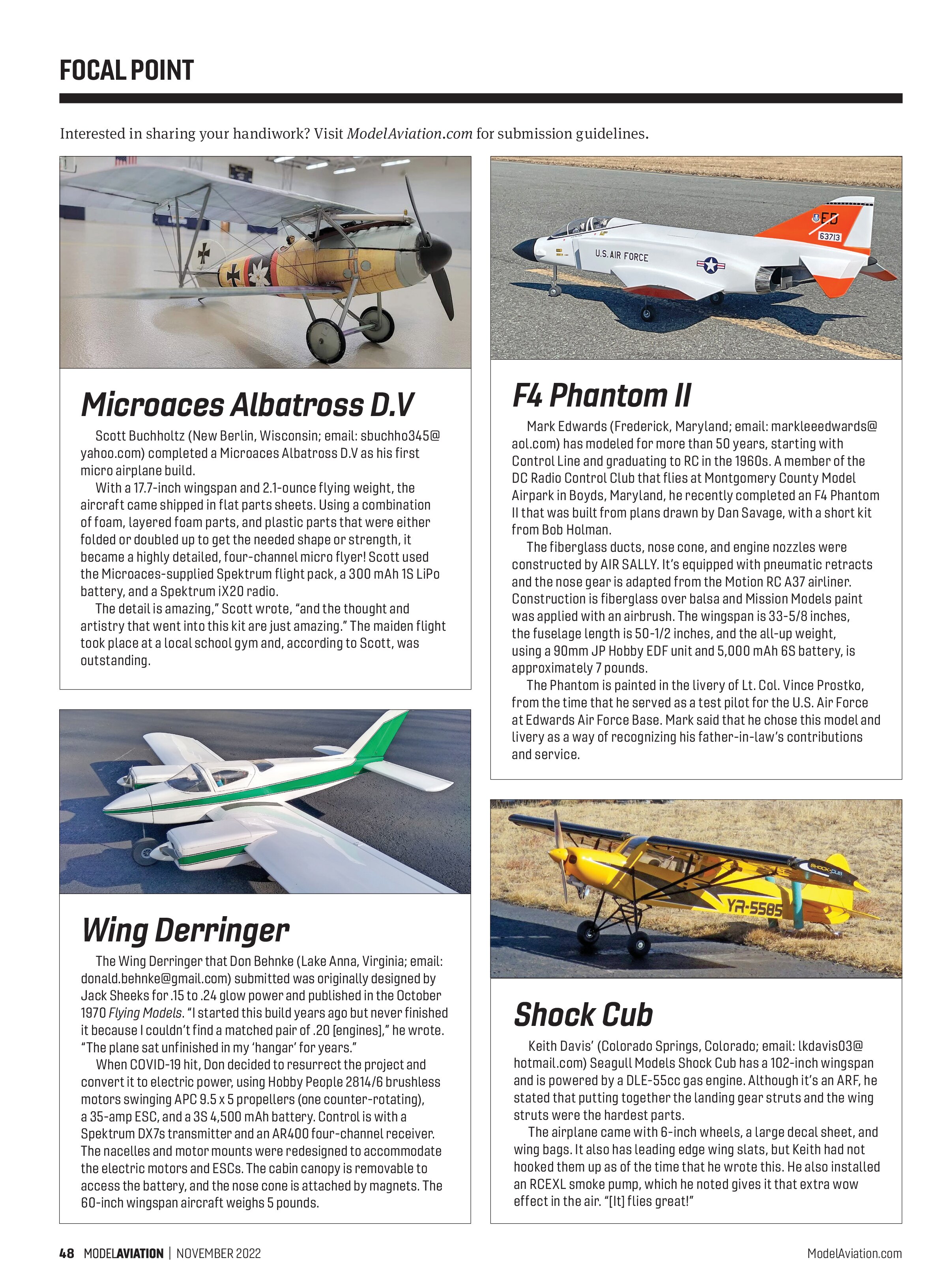
Scott Buchholtz (New Berlin, Wisconsin; email: sbuchho345@yahoo.com) completed a Microaces Albatross D.V as his first micro airplane build.
With a 17.7-inch wingspan and 2.1-ounce flying weight, the aircraft came shipped in flat parts sheets. Using a combination of foam, layered foam parts, and plastic parts that were either folded or doubled up to get the needed shape or strength, it became a highly detailed, four-channel micro flyer! Scott used the Microaces-supplied Spektrum flight pack, a 300 mAh 1S LiPo battery, and a Spektrum iX20 radio.
The detail is amazing,” Scott wrote, “and the thought and artistry that went into this kit are just amazing.” The maiden flight took place at a local school gym and, according to Scott, was outstanding.
Wing Derringer

The Wing Derringer that Don Behnke (Lake Anna, Virginia; email: donald.behnke@gmail.com) submitted was originally designed by Jack Sheeks for .15 to .24 glow power and published in the October 1970 Flying Models. “I started this build years ago but never finished it because I couldn’t find a matched pair of .20 [engines],” he wrote. “The plane sat unfinished in my ‘hangar’ for years.”
When COVID-19 hit, Don decided to resurrect the project and convert it to electric power, using Hobby People 2814/6 brushless motors swinging APC 9.5 x 5 propellers (one counter-rotating), a 35-amp ESC, and a 3S 4,500 mAh battery. Control is with a Spektrum DX7s transmitter and an AR400 four-channel receiver. The nacelles and motor mounts were redesigned to accommodate the electric motors and ESCs. The cabin canopy is removable to access the battery, and the nose cone is attached by magnets. The 60-inch wingspan aircraft weighs 5 pounds.
F4 Phantom II

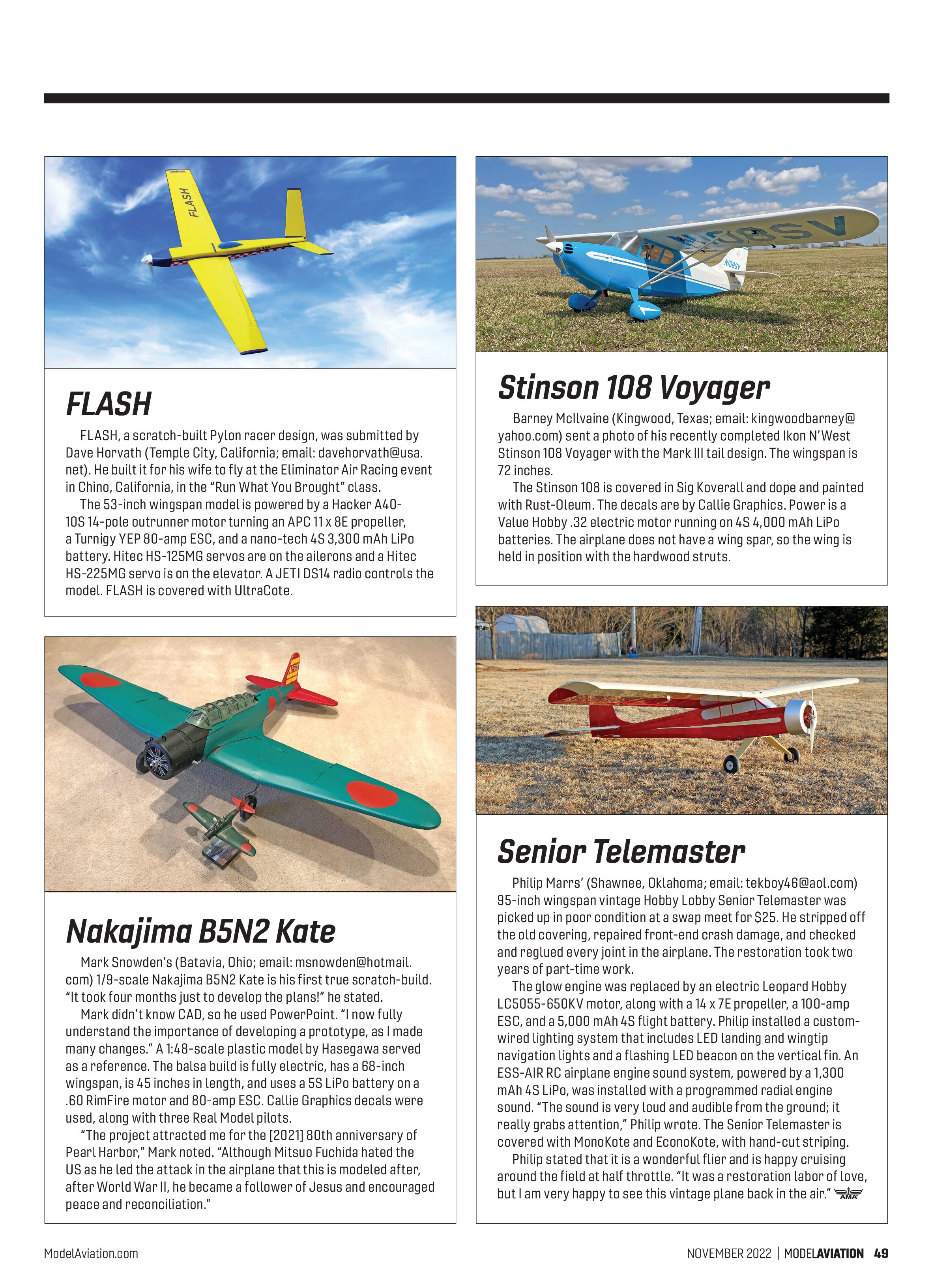
Mark Edwards (Frederick, Maryland; email: markleeedwards@aol.com) has modeled for more than 50 years, starting with Control Line and graduating to RC in the 1960s. A member of the DC Radio Control Club that flies at Montgomery County Model Airpark in Boyds, Maryland, he recently completed an F4 Phantom II that was built from plans drawn by Dan Savage, with a short kit from Bob Holman.
The fiberglass ducts, nose cone, and engine nozzles were constructed by AIR SALLY. It’s equipped with pneumatic retracts and the nose gear is adapted from the Motion RC A37 airliner. Construction is fiberglass over balsa and Mission Models paint was applied with an airbrush. The wingspan is 33-5/8 inches, the fuselage length is 50-1/2 inches, and the all-up weight, using a 90mm JP Hobby EDF unit and 5,000 mAh 6S battery, is approximately 7 pounds.
The Phantom is painted in the livery of Lt. Col. Vince Prostko, from the time that he served as a test pilot for the U.S. Air Force at Edwards Air Force Base. Mark said that he chose this model and livery as a way of recognizing his father-in-law’s contributions and service.
Shock Cub

Keith Davis (Colorado Springs, Colorado; email: kdavis03@hotmail.com) Seagull Models Shock Cub has a 102-inch wingspan and is powered by a DLE-55cc gas engine. Although it’s an ARF, he stated that putting together the landing gear struts and the wing struts were the hardest parts.
The airplane came with 6-inch wheels, a large decal sheet, and wing bags. It also has leading edge wing slats, but Keith had not hooked them up as of the time that he wrote this. He also installed an RCEXL smoke pump, which he noted gives it that extra wow effect in the air. “[It] flies great!”
FLASH

FLASH, a scratch-built Pylon racer design, was submitted by Dave Horvath (Temple City, California; email: davehorvath@usa.net). He built it for his wife to fly at the Eliminator Air Racing event in Chino, California, in the “Run What You Brought” class.
The 53-inch wingspan model is powered by a Hacker A40-10S 14-pole outrunner motor turning an APC 11 x 8E propeller, a Turnigy YEP 80-amp ESC, and a nano-tech 4S 3,300 mAh LiPo battery. Hitec HS-125MG servos are on the ailerons and a Hitec HS-225MG servo is on the elevator. A JETI DS14 radio controls the model. FLASH is covered with UltraCote.
Nakajima B5N2 Kate

Mark Snowden’s (Batavia, Ohio; email: msnowden@hotmail.com) 1/9-scale Nakajima B5N2 Kate is his first true scratch-build. “It took four months just to develop the plans!” he stated.
Mark didn’t know CAD, so he used PowerPoint. “I now fully understand the importance of developing a prototype, as I made many changes.” A 1:48-scale plastic model by Hasegawa served as a reference. The balsa build is fully electric, has a 68-inch wingspan, is 45 inches in length, and uses a 5S LiPo battery on a .60 RimFire motor and 80-amp ESC. Callie Graphics decals were used, along with three Real Model pilots.
“The project attracted me for the [2021] 80th anniversary of Pearl Harbor,” Mark noted. “Although Mitsuo Fuchida hated the US as he led the attack in the airplane that this is modeled after, after World War II, he became a follower of Jesus and encouraged peace and reconciliation.”
Stinson 108 Voyager

Barney McIlvaine (Kingwood, Texas; email: kingwoodbarney@yahoo.com) sent a photo of his recently completed Ikon N’West Stinson 108 Voyager with the Mark III tail design. The wingspan is 72 inches.
The Stinson 108 is covered in Sig Koverall and dope and painted with Rust-Oleum. The decals are by Callie Graphics. Power is a Value Hobby .32 electric motor running on 4S 4,000 mAh LiPo batteries. The airplane does not have a wing spar, so the wing is held in position with the hardwood struts.
Senior Telemaster

Philip Marrs’ (Shawnee, Oklahoma; email: tekboy46@aol.com) 95-inch wingspan vintage Hobby Lobby Senior Telemaster was picked up in poor condition at a swap meet for $25. He stripped off the old covering, repaired front-end crash damage, and checked and reglued every joint in the airplane. The restoration took two years of part-time work.
The glow engine was replaced by an electric Leopard Hobby LC5055-650KV motor, along with a 14 x 7E propeller, a 100-amp ESC, and a 5,000 mAh 4S flight battery. Philip installed a custom-wired lighting system that includes LED landing and wingtip navigation lights and a flashing LED beacon on the vertical fin. An ESS-AIR RC airplane engine sound system, powered by a 1,300 mAh 4S LiPo, was installed with a programmed radial engine sound. “The sound is very loud and audible from the ground; it really grabs attention,” Philip wrote. The Senior Telemaster is covered with MonoKote and EconoKote, with hand-cut striping.
Philip stated that it is a wonderful flier and is happy cruising around the field at half throttle. “It was a restoration labor of love, but I am very happy to see this vintage plane back in the air.”