Fac NATS
Returning to the Flying Aces Club Nationals in Geneseo
By Tom Hallman
maxfliart@hallmanstudio.com
Photos by the author


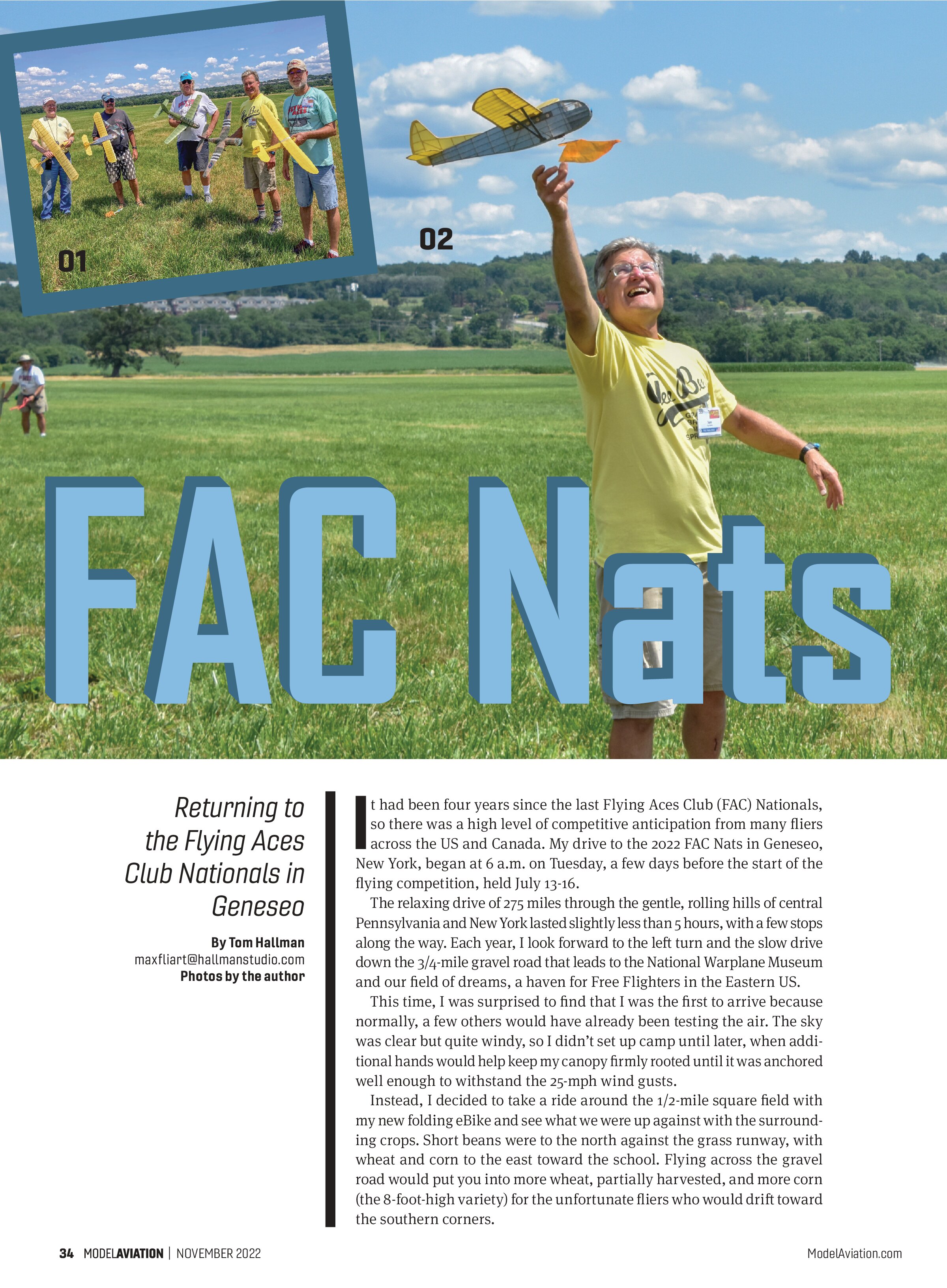
It had been four years since the last Flying Aces Club (FAC) Nationals, so there was a high level of competitive anticipation from many fliers across the US and Canada. My drive to the 2022 FAC Nats in Geneseo, New York, began at 6 a.m. on Tuesday, a few days before the start of the flying competition, held July 13-16.
The relaxing drive of 275 miles through the gentle, rolling hills of central Pennsylvania and New York lasted slightly less than 5 hours, with a few stops along the way. Each year, I look forward to the left turn and the slow drive down the 3/4-mile gravel road that leads to the National Warplane Museum and our field of dreams, a haven for Free Flighters in the Eastern US.
This time, I was surprised to find that I was the first to arrive because normally, a few others would have already been testing the air. The sky was clear but quite windy, so I didn’t set up camp until later, when additional hands would help keep my canopy firmly rooted until it was anchored well enough to withstand the 25-mph wind gusts.
Instead, I decided to take a ride around the 1/2-mile square field with my new folding eBike and see what we were up against with the surrounding crops. Short beans were to the north against the grass runway, with wheat and corn to the east toward the school. Flying across the gravel road would put you into more wheat, partially harvested, and more corn (the 8-foot-high variety) for the unfortunate fliers who would drift toward the southern corners.
The west gave you the hangar, along with numerous full-scale vintage aircraft in the yard, but with a large area of grass alongside bordered by a wall of 80-foot trees. This was the setting for the 2022 FAC Nats. The grassy terrain was in good shape, having recently been mowed. The next four days would surely be a blast for the Free Flight (FF) crowd, as long as the wind died down.
Day One, Wednesday
Each year, the first day is reserved for scale judging and compliance checks. Hundreds of models in all styles, shapes, and sizes go through the process, giving the rest of us time to check out the FF version of eye candy.
Seventy-five competitors presented their models on display tables inside the National Warplane Museum’s hangar, under the wings and shadows cast by a C-47, a PT-26, a nearby Fokker Triplane, and many other vintage aircraft. Perfect! It was time to pinch ourselves to make sure this was real.
While the models went through the judging process, the fliers could check out the model kits and supplies by vendors Easy Built Models, Volaré Products, and newcomer Brooklyn Balsa, with Oliver Sand’s line of self-designed short kits.
It was no surprise that the air outside was ideal for flying, so a few took advantage and returned to the flightline while the rest of us gritted our teeth for the tasks at hand. However, a few rogue rainstorms came through in cartoonlike fashion, giving us all a wild show and a chuckle, but leaving us relieved to be safely under the protection of the hangar.
Day Two, Thursday
The morning of the first day of flying competition sets the tone for the rest of the Nats. Luckily, conditions were nearly ideal, with mild temperatures, overcast, and little drift. Many waited for the heat and lift to arrive, but those who were interested in the Old Time Rubber Stick event immediately pulled out their models in hopes of scoring three max flights of 120 seconds in the first hour.
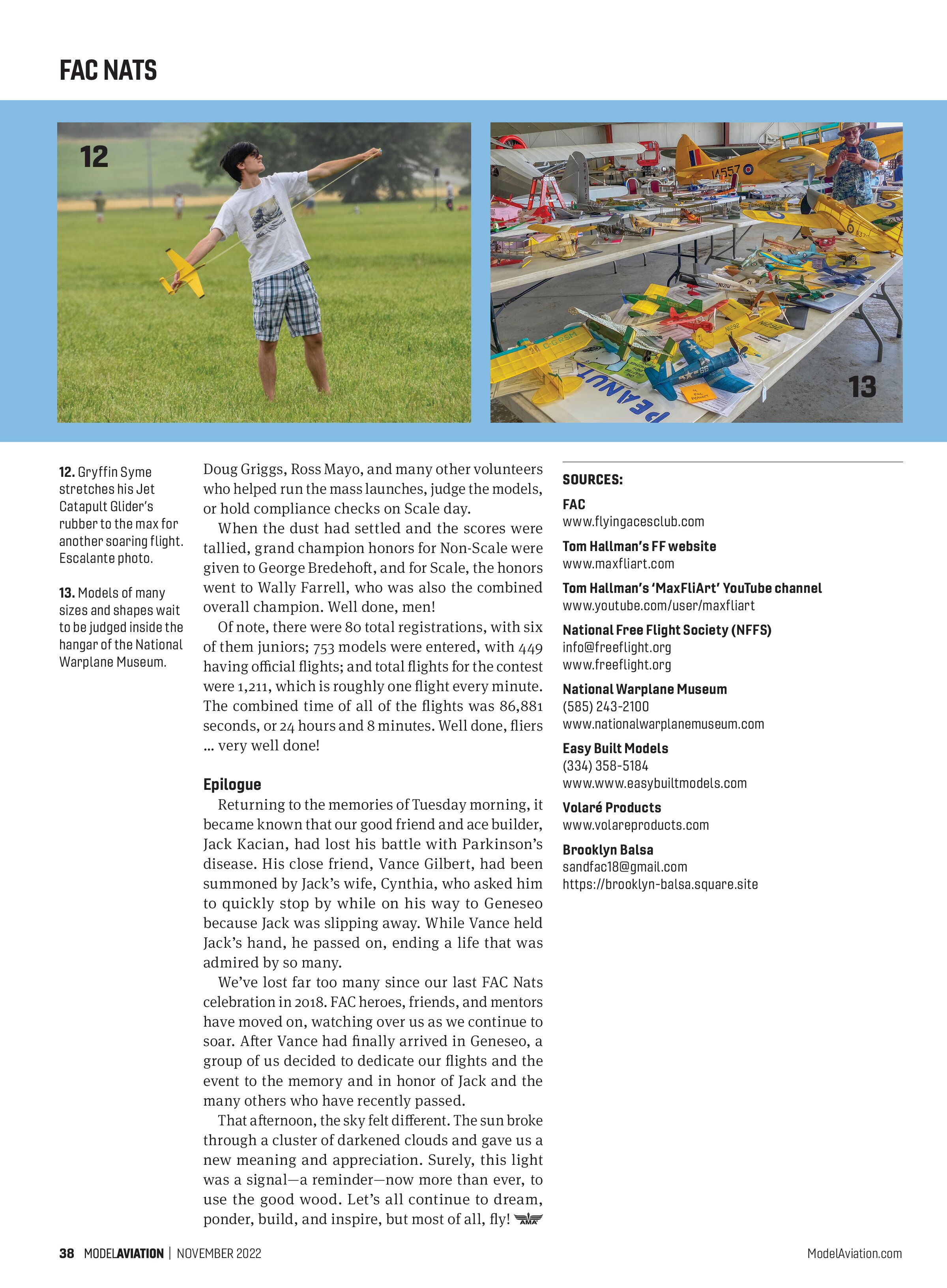
These duration aircraft from the 1930s and ’40s are some of the best flyers you will ever see, so it was a treat


to watch them soar. Gollywocks, Korda Sticks, Wanderers, and Casanos are the class of the field. In fact, seven of the 11 contestants who were entered had triple maxes, which led to an exciting last-one-down flyoff the next morning at 8. Typically, the flyoff would happen the same day as the event, but high wind would have led to mass flyaways, so we all agreed to a morning mass launch. The winning flight was slightly more than 3 minutes, under a beautiful, cloudless, clear blue sky.
The first morning of competition continued with low wind conditions, as fliers up and down the flightline brought out their models to fly in scale-judged events, along with numerous total-of-three-flight events, known as TOTFs. Miscellaneous timed events were held for No Blue Max fliers (e.g., modelers who have fewer than 16 victories, or kanones), giving them a better chance to experience the thrill of victory in the FAC.
The event list was rounded out with two mass launch events: World War I and the Thompson Race. Each was heavily contested during the three elimination rounds as the multicolored aircraft soared, looking to outperform the others.
The wind picked up around 2 p.m., so those who waited for better air or got behind on their event lists had to risk long, downwind chases or worse. A few aircraft did manage to fly away or go out of sight that day. The competition ended at 5 p.m.
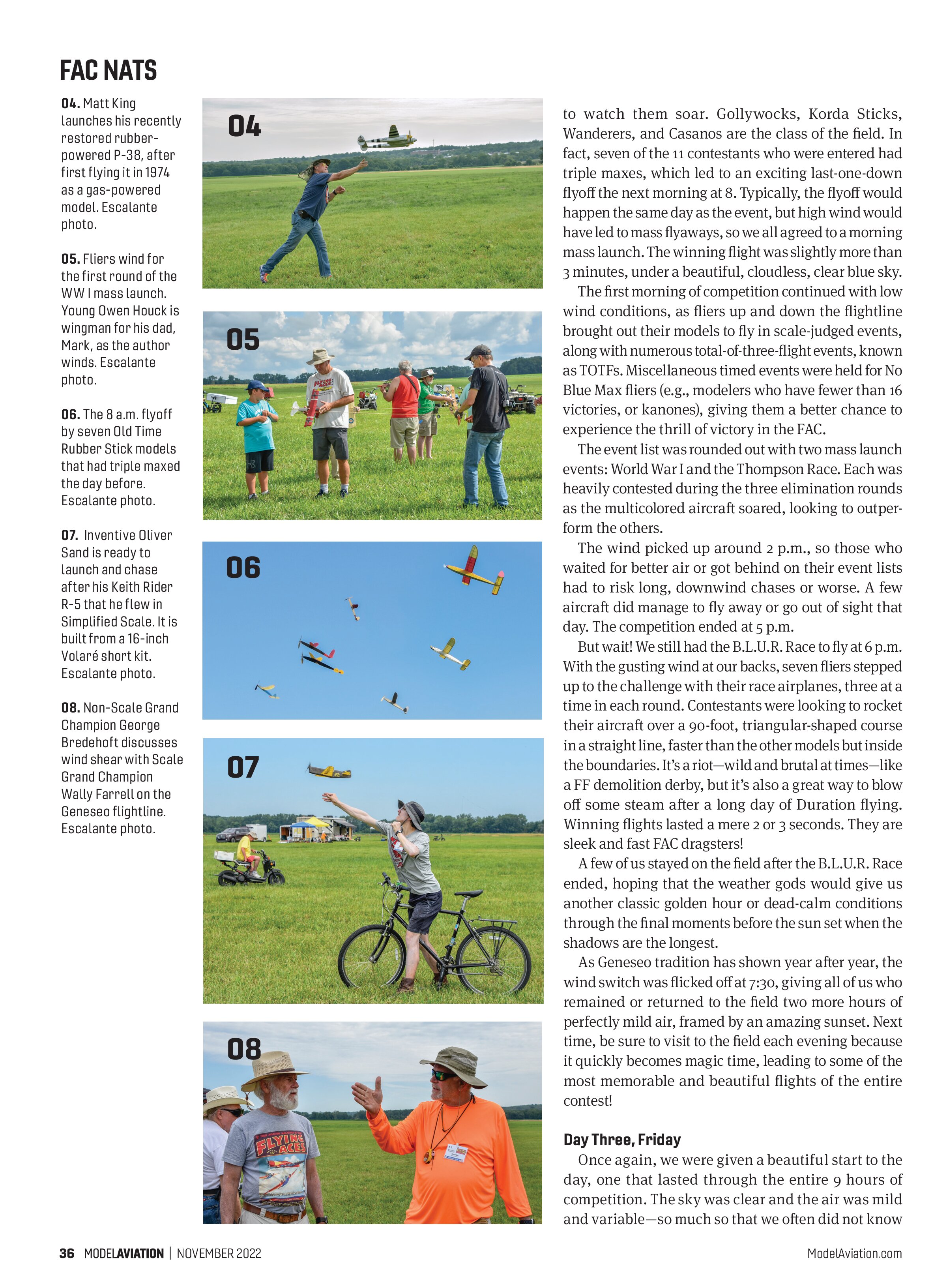
But wait! We still had the B.L.U.R. Race to fly at 6 p.m. With the gusting wind at our backs, seven fliers stepped up to the challenge with their race airplanes, three at a time in each round. Contestants were looking to rocket their aircraft over a 90-foot, triangular-shaped course in a straight line, faster than the other models but inside the boundaries. It’s a riot—wild and brutal at times—like a FF demolition derby, but it’s also a great way to blow off some steam after a long day of Duration flying. Winning flights lasted a mere 2 or 3 seconds. They are sleek and fast FAC dragsters!
A few of us stayed on the field after the B.L.U.R. Race ended, hoping that the weather gods would give us another classic golden hour or dead-calm conditions through the final moments before the sun set when the shadows are the longest.
As Geneseo tradition has shown year after year, the wind switch was flicked off at 7:30, giving all of us who remained or returned to the field two more hours of perfectly mild air, framed by an amazing sunset. Next time, be sure to visit to the field each evening because it quickly becomes magic time, leading to some of the most memorable and beautiful flights of the entire contest!
Day Three, Friday
Once again, we were given a beautiful start to the day, one that lasted through the entire 9 hours of competition. The sky was clear and the air was mild and variable—so much so that we often did not know which way to launch.
The thermal gods were clearly watching and waiting to pounce, giving our aircraft an unexpected ride to the outer edges of the field or perhaps simply straight overhead. Three mass launches were contested this day, including World War II, the Greve Race, and Goodyear/Formula Peanut. Other events included Scale Glider hi-start/towline, Jet Catapult Glider, various scale-judged events, TOTFs, and Non-Scale Endurance events.
Massive flights were seen against the brilliant, billowy clouds, as Power Scale models and Old Time Rubber fuselage airplanes soared in the thermal air. For those of us with heavy event slates, it was tempting to stop and gaze skyward at all of the action, but time moves quickly at the FAC Nats. Whoops and yells exclaiming “best flight ever” rang up and down the flightline. This day was FF heaven, with some saying it was the best weather in many years for Geneseo.
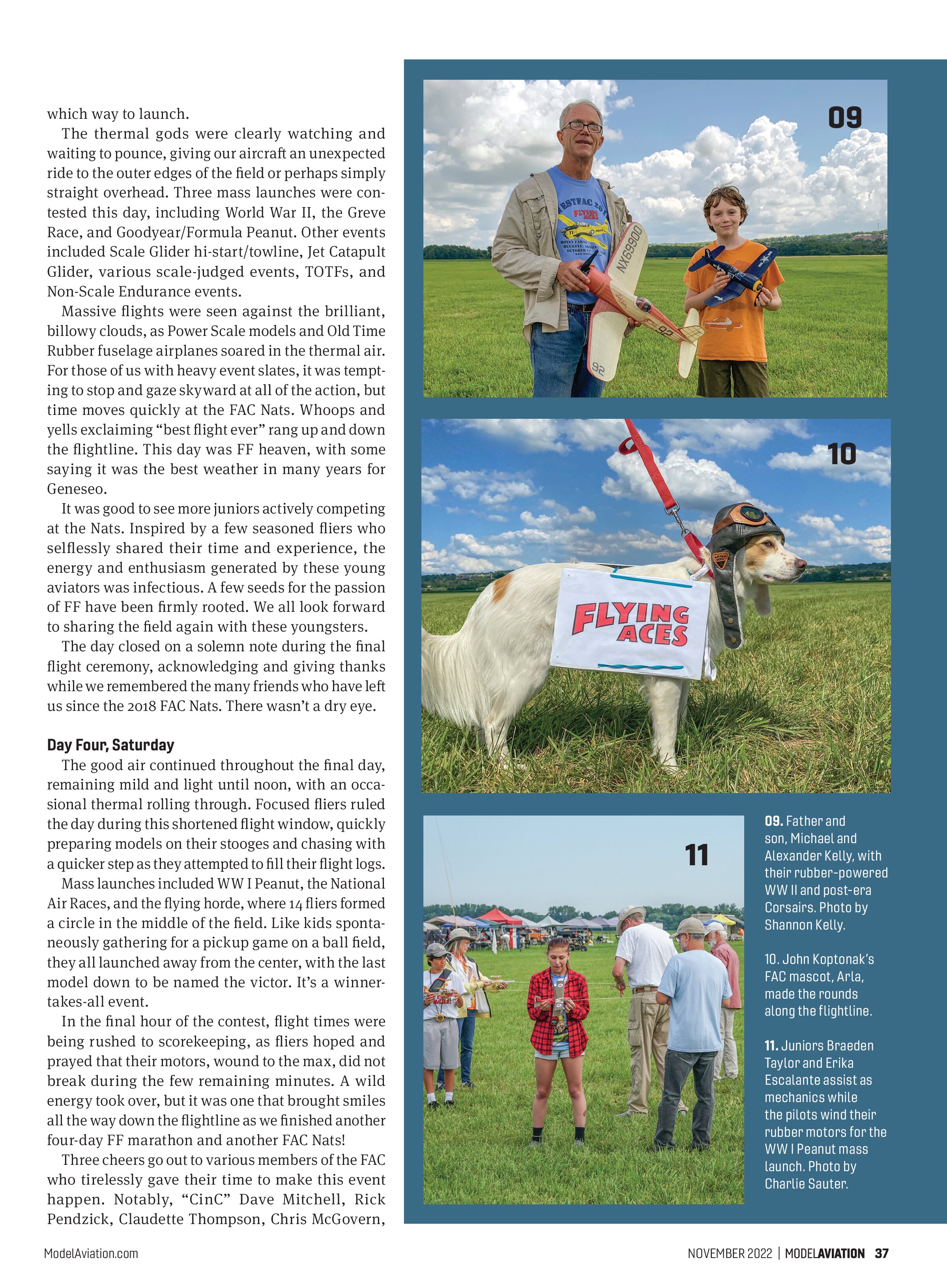
It was good to see more juniors actively competing at the Nats. Inspired by a few seasoned fliers who selflessly shared their time and experience, the energy and enthusiasm generated by these young aviators was infectious. A few seeds for the passion of FF have been firmly rooted. We all look forward to sharing the field again with these youngsters.
The day closed on a solemn note during the final flight ceremony, acknowledging and giving thanks while we remembered the many friends who have left us since the 2018 FAC Nats. There wasn’t a dry eye.
Day Four, Saturday
The good air continued throughout the final day, remaining mild and light until noon, with an occasional thermal rolling through. Focused fliers ruled the day during this shortened flight window, quickly preparing models on their stooges and chasing with a quicker step as they attempted to fill their flight logs.
Mass launches included WW I Peanut, the National Air Races, and the flying horde, where 14 fliers formed a circle in the middle of the field. Like kids spontaneously gathering for a pickup game on a ball field, they all launched away from the center, with the last model down to be named the victor. It’s a winner-takes-all event.
In the final hour of the contest, flight times were being rushed to scorekeeping, as fliers hoped and prayed that their motors, wound to the max, did not break during the few remaining minutes. A wild energy took over, but it was one that brought smiles all the way down the flightline as we finished another four-day FF marathon and another FAC Nats!
Three cheers go out to various members of the FAC who tirelessly gave their time to make this event happen. Notably, “CinC” Dave Mitchell, Rick Pendzick, Claudette Thompson, Chris McGovern,


Doug Griggs, Ross Mayo, and many other volunteers who helped run the mass launches, judge the models, or hold compliance checks on Scale day.
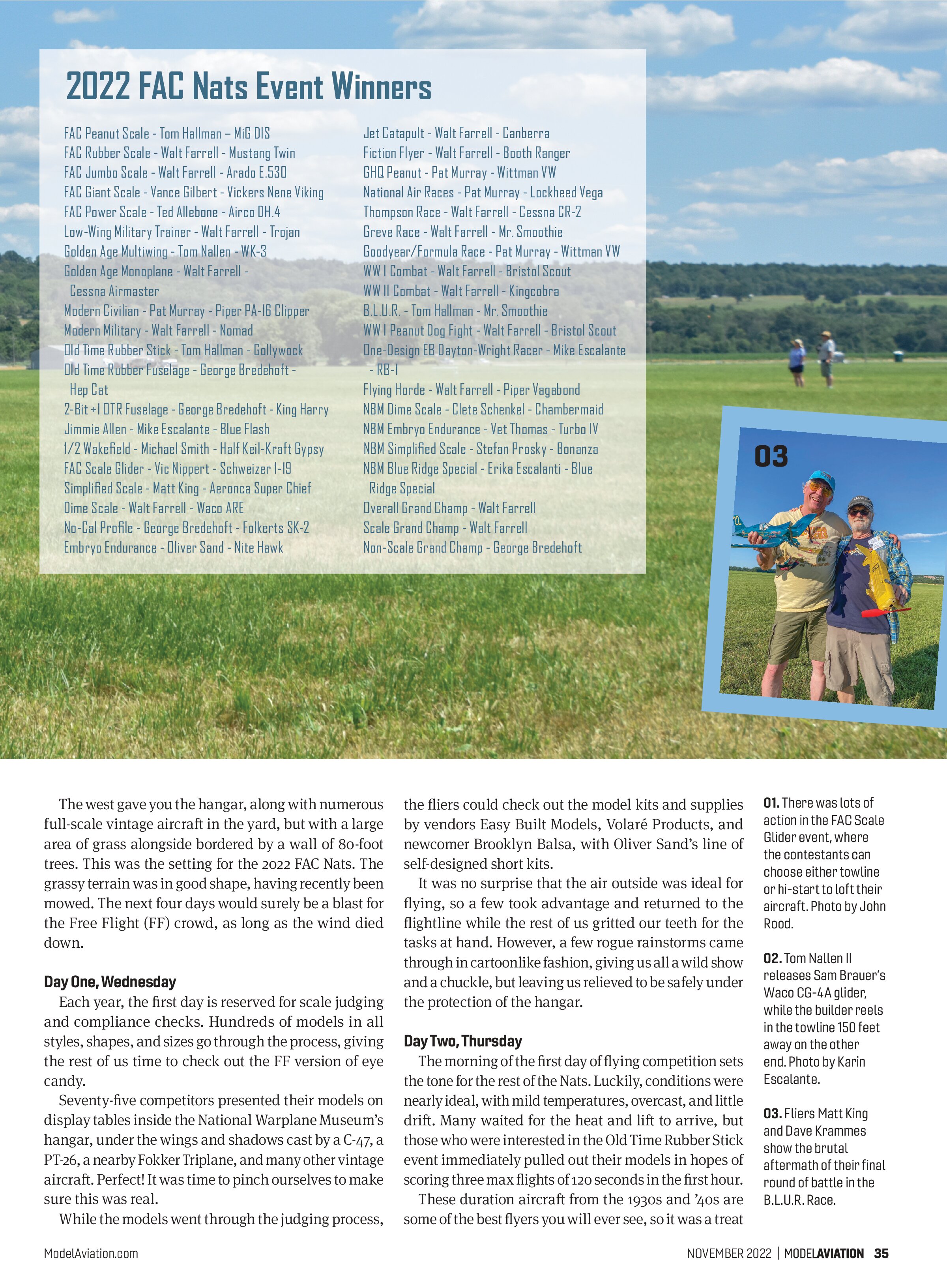
When the dust had settled and the scores were tallied, grand champion honors for Non-Scale were given to George Bredehoft, and for Scale, the honors went to Wally Farrell, who was also the combined overall champion. Well done, men!
Of note, there were 80 total registrations, with six of them juniors; 753 models were entered, with 449 having official flights; and total flights for the contest were 1,211, which is roughly one flight every minute. The combined time of all of the flights was 86,881 seconds, or 24 hours and 8 minutes. Well done, fliers ... very well done!
Epilogue
Returning to the memories of Tuesday morning, it became known that our good friend and ace builder, Jack Kacian, had lost his battle with Parkinson’s disease. His close friend, Vance Gilbert, had been summoned by Jack’s wife, Cynthia, who asked him to quickly stop by while on his way to Geneseo because Jack was slipping away. While Vance held Jack’s hand, he passed on, ending a life that was admired by so many.
We’ve lost far too many since our last FAC Nats celebration in 2018. FAC heroes, friends, and mentors have moved on, watching over us as we continue to soar. After Vance had finally arrived in Geneseo, a group of us decided to dedicate our flights and the event to the memory and in honor of Jack and the many others who have recently passed.
That afternoon, the sky felt different. The sun broke through a cluster of darkened clouds and gave us a new meaning and appreciation. Surely, this light was a signal—a reminder—now more than ever, to use the good wood. Let’s all continue to dream, ponder, build, and inspire, but most of all, fly!
SOURCES:
Tom Hallman’s FF website
www.maxfliart.com
Tom Hallman’s ‘MaxFliart’ YouTube channel
www.youtube.com/user/maxfliart
National Free Flight Society (NFFS)
info@freeflight.org
www.freeflight.org
National Warplane Museum
(585) 243-2100
www.nationalwarplanemuseum.com
Easy Built Models
(334) 358-5184
www.ww.easybuiltmodels.com
Volaré Products
www.volareproducts.com
Brooklyn Balsa
sandfac18@gmail.com
https://brooklyn-balsa.square.site