FAC NATS
By Thayer Syme | thayer@flying-models.com

THE FREE FLIGHT (FF) faithful gathered again in Geneseo, New York, this past July for the first official Flying Aces Club (FAC) Nats or Non-Nats since 2019. Yes, it really has been three years! Tom Hallman has written a feature article about the event in this issue, so I’ll just add a few of my own thoughts and impressions here to augment his coverage.
First and foremost was an overwhelming sense of relief just to be back on that field. My son and I went primarily to see everyone again, and getting in a little flying was a bonus. As always, there were a couple of standout moments that formed the proverbial frosting on the cake.
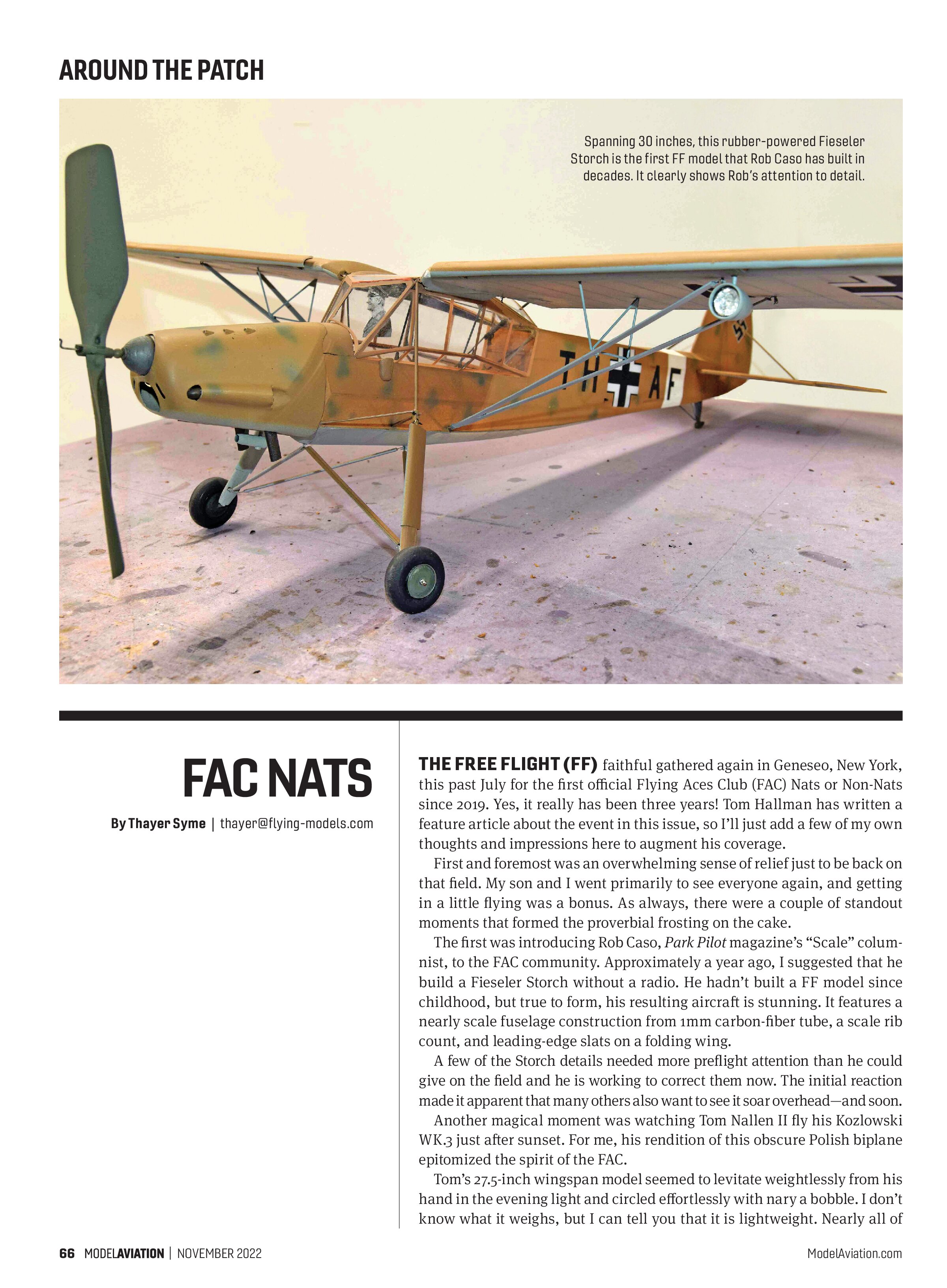
The first was introducing Rob Caso, Park Pilot magazine’s “Scale” columnist, to the FAC community. Approximately a year ago, I suggested that he build a Fieseler Storch without a radio. He hadn’t built a FF model since childhood, but true to form, his resulting aircraft is stunning. It features a nearly scale fuselage construction from 1mm carbon-fiber tube, a scale rib count, and leading-edge slats on a folding wing.
A few of the Storch details needed more preflight attention than he could give on the field and he is working to correct them now. The initial reaction made it apparent that many others also want to see it soar overhead—and soon.
Another magical moment was watching Tom Nallen II fly his Kozlowski WK.3 just after sunset. For me, his rendition of this obscure Polish biplane epitomized the spirit of the FAC.
Tom’s 27.5-inch wingspan model seemed to levitate weightlessly from his hand in the evening light and circled effortlessly with nary a bobble. I don’t know what it weighs, but I can tell you that it is lightweight. Nearly all of the fuselage structure is 1/16-inch square balsa, and it seemed helium-infused while in the air. You can see Tom’s WK.3 in action and more of its construction details on YouTube via the link in “Sources” at the end of this column.
Tom and Rob, thank you both for your endless inspiration.
Outdoor Torque Meters
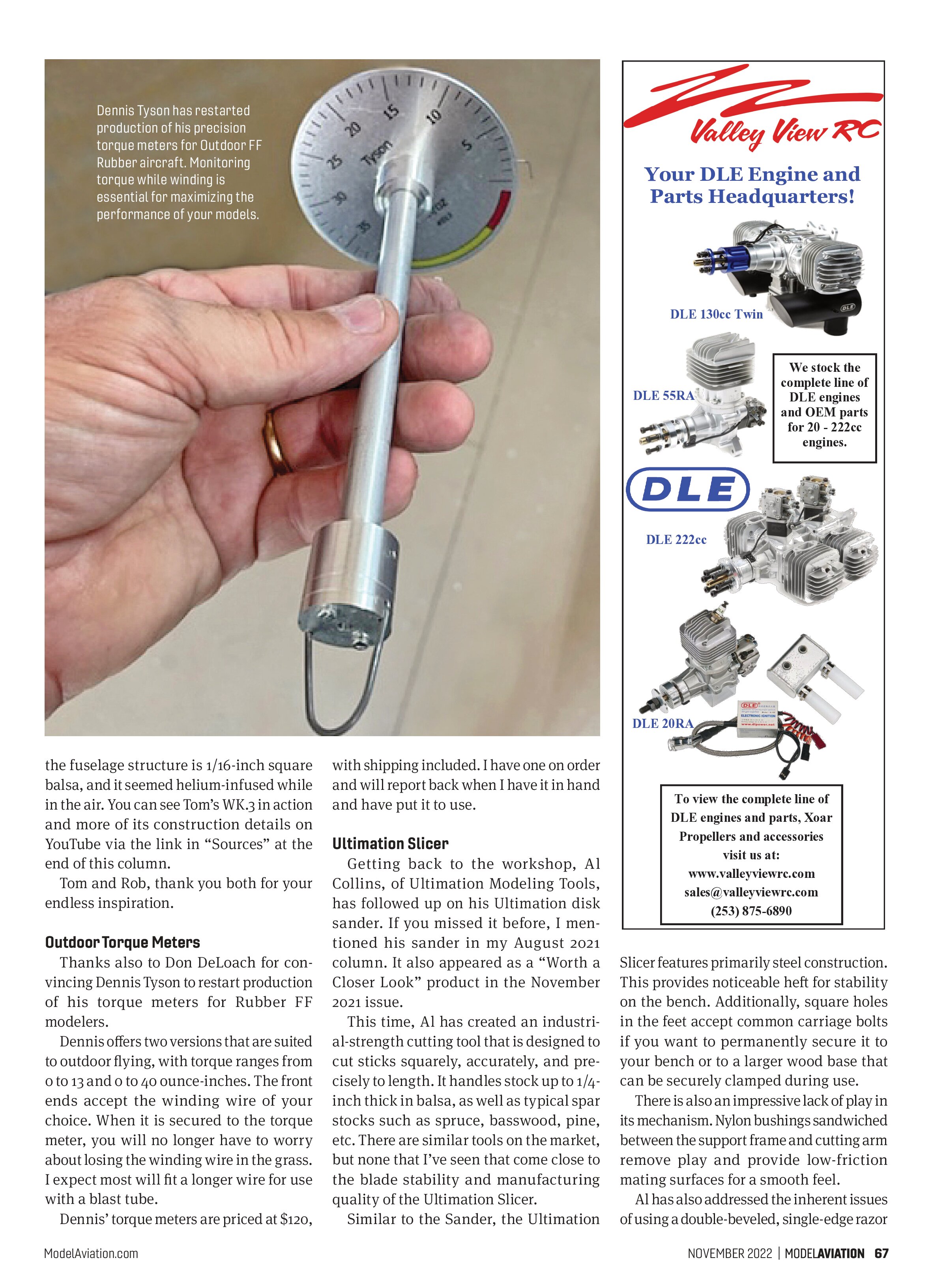
Thanks also to Don DeLoach for convincing Dennis Tyson to restart production of his torque meters for Rubber FF models.
Dennis offers two versions that are suited to outdoor flying, with torque ranges from 0 to 13 and 0 to 40 ounce-inches. The front ends accept the winding wire of your choice. When it is secured to the torque meter, you will no longer have to worry about losing the winding wire in the grass. I expect most will fit a longer wire for use with a blast tube.
Dennis’ torque meters are priced at $120, with shipping included. I have one on order and will report back when I have it in hand and have put it to use.

Ultimation Slicer
Getting back to the workshop, Al Collins, of Ultimation Modeling Tools, has followed up on his Ultimation disk sander. If you missed it before, I mentioned his sander in my August 2021 column. It also appeared as a “Worth a Closer Look” product in the November 2021 issue.
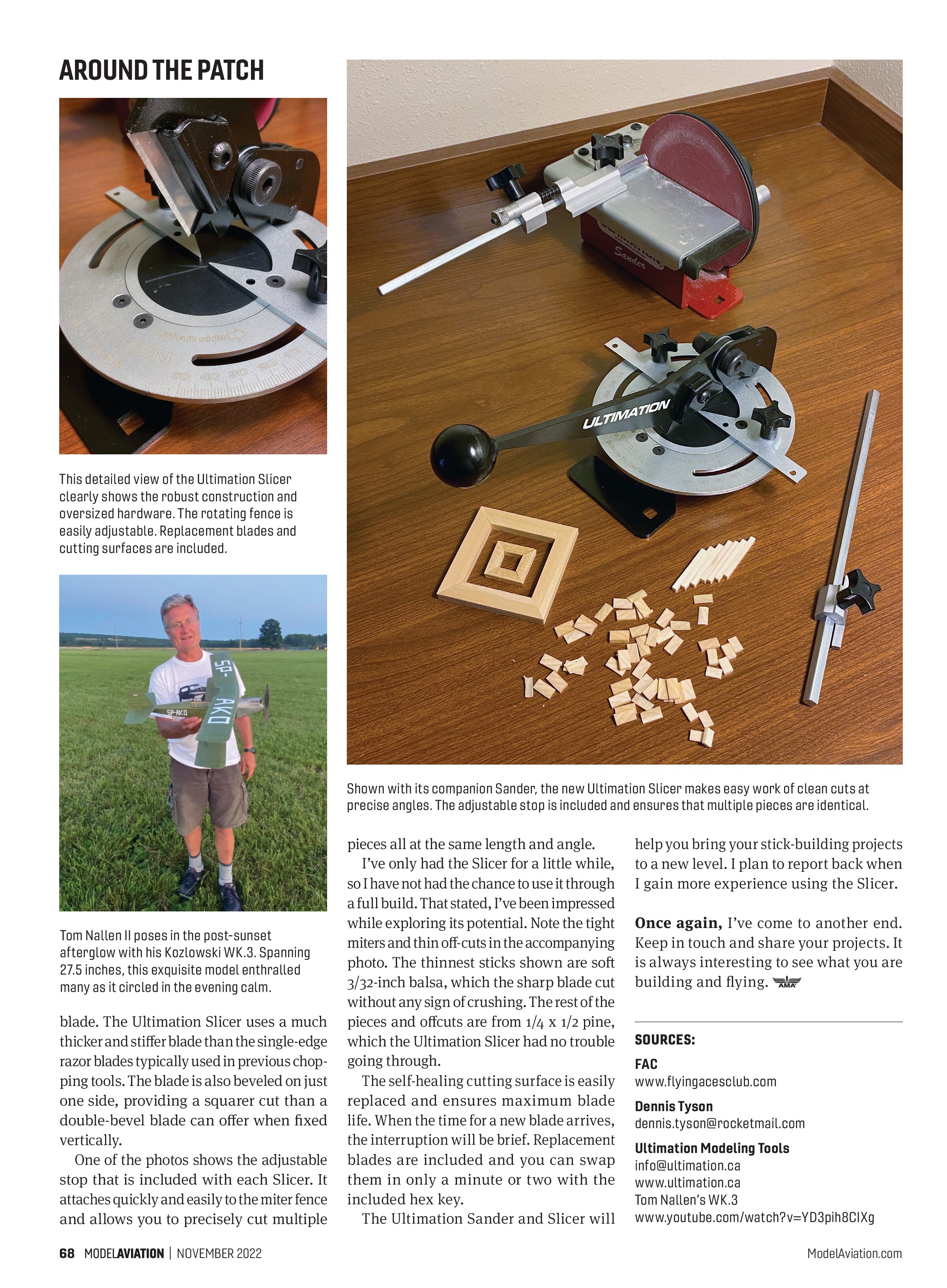
This time, Al has created an industrial-strength cutting tool that is designed to cut sticks squarely, accurately, and precisely to length. It handles stock up to 1/4-inch thick in balsa, as well as typical spar stocks such as spruce, basswood, pine, etc. There are similar tools on the market, but none that I’ve seen that come close to the blade stability and manufacturing quality of the Ultimation Slicer.
Similar to the Sander, the Ultimation Slicer features primarily steel construction. This provides noticeable heft for stability on the bench. Additionally, square holes in the feet accept common carriage bolts if you want to permanently secure it to your bench or to a larger wood base that can be securely clamped during use.
There is also an impressive lack of play in its mechanism. Nylon bushings sandwiched between the support frame and cutting arm remove play and provide low-friction mating surfaces for a smooth feel.
Al has also addressed the inherent issues of using a double-beveled, single-edge razor


blade. The Ultimation Slicer uses a much thicker and stiffer blade than the single-edge razor blades typically used in previous chopping tools. The blade is also beveled on just one side, providing a squarer cut than a double-bevel blade can offer when fixed vertically.
One of the photos shows the adjustable stop that is included with each Slicer. It attaches quickly and easily to the miter fence and allows you to precisely cut multiple

pieces all at the same length and angle.
I’ve only had the Slicer for a little while, so I have not had the chance to use it through a full build. That stated, I’ve been impressed while exploring its potential. Note the tight miters and thin off-cuts in the accompanying photo. The thinnest sticks shown are soft 3/32-inch balsa, which the sharp blade cut without any sign of crushing. The rest of the pieces and offcuts are from 1/4 x 1/2 pine, which the Ultimation Slicer had no trouble going through.
The self-healing cutting surface is easily replaced and ensures maximum blade life. When the time for a new blade arrives, the interruption will be brief. Replacement blades are included and you can swap them in only a minute or two with the included hex key.
The Ultimation Sander and Slicer will help you bring your stick-building projects to a new level. I plan to report back when I gain more experience using the Slicer.
Once again, I’ve come to another end. Keep in touch and share your projects. It is always interesting to see what you are building and flying.
SOURCES:
Dennis Tyson
dennis.tyson@rocketmail.com
Ultimation Modeling Tools
info@ultimation.ca
www.ultimation.ca
Tom Nallen’s WK.3
www.youtube.com/watch?v=YD3pih8CIXg