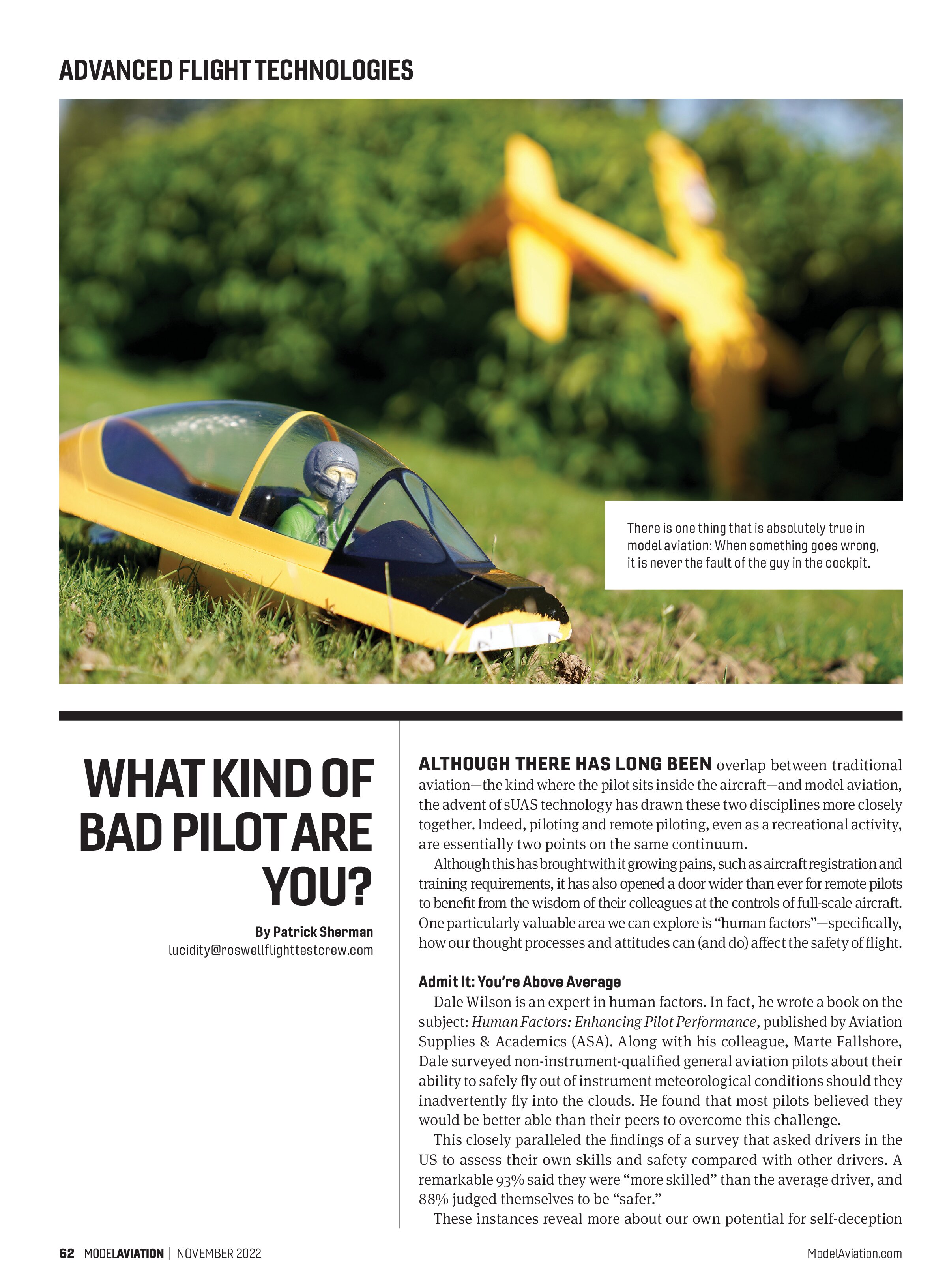
WHAT KIND OF BAD PILOT ARE YOU?
By Patrick Sherman
lucidity@roswellflighttestcrew.com

ALTHOUGH THERE HAS LONG BEEN overlap between traditional aviation—the kind where the pilot sits inside the aircraft—and model aviation, the advent of sUAS technology has drawn these two disciplines more closely together. Indeed, piloting and remote piloting, even as a recreational activity, are essentially two points on the same continuum.
Although this has brought with it growing pains, such as aircraft registration and training requirements, it has also opened a door wider than ever for remote pilots to benefit from the wisdom of their colleagues at the controls of full-scale aircraft. One particularly valuable area we can explore is “human factors”—specifically, how our thought processes and attitudes can (and do) affect the safety of flight.
Admit It: You’re Above Average
Dale Wilson is an expert in human factors. In fact, he wrote a book on the subject: Human Factors: Enhancing Pilot Performance, published by Aviation Supplies & Academics (ASA). Along with his colleague, Marte Fallshore, Dale surveyed non-instrument-qualified general aviation pilots about their ability to safely fly out of instrument meteorological conditions should they inadvertently fly into the clouds. He found that most pilots believed they would be better able than their peers to overcome this challenge.
This closely paralleled the findings of a survey that asked drivers in the US to assess their own skills and safety compared with other drivers. A remarkable 93% said they were “more skilled” than the average driver, and 88% judged themselves to be “safer.”
These instances reveal more about our own potential for self-deception than they do about our abilities as pilots or drivers. After all, 93% of the population can’t actually be more skilled than 50% of the population—those with skills that are objectively average or worse. What this survey actually reveals is that approximately half of us have an inflated sense of our own abilities, and that’s not a great starting point if you are hoping to make rational decisions when confronting uncertain or risky circumstances.
Not to worry: These findings only apply to other people—not you and me. Well, not me, anyway. Now that I think about it, I’m not so sure about you. After all, there is a 50% chance, mathematically speaking, that you’re one of them.
Bad Attitudes
It’s painful for anyone, including me, to admit it, but most likely, all of us overestimate our own skills and abilities, at least to some degree. Even if we could somehow recognize and internalize that fact, there are other psychological hazards that we must confront as pilots. Five distinct and aptly named hazardous attitudes are among them: anti-authority, impulsivity, invulnerability, macho, and resignation.
The FAA has identified these attitudes as contributing to unsafe flying and enshrined them within the Aeronautical Decision Making (ADM) process. ADM could be its own article or, more likely, its own book, but its worth understanding the five hazardous attitudes and how to confront them in ourselves so that we can be the best and safest pilots that we are able to be.
How does it work? According to the FAA, when you recognize a hazardous attitude taking shape in your own mind, you should first identify it as such, and then employ an antidote. Almost like a mantra, the antidote to a hazardous attitude is a clear reminder that it is, in fact, not true. So, how do you recognize each of the five hazardous attitudes, and what is the antidote to each?
- Anti-authority is embodied in the phrase, “Don’t tell me what to do!” It is the tendency of a person to disregard the rules as somehow not applicable to them or their situation. Have you ever rolled through a stop sign or pressed on the gas pedal instead of the brake when you see a yellow light? That’s the anti-authority hazardous attitude at work. The

antidote is, “Follow the rules. They are usually right.”
2. Impulsivity, associated with the phrase, “Do it quickly,” manifests itself as the urge to do something—anything—so long as you do it right now. Obviously, there are circumstances in aviation that do require us to respond promptly to emergent conditions; however, if that response is not correct, it could make the outcome even worse. The antidote to impulsivity is, “Not so fast. Think first.”
3. Invulnerability can be recognized with the phrase, “It won’t happen to me!” It is the belief, however misguided, that accidents only happen to other people. Pilots who fall prey to invulnerability are more likely to take risks that might result in a bad outcome. The antidote to invulnerability is, “It could happen to me.”
4. Macho is on full display in the phrase, “I can do it!” and possibly even more so in the phrase, “Hold my beer … watch this!” A pilot who succumbs to the macho hazardous attitude will take chances in order to demonstrate to themselves or others that they have superior skills and will not shrink from a challenge. The antidote to macho is, “Taking chances is foolish.”
5. Resignation can be identified in the phrase, “What’s the use?” This can be a counter-intuitive hazardous attitude to understand because, unlike the other four, it is passive, not active. However, there have been numerous examples in traditional aviation where a pilot simply gives up and withdraws in the face of a serious challenge. The antidote to resignation is, “I’m not helpless. I can make a difference.”
Watch Your Attitude
As those surveys of pilots and drivers revealed, all humans are, at least to some degree, vulnerable to error when assessing our own skills and abilities. In precisely that same way, we can all experience the effects of the five hazardous attitudes, even if we are reticent to admit it to ourselves, let alone anyone else.
To be sure, any of these attitudes could strike any of us at any moment; however, each of us is especially susceptible to one—or more—of them. You should actively seek to discover what your “favorite” hazardous attitude is and always keep that knowledge front and center when you are out flying.
Because it’s only a quarter million of my closest friends here, I’ll go ahead and start the ball rolling. The hazardous attitude to which I’m most vulnerable is, ironically, invulnerability.
It’s alarming how often in my flying career I’ve managed to persuade myself that nothing bad will happen right before I do something stupid and, predictably, something bad happens.
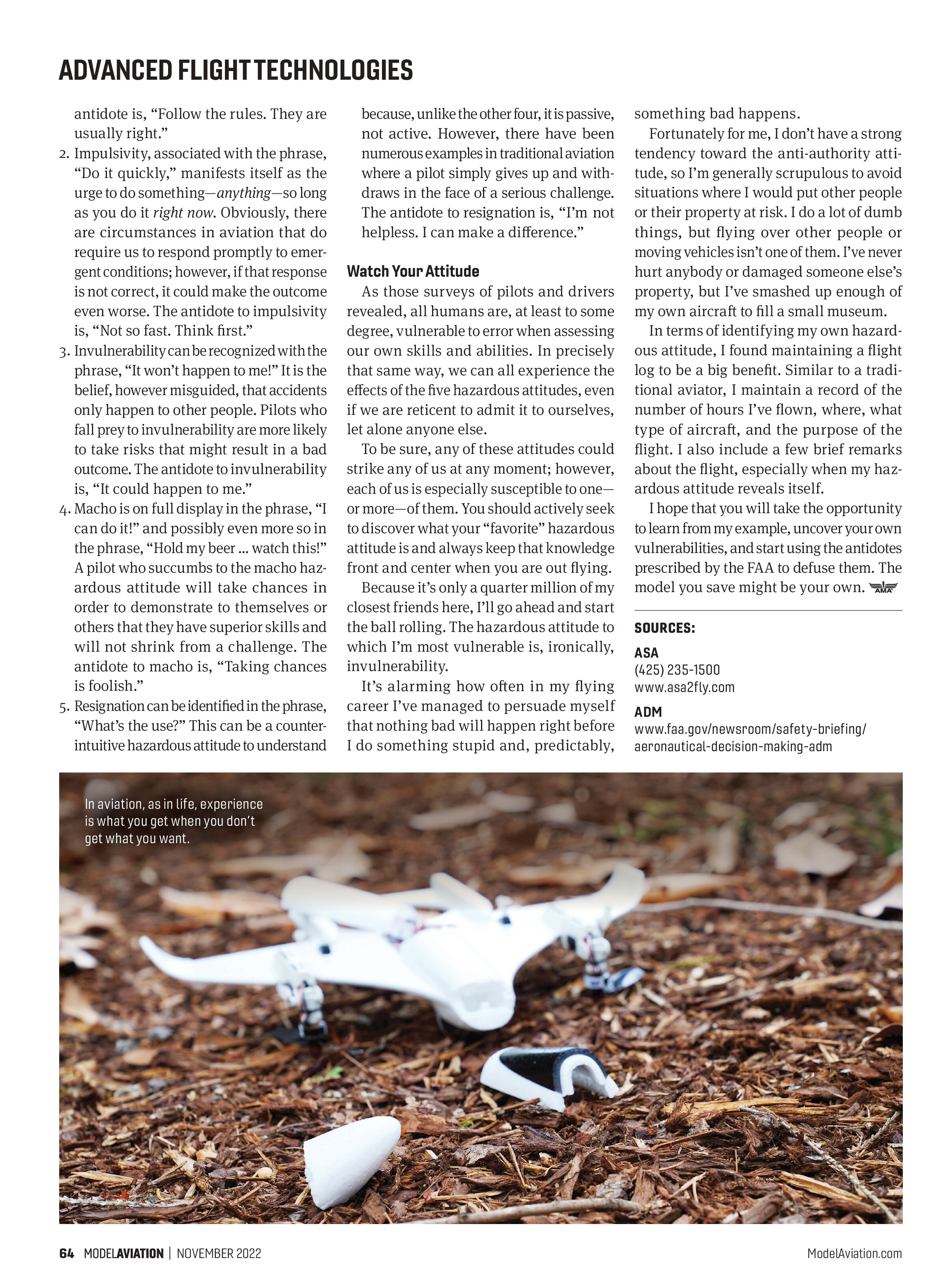
Fortunately for me, I don’t have a strong tendency toward the anti-authority attitude, so I’m generally scrupulous to avoid situations where I would put other people or their property at risk. I do a lot of dumb things, but flying over other people or moving vehicles isn’t one of them. I’ve never hurt anybody or damaged someone else’s property, but I’ve smashed up enough of my own aircraft to fill a small museum.
In terms of identifying my own hazardous attitude, I found maintaining a flight log to be a big benefit. Similar to a traditional aviator, I maintain a record of the number of hours I’ve flown, where, what type of aircraft, and the purpose of the flight. I also include a few brief remarks about the flight, especially when my hazardous attitude reveals itself.
I hope that you will take the opportunity to learn from my example, uncover your own vulnerabilities, and start using the antidotes prescribed by the FAA to defuse them. The model you save might be your own.
SOURCES:
ASA
(425) 235-1500
www.asa2fly.com
ADM
www.faa.gov/newsroom/safety-briefing/aeronautical-decision-making-adm