Focal Point
Interested in sharing your handiwork? Visit ModelAviation.com for submission guidelines.
Wacko Mystery Ship

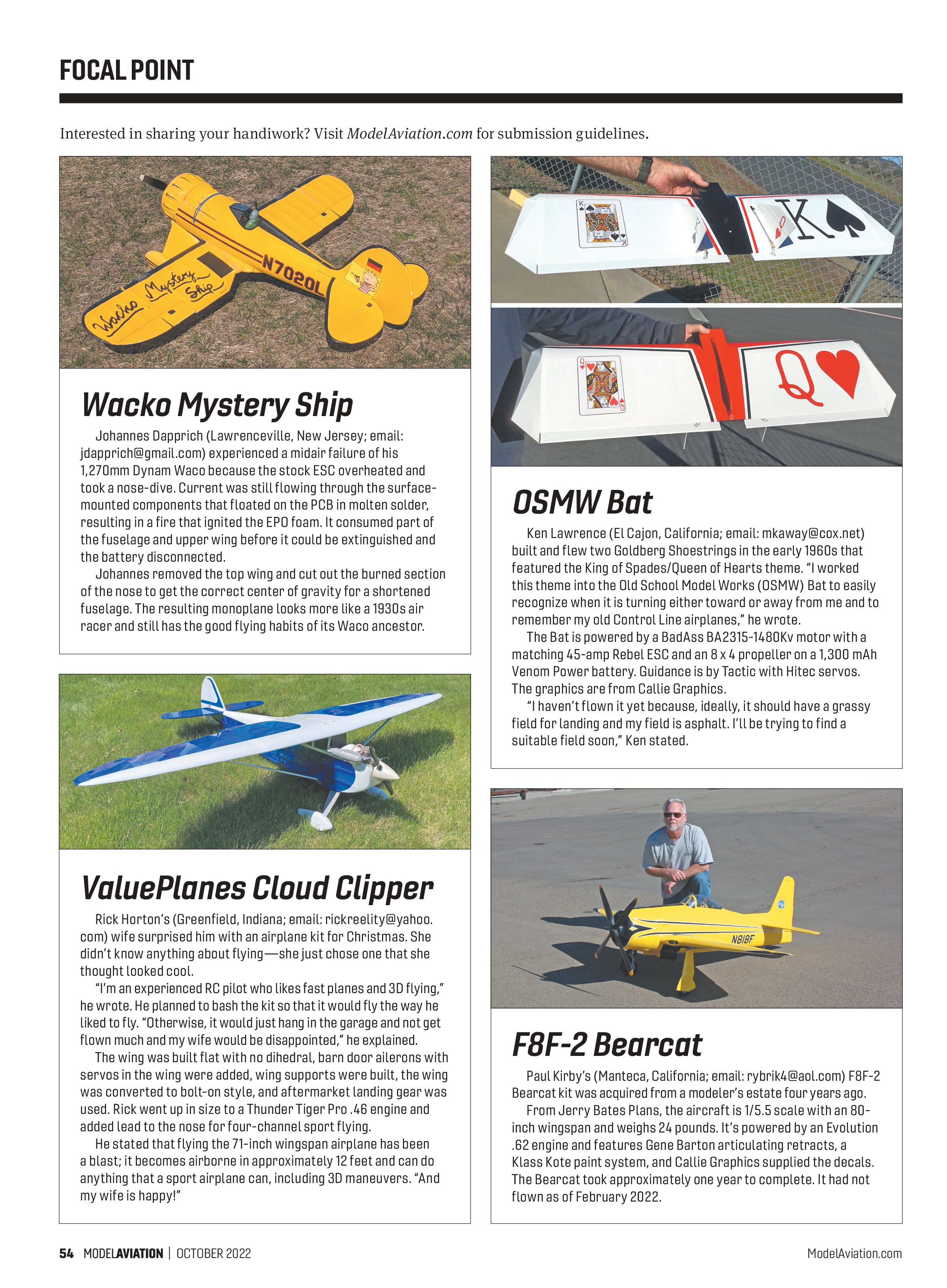
Johannes Dapprich (Lawrenceville, New Jersey; email: jdapprich@gmail.com) experienced a midair failure of his 1,270mm Dynam Waco because the stock ESC overheated and took a nose-dive. Current was still flowing through the surface-mounted components that floated on the PCB in molten solder, resulting in a fire that ignited the EPO foam. It consumed part of the fuselage and upper wing before it could be extinguished and the battery disconnected.
Johannes removed the top wing and cut out the burned section of the nose to get the correct center of gravity for a shortened fuselage. The resulting monoplane looks more like a 1930s air racer and still has the good flying habits of its Waco ancestor.
ValuePlanes Cloud Clipper

Rick Horton’s (Greenfield, Indiana; email: rickreelity@yahoo.com) wife surprised him with an airplane kit for Christmas. She didn’t know anything about flying—she just chose one that she thought looked cool.
“I’m an experienced RC pilot who likes fast planes and 3D flying,” he wrote. He planned to bash the kit so that it would fly the way he liked to fly. “Otherwise, it would just hang in the garage and not get flown much and my wife would be disappointed,” he explained.
The wing was built flat with no dihedral, barn door ailerons with servos in the wing were added, wing supports were built, the wing was converted to bolt-on style, and aftermarket landing gear was used. Rick went up in size to a Thunder Tiger Pro .46 engine and added lead to the nose for four-channel sport flying.
He stated that flying the 71-inch wingspan airplane has been a blast; it becomes airborne in approximately 12 feet and can do anything that a sport airplane can, including 3D maneuvers. “And my wife is happy!”
OSMW Bat


Ken Lawrence (El Cajon, California; email: mkaway@cox.net) built and flew two Goldberg Shoestrings in the early 1960s that featured the King of Spades/Queen of Hearts theme. “I worked this theme into the Old School Model Works (OSMW) Bat to easily recognize when it is turning either toward or away from me and to remember my old Control Line airplane,” he wrote.
The Bat is powered by a BadAss BA2315-1480Kv motor with a matching 45-amp Rebel ESC and an 8 x 4 propeller on a 1,300 mAh Venom Power battery. Guidance is by Tactic with Hitec servos. The graphics are from Callie Graphics.
“I haven’t flown it yet because, ideally, it should have a grassy field for landing and my field is asphalt. I’ll be trying to find a suitable field soon,” Ken stated.
F8F-2 Bearcat

Paul Kirby’s (Manteca, California; email: rybrik4@aol.com) F8F-2 Bearcat kit was acquired from a modeler’s estate four years ago.
From Jerry Bates Plans, the aircraft is 1/5.5 scale with an 80-inch wingspan and weighs 24 pounds. It’s powered by an Evolution .62 engine and features Gene Barton articulating retracts, a Klass Kote paint system, and Callie Graphics supplied the decals. The Bearcat took approximately one year to complete. It had not flown as of February 2022.
Coroplast CoroStick

Andrew S. Rosz (Hollywood, Florida, email: arosz@att.net) designed and scratch-built a pair of polypropylene Coroplast CoroStick sport airplanes that were modeled after the popular Ugly Stik design. They feature fully symmetrical airfoils and large control surfaces.
The CoroStick is an all-wind, all-weather airplane that can be flown in challenging conditions. The CoroSticks are powered by O.S. 46FX glow engines and controlled by a standard four-channel Futaba radio.
The 60-inch wingspan CoroStick weighs 5-1/2 pounds when loaded with fuel. The wing is structurally reinforced by a central tapered spar, and the control surfaces provide plenty of travel so that it can be flown to the extreme. The tricycle-gear design also adds to its enhanced controllability when taxiing and during takeoffs.
“It flies amazingly well,” Andrew noted. It ranks high among his favorite airplanes to fly.
3D-Printed Airbus

Daniel Eng (San Antonio, Texas; email: danieleng01@gmail.com) flies with the Alamo Radio Control Society in San Antonio. He wrote, “I bought a 3D printer to play around with and make parts for the car that I drive. I saw [a video] on YouTube [by an] RCer named Troy McMillan. He had designed an Airbus airliner and I wanted to see if my 3D printer could print something of that scale and fly. It took a week and a half to print the parts running nonstop and roughly a month to assemble and paint.”
Daniel purchased the files for the aircraft and bought a few rolls of filament and printed them. “I’ve found the detail and assembly to be much easier than the traditional balsa, although it’s a tad heavier than foam planes and fiberglass fuselages.”
Daniel chose the UPS livery. The 60-inch wingspan Airbus A321 is powered with two 70mm EDFs and a 4S battery pack with two 80-amp ESCs and controlled with a Spektrum radio system.
Telemaster .40

Matthew Obregon (Granite City, California; email: matthewdobregon@gmail.com) submitted his completed, original Hobby Lobby Telemaster .40.
Featuring flaps, the airplane is powered by a new O.S. .40FP engine. It’s covered with MonoKote and utilizes custom landing gear with rubber band springs for soft landings.
This picture was taken at dusk at the Associated Modelers of Sacramento field in Lincoln, California, after its maiden flight. Matthew reported that the Telemaster is a slow flyer and loves to fly just above idle.
Guillow’s Flying Machine

Jeff Penny (Lyons, Kansas; email: jpenny419@cox.net) upscaled his version of the Guillow’s Flying Machine. “I copied the balsa plane to a PDF file then enlarged the plans to a 48-inch wingspan,” he wrote.
The foam-board Flying Machine is painted tan with brown Sharpie lines to imitate balsa. The graphic is red marker. There is a 1/16-inch balsa doubler on both sides of the fuselage for strength that is three thicknesses to accommodate the micro servos. Control is rudder and elevator. Power is by a 2212 brushless motor with a 3S 1,500 mAh battery. Weight is 17-1/2 ounces. “As built, the model was very tall and heavy, hence the larger-than-needed motor; it’s power over dead weight,” Jeff stated. The wing is single thickness, with a 1-inch strip of foam and a 1/8-inch bamboo skewer on the bottom plus struts for strength. “They haven’t folded—yet.”
Jeff noted that it’s an easy and inexpensive model to build. “It flies okay, but I thought it just looked nostalgic.”