GO OR NO-GO:
MANAGING
YOUR
BATTERIES AT
THE FIELD
By Terry Dunn | terrydunn74@gmail.com
DISCOVER MORE CONTENT!
Read more in the author’s September 2018 Model Aviation article that highlights some methods for using Velcro in electric models. Visit www.ModelAviation.com and search “Sticky Strategies.”
BEFORE I DIG INTO the primary subject of this month’s column, I want to share more letters and photos that I have received from readers. I am still amazed by the huge response to my February 2022 column that talked about using brushed motors in our electric-powered models. Although I love modern, brushless power systems, I am happy to see so many brushed motors still in use.
Buck Buchanan sent a photo of his Viking Old-Timer and a nice description of its history.
“Enclosed is a picture of my Astro Flight Viking that I built in the late 1980s. It is powered by an Astro Flight geared Cobalt 05 ‘can’ motor. I use a wooden, 11 x 9 Zinger propeller, along with a Williams Brothers ‘fake’ ignition cylinder head to give it that nostalgic, vintage look. I have upgraded to a modern ESC and two-cell LiPo powertrain. It flies great and is still going strong at 35 years old.”
The next letter is from Glenn Means. Interestingly, Glenn’s letter is a response to Paul Spreiregen’s letter that was published in my June 2022 column. Paul’s letter and photos describe his Astro Flight Challengers and Mini-Challengers. That information allowed Glenn to identify a mystery model from his fleet as a Challenger.
“I did a real double-take when I saw the gliders from your article in the June 2022 issue of Model Aviation. I built my 72-inch sailplane many years ago. At that time, I only did Slope Soaring, so it was built without a motor.
“Sixteen years ago, when we moved to central Oregon, I converted it, along with an Aquila, to a motor and folding propeller. I have been asked many times what model it was—I just could not remember. It makes sense that it is an Astro Flight Challenger. Now I have something to call it other than my ‘Yellow Glider.’ It’s great to finally solve the mystery. The model is still one of my favorites to fly.”


Speaking of solved mysteries, the final letter that I want to mention came from Bernard Cawley. He correctly identified the unknown ESC that I presented in my February column. It is a Jomar SM-5. Bernard was also able to provide advice on how to configure this vintage unit.
I will give it a shot when I clear a few projects from my workbench.
Thanks to Buck, Glenn, and Bernard (and many others) for reaching out. Their emails are perfect examples of the information sharing that makes RC modeling so amazing. Not to mention that Buck’s and Glenn’s airplanes are true time capsules that are fun to look at!
What’s the Status, Gladys?
I recently read a story from a modeler who crashed his airplane because he accidentally reinserted a battery that had already been flown. By the time he realized his mistake, it was too late to return to the runway for a normal landing. The airplane

can be repaired, but this story highlights the need for modelers who fly electrics to identify which batteries are charged or discharged before a flight.
If you’re like me, you have multiple examples of the same battery. That is especially true for batteries that can be used in many different models. I’m sure that I have more than a half-dozen 3S 2,200 mAh batteries in my current inventory. With that many lookalikes, you need a system in place to indicate which batteries are juiced up and which ones are already flat.
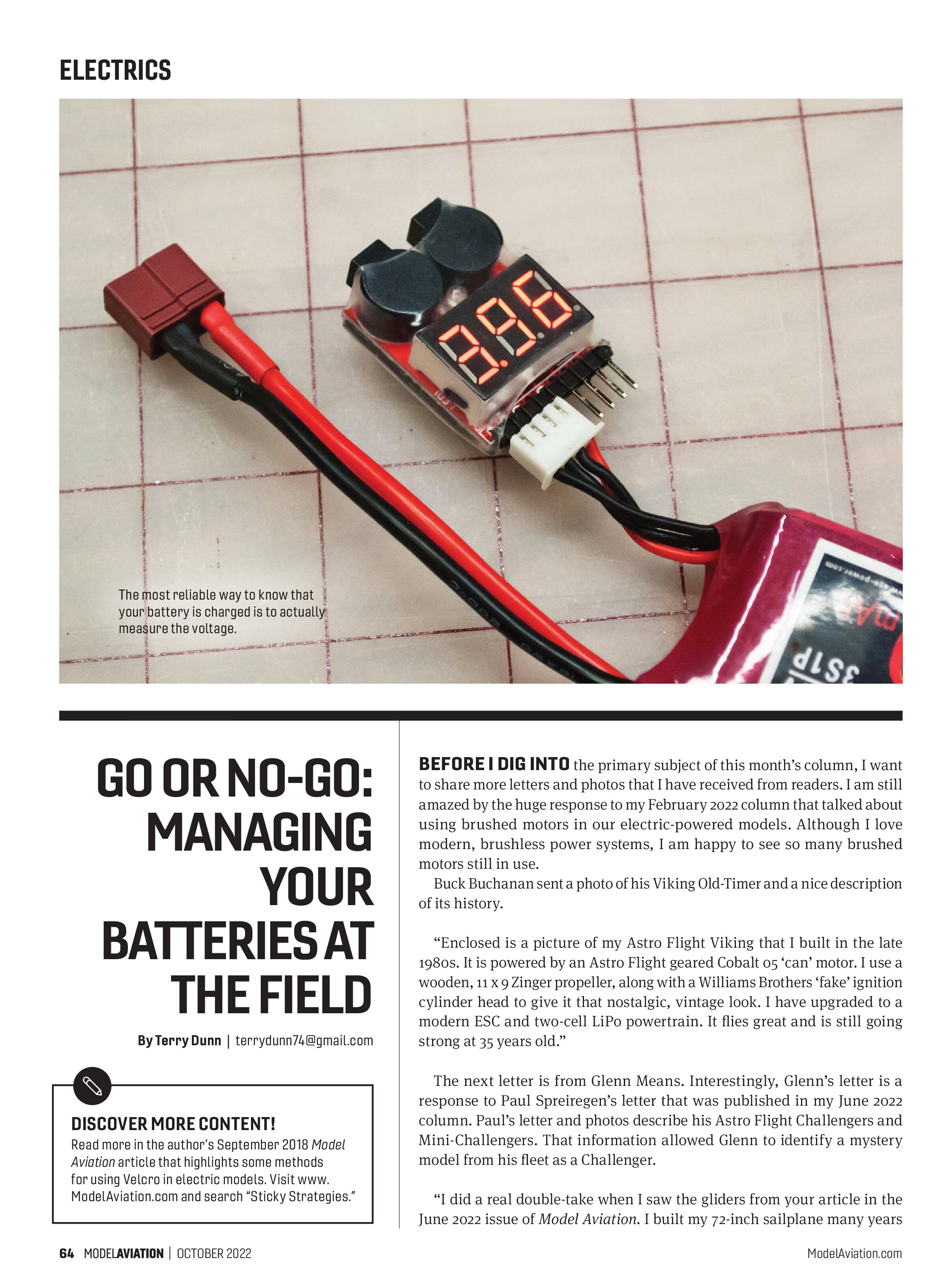
The most reliable method is to actually measure the voltage of the battery just before you put it in the model. There are many off-the-shelf devices that you can plug into the battery for a quick voltage reading. Most of them are small enough to keep in your pocket.
A fully charged LiPo battery will read 4.2 volts per cell. For example, a four-cell battery should read 16.8 volts (give or take 0.1 volt). Any battery that reads less than 4.2 volts per cell should be put on the charger before it goes in the airplane. For that matter, there is no harm in topping off a questionable battery, just to be sure.
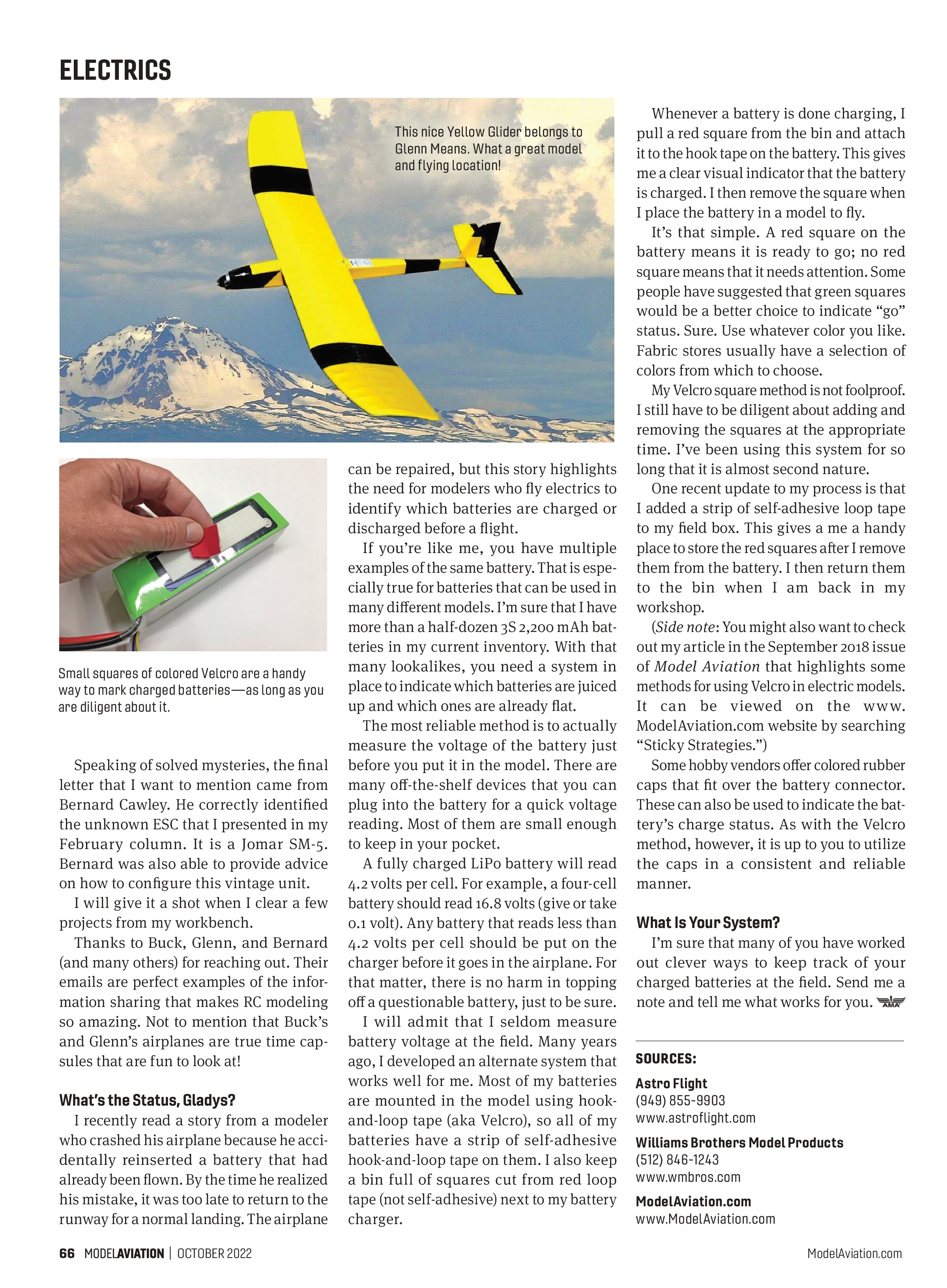
I will admit that I seldom measure battery voltage at the field. Many years ago, I developed an alternate system that works well for me. Most of my batteries are mounted in the model using hook-and-loop tape (aka Velcro), so all of my batteries have a strip of self-adhesive hook-and-loop tape on them. I also keep a bin full of squares cut from red loop tape (not self-adhesive) next to my battery charger.
Whenever a battery is done charging, I pull a red square from the bin and attach it to the hook tape on the battery. This gives me a clear visual indicator that the battery is charged. I then remove the square when I place the battery in a model to fly.
It’s that simple. A red square on the battery means it is ready to go; no red square means that it needs attention. Some people have suggested that green squares would be a better choice to indicate “go” status. Sure. Use whatever color you like. Fabric stores usually have a selection of colors from which to choose.
My Velcro square method is not foolproof. I still have to be diligent about adding and removing the squares at the appropriate time. I’ve been using this system for so long that it is almost second nature.
One recent update to my process is that I added a strip of self-adhesive loop tape to my field box. This gives a me a handy place to store the red squares after I remove them from the battery. I then return them to the bin when I am back in my workshop.
(Side note: You might also want to check out my article in the September 2018 issue of Model Aviation that highlights some methods for using Velcro in electric models. It can be viewed on the www. ModelAviation.com website by searching “Sticky Strategies.”)
Some hobby vendors offer colored rubber caps that fit over the battery connector. These can also be used to indicate the battery’s charge status. As with the Velcro method, however, it is up to you to utilize the caps in a consistent and reliable manner.
What Is Your System?
I’m sure that many of you have worked out clever ways to keep track of your charged batteries at the field. Send me a note and tell me what works for you.
SOURCES:
Astro Flight
(949) 855-9903
www.astroflight.com
Williams Brothers Model Products
(512) 846-1243
www.wmbros.com
ModelAviation.com
www.ModelAviation.com