VINTAGE VIEWPOINT

JUNE 1972
By Bob Noll | bobrc@aol.com
BY NOW, MODELERS IN the US should have had enough good weather to get in a few flights. The weather here in upstate New York has been particularly good, and fellow club members have been getting out to our club field to get in some solo flying.
I am still recovering from a hip replacement, so that has kept me housebound except for trips to physical therapy. I endured some pain during my trip to my magazine library to find out what was being written about 50 years ago.
American Aircraft Modeler (AAM) had an article about Hal deBolt’s Benight Special, a winning Formula 1 design, into which Hal incorporated several features that he used when he competed in Control Line (CL) Speed.
One feature was the use of only one aileron. The right aileron helped when entering a pylon turn. He wrote that the single aileron allowed you to “fly into the turns much harder with the nose down and yet the reaction from the single aileron will keep the model level as it progresses through the turn.” Another feature that Hal took from his CL Speed days was the use of a power unit for the first time in an RC Pylon racer. He built a pressure cowling unit that was easily removable for service.
AAM had the third part in a series by Fred Marks about the AAM Commander. This series covered the design and construction of a complete two-channel system. The article contained a receiver schematic, decoder schematic, and printed circuit layouts. Yes, 50 years ago, many modelers had fun building their own equipment. Many ham radio operators were entering RC and they enjoyed the challenge of building electronics.
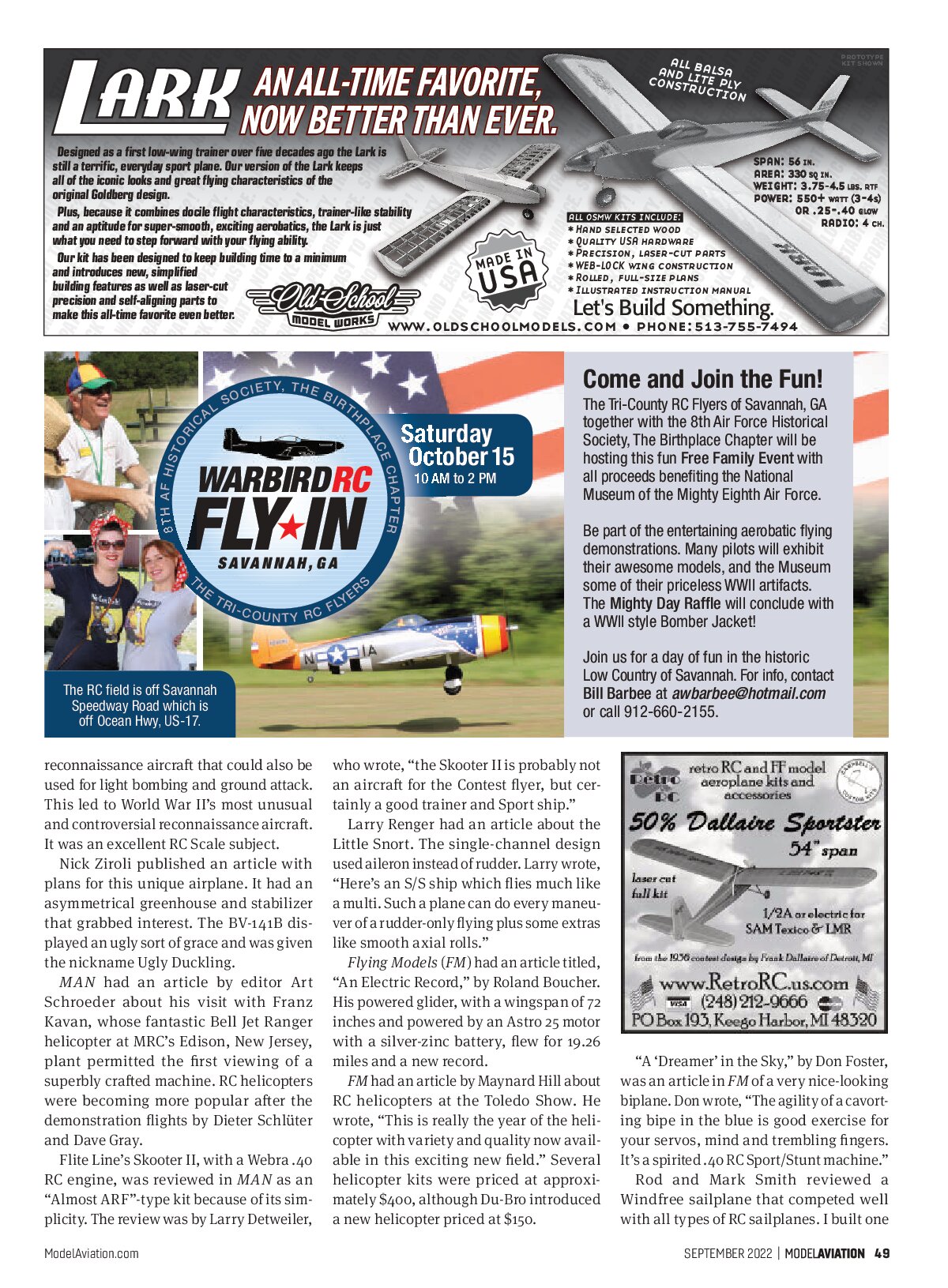
Model Airplane News (MAN) had a construction article on the Blohm und Voss BV-141B. Early in 1937, a specification was issued for the design of a short-range reconnaissance aircraft that could also be used for light bombing and ground attack. This led to World War II’s most unusual and controversial reconnaissance aircraft. It was an excellent RC Scale subject.
Nick Ziroli published an article with plans for this unique airplane. It had an asymmetrical greenhouse and stabilizer that grabbed interest. The BV-141B displayed an ugly sort of grace and was given the nickname Ugly Duckling.
MAN had an article by editor Art Schroeder about his visit with Franz Kavan, whose fantastic Bell Jet Ranger helicopter at MRC’s Edison, New Jersey, plant permitted the first viewing of a superbly crafted machine. RC helicopters were becoming more popular after demonstration flights by Dieter Schlüter and Dave Gray.
Flite Line’s Skooter II, with a Webra .40 RC engine, was reviewed in MAN as an “Almost ARF”-type kit because of its simplicity. The review was by Larry Detweiler, who wrote, “the Skooter II is probably not an aircraft for the Contest flyer, but certainly a good trainer and Sport ship.”
Larry Renger had an article about the Little Snort. The single-channel design used aileron instead of rudder. Larry wrote, “Here’s an S/S ship which flies much like a multi. Such a plane can do every maneuver of a rudder-only flying plus some extras like smooth axial rolls.”
Flying Models (FM) had an article titled, “An Electric Record,” by Roland Boucher. His powered glider, with a wingspan of 72 inches and powered by an Astro 25 motor with a silver-zinc battery, flew for 19.26 miles and a new record.
FM had an article by Maynard Hill about RC helicopters at the Toledo Show. He wrote, “This is really the year of the helicopter with variety and quality now available in this exciting new field.” Several helicopter kits were priced at approximately $400, although Du-Bro introduced a new helicopter priced at $150.
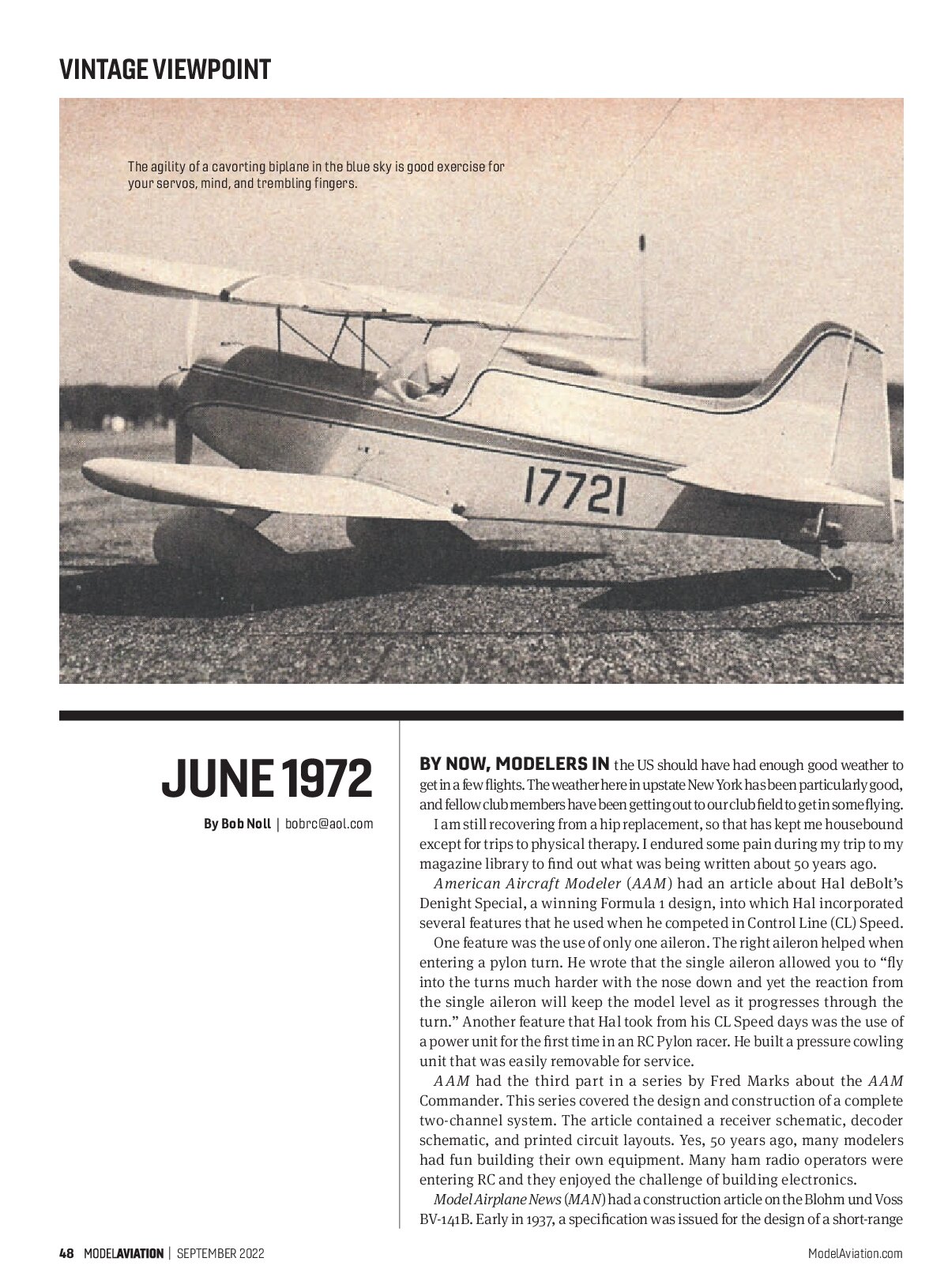
“A ‘Dreamer’ in the Sky,” by Don Foster, was an article in FM of a very nice-looking biplane. Don wrote, “The agility of a cavorting biplane in the blue is good exercise for your servos, mind and trembling fingers. It’s a spirited .40 RC Sport/Stunt machine.”
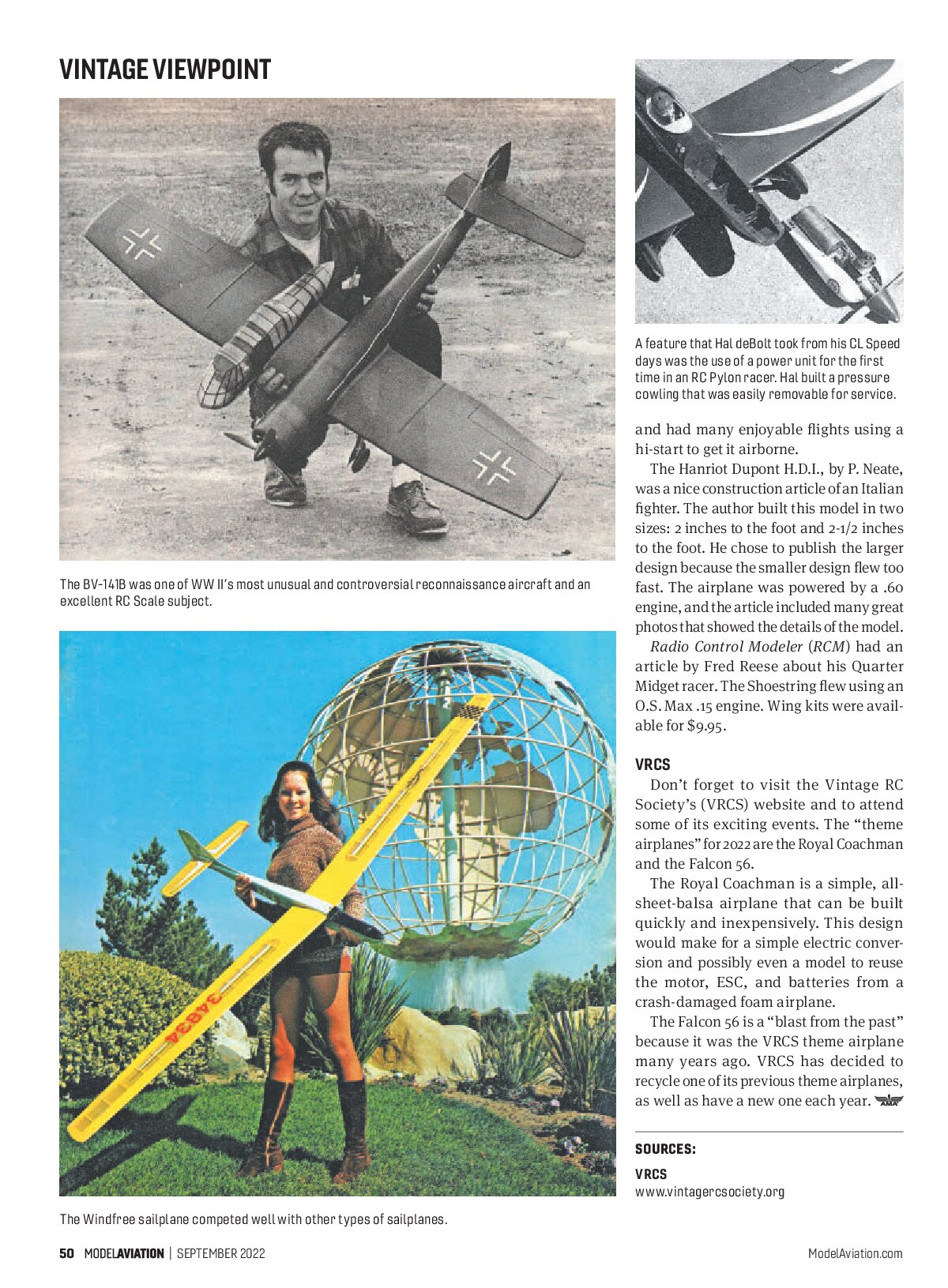
Rod and Mark Smith reviewed a Windfree sailplane that competed well with all types of RC sailplanes. I built one


and had many enjoyable flights using a hi-start to get it airborne.
The Hanriot Dupont H.D.I., by P. Neate, was a nice construction article of an Italian fighter. The author built this model in two sizes: 2 inches to the foot and 2-1/2 inches to the foot. He chose to publish the larger design because the smaller design flew too fast. The airplane was powered by a .60 engine, and the article included many great photos that showed the details of the model.
Radio Control Modeler (RCM) had an article by Fred Reese about his Quarter Midget racer. The Shoestring flew using an O.S. Max .15 engine. Wing kits were available for $9.95.
VRCS
Don’t forget to visit the Vintage RC Society’s (VRCS) website and to attend some of its exciting events. The “theme airplanes” for 2022 are the Royal Coachman and the Falcon 56.
The Royal Coachman is a simple, all-sheet-balsa airplane that can be built quickly and inexpensively. This design would make for a simple electric conversion and possibly even a model to reuse the motor, ESC, and batteries from a crash-damaged foam airplane.
The Falcon 56 is a “blast from the past” because it was the VRCS theme airplane many years ago. VRCS has decided to recycle one of its previous theme airplanes, as well as have a new one each year.