SAFETY COMES FIRST

STAND AND FACE … BACKWARD?
By Dave Gee | safetycolumn@cs.com
STEVE “STARTING STAND” ROGERS is the man who let me give away his plans for an engine-starting rack in my March 2021 column. Nobody knows how many big and little injuries have been prevented by his generous act, but I bet it’s a lot.
Steve recently emailed me about an interesting controversy.
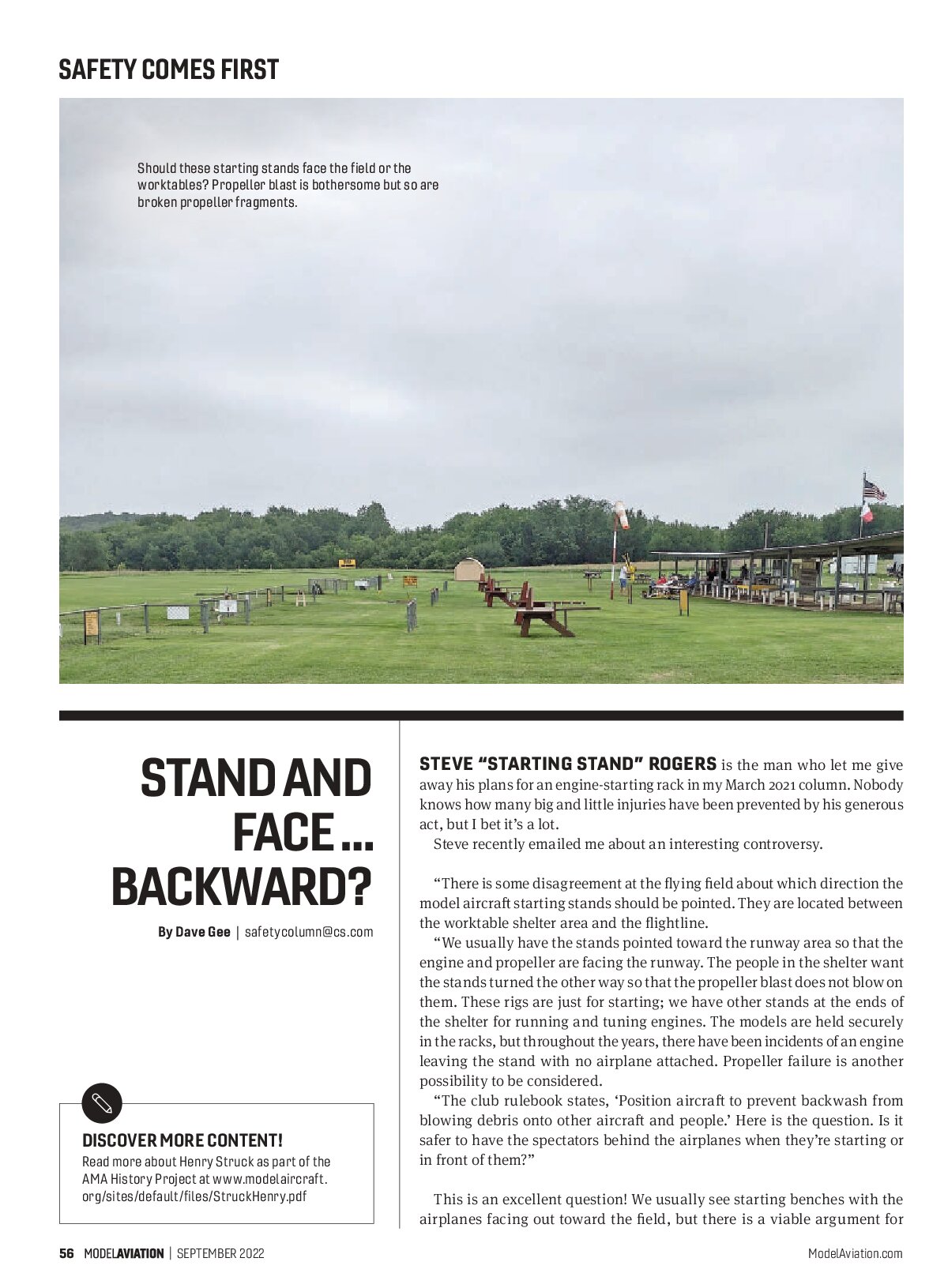
“There is some disagreement at the flying field about which direction the model aircraft starting stands should be pointed. They are located between the workable shelter area and the flightline.
“We usually have the stands pointed toward the runway area so that the engine and propeller are facing the runway. The people in the shelter want the stands turned the other way so that the propeller blast does not blow on them. These rigs are just for starting; we have other stands at the ends of the shelter for running and tuning engines. The models are held securely in the racks, but throughout the years, there have been incidents of an engine leaving the stand with no airplane attached. Propeller failure is another possibility to be considered.
“The club rulebook states, ‘Position aircraft to prevent backwash from blowing debris onto other aircraft and people.’ Here is the question. Is it safer to have the spectators behind the airplanes when they’re starting or in front of them?”
This is an excellent question! We usually see starting benches with the airplanes facing out toward the field, but there is a viable argument for reversing the direction. To clarify, this field is not huge, so space matters. There are usually fewer people on the runway side, so facing the airplanes out would seem safer, but propwash and particles blowing into the service and spectator zone is a problem. It is unlikely that an engine that tears loose could travel far, but unpredictable failures are just that—unpredictable.
My first thought is to angle the stands by 20° or so. That would effectively give greater distance from the front and rear and lessen the propwash factor.
Please share your opinions with me via the email address at the top of this column, and let’s see if the combined wisdom of Model Aviation readers can provide a good answer to this question.
What Happens If?
My club has supported a middle school model aviation club for many years, until the COVID lockdown. Now that live classes have resumed, we want to return to teaching young pilots the useful skills of aeromodeling. Well, that’s the goal. Sometimes it devolves into corny jokes and “test to destruction” of student-designed Hand-Launch Gliders.
The school model club sessions teach the students about basic aerodynamics, tool use, and flight operations with various types of model aircraft. Safety training is the glue that holds it all together. We’ve found that kids enjoy knowing the right way to do things so that they can show their expertise.
We were invited to the school’s field picnic event. We wanted to let the kids know that there would once again be a model club. Model demonstrations were approved, and because the flying would take place amid crowds of students, we


brought lightweight Free Flight (FF) models that were suitable for beginning pilots.
The weather did not cooperate and brought high wind. After losing a couple of rubber-powered aircraft, our models were put away and we broke out some big kites. Hey, it’s still aviation, right? In this digital era, most kids have never flown a kite in person, so we had plenty of interested participants.
As the youngsters let out string, there was a chance to instill a good flying habit. The kites were soaring over the crowded schoolyard and I asked the kids to consider what would happen if the wind gusted or died. Where would the kite and string end up?
They began planning for a forced landing and staying ahead of the situation like any good pilot. Is it too much to hope that perhaps one day that little nugget of training will come in handy?
Yes, but Is It Art?
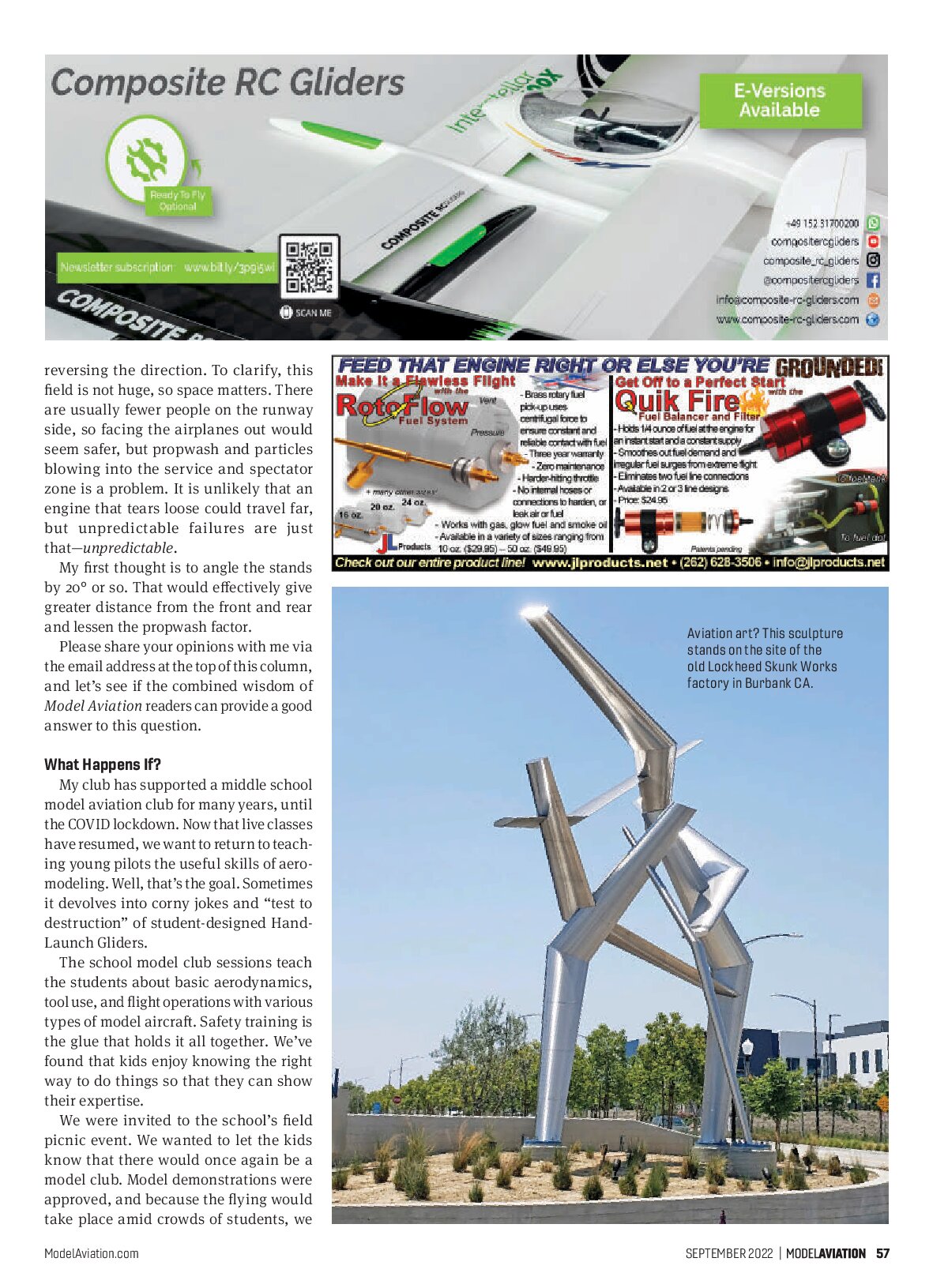
A new sculpture appeared at the business park that replaced the original Lockheed Skunk Works plant in Burbank, California. It seems to be a jumble of aircraft wings in either an artistic configuration or a terrible crash, depending on your taste.
What do you think of this piece? Is it a pleasing display? I’m glad that the developers at least commissioned an aviation-related image for such a historic site. Perhaps some modeler will borrow one of the wings for RC Slope Soaring?

Guess the Mystery Airplane
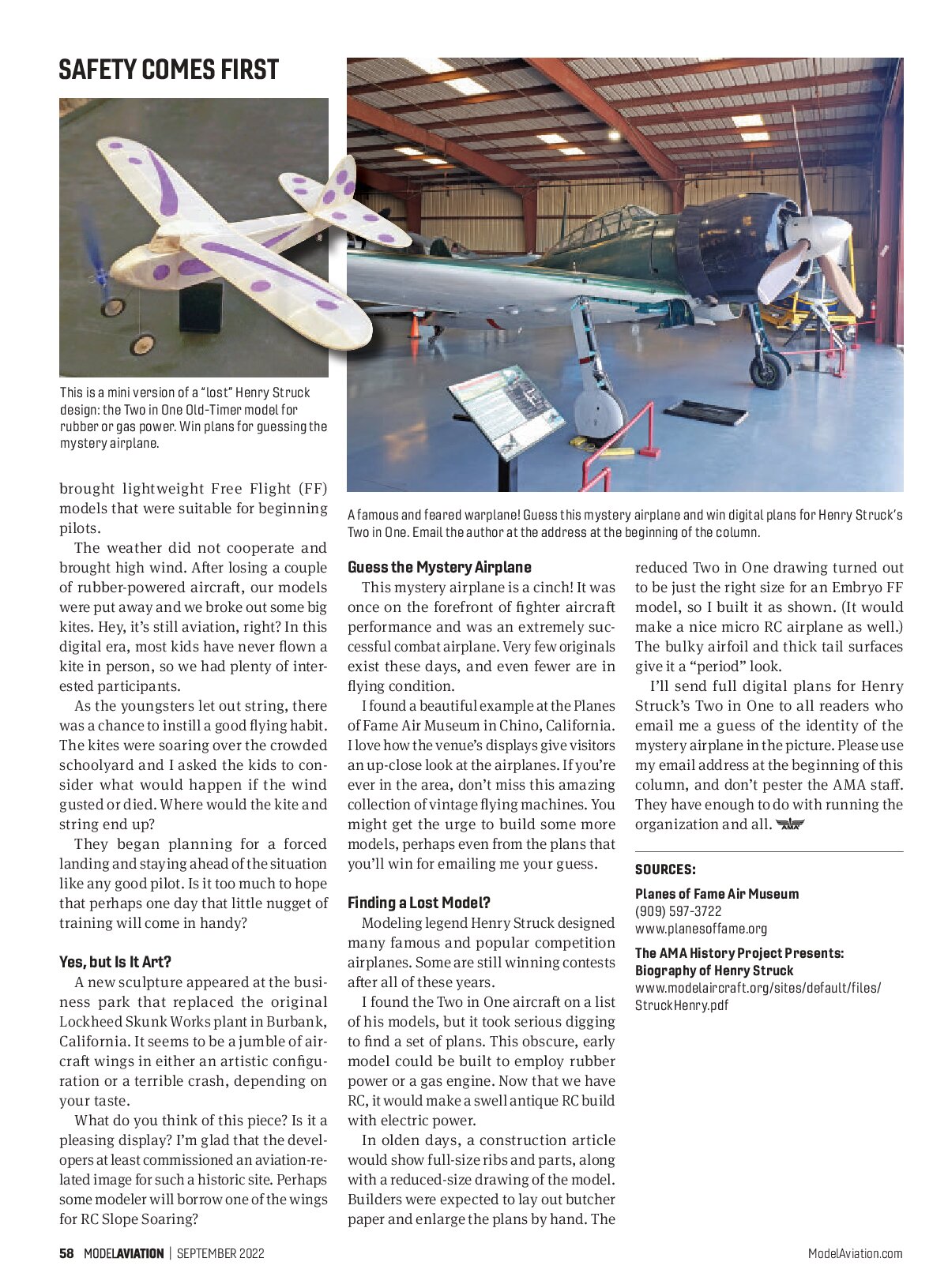
This mystery airplane is a cinch! It was once on the forefront of fighter aircraft performance and was an extremely successful combat airplane. Very few originals exist these days, and even fewer are in flying condition.
I found a beautiful example at the Planes of Fame Air Museum in Chino, California. I love how the venue’s displays give visitors an up-close look at the airplanes. If you’re ever in the area, don’t miss this amazing collection of vintage flying machines. You might get the urge to build some more models, perhaps even from the plans that you’ll win for emailing me your guess.
Finding a Lost Model?
Modeling legend Henry Struck designed many famous and popular competition airplanes. Some are still winning contests after all of these years.
I found the Two in One aircraft on a list of his models, but it took serious digging to find a set of plans. This obscure, early model could be built to employ rubber power or a gas engine. Now that we have RC, it would make a swell antique RC build with electric power.
In olden days, a construction article would show full-size ribs and parts, along with a reduced-size drawing of the model. Builders were expected to lay out butcher paper and enlarge the plans by hand. The reduced Two in One drawing turned out to be just the right size for an Embryo FF model, so I built it as shown. (It would make a nice micro RC airplane as well.) The bulky airfoil and thick tail surfaces give it a “period” look.
I’ll send full digital plans for Henry Struck’s Two in One to all readers who email me a guess of the identity of the mystery airplane in the picture. Please use my email address at the beginning of this column, and don’t pester the AMA staff. They have enough to do with running the organization and all.
SOURCES:
Planes of Fame Air Museum
(909) 597-3722
www.planesoffame.org
The AMA History Project Presents:
Biography of Henry Struck
www.modelaircraft.org/sites/default/files/StruckHenry.pdf