GOOD CALLERS AND TEAMMATES
By Tim Lampe | tim.lampe@hotmail.com

IN RC PYLON RACING, your teammate can save the weekend. At my final race of 2021, at the Old Julian Airport in Liberty, North Carolina, I was having a terrible time. I had lost my newest, handmade, all-wood Quickie 500 (Q-500) airplane in a crash because of a design flaw by me.
In Quarter 40 (Q-40), I was having the worst time of all. I was having engine trouble and in one round, I even failed to get the airplane off the ground. It should have been an enjoyable time because my wife, daughter, and son-in-law were there.
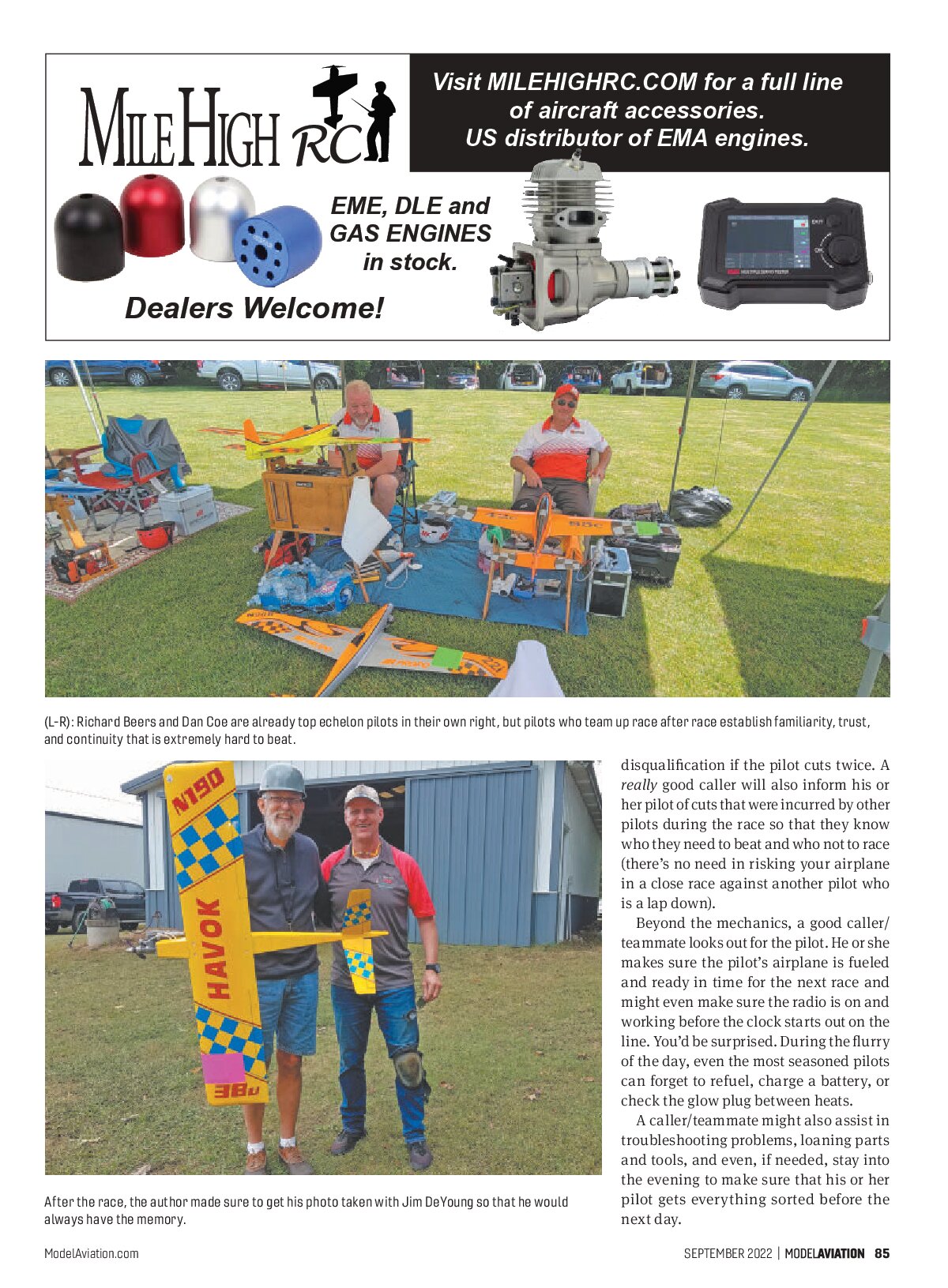
I kept a positive attitude as best as I could, but nothing was working, except for one thing: The person I was calling for was doing well and having a great time. I was calling for a friend of a friend, Jim DeYoung. Jim was big into Pylon Racing some time ago then left the discipline but has recently gotten back into it. He needed a caller for Electric Formula 1 and AMA 424 (Sport Q-500). The longer I continue in Pylon Racing, the more I realize the satisfaction in helping someone else, especially those who are new to it.
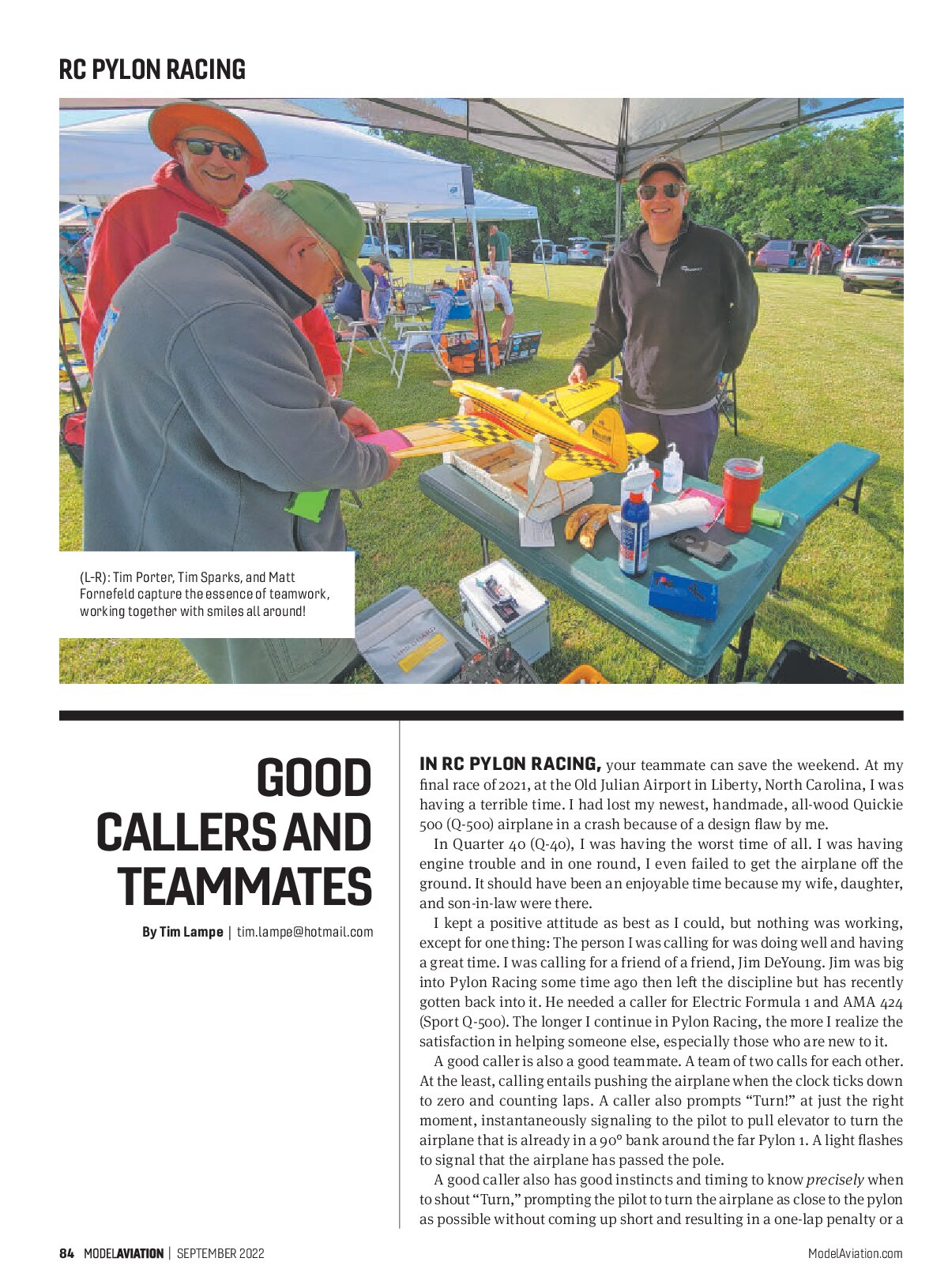
A good caller is also a good teammate. A team of two calls for each other. At the least, calling entails pushing the airplane when the clock ticks down to zero and counting laps. A caller also prompts “Turn!” at just the right moment, instantaneously signaling to the pilot to pull elevator to turn the airplane that is already in a 90° bank around the far Pylon 1. A light flashes to signal that the airplane has passed the pole.
A good caller also has good instincts and timing to know precisely when to shout “Turn,” prompting the pilot to turn the airplane as close to the pylon as possible without coming up short and resulting in a one-lap penalty or a disqualification if the pilot cuts twice. A really good caller will also inform his or her pilot of cuts that were incurred by other pilots during the race so that they know who they need to beat and who not to race (there’s no need in risking your airplane in a close race against another pilot who is a lap down).
Beyond the mechanics, a good caller/teammate looks out for the pilot. He or she makes sure the pilot’s airplane is fueled and ready in time for the next race and might even make sure the radio is on and working before the clock starts out on the line. You’d be surprised. During the flurry of the day, even the most seasoned pilots can forget to refuel, charge a battery, or check the glow plug between heats.
A caller/teammate might also assist in troubleshooting problems, loaning parts and tools, and even, if needed, stay into the evening to make sure that his or her pilot gets everything sorted before the next day.


I didn’t have to do any of that on the weekend I was calling for Jim. His equipment was ready, he was flying well, and he even won a few heats. I was able to live vicariously through Jim and bask in his success, knowing that I had played a small part in that. In comparison to my own troubles, calling for Jim really lifted my weekend.
It’s exhilarating when you call for a newer pilot who might not have the same expectations as a veteran because the pressure is off. We sometimes take for granted the small things that we have picked up through the years that a newer pilot might have never heard of. I suppose my point is that if you can spare the time and add another pilot to your team, maybe find a new person who is also eager to learn.

Naphtha in the Workshop
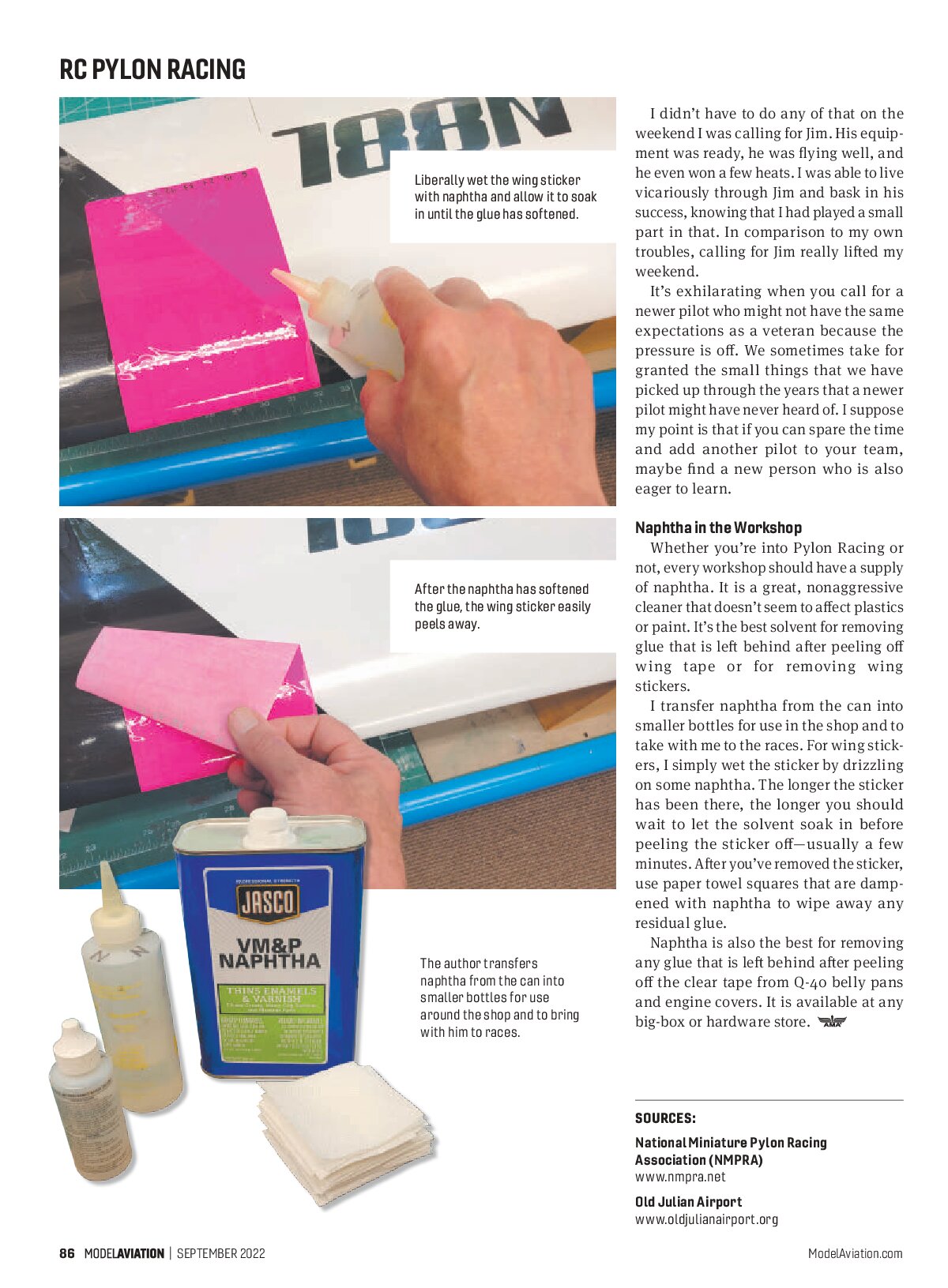
Whether you’re into Pylon Racing or not, every workshop should have a supply of naphtha. It is a great, nonaggressive cleaner that doesn’t seem to affect plastics or paint. It’s the best solvent for removing glue that is left behind after peeling off wing tape or for removing wing stickers.
I transfer naphtha from the can into smaller bottles for use in the shop and to take with me to the races. For wing stickers, I simply wet the sticker by drizzling on some naphtha. The longer the sticker has been there, the longer you should wait to let the solvent soak in before peeling the sticker off—usually a few minutes. After you’ve removed the sticker, use paper towel squares that are dampened with naphtha to wipe away any residual glue.

Naphtha is also the best for removing any glue that is left behind after peeling off the clear tape from Q-40 belly pans and engine covers. It is available at any big-box or hardware store.
SOURCES:
National Miniature Pylon Racing Association (NMPRA)
www.nmpra.net
Old Julian Airport
www.oldjulianairport.org