FOCAL POINT
Interested in sharing your handiwork? Visit ModelAviation.com for submission guidelines.
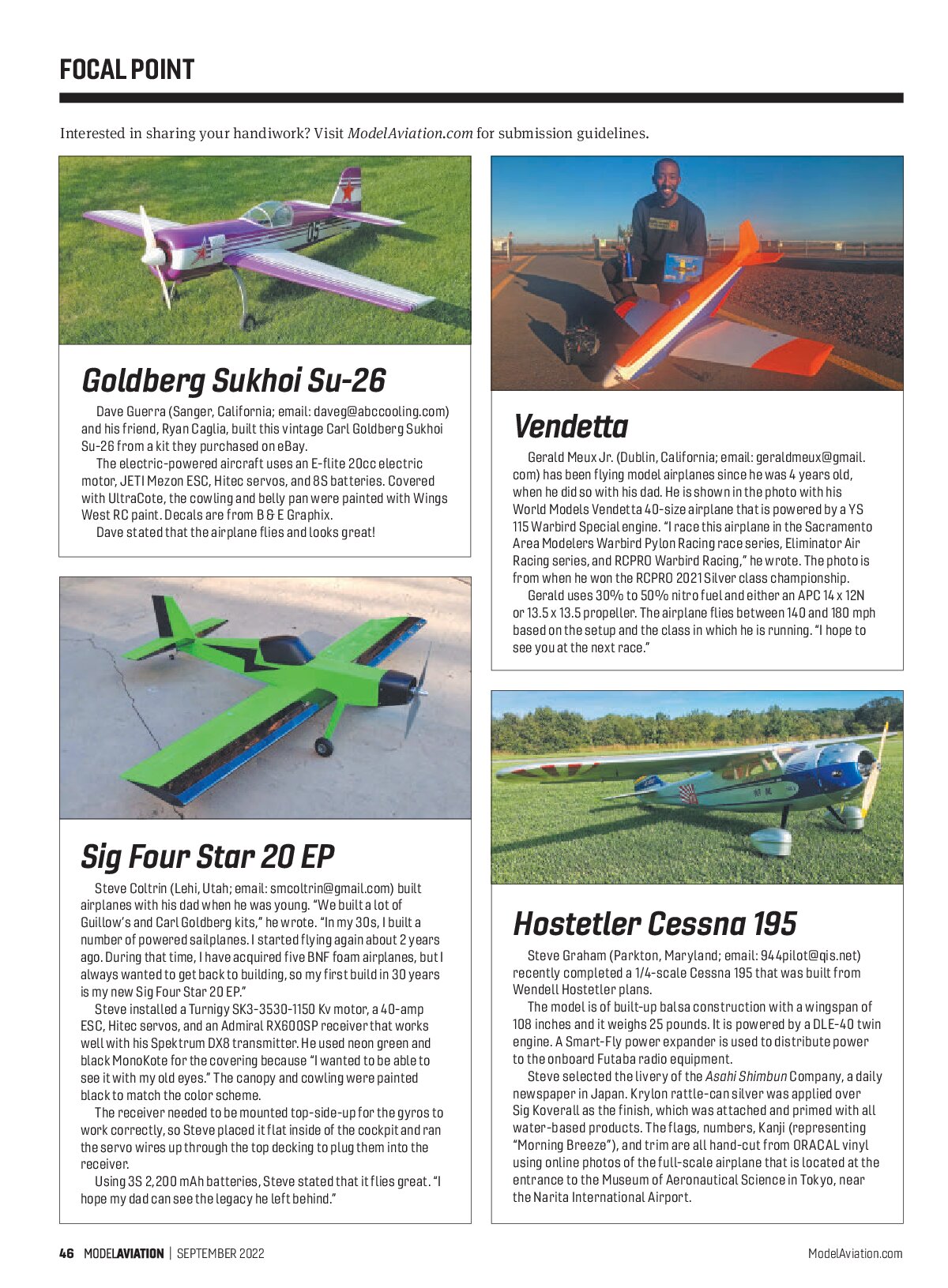
Goldberg Sukhoi Su-26

Dave Guerra (Sanger, California; email: daveg@abccooling.com) and his friend, Ryan Caglia, built this vintage Carl Goldberg Sukhoi Su-26 from a kit they purchased on eBay.
The electric-powered aircraft uses an E-flite 20cc electric motor, JETI Mezon ESC, Hitec servos, and 8S batteries. Covered with UltraCote, the cowling and belly pan were painted with Wings West RC paint. Decals are from B & E Graphix.
Dave stated that the airplane flies and looks great!
Sig Four Star 20 EP

Steve Coltrin (Lehi, Utah; email: smcoltrin@gmail.com) built airplanes with his dad when he was young. “We built a lot of Gullow’s and Carl Goldberg kits,” he wrote. “In my 30s, I built a number of powered sailplanes. I started flying again about 2 years ago. During that time, I have acquired five BNF foam airplanes, but I always wanted to get back to building, so my first build in 30 years is my new Sig Four Star 20 EP.”
Steve installed a Turnigy SK3-3530-1150 Kv motor, a 40-amp ESC, Hitec servos, and an Admiral RX600SP receiver that works well with his Spektrum DX8 transmitter. He used neon green and black MonoKote for the covering because “I wanted to be able to see it with my old eyes.” The canopy and cowling were painted black to match the color scheme.
The receiver needed to be mounted top-side-up for the gyros to work correctly, so Steve placed it flat inside of the cockpit and ran the servo wires up through the top decking to plug them into the receiver.
Using 3S 2,200 mAh batteries, Steve stated that it flies great. “I hope my dad can see the legacy he left behind.”
Vendetta

Gerald Meux Jr. (Dublin, California; email: geraldmeux@gmail.com) has been flying model airplanes since he was 4 years old, when he did so with his dad. He is shown in the photo with his World Models Vendetta 40-size airplane that is powered by a YS 115 Warbird Special engine. “I race this airplane in the Sacramento Area Modelers Warbird Pylon Racing race series, Eliminator Air Racing series, and RCPRO Warbird Racing,” he wrote. The photo is from when he won the RCPRO 2021 silver class championship.
Gerald uses 30% to 50% nitro fuel and either an APC 14 x 12N or 13.5 x 13.5 propeller. The airplane flies between 140 and 180 mph based on the setup and the class in which he is running. “I hope to see you at the next race.”
Hostetler Cessna 195

Steve Graham (Parkton, Maryland; email: 944pilot@gis.net) recently completed a 1/4-scale Cessna 195 that was built from Wendell Hostetler plans.
The model is of built-up balsa construction with a wingspan of 108 inches and it weighs 25 pounds. It is powered by a DLE-40 twin engine. A Smart-Fly power expander is used to distribute power to the onboard Futaba radio equipment.
Steve selected the livery of the Asahi Shimbun Company, a daily newspaper in Japan. Krylon rattle-can silver was applied over Sig Koverall as the finish, which was attached and primed with all water-based products. The flags, numbers, Kanji (representing “Morning Breeze”), and trim are all hand-cut from ORACAL vinyl using online photos of the full-scale airplane that is located at the entrance to the Museum of Aeronautical Science in Tokyo, near the Narita International Airport.
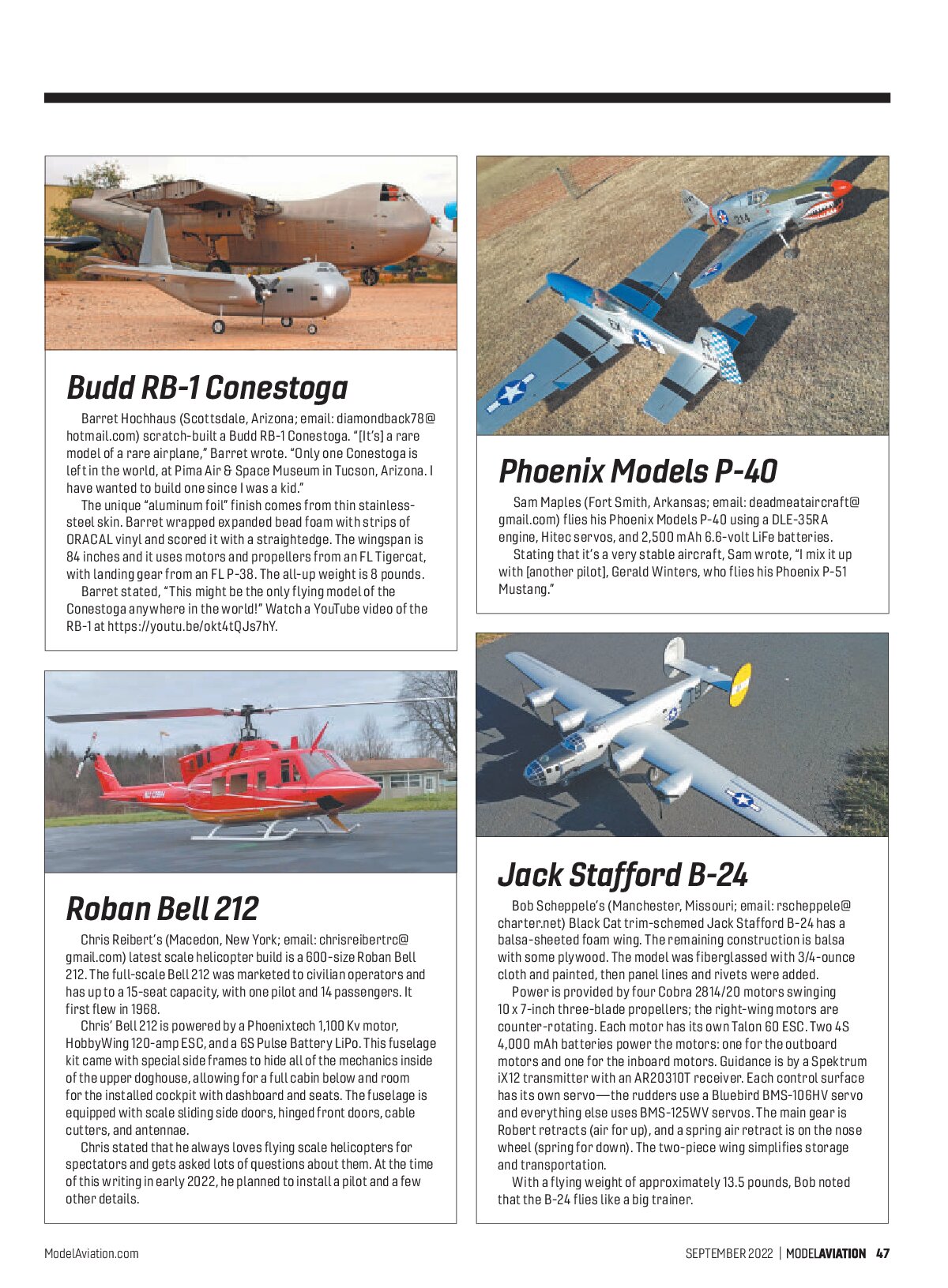
Budd RB-1 Conestoga

Barret Hochhaus (Scottsdale, Arizona; email: diamondback78@hotmail.com) scratch-built a Budd RB-1 Conestoga. “[It’s] a rare model of a rare airplane,” Barret wrote. “Only one Conestoga is left in the world, at Pima Air & Space Museum in Tucson, Arizona. I have wanted to build one since I was a kid.”
The unique “aluminum foil” finish comes from thin stainless-steel skin. Barret wrapped expanded bead foam with strips of ORACAL vinyl and scored it with a straightedge. The wingspan is 84 inches and it uses motors and propellers from an F1 Tigercat, with landing gear from an FLP-38. The all-up weight is 8 pounds.
Barret stated, “This might be the only flying model of the Conestoga anywhere in the world!” Watch a YouTube video of the RB-1 at https://youtu.be/okt4tQJs7hY.
Roban Bell 212

Chris Reibert’s (Macedon, New York; email: chrisreibertcr@gmail.com) latest scale helicopter build is a 600-size Roban Bell 212. The full-scale Bell 212 was marketed to civilian operators and has up to a 15-seat capacity, with one pilot and 14 passengers. It first flew in 1968.
Chris’ Bell 212 is powered by a Phoenixtech 1,100 Kv motor, HobbyWing 120-amp ESC, and a 6S Pulse Battery LiPo. This fuselage kit came with special side frames to hide all of the mechanics inside of the upper doghouse, allowing for a full cabin below and room for the installed cockpit with dashboard and seats. The fuselage is equipped with scale sliding side doors, hinged front doors, cable cutters, and antennae.
Chris stated that he always loves flying scale helicopters for spectators and gets asked lots of questions about them. At the time of this writing in early 2022, he planned to install a pilot and a few other details.
Phoenix Models P-40

Sam Manles (Fort Smith, Arkansas; email: deadmeataircraft@gmail.com) flies his Phoenix Models P-40 using a DLE-35RA engine, Hitec servos, and 2,500 mAh 6.6-volt LiFe batteries.
Stating that it’s a very stable aircraft, Sam wrote, “I mix it up with [another pilot], Gerald Winters, who flies his Phoenix P-51 Mustang.”
Jack Stafford B-24

Bob Scheppele’s (Manchester, Missouri; email: r scheppele@charter.net) Black Cat trim-schemed Jack Stafford B-24 has a balsa-sheeted foam wing. The remaining construction is balsa with some plywood. The model has fiberglassed with 3/4-ounce cloth and painted, then panel lines and rivets were added.
Power is provided by four Cobra 2814/20 motors swinging 10 x 7-inch three-blade propellers; the right-wing motors are counter-rotating. Each motor has its own Talon 60 ESC. Two 4S 4,000 mAh batteries power the motors: one for the outboard motors and one for the inboard motors. Guidance is by a Spektrum iX12 transmitter with an AR20310T receiver. Each control surface has its own servo—the rudders use a Bluebird BMS-10HV servo and everything else uses BMS-125HV servos. The main gear is Robert retracts (air for up), and a spring air retract is on the nose wheel (spring for down). The two-piece wing simplifies storage and transportation.
With a flying weight of approximately 13.5 pounds, Bob noted that the B-24 flies like a big trainer.