CONTROL LINE COMBAT
MIAMI WINTER WARRIORS
F2D COMBAT CHAMPIONSHIP
By Mark Rudner | mark.s.rudner@gmail.com

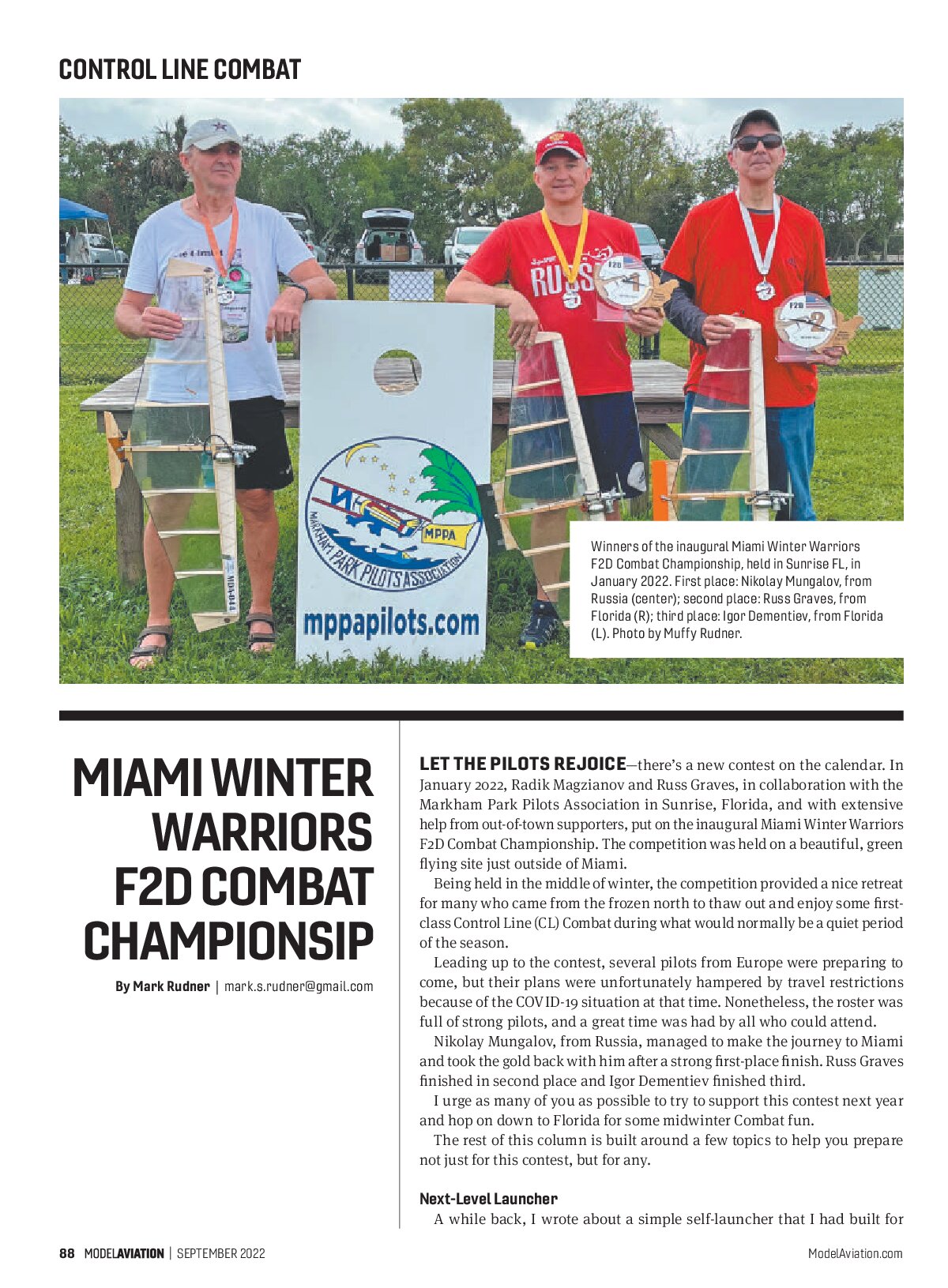
LET THE PILOTS REJOICE—there’s a new contest on the calendar. In January 2022, Radik Magzianov and Russ Graves, in collaboration with the Markham Park Pilots Association in Sunrise, Florida, and with extensive help from out-of-town supporters, put on the inaugural Miami Winter Warriors F2D Combat Championship. The competition was held on a beautiful, green flying site just outside of Miami.
Being held in the middle of winter, the competition provided a nice retreat for many who came from the frozen north to thaw out and enjoy some first-class Control Line (CL) Combat during what would normally be a quiet period of the season.
Leading up to the contest, several pilots from Europe were preparing to come, but their plans were unfortunately hampered by travel restrictions because of the COVID-19 situation at that time. Nonetheless, the roster was full of strong pilots, and a great time was had by all who could attend.
Nikolay Mungalov, from Russia, managed to make the journey to Miami and took the gold back with him after a strong first-place finish. Russ Graves finished in second place and Igor Dementiev finished third.
I urge as many of you as possible to try to support this contest next year and hop on down to Florida for some midwinter Combat fun.
The rest of this column is built around a few topics to help you prepare not just for this contest, but for any.
Next-Level Launcher
A while back, I wrote about a simple self-launcher that I had built for practicing in Denmark. It was based on a design by Alex Prokofiev. Because CL Combat airplanes don’t have wheels, a typical self-launcher will hold the airplane up off the ground, either through a sleeve that holds the wing or a set of hooks that can grab the airplane by its tail and stabilize the leading edge (LE) and/or trailing edges.
In the case of the sleeve design that I previously wrote about, the airplane can be released from the launcher simply by stepping radially backward with the lines tight to pull the outboard wing out of the sleeve. For other designs, there might be an additional wire that the pilot pulls with his or her nonflying hand to release the holding mechanism.
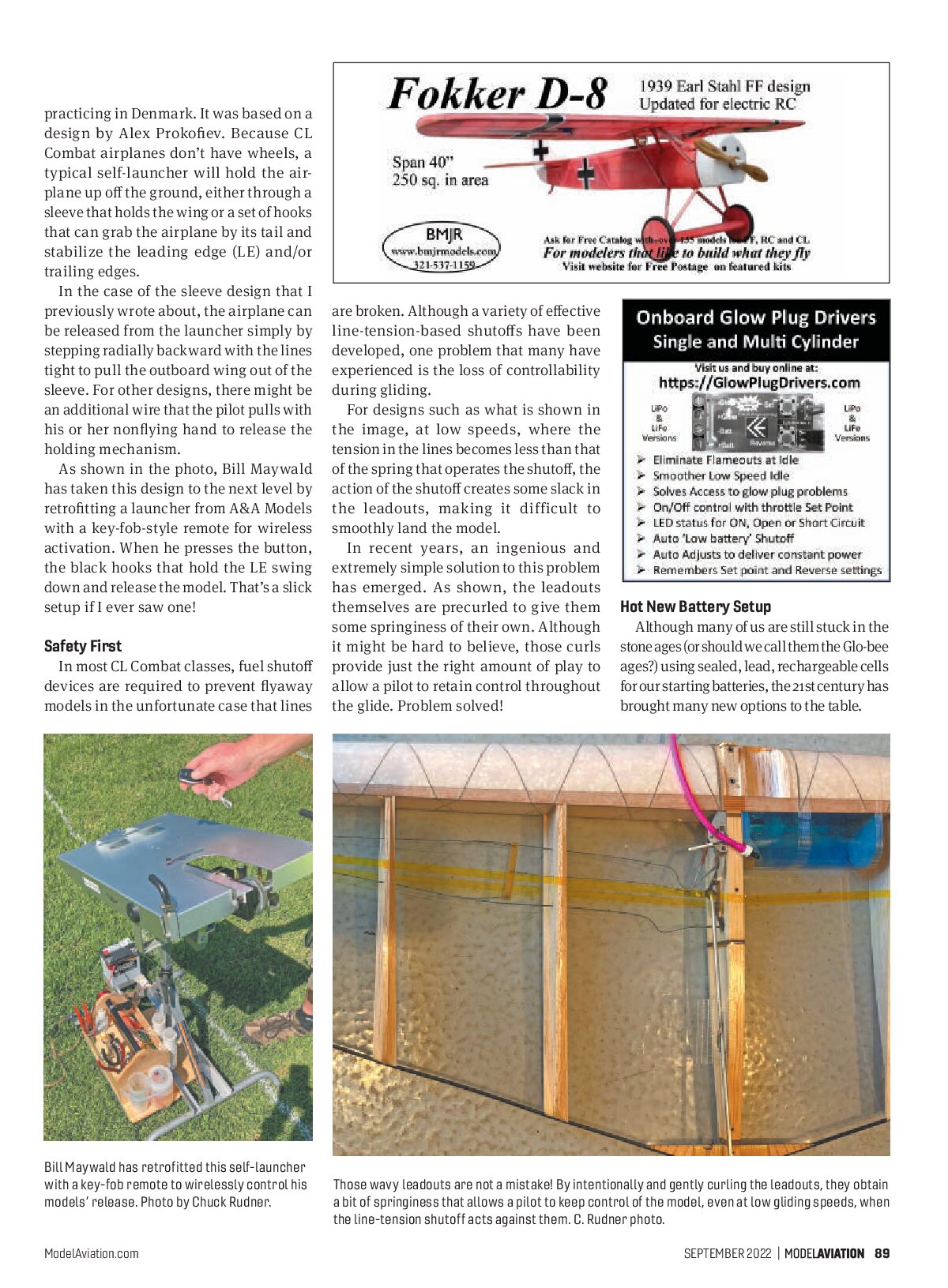
As shown in the photo, Bill Maywald has taken this design to the next level by retrofitting a launcher from A&A Models with a key-fob-style remote for wireless activation. When he presses the button, the black hooks that hold the LE swing down and release the model. That’s a slick setup if I ever saw one!
Safety First
In most CL Combat classes, fuel shutoff devices are required to prevent flyaway models in the unfortunate case that lines are broken. Although a variety of effective line-tension-based shutoffs have been developed, one problem that many have experienced is the loss of controllability during gliding.
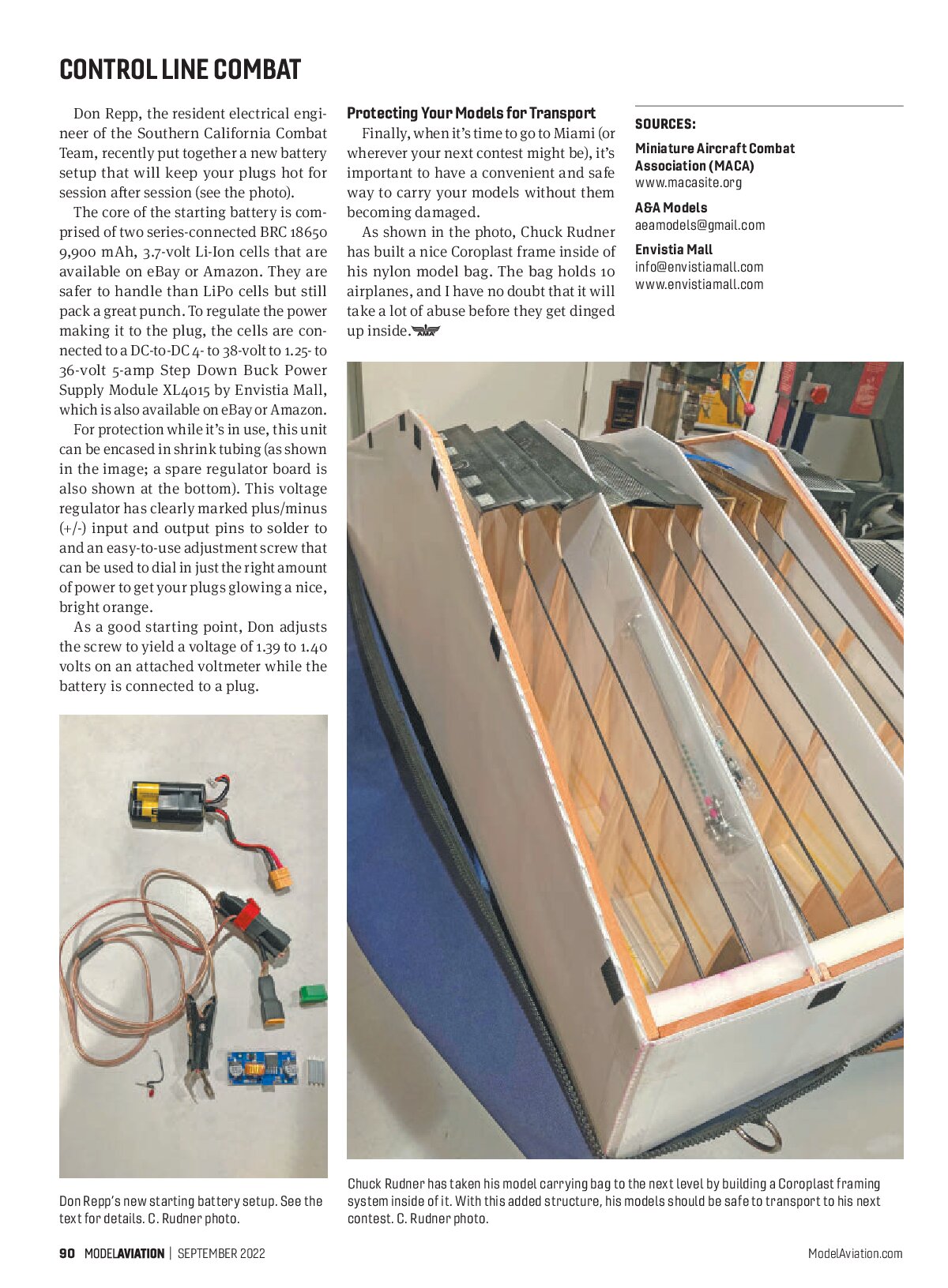
For designs such as what is shown in the image, at low speeds, where the tension in the lines becomes less than that of the spring that operates the shutoff, the action of the shutoff creates some slack in the leadouts, making it difficult to smoothly land the model.
In recent years, an ingenious and extremely simple solution to this problem has emerged. As shown, the leadouts themselves are precurled to give them some springiness of their own. Although it might be hard to believe, those curls provide just the right amount of play to allow a pilot to retain control throughout the glide. Problem solved!
Hot New Battery Setup
Although many of us are still stuck in the stone ages (or should we call them the Glo-bee ages?) using sealed, lead, rechargeable cells for our starting batteries, the 21st century has brought many new options to the table.


Don Repp, the resident electrical engineer of the Southern California Combat Team, recently put together a new battery setup that will keep your plugs hot for session after session (see the photo).
The core of the starting battery is comprised of two series-connected BRC 18650 9,900 mAh, 3.7-volt Li-Ion cells that are available on eBay or Amazon. They are safer to handle than LiPo cells but still pack a great punch. To regulate the power making it to the plug, the cells are connected to a DC-to-DC 4- to 38-volt to 1.25- to 36-volt 5-amp Step Down Buck Power Supply Module XL4015 by Envista Mall, which is also available on eBay or Amazon.
For protection while it’s in use, this unit can be encased in shrink tubing (as shown in the image; a spare regulator board is also shown at the bottom). this voltage regulator has clearly marked plus/minus (+/-) input and output pins to solder to and an easy-to-use adjustment screw that can be used to dial in just the right amount of power to get your plugs glowing a nice, bright orange.
As a good starting point, Don adjusts the screw to yield a voltage of 1.39 to 1.40 volts on an attached voltmeter while the battery is connected to a plug.

Protecting Your Models for Transport
Finally, when it’s time to go to Miami (or wherever your next contest might be), it’s important to have a convenient and safe way to carry your models without them becoming damaged.
As shown in the photo, Chuck Rudner has built a nice Coroplast frame inside of his nylon model bag. The bag holds 10 airplanes, and I have no doubt that it will take a lot of abuse before they get dinged up inside.

SOURCES:
Miniature Aircraft Combat Association (MACA)
www.macasite.org
A&A Models
aaamodels@gmail.com
Envistia Mall
info@envistiamall.com
www.envistiamall.com