ADVANCED FLIGHT TECHNOLOGIES

BUCKET LIST
By Patrick Sherman
lucidity@roswellflighttestcrew.com
TWO-GALLON BUCKETS are suddenly popular with commercial drone pilots. They are spending time flying over them, photographing them, and even practicing flying over and photographing them using simulators. It’s not because aerial photographs of buckets are the latest hot commodity in the non-fungible token market. They won’t be displacing those “bored apes” we’ve all heard about anytime soon. Instead, it’s part of an effort to overcome a fundamental flaw in 14 CFR Part 107.
It was precisely six years ago, in late August 2016, that Part 107 went into effect. It established the standards that allow for the commercial use of sUAS in the National Airspace System. Then, as now, a component considered essential to virtually every other type of pilot rating is missing: the check ride.
That’s right. You can become a fully qualified Remote Pilot In Command, certified by the FAA, without even once having touched the aircraft you intend to pilot. This unprecedented set of circumstances has created a real problem for people and organizations that employ remote pilots. How do you know that they can actually fly?
Getting the NIST of It
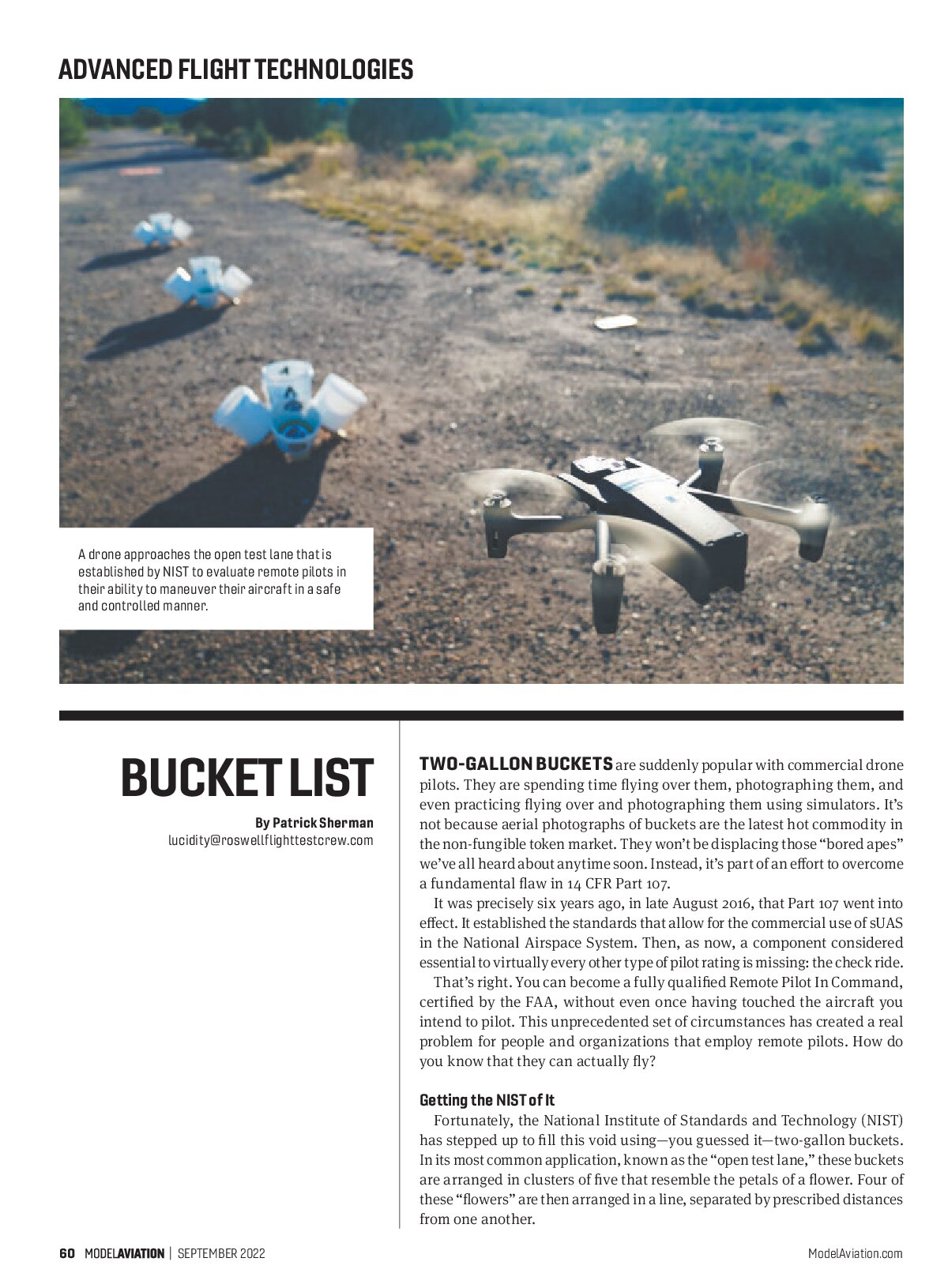
Fortunately, the National Institute of Standards and Technology (NIST) has stepped up to fill this void using—you guessed it—two-gallon buckets. In its most common application, known as the “open test lane,” those buckets are arranged in clusters of five that resemble the petals of a flower. Four of these “flowers” are then arranged in a line, separated by prescribed distances from one another.
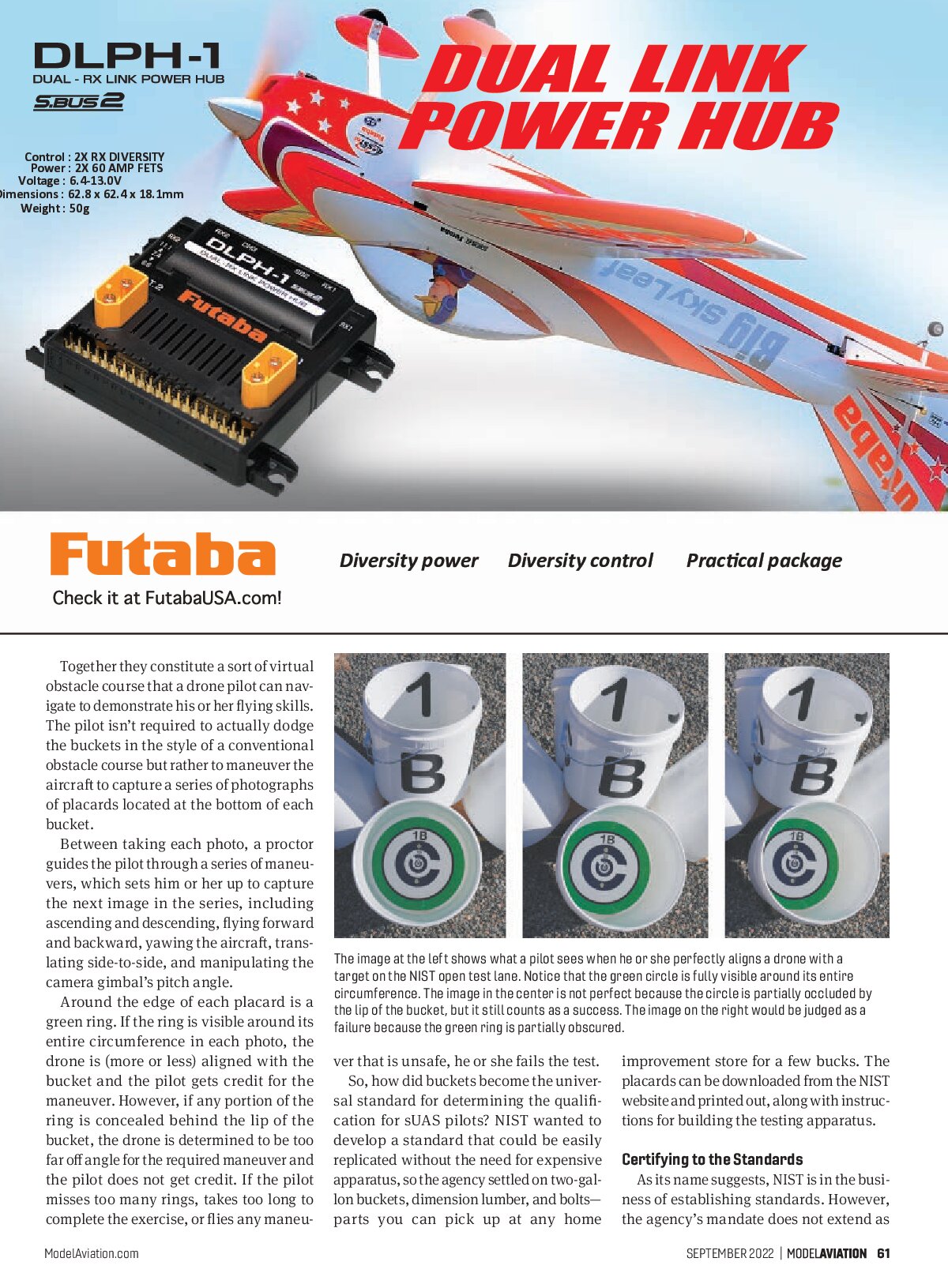
Together they constitute a sort of virtual obstacle course that a drone pilot can navigate to demonstrate his or her flying skills. The pilot isn’t required to actually dodge the buckets in the style of a conventional obstacle course but rather to maneuver the aircraft to capture a series of photographs of placards located at the bottom of each bucket.
Between taking each photo, a proctor guides the pilot through a series of maneuvers, which sets him or her up to capture the next image in the series, including ascending and descending, flying forward and backward, yawing the aircraft, translating side-to-side, and manipulating the camera gimbal’s pitch angle.
Around the edge of each placard is a green ring. If the ring is visible around its entire circumference in each photo, the drone is (more or less) aligned with the bucket and the pilot gets credit for the maneuver. However, if any portion of the ring is concealed behind the lip of the bucket, the drone is determined to be too far off angle for the required maneuver and the pilot does not get credit. If the pilot misses too many rings, takes too long to complete the exercise, or flies any maneuver that is unsafe, he or she fails the test.

So, how did buckets become the universal standard for determining the qualification for sUAS pilots? NIST wanted to develop a standard that could be easily replicated without the need for expensive apparatus, so the agency settled on two-gallon buckets, dimension lumber, and bolts—parts you can pick up at any home improvement store for a few bucks. The placards can be downloaded from the NIST website and printed out, along with instructions for building the testing apparatus.
Certifying to the Standards
As its name suggests, NIST is in the business of establishing standards. However, the agency’s mandate does not extend as

far as documenting who has actually met those standards, so it made all of this material available to any person or organization that wants to use it as the basis for a professional certification. It’s essentially the check ride that is missing from Part 107, except it’s conducted and attested to by a private third party.
One of those third parties is the Embry-Riddle Aeronautical University Worldwide Campus Department of Flight, where teaching is my day job. As part of both our academic curriculum and our professional education courses (which anyone can take online), we offer Trusted Operator Program (TOP) certifications. TOP was established by the Association for Uncrewed Vehicle Systems International (AUVSI) to certify that remote pilots possess both the knowledge and practical flying skills that are not required to earn a Part 107 rating.
There are three levels of TOP certification available. We adopted the open lane test as our check ride to achieve the Level 2 and Level 3 ratings. We also weren’t alone in deferring to all of the hard work that NIST had already done on behalf of the industry by establishing the standard.
The Airborne Public Safety Association (APSA) also adopted the open test lane as the certification standard for all of those police officers and firefighters who are becoming drone pilots to provide their colleagues with an aerial perspective on the dangerous situations that they face.
Again, this was crucial so that agency leaders could bring credibility to the communities they serve, showing that their pilots not only possess the requisite book knowledge, but that they actually know how to fly as well.
Training and Certifying Anywhere
My Embry-Riddle colleagues took their initial NIST standards training through APSA. In doing so, they discovered a way that we could help the members of that association as well. There are firefighters and police officers in every community across the country, but only the largest among them can host an in-person APSA certification event.
Fortunately, teaching people about aviation and aeronautics in remote locations is what we do at the Embry-Riddle Worldwide Campus, so we formed a class through our office of professional education to accomplish just that for first responders who need to earn their APSA credentials. Because the test apparatus is so easy to build, they can even complete their check ride remotely.
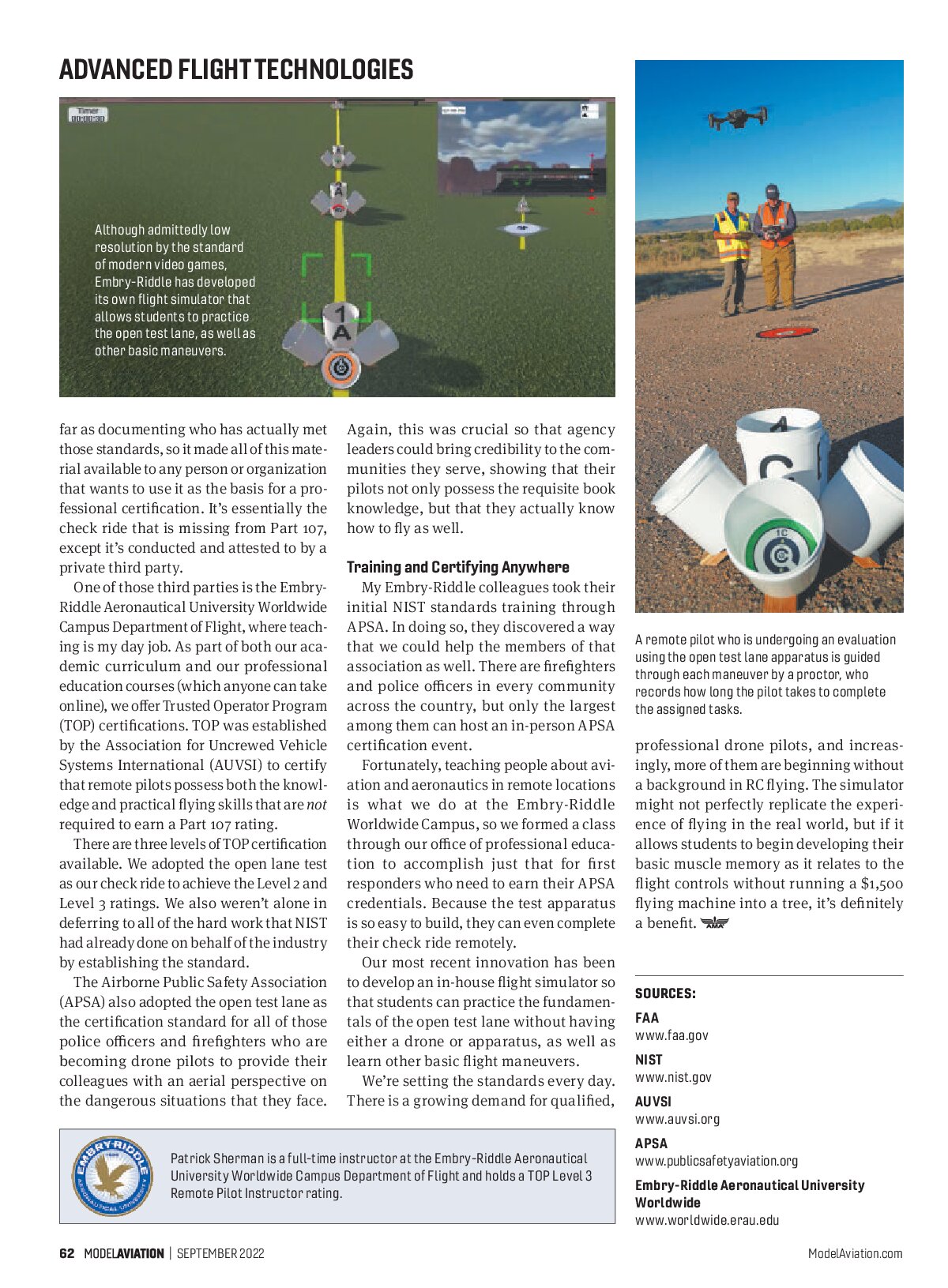
Our most recent innovation has been to develop an in-house flight simulator so that students can practice the fundamentals of the open test lane without having either a drone or apparatus, as well as learn other basic flight maneuvers.
We’re setting the standards every day. There is a growing demand for qualified,

professional drone pilots, and increasingly, more of them are beginning without a background in RC flying. The simulator might not perfectly replicate the experience of flying in the real world, but if it allows students to begin developing their basic muscle memory as it relates to the flight controls without running a $1,500 flying machine into a tree, it’s definitely a benefit.
Sources:
FAA
www.faa.gov
NIST
www.nist.gov
AUVSI
www.auvsi.org
APSA
www.publicsafetyaviation.org
Embry-Riddle Aeronautical University Worldwide
www.worldwide.erau.edu