SMALL-FIELD FLYING

LEARNING MODELING TRICKS
By Pat Tritle | patscustommodels@gmail.com
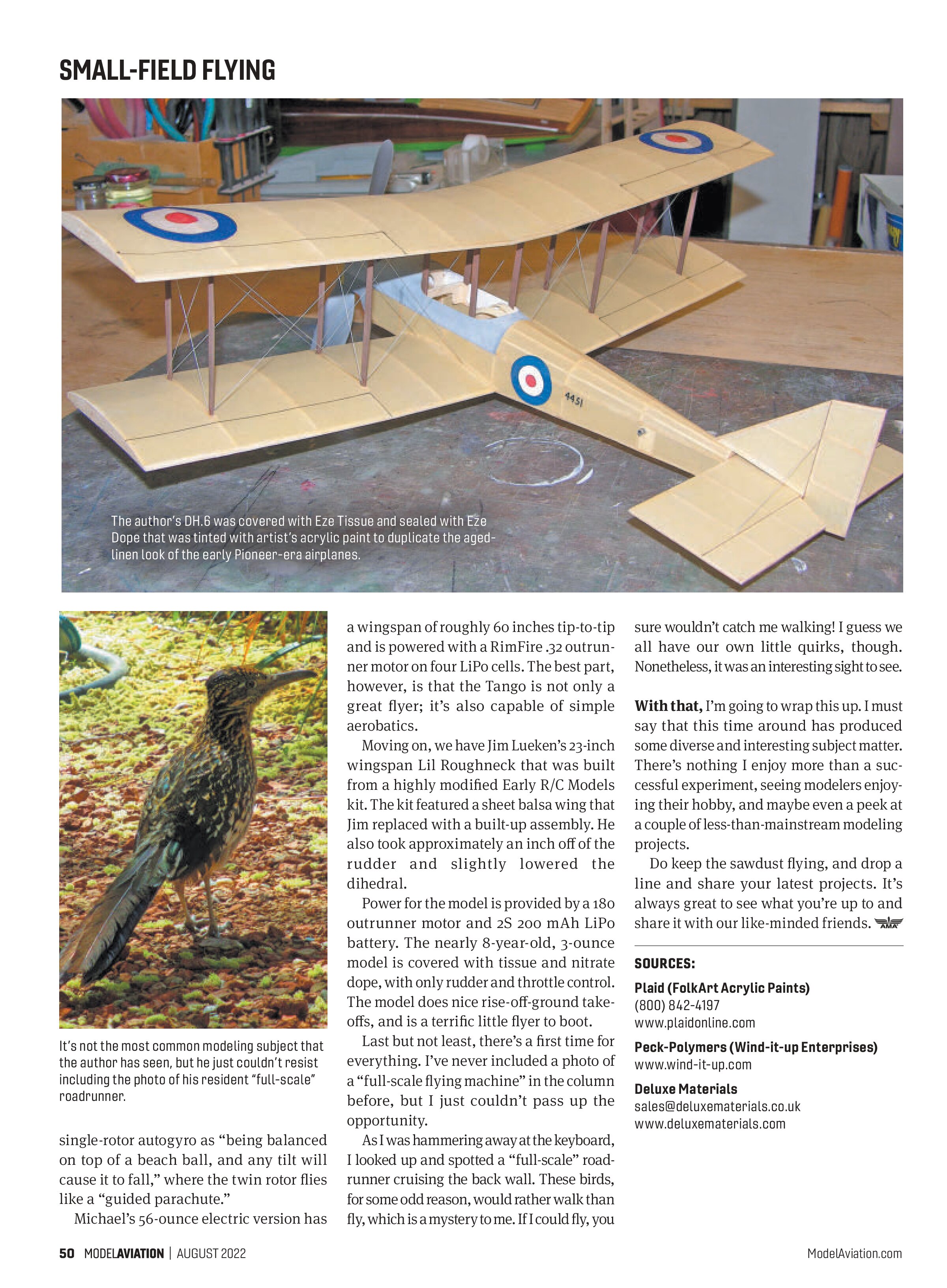
IN THE PAST, I’ve looked at a couple of different ways to apply an aged or “antique” look to Pioneer-era models. Some of the methods I’ve tried have actually worked out quite well. Others? Well, maybe not so much. Successful or not, experimentation is always fun, and even when a grand plan ends in abject failure, you can often learn what not to do again—which, in itself, could be considered a success.
More to the point, in my quest for an antique look, I use Deluxe Materials Eze Dope to seal tissue-covered models and have come to like it a lot. On my latest project, I also tried the Deluxe Materials Eze Tissue and like it every bit as much as I like Flying Bird Japanese tissue. I find that it handles somewhat like domestic tissue in its application, but its wet strength is excellent when shrinking and sealing with the water-based dope.
To achieve the desired aged look, the model was covered with white (natural) Eze Tissue and sealed with one coat of Eze Dope, which also shrinks the tissue. From there, a small quantity of dope was mixed with a couple of drops of FolkArt Teddy Bear Brown artist acrylic paint to make a translucent “wash.” Two coats were brushed on the tissue, which came as close to the look that I was after as anything I’ve tried. There might be other shades of the artist acrylic paint that would do as well or maybe even better, but I’ll leave that to further experimentation.
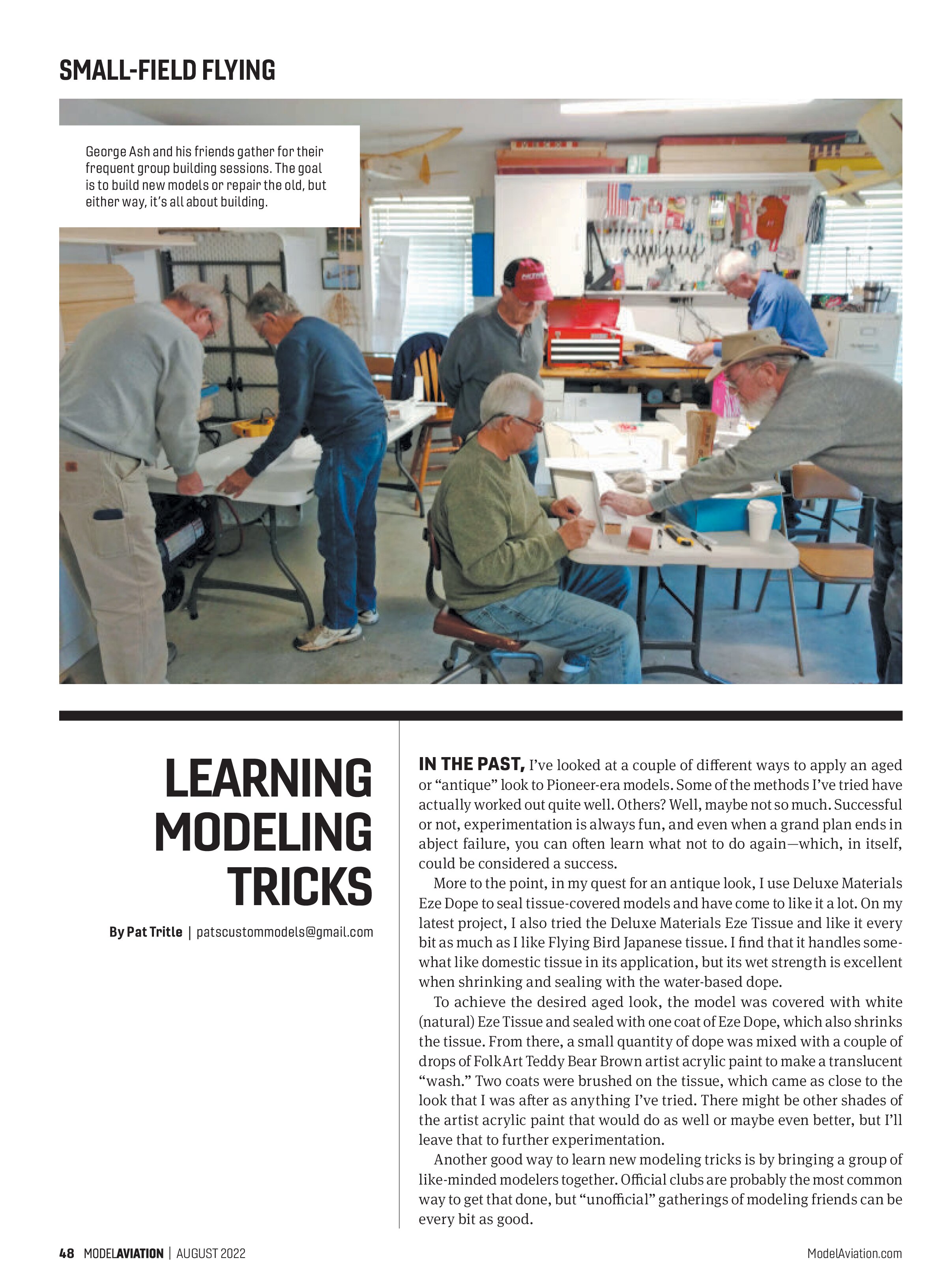
Another good way to learn new modeling tricks is by bringing a group of like-minded modelers together. Official clubs are probably the most common way to get that done, but “unofficial” gatherings of modeling friends can be every bit as good.
An excellent example of one of those gatherings comes from George Ash. George gets together a group to build new models from kits or plans or simply to repair models that were damaged from the day’s unfortunate mishaps.
It doesn’t matter what they might be building, whether it’s wood or foam—the goal is to build, and it looks to me like they’re having a great time doing it. Put a bunch of creative minds like that together, along with their collective years of modeling experience, and there’s no telling what good things might come of it.
As Long as I’m Discussing Good Things ...
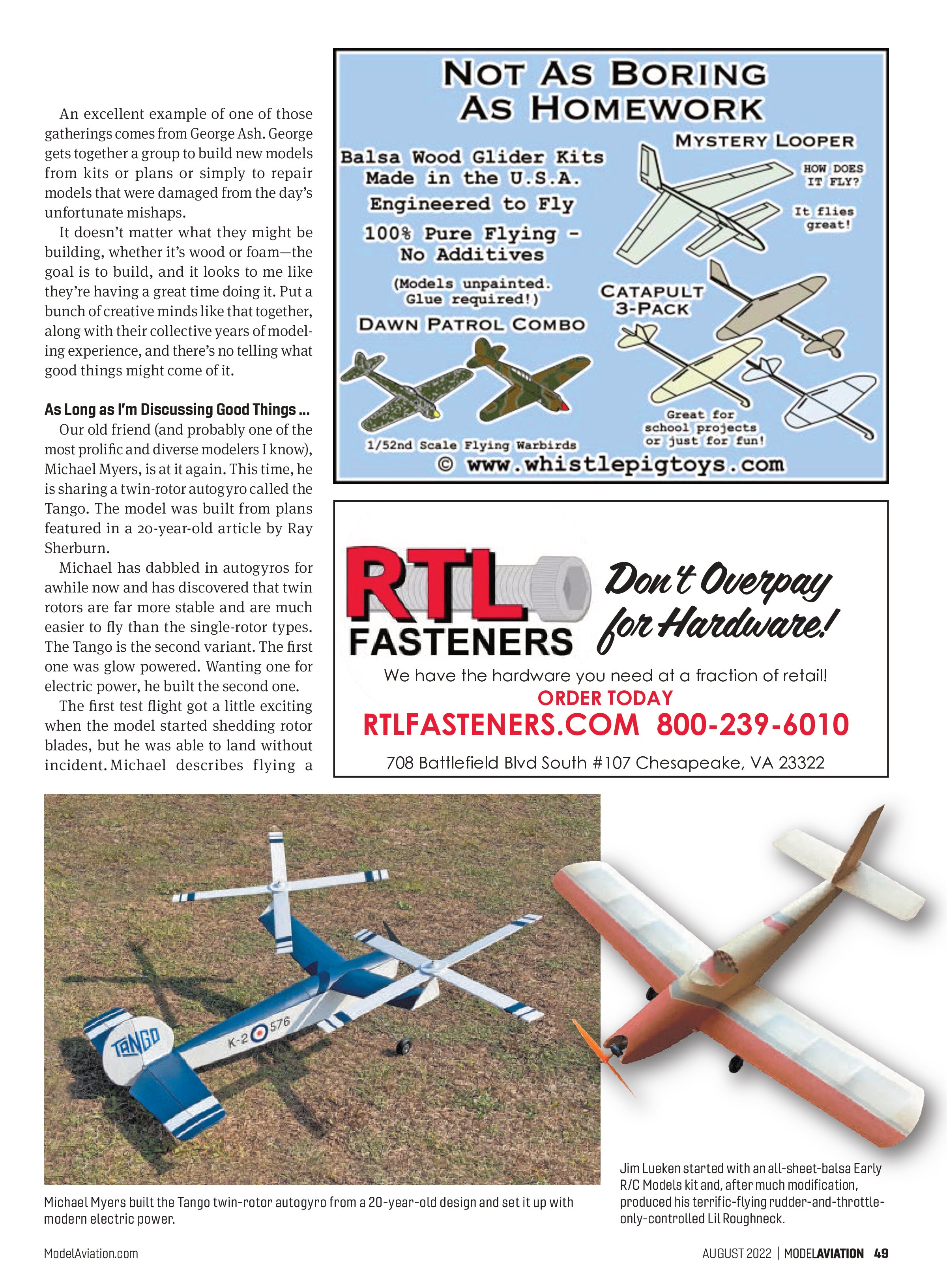
Our old friend (and probably one of the most prolific and diverse modelers I know), Michael Myers, is at it again. This time, he is sharing a twin-rotor autogyro called the Tango. The model was built from plans featured in a 20-year-old article by Ray Sherburn.
Michael has dabbled in autogyros for awhile now and has discovered that twin rotors are far more stable and are much easier to fly than the single-rotor types. The Tango is the second variant. The first one was glow powered. Wanting one for electric power, he built the second one.
The first test flight got a little exciting when the model started shedding rotor blades, but he was able to land without incident. Michael describes flying a


single-rotor autogyro as “being balanced on top of a beach ball, and any tilt will cause it to fall,” where the twin rotor flies like a “guided parachute.”
Michael’s 56-ounce electric version has a wingspan of roughly 60 inches tip-to-tip and is powered with a RimFire .32 outrunner motor on four LiPo cells. The best part, however, is that the Tango is not only a great flyer; it’s also capable of simple aerobatics.
Moving on, we have Jim Lueken’s 23-inch wingspan Lil Roughneck that was built from a highly modified Early R/C Models kit. The kit featured a sheet balsa wing that Jim replaced with a built-up assembly. He also took approximately an inch off of the rudder and slightly lowered the dihedral.
Power for the model is provided by a 180 outrunner motor and 2S 200 mAh LiPo battery. The nearly 8-year-old, 3-ounce model is covered with tissue and nitrate dope, with only rudder and throttle control. The model does nice rise-off-ground takeoffs, and is a terrific little flyer to boot.
Last but not least, there’s a first time for everything. I’ve never included a photo of a “full-scale flying machine” in the column before, but I just couldn’t pass up the opportunity.
As I was hammering away at the keyboard, I looked up and spotted a “full-scale” roadrunner cruising the back wall. These birds, for some odd reason, would rather walk than fly, which is a mystery to me. If I could fly, you sure wouldn’t catch me walking! I guess we all have our own little quirks, though. Nonetheless, it was an interesting sight to see.
With that, I’m going to wrap this up. I must say that this time around has produced some diverse and interesting subject matter. There’s nothing I enjoy more than a successful experiment, seeing modelers enjoying their hobby, and maybe even a peek at a couple of less-than-mainstream modeling projects.
Do keep the sawdust flying, and drop a line and share your latest projects. It’s always great to see what you’re up to and share it with our like-minded friends.
SOURCES:
Plaid (FolkArt Acrylic Paints)
(800) 842-4197
www.plaidonline.com
Peck-Polymers (Wind-it-up Enterprises)
www.wind-it-up.com
Deluxe Materials
sales@deluxematerials.co.uk
www.deluxematerials.com