RC SLOPE SOARING

NEW TOOL FOR
THE TRADE
By Greg Schutte | gshooty@yahoo.com
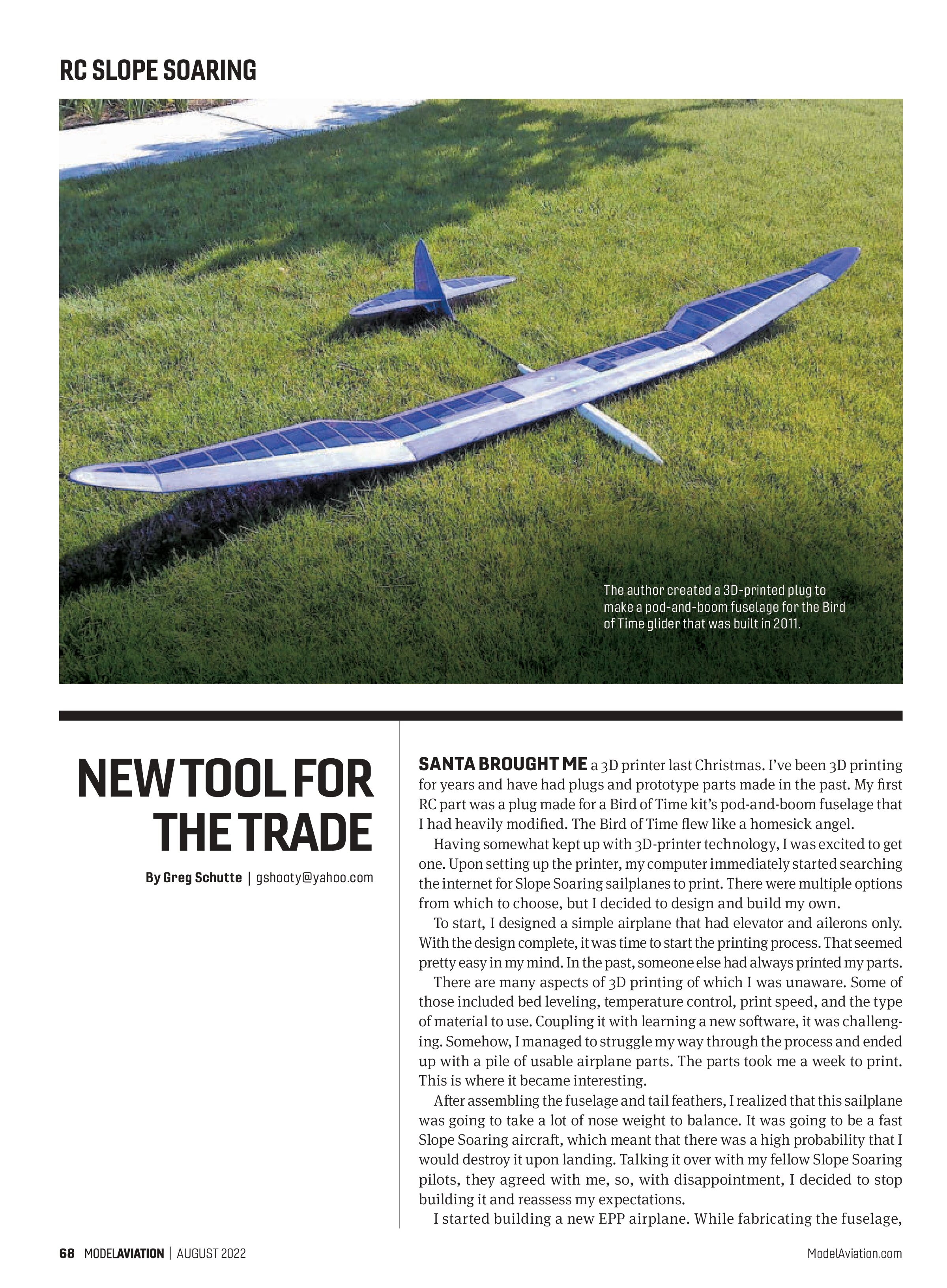
SANTA BROUGHT ME a 3D printer last Christmas. I’ve been 3D printing for years and have had plugs and prototype parts made in the past. My first RC part was a plug made for a Bird of Time kit’s pod-and-boom fuselage that I had heavily modified. The Bird of Time flew like a homesick angel.
Having somewhat kept up with 3D-printer technology, I was excited to get one. Upon setting up the printer, my computer immediately started searching the internet for Slope Soaring sailplanes to print. There were multiple options from which to choose, but I decided to design and build my own.
To start, I designed a simple airplane that had elevator and ailerons only. With the design complete, it was time to start the printing process. That seemed pretty easy in my mind. In the past, someone else had always printed my parts.
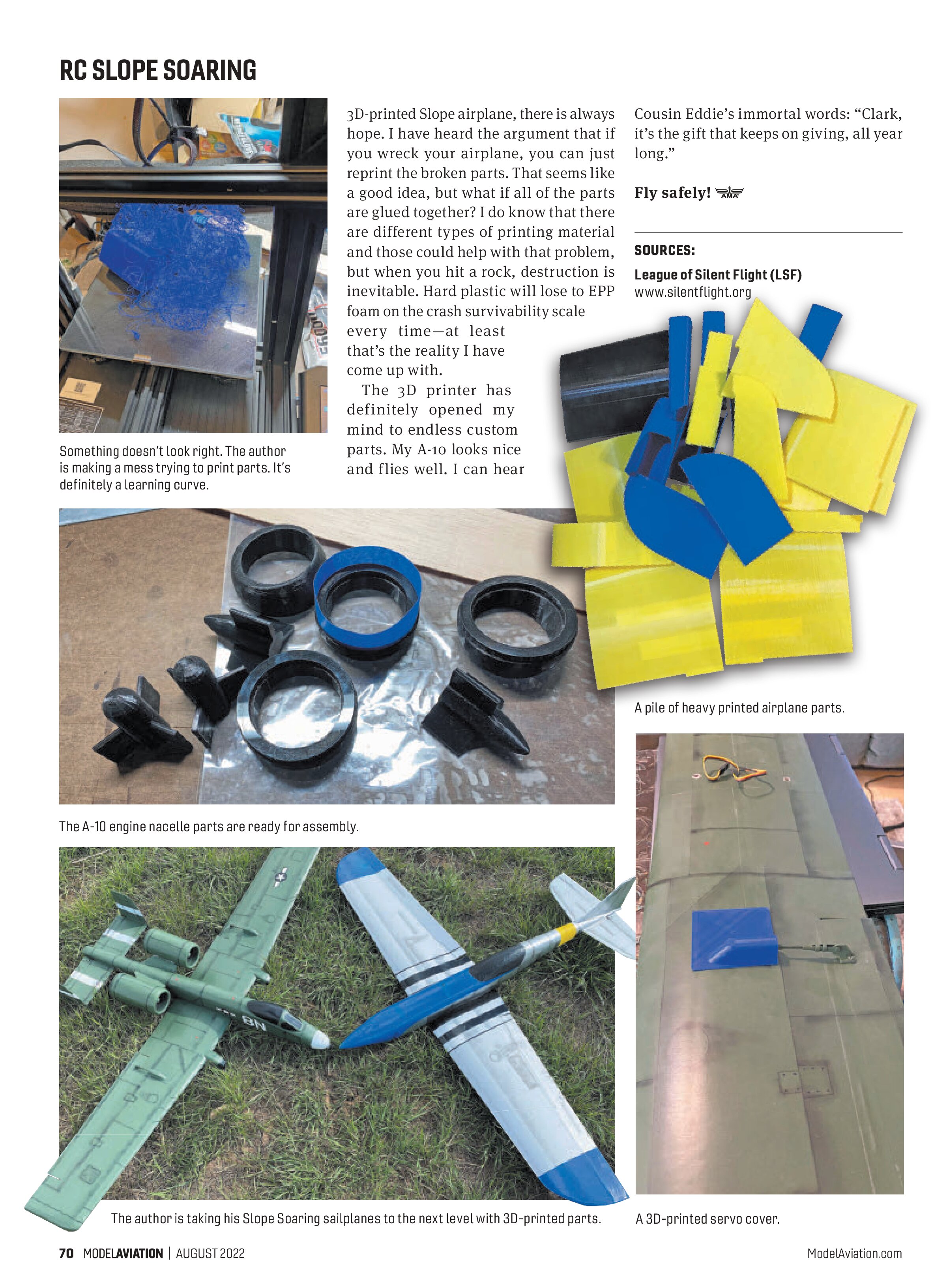
There are many aspects of 3D printing of which I was unaware. Some of those included bed leveling, temperature control, print speed, and the type of material to use. Coupling it with learning a new software, it was challenging. Somehow, I managed to struggle my way through the process and ended up with a pile of usable airplane parts. The parts took me a week to print. This is where it became interesting.
After assembling the fuselage and tail feathers, I realized that this sailplane was going to take a lot of nose weight to balance. It was going to be a fast Slope Soaring aircraft, which meant that there was a high probability that I would destroy it upon landing. Talking it over with my fellow Slope Soaring pilots, they agreed with me, so, with disappointment, I decided to stop building it and reassess my expectations.
I started building a new EPP airplane. While fabricating the fuselage,
I realized that a nose cone was needed. I usually use a gas-engine nose cone and just fill in the gaps. I decided to give the 3D printer another try. To my delight, the nose cone turned out to be what I was looking for. It could be screwed on to the front of the sailplane and filled with lead shot for balance. It also held up well when it was banged into the ground during a hard landing. I had a renewed interest in the 3D printer.
My next project was going to be an A-10. I designed the engine nacelles, landing gear pods, servo covers, and the nose gun for the aircraft. You can’t have an A-10 without the nose gun. At first, the engine nacelles and engine mounts were all one piece. Upon slicing, the 3D model would take more than three days to print. That wasn’t going to work for me. Breaking up the engine nacelles into just the front cap, back cap, and the engine interior greatly reduced the printing time. The nacelles would use 1/16-inch balsa for the main body.
My biggest surprise was letting the software figure out how to print a solid part. For my initial sailplane, I had designed all of the wall thickness and interior structure. With the 3D printer software, you load a solid model and tell the program the wall thickness and how dense the interior of the model needs to be. The program then does all of the work for you. The engine nacelles and the other printed parts were surprisingly lightweight. The servo covers were designed to specifically fit the servo opening and the size of the control horns.
I was finally able to use the 3D printer to make parts for my sailplanes. Although I’m not completely sold on a full

3D-printed Slope airplane, there is always hope. I have heard the argument that if you wreck your airplane, you can just reprint the broken parts. That seems like a good idea, but what if all of the parts are glued together? I do know that there are different types of printing material and those could help with that problem, but when you hit a rock, destruction is inevitable. Hard plastic will lose to EPP foam on the crash survivability scale every time—at least that’s the reality I have come up with.
The 3D printer has definitely opened my mind to endless custom parts. My A-10 looks nice and flies well. I can hear Cousin Eddie’s immortal words: “Clark, it’s the gift that keeps on giving, all year long.”
Fly safely!
SOURCES:
League of Silent Flight (LSF)
www.silentflight.org