FOCAL POINT
Interested in sharing your handiwork? Visit ModelAviation.com for submission guidelines.
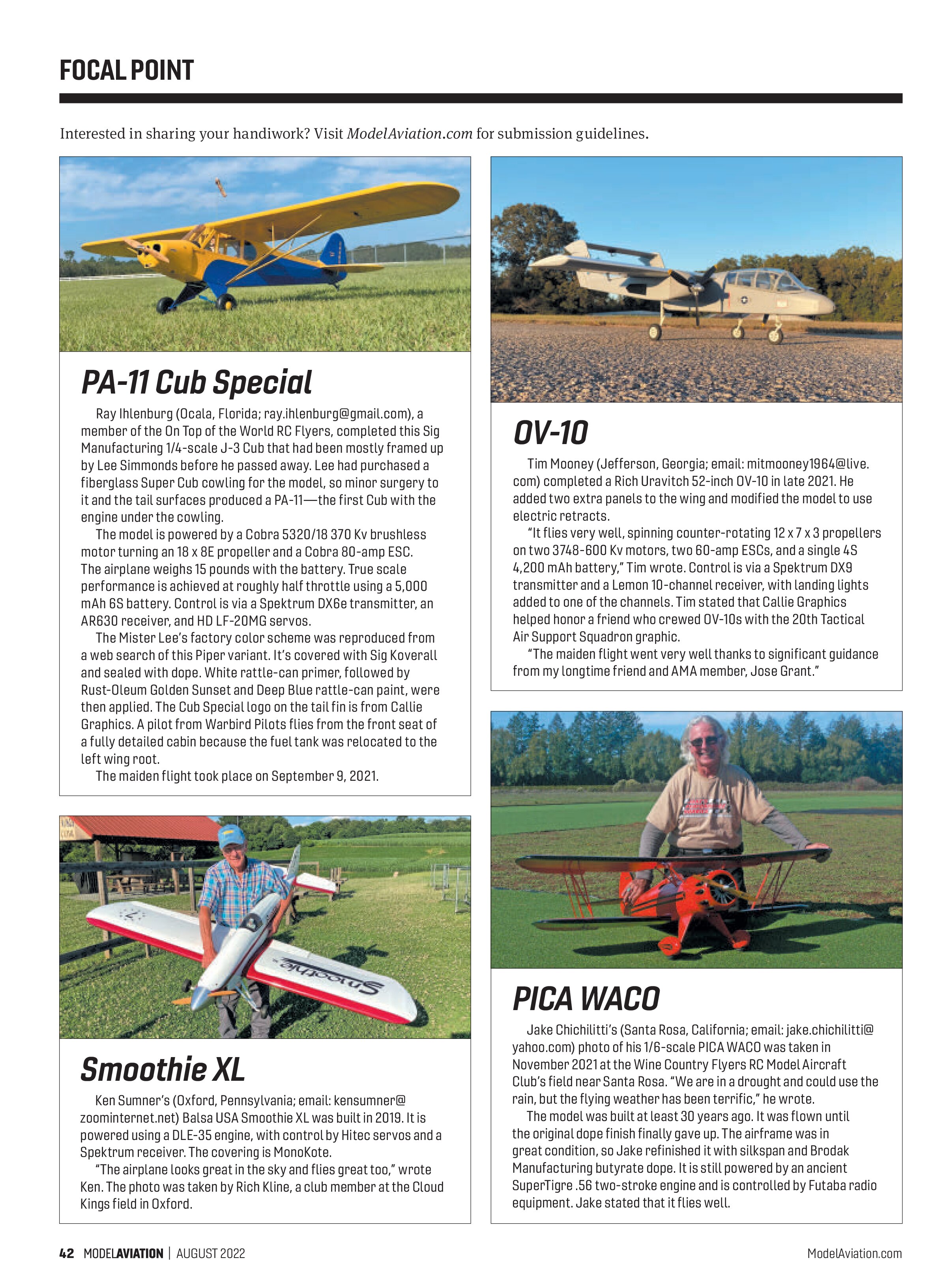
PA-11 Cub Special

Ray Ihlenburg (Ocala, Florida; ray.ihlenburg@gmail.com), a member of the On Top of the World RC Flyers, completed this Sig Manufacturing 1/4-scale J-3 Cub that had been mostly framed up by Lee Simmonds before he passed away. Lee had purchased a fiberglass Super Cub cowling for the model, so minor surgery to it and the tail surfaces produced a PA-11—the first Cub with the engine under the cowling.
The model is powered by a Cobra 5320/18 370 Kv brushless motor turning an 18 x 8E propeller and a Cobra 80-amp ESC. The airplane weighs 15 pounds with the battery. True scale performance is achieved at roughly half throttle using a 5,000 mAh 6S battery. Control is via a Spektrum DX6e transmitter, an AR630 receiver, and HD LF-20MG servos.
The Mister Lee’s factory color scheme was reproduced from a web search of this Piper variant. It’s covered with Sig Koverall and sealed with dope. White rattle-can primer, followed by Rust-Oleum Golden Sunset and Deep Blue rattle-can paint, were then applied. The Cub Special logo on the tail fin is from Callie Graphics. A pilot from Warbird Pilots flies from the front seat of a fully detailed cabin because the fuel tank was relocated to the left wing root.
The maiden flight took place on September 9, 2021.
Smoothie XL

Ken Sumner’s (Oxford, Pennsylvania; email: kensumner@zoominternet.net) Balsa USA Smoothie XL was built in 2019. It is powered using a DLE-35 engine, with control by Hitec servos and a Spektrum receiver. The covering is MonoKote.
“The airplane looks great in the sky and flies great too,” wrote Ken. The photo was taken by Rich Kline, a club member at the Cloud Kings field in Oxford.
OV-10

Tim Mooney (Jefferson, Georgia; email: timmooney1964@live.com) completed a Ritch Uravitch 52-inch OV-10 in late 2021. He added two extra panels to the wing and modified the model to use electric retracts.
“It flies very well, spinning counter-rotating 12 x 7 x 3 propellers on two 3748-600 Kv motors, two 60-amp ESCs, and a single 4S 4,200 mAh battery,” Tim wrote. Control is via a Spektrum DX9 transmitter and a Lemon 10-channel receiver, with landing lights added to one of the channels. Tim stated that Callie Graphics helped honor a friend who crewed OV-10s with the 20th Tactical Air Support Squadron graphic.
“The maiden flight went very well thanks to significant guidance from my longtime friend and AMA member, Jose Grant.”
PICA WACO

Jake Chichilitti’s (Santa Rosa, California; email: jake.chichilitti@yahoo.com) photo of his 1/6-scale PICA WACO was taken in November 2021 at the Wine Country Flyers RC Model Aircraft Club’s field near Santa Rosa. “We are in a drought and could use the rain, but the flying weather has been terrific,” he wrote.
The model was built at least 30 years ago. It was flown until the original dope finish finally gave up. The airframe was in great condition, so Jake refinished it with silkspan and Brodak Manufacturing butyrate dope. It is still powered by an ancient SuperTigre .56 two-stroke engine and is controlled by Futaba radio equipment. Jake stated that it flies well.
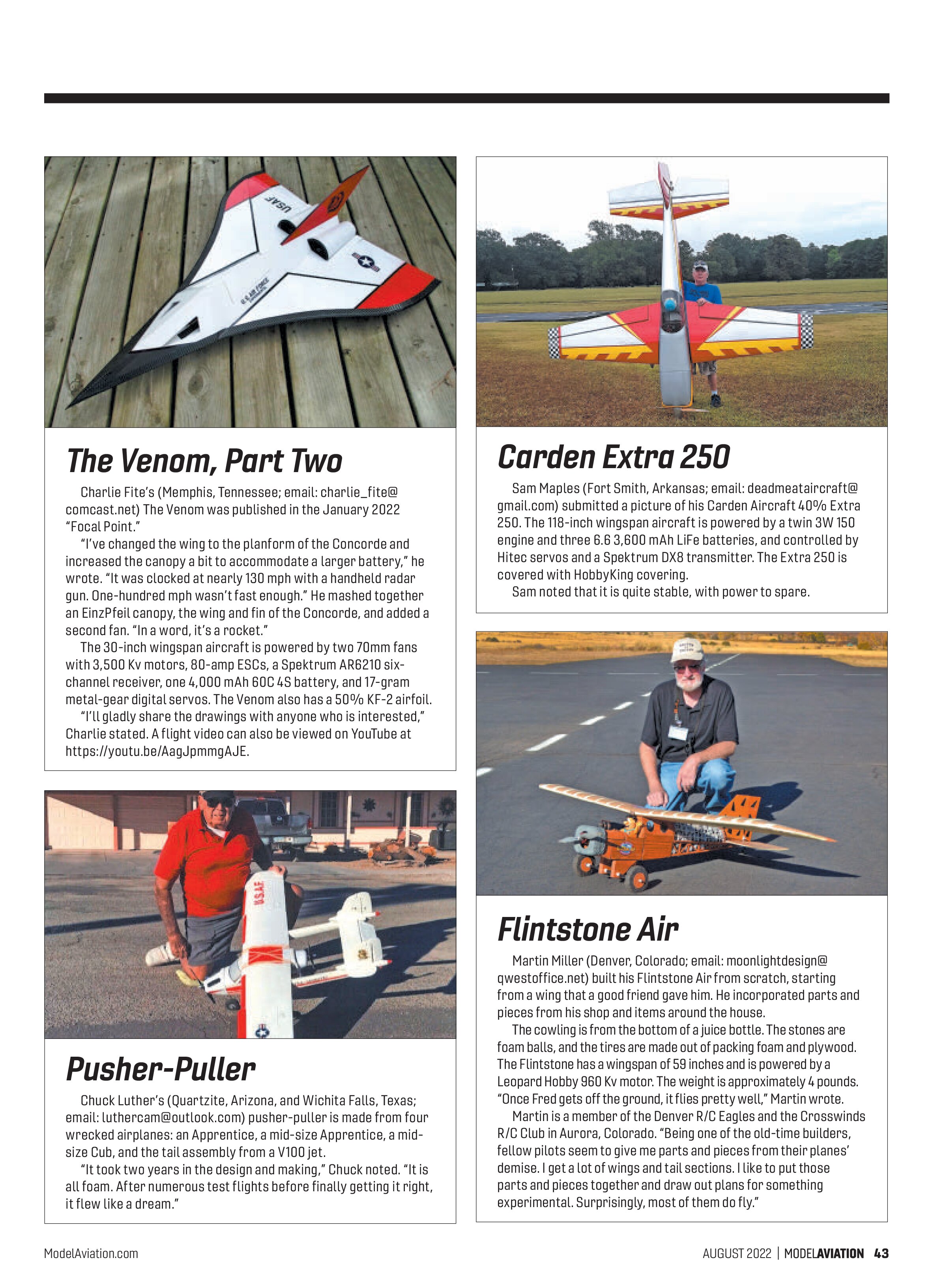
The Venom, Part Two

Charlie Fite’s (Memphis, Tennessee; email: charlie_fite@comcast.net) The Venom was published in the January 2022 “Focal Point.”
“I’ve changed the wing to the planform of the Concorde and increased the canopy a bit to accommodate a larger battery,” he wrote. “It was clocked at nearly 130 mph with a handheld radar gun. One-hundred mph wasn’t fast enough.” He mashed together an EinzPfeil canopy, the wing and fin of the Concorde, and added a second fan. “In a word, it’s a rocket.”
The 30-inch wingspan aircraft is powered by two 70mm fans with 3,500 Kv motors, 80-amp ESCs, a Spektrum AR6210 six-channel receiver, one 4,000 mAh 60C 4S battery, and 17-gram metal-gear digital servos. The Venom also has a 50% KF-2 airfoil.
“I’ll gladly share the drawings with anyone who is interested,” Charlie stated. A flight video can also be viewed on YouTube at https://youtu.be/AagJpmmgAJE.
Pusher-Puller

Chuck Luther’s (Quartzite, Arizona, and Wichita Falls, Texas; email: luthercam@outlook.com) pusher-puller is made from four wrecked airplanes: an Apprentice, a mid-size Apprentice, a mid-size Cub, and the tail assembly from a V100 jet.
“It took two years in the design and making,” Chuck noted. “It is all foam. After numerous test flights before finally getting it right, it flew like a dream.”
Garden Extra 250

Sam Maples (Fort Smith, Arkansas; email: deadmeataircraft@gmail.com) submitted a picture of his Garden Aircraft 40% Extra 250. The 118-inch wingspan aircraft is powered by a twin 3W 150 engine and three 6.6 3,600 mAh LiFe batteries, and controlled by Hitec servos and a Spektrum DX8 transmitter. The Extra 250 is covered with HobbyKing covering.
Sam noted that it is quite stable, with power to spare.
Flintstone Air

Martin Miller (Denver, Colorado; email: moonlightdesign@qwestoffice.net) built his Flintstone Air from scratch, starting from a wing that a good friend gave him. He incorporated parts and pieces from his shop and items around the house.
The cowling is from the bottom of a juice bottle. The stones are foam balls, and the tires are made out of packing foam and plywood. The Flintstone has a wingspan of 59 inches and is powered by a Leopard Hobby 960 Kv motor. The weight is approximately 4 pounds. “Once Fred gets off the ground, it flies pretty well,” Martin wrote.
Martin is a member of the Denver R/C Eagles and the Crosswinds R/C Club in Aurora, Colorado. “Being one of the old-time builders, fellow pilots seem to give me parts and pieces from their planes’ demise. I get a lot of wings and tail sections. I like to put those parts and pieces together and draw out plans for something experimental. Surprisingly, most of them do fly.”