ELECTRIC FUNERAL: DISPOSING OF YOUR LIPO BATTERIES
By Terry Dunn | terrydunn74@gmail.com

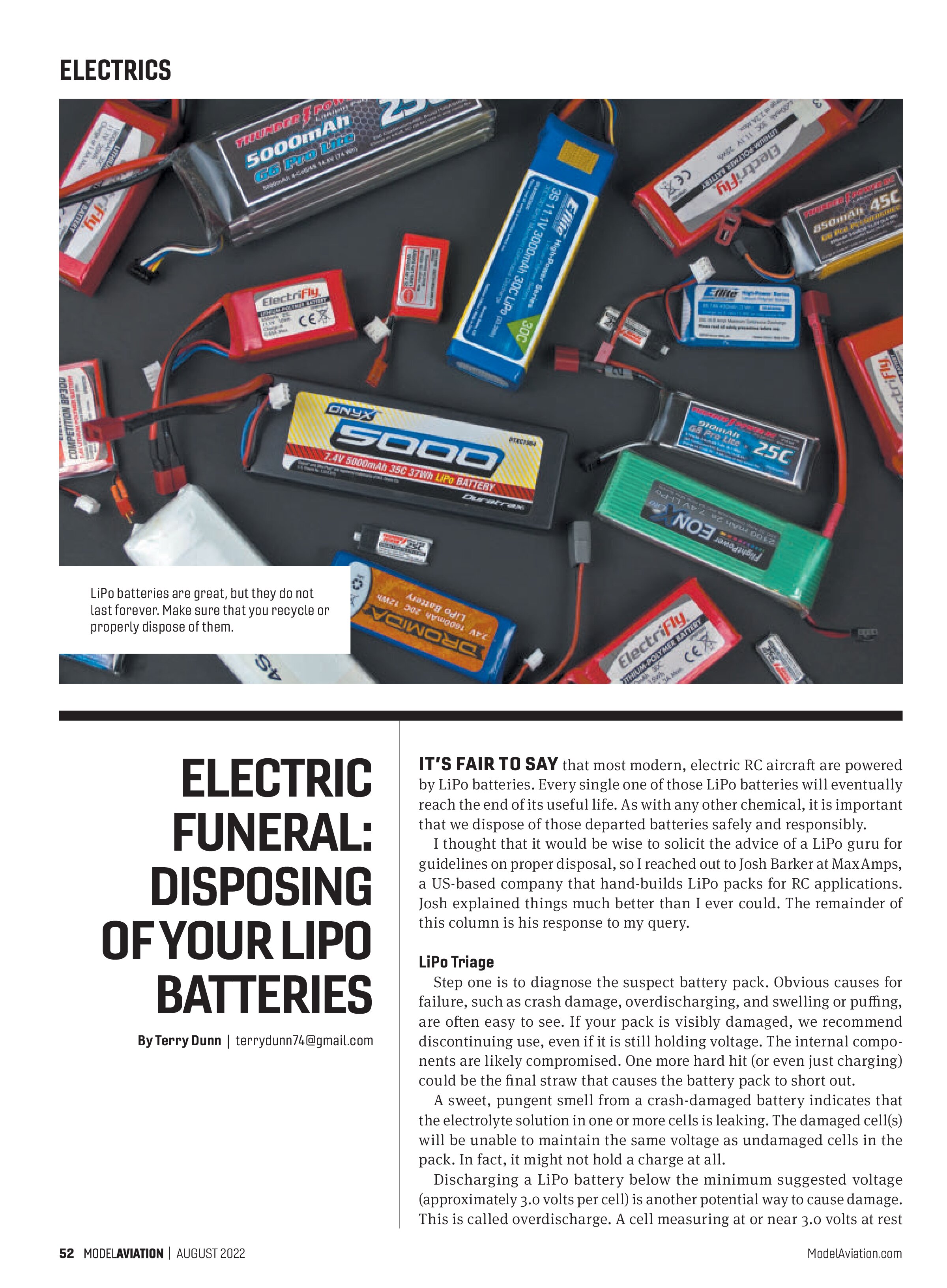
IT’S FAIR TO SAY that most modern, electric RC aircraft are powered by LiPo batteries. Every single one of those LiPo batteries will eventually reach the end of its useful life. As with any other chemical, it is important that we dispose of those departed batteries safely and responsibly.
I thought that it would be wise to solicit the advice of a LiPo guru for guidelines on proper disposal, so I reached out to Josh Barker at MaxAmps, a US-based company that hand-builds LiPo packs for RC applications. Josh explained things much better than I ever could. The remainder of this column is his response to my query.
LiPo Triage
Step one is to diagnose the suspect battery pack. Obvious causes for failure, such as crash damage, overdischarging, and swelling or puffing, are often easy to see. If your pack is visibly damaged, we recommend discontinuing use, even if it is still holding voltage. The internal components are likely compromised. One more hard hit (or even just charging) could be the final straw that causes the battery pack to short out.
A sweet, pungent smell from a crash-damaged battery indicates that the electrolyte solution in one or more cells is leaking. The damaged cell(s) will be unable to maintain the same voltage as undamaged cells in the pack. In fact, it might not hold a charge at all.
Discharging a LiPo battery below the minimum suggested voltage (approximately 3.0 volts per cell) is another potential way to cause damage. This is called overdischarge. A cell measuring at or near 3.0 volts at rest

was most likely even lower when it was used in the model. Most hobby-grade chargers will not begin a charge process if any cell in the battery pack is below 3.0 volts. This is a safety feature of the charger because overdischarged batteries can be unstable.
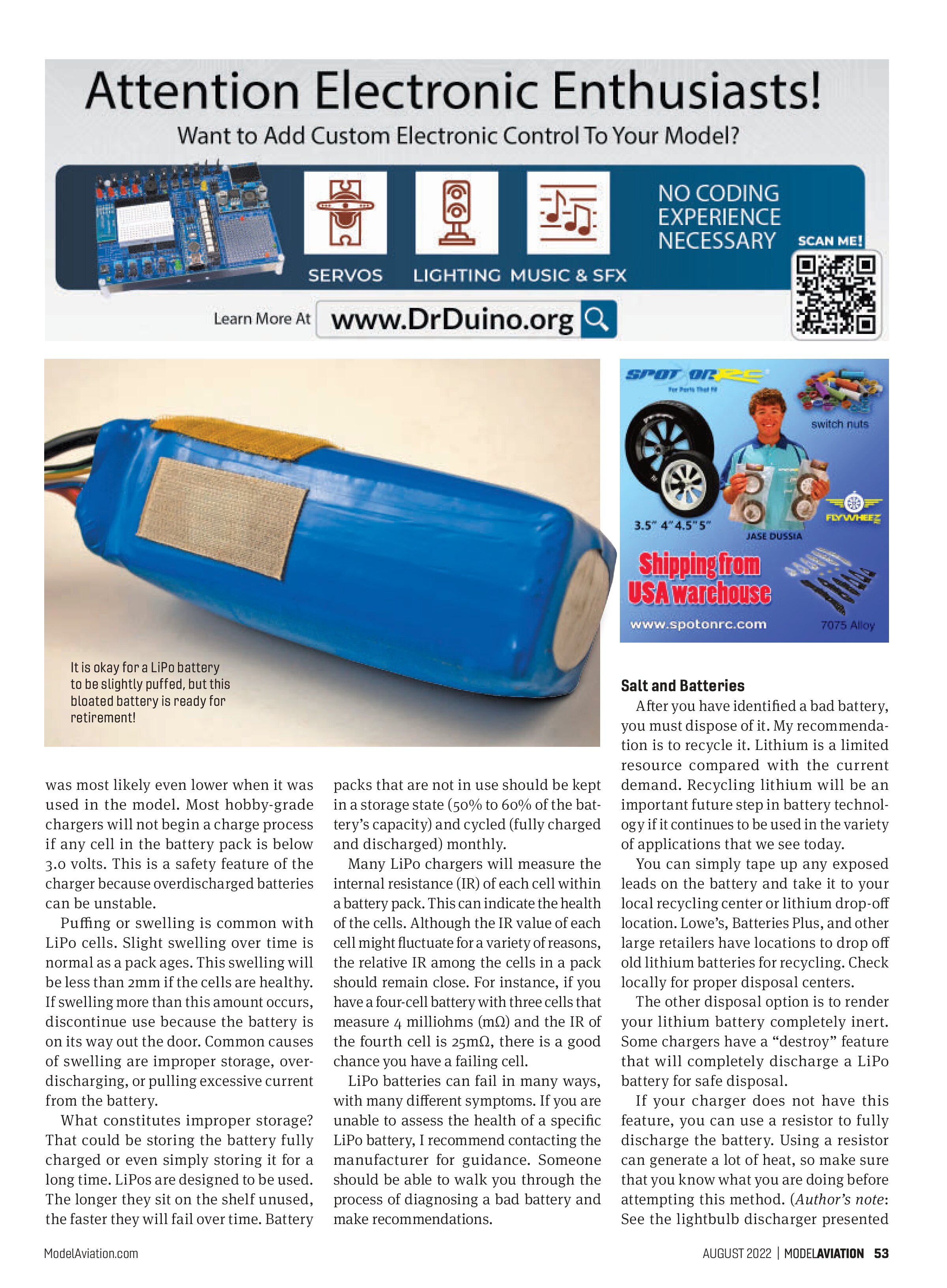
Puffing or swelling is common with LiPo cells. Slight swelling over time is normal as a pack ages. This swelling will be less than 2mm if the cells are healthy. If swelling more than this amount occurs, discontinue use because the battery is on its way out the door. Common causes of swelling are improper storage, over-discharging, or pulling excessive current from the battery.
What constitutes improper storage? That could be storing the battery fully charged or even simply storing it for a long time. LiPos are designed to be used. The longer they sit on the shelf unused, the faster they will fail over time. Battery packs that are not in use should be kept in a storage state (50% to 60% of the battery’s capacity) and cycled (fully charged and discharged) monthly.
Many LiPo chargers will measure the internal resistance (IR) of each cell within a battery pack. This can indicate the health of the cells. Although the IR value of each cell might fluctuate for a variety of reasons, the relative IR among the cells in a pack should remain close. For instance, if you have a four-cell battery with three cells that measure 4 milliohms (mΩ) and the IR of the fourth cell is 25mΩ, there is a good chance you have a failing cell.
LiPo batteries can fail in many ways, with many different symptoms. If you are unable to assess the health of a specific LiPo battery, I recommend contacting the manufacturer for guidance. Someone should be able to walk you through the process of diagnosing a bad battery and make recommendations.
Salt and Batteries
After you have identified a bad battery, you must dispose of it. My recommendation is to recycle it. Lithium is a limited resource compared with the current demand. Recycling lithium will be an important future step in battery technology if it continues to be used in the variety of applications that we see today.
You can simply tape up any exposed leads on the battery and take it to your local recycling center or lithium drop-off location. Lowe’s, Batteries Plus, and other large retailers have locations to drop off old lithium batteries for recycling. Check locally for proper disposal centers.
The other disposal option is to render your lithium battery completely inert. Some chargers have a “destroy” feature that will completely discharge a LiPo battery for safe disposal.
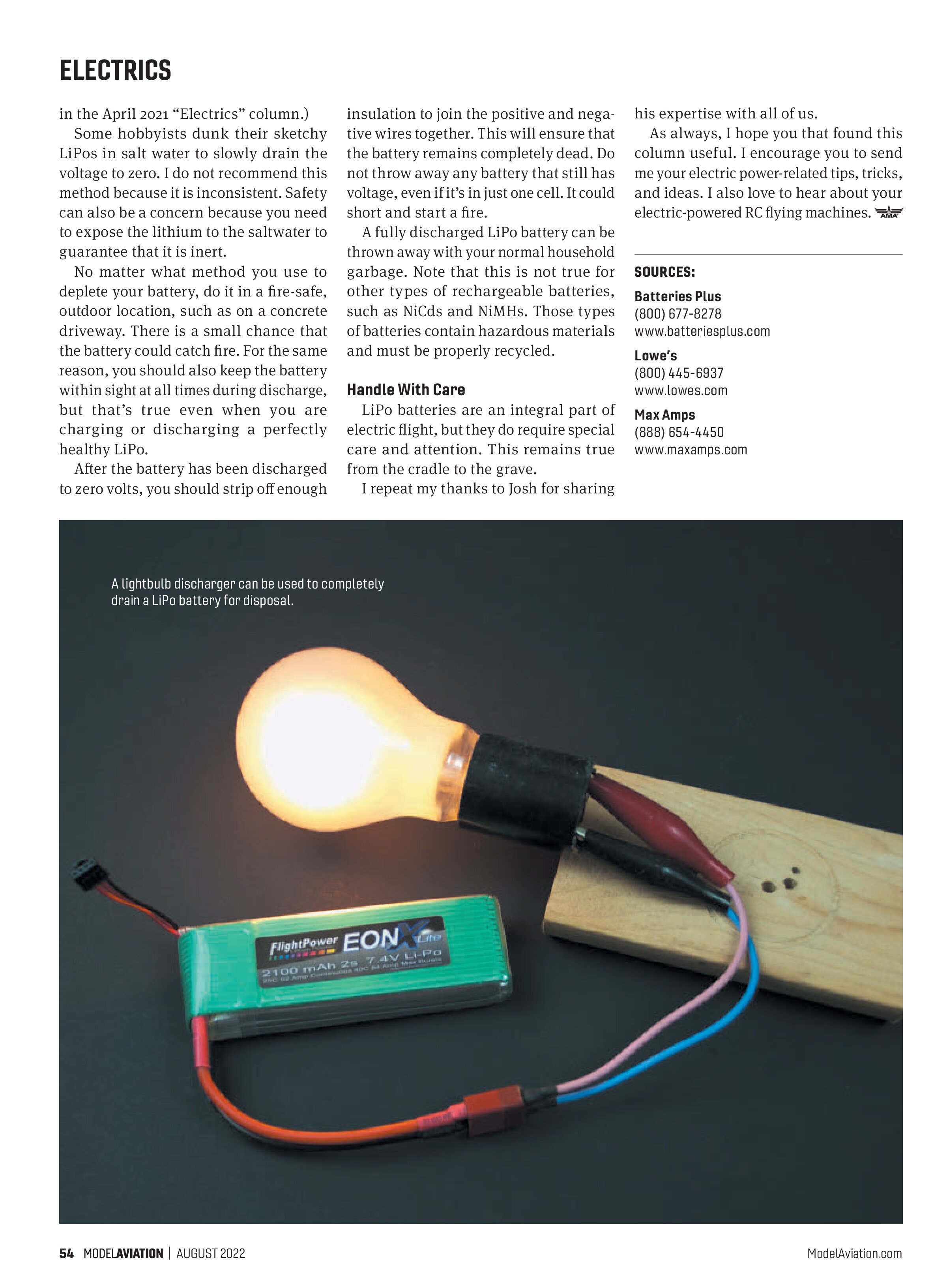
If your charger does not have this feature, you can use a resistor to fully discharge the battery. Using a resistor can generate a lot of heat, so make sure that you know what you are doing before attempting this method. (Author’s note: See the lightbulb discharger presented
in the April 2021 “Electrics” column.)
Some hobbyists dunk their sketchy LiPos in salt water to slowly drain the voltage to zero. I do not recommend this method because it is inconsistent. Safety can also be a concern because you need to expose the lithium to the saltwater to guarantee that it is inert.
No matter what method you use to deplete your battery, do it in a fire-safe, outdoor location, such as on a concrete driveway. There is a small chance that the battery could catch fire. For the same reason, you should also keep the battery within sight at all times during discharge, but that’s true even when you are charging or discharging a perfectly healthy LiPo.
After the battery has been discharged to zero volts, you should strip off enough insulation to join the positive and negative wires together. This will ensure that the battery remains completely dead. Do not throw away any battery that still has voltage, even if it’s in just one cell. It could short and start a fire.
A fully discharged LiPo battery can be thrown away with your normal household garbage. Note that this is not true for other types of rechargeable batteries, such as NiCds and NiMHs. Those types of batteries contain hazardous materials and must be properly recycled.
Handle With Care
LiPo batteries are an integral part of electric flight, but they do require special care and attention. This remains true from the cradle to the grave.
I repeat my thanks to Josh for sharing his expertise with all of us.
As always, I hope you that found this column useful. I encourage you to send me your electric power-related tips, tricks, and ideas. I also love to hear about your electric-powered RC flying machines.
SOURCES:
Batteries Plus
(800) 677-8278
www.batteriesplus.com
Lowe’s
(800) 445-6937
www.lowes.com
Max Amps
(888) 654-4450
www.maxamps.com