APRIL 1970 RC MAGAZINES
By Bob Noll | bobrc@aol.com

BOY, AM I GLAD that I like to build! It’s the first week of April as I write this and all of the snow has melted in the southern tier of New York. I have been told to stay at home—with a few acceptable excuses.
Being a model builder means that I have a well-equipped workshop in my basement. It’s easy to just go down there and forget all about the problems of COVID-19. Oh yes, I also have a model railroad that can provide entertainment, along with a vintage pinball machine. Sometimes I don’t even know what the weather has brought that day.
I decided to again go through my magazine files to find out what was going on with RC aircraft 50 years ago. I perused a handful of magazines from April 1970.
Model Airplane News opened with a full-page ad by Orbit Electronics that showed Bob Dunham teaching a young boy how to fly. The headline was, “Orbit announces the end of the crash course.” It goes on to state, “By the flick of a switch, either transmitter can be the pilot. No special transmitter needed … only a $3.95 cord.”
Art Schroeder took us on a visit to the Dee Bee operations in Pitman, New Jersey. Don Brown and Dick Maloney introduced the Dee Bee Mod-One and the Dee Bee Beta. The ad stated, “announcing vibration-proof engineering” and “low inertia wing construction for thread the needle performance.” I’m not sure what all that meant, but both were listed at $48.95. The wings and stabilizers were factory covered with Dee Bee’s exclusive Duraflite for unusual durability and beauty.
Hurst Bowers had a construction article of a beautiful Mister Mulligan.
Hurst wrote, “Breathes there a man with soul so dead, who never to himself hath said, ‘I’m going to build a Mister Mulligan!’” In 1935, the full-scale Mister Mulligan proved to be a top racing contender by winning the Bendix and Thompson races at speeds of more than 220 mph.
Lanier’s ad showed the company’s new Maverick. Lanier was clever with its airplane designs. Two wing shapes, constant and tapered chord, were used—the same basic fuselages with different vertical stabilizers to get a different look.
American Aircraft Modeler had a construction article by Skip Williams of the world-famous de Havilland Comet DH88 racer. The full-scale DH88 was famous for winning the England-to-Australia race. The Scale model was sleek, with two .19 engines.
Flying Models (FM) had a construction article by Gene Rogers for the Invader, a design he referred to as a crossbreed of a sailplane and a javelin. This clean, low-drag configuration climbed at an amazing rate with an ST .23 engine and weighed only 3 pounds with its 9:1 aspect-ratio, 73-inch wingspan.
Another FM construction article was for the Touchdown Mk II, by Bryce Peterson. This cute, low-wing aircraft flew with an O.S. .15 engine. The plans showed templates for cutting your own stabilizer and wing cores from foam.
Bryce featured what he called a “flight stabilizer.” This was a short piece of dental floss that was attached at one end near the bottom of the rudder, and the other end was attached to a small elevator extension. It was done to provide rudder-only flying because it had considerable wing dihedral. When rudder was applied, the dental floss would pull the stabilizer up to assist in


rudder-only turns. This is the first that I had ever read about this neat gimmick.
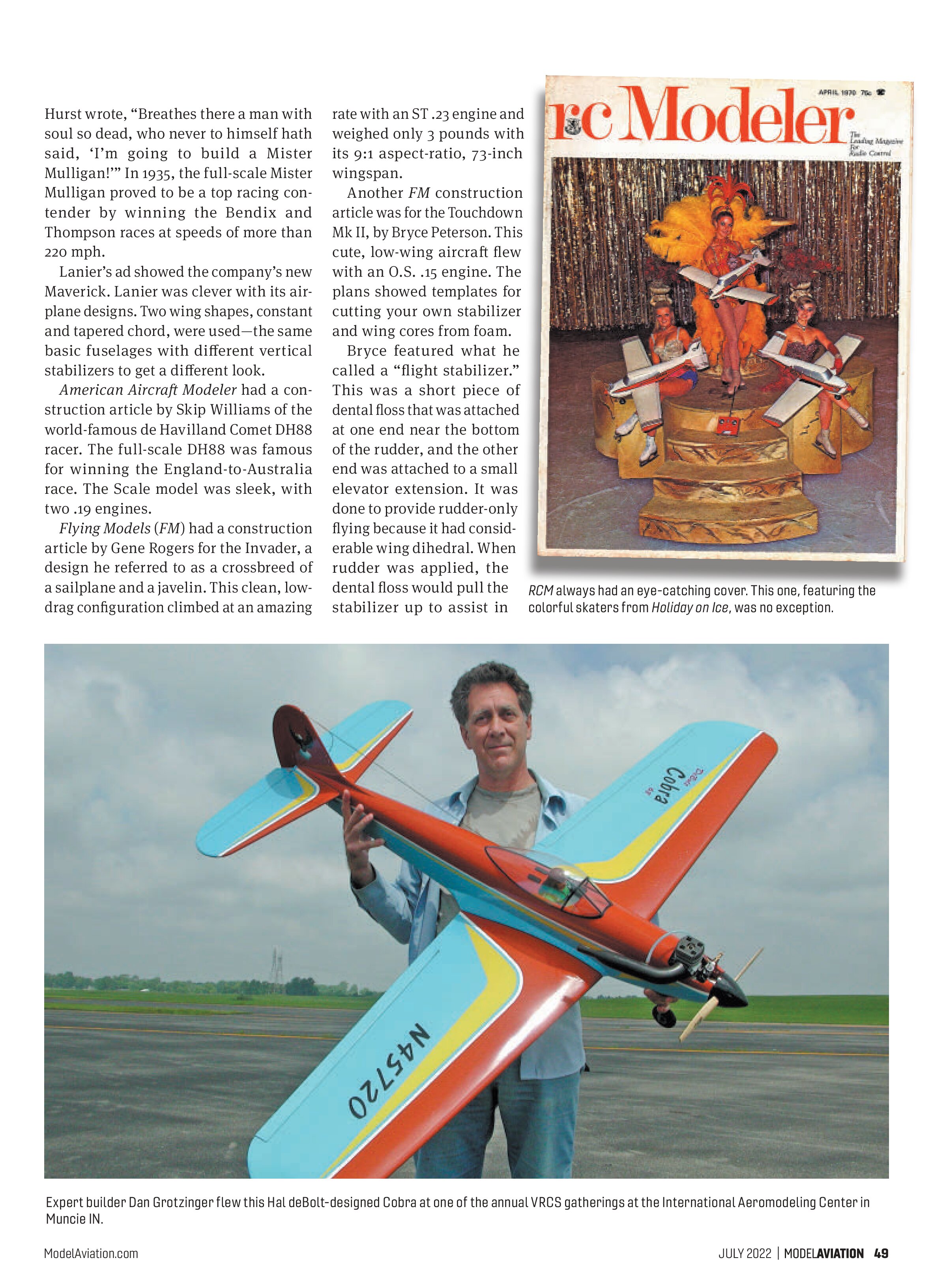
Radio Control Modeler (RCM) had another eye-catching, colorful cover. Three women of the world-famous Holiday on Ice show posed on location with three Product 60 Hobbies ARFs. An EK Logictrol transmitter could be seen in the photo.
A construction article of The Graduate, by Joel Cimmino, was for a medium-size, low-wing airplane for .29 to .35 engines. Joel advertised The Graduate as a great airplane to transition from high-wing to low-wing aircraft. The article explained how to make a fiberglass cowling using the “balloon over pattern” trick.
Dan Santich had a construction article for The Rapier, a 60-size Pattern airplane that was designed for the high wind in Oklahoma. Heathkit introduced its new Lowest Cost R/C Rig, the GD-57 three-channel system with two servos, for only $129.95.
Something that I noticed in nearly all of the major proportional radio ads was that both single-stick and two-stick systems were offered. I also noticed that only ProLine offered the two-stick transmitters with either closed sticks or open sticks. Closed gimbals had the advantage of keeping dirt out of the stick mechanism, but the open gimbles were considered to be more precise.
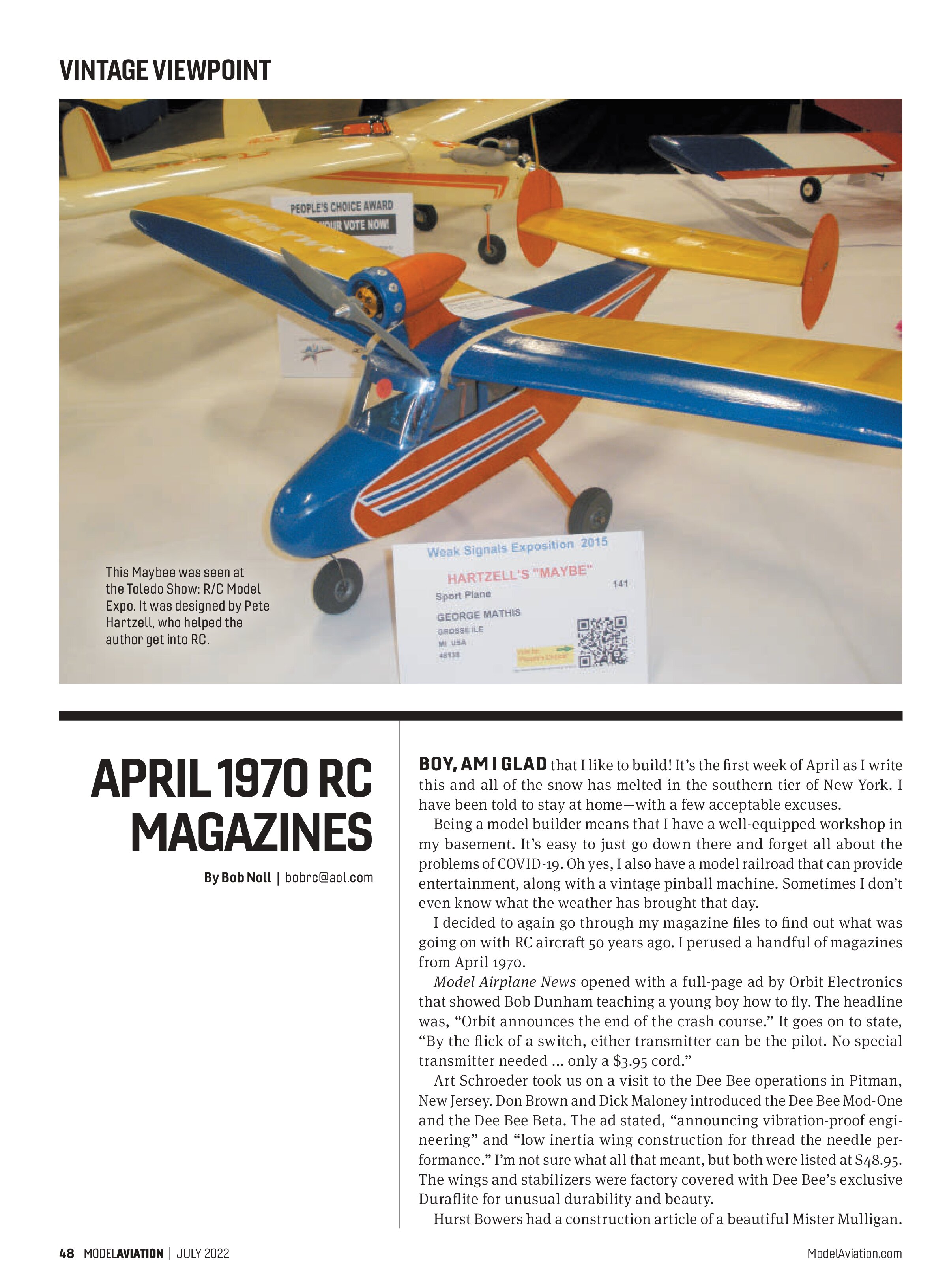
One last thing that I want to share with you is an airplane that I saw in the Vintage RC category at the Toledo Show: R/C Model Expo. It was a beautiful rudder-only airplane rendition of Maybee by George Mathis. George gave credit to the designer, Pete Hartzell, on his display card. I recognized the aircraft immediately because Pete was one of the locals in Allentown, Pennsylvania, who helped me get into the hobby when I was a teenager in the 1950s.
Vintage Flier
Before I close, I would like to mention the great newsletter published by the Vintage RC Society (VRCS). The Vintage Flier is a bimonthly, color publication with reports from across the country. It is only available to members, so join VRCS by going to its website, listed in “Sources.” While you are there, you can view an earlier Vintage Flier. This is a quality newsletter.