SAFETY COMES FIRST

MAINTAIN VISUAL
By Dave Gee | safetycolumn@cs.com
THE REASON WE TAKE such care when operating our model aircraft is that it is possible to be injured by them or by the substances we use. Eye injury is one of the most serious dangers, so protecting our sight is a high priority. Wearing safety glasses when servicing or operating a model is a basic precaution, but I’ve seen some pilots who take risks instead of putting something between their eyes and a spinning propeller. That’s a bad habit.
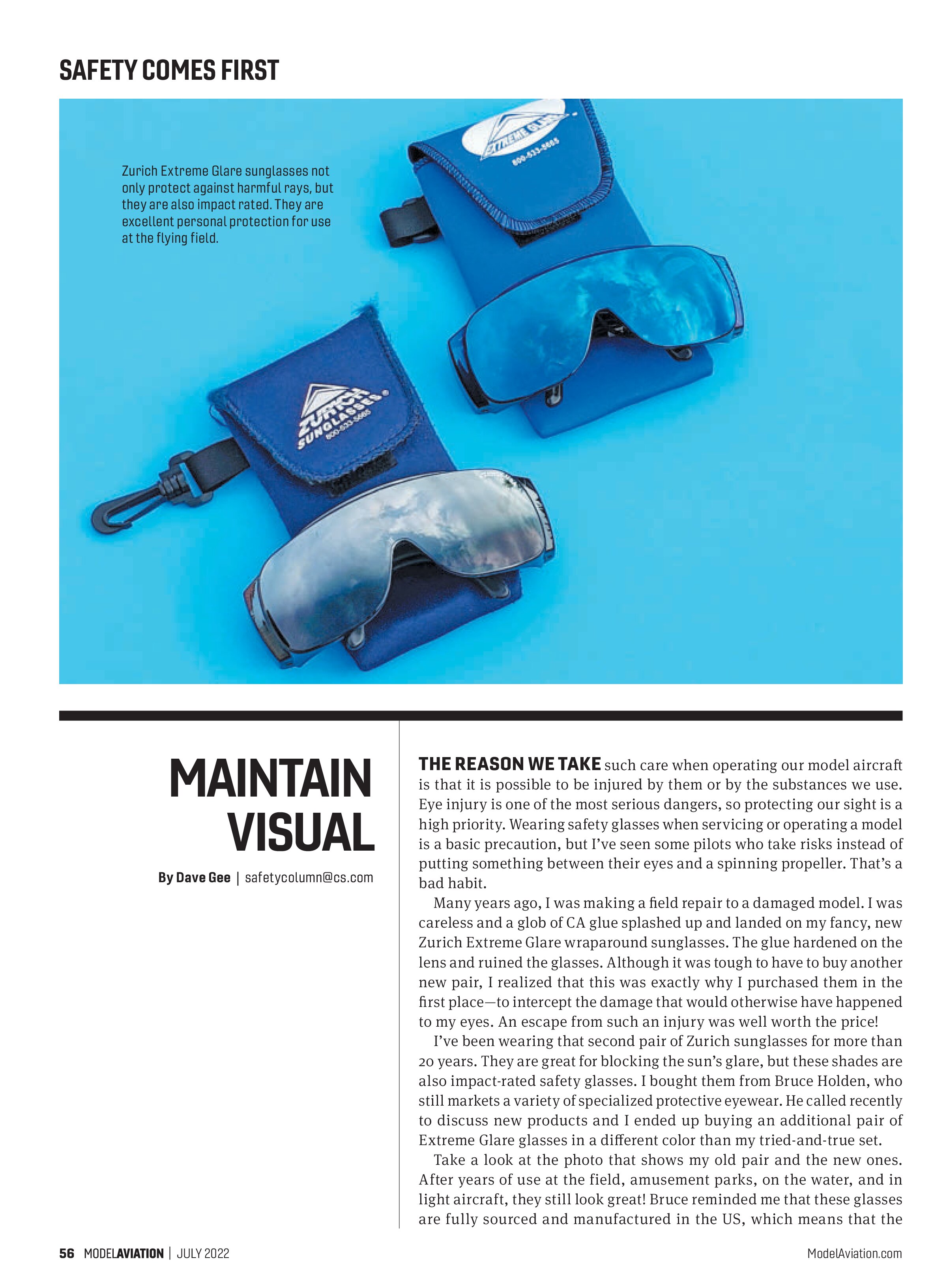
Many years ago, I was making a field repair to a damaged model. I was careless and a glob of CA glue splashed up and landed on my fancy, new Zurich Extreme Glare wraparound sunglasses. The glue hardened on the lens and ruined the glasses. Although it was tough to have to buy another new pair, I realized that this was exactly why I purchased them in the first place—to intercept the damage that would otherwise have happened to my eyes. An escape from such an injury was well worth the price!
I’ve been wearing that second pair of Zurich sunglasses for more than 20 years. They are great for blocking the sun’s glare, but these shades are also impact-rated safety glasses. I bought them from Bruce Holden, who still markets a variety of specialized protective eyewear. He called recently to discuss new products and I ended up buying an additional pair of Extreme Glare glasses in a different color than my tried-and-true set.
Take a look at the photo that shows my old pair and the new ones. After years of use at the field, amusement parks, on the water, and in light aircraft, they still look great! Bruce reminded me that these glasses are fully sourced and manufactured in the US, which means that the raw materials are domestic as well.
Cheap sunglasses don’t compare to these beauties, which have high-quality lenses. My skill at piloting RC aircraft is minimal, and I need all of the help that I can get, so distorted lenses are a deal-breaker. My Zurich glasses are wrap-around, which keeps debris out of my eyes on windy days. Model aircraft pilots like having safety-rated shades to wear in the pit area. A surprise motor start or propeller failure could throw fast-moving shards around, and eye injuries are never good.
Clubs and Changes
My local club is approaching its 50-year anniversary, and I was thinking back about how much the members and our models have changed throughout the decades. From our beginning as a Control Line demonstration team, we’ve branched out into RC and Free Flight (FF), with lots of indoor flying as well.
This is not unusual. Many clubs go through evolutions and generational changes. Members pass away, and newcomers come along with their own special areas of interest.
From a safety standpoint, we need to adapt and keep up with new technology. Look at the changes that multirotor models have brought to our flying sites.
Flight operation rules at your field might need to be adjusted when new and different types of aircraft become popular.
It’s always been that way with aeromodeling. Imagine how tough it was to adapt during the invention of radio control—never mind the day that someone first brought a gas engine to a flying field full of rubber-powered models.
Keep an open mind concerning new developments in aeromodeling. There’s sure to be something exciting in the future, and we’ll have the fun challenge of learning how to safely operate the trendy, new zero-gravity models—or whatever.

Mystery Airplane: A Tricky One!
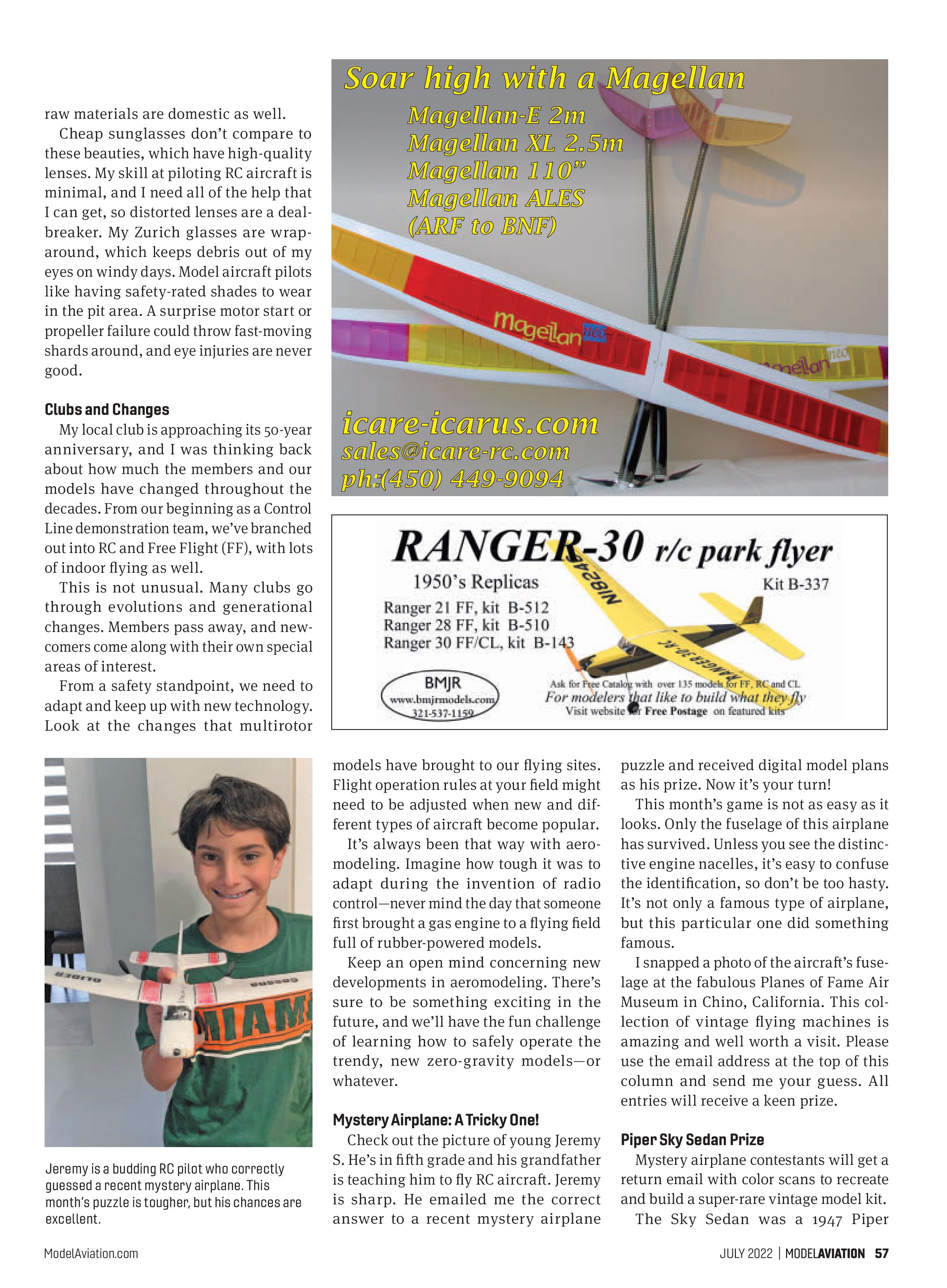
Check out the picture of young Jeremy S. He’s in fifth grade and his grandfather is teaching him to fly RC aircraft. Jeremy is sharp. He emailed me the correct answer to a recent mystery airplane puzzle and received digital model plans as his prize. Now it’s your turn!
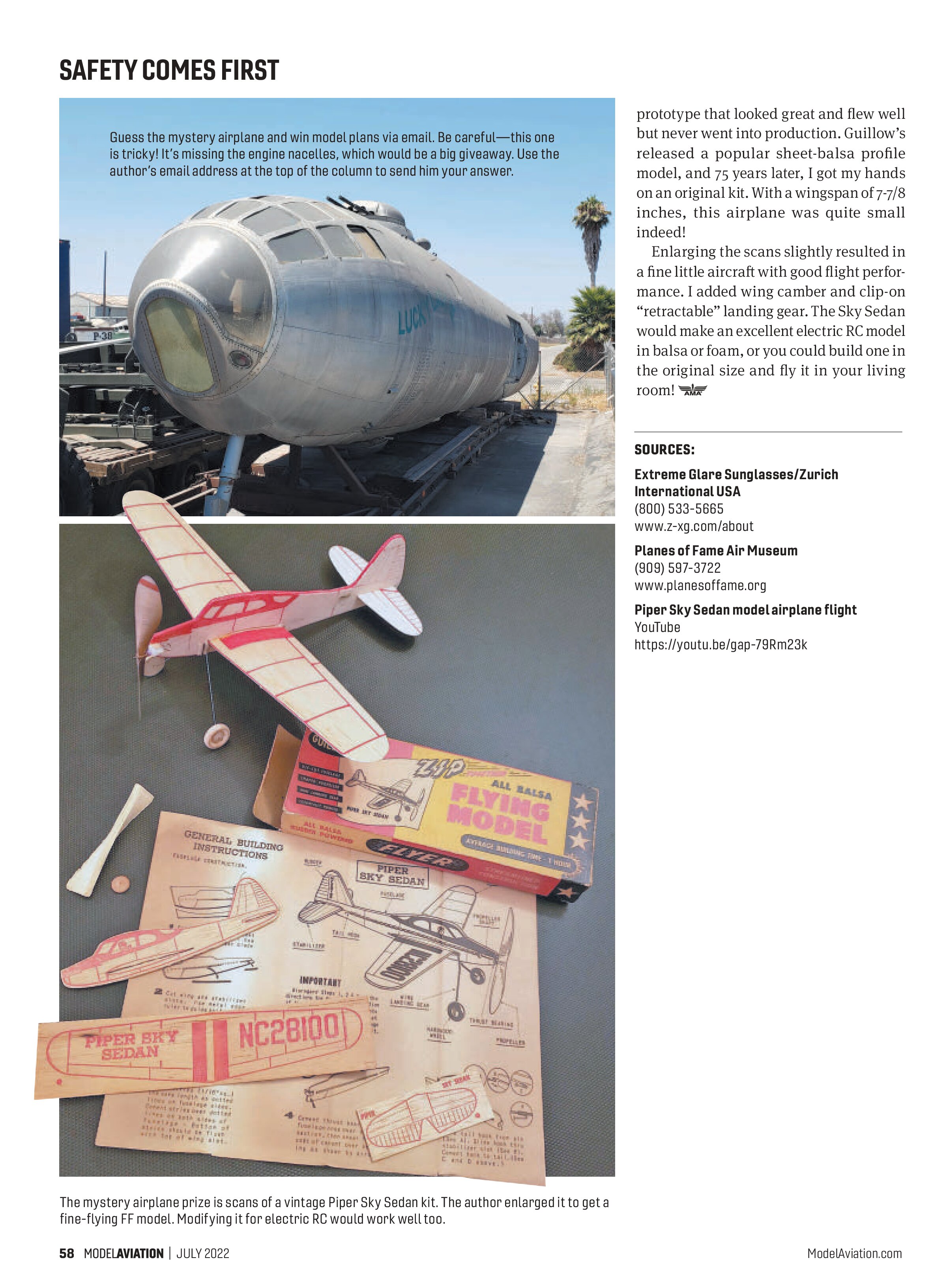
This month’s game is not as easy as it looks. Only the fuselage of this airplane has survived. Unless you see the distinctive engine nacelles, it’s easy to confuse the identification, so don’t be too hasty. It’s not only a famous type of airplane, but this particular one did something famous.
I snapped a photo of the aircraft’s fuselage at the fabulous Planes of Fame Air Museum in Chino, California. This collection of vintage flying machines is amazing and well worth a visit. Please use the email address at the top of this column and send me your guess. All entries will receive a keen prize.
Piper Sky Sedan Prize
Mystery airplane contestants will get a return email with color scans to recreate and build a super-rare vintage model kit. The Sky Sedan was a 1947 Piper


prototype that looked great and flew well but never went into production. Guilllow’s released a popular sheet-balsa profile model, and 75 years later, I got my hands on an original kit. With a wingspan of 7-7/8 inches, this airplane was quite small indeed!
Enlarging the scans slightly resulted in a fine little aircraft with good flight performance. I added wing camber and clip-on “retractable” landing gear. The Sky Sedan would make an excellent electric RC model in balsa or foam, or you could build one in the original size and fly it in your living room!
SOURCES:
Extreme Glare Sunglasses/Zurich International USA
(800) 533-5665
www.z-xg.com/about
Planes of Fame Air Museum
(909) 597-3722
www.planesoffame.org
Piper Sky Sedan model airplane flight
YouTube
https://youtu.be/gap-79Rm23k