FLIGHT MANEUVERS
By Stan Alexander | onawing4602@att.net

CHOOSING FLIGHT MANEUVERS for a Scale model can be daunting. You need to make the flight performance as realistic as possible if you are in competition; however, even if you are at a fly-in, you don’t want to do tail stands on the main runway with an F-4 Phantom.
One item that I’ve always disliked is the aerobatic/non-aerobatic designation. Why? Many airplanes are aerobatic but not fully aerobatic like a Pitts or a Bücker Zlin biplane. For instance, the Douglas SBD Dauntless is a purpose-built dive bomber. It can dive on a target at a 70° rate with perforated dive flaps deployed. It also features machine guns that fire forward, as well as a gunner in the rear for protection. Is the SBD aerobatic? That question is debated in some circles. This aircraft is generally deemed non-aerobatic, but I disagree; the SBD is somewhat aerobatic. Many aircraft are similar to this one.
The SBD is capable of some maneuvers, such as a Split-S or a military roll, but is it capable of a full Cuban 8? No, it isn’t. That is a maneuver where fully aerobatic aircraft, such as the Pitts or the Zlin, excel. They have enough power and aerobatic capability to stay in a groove long enough to complete a full Cuban 8.
At one competition that I judged, there were three models: a T-34 Mentor, a Ki-84 Hayate, and an N1K2 George. They all performed the following maneuvers: a Lazy 8, a full Cuban 8, and a three-turn spin. I later asked the pilots why they performed these maneuvers. The answers were because the pilots wanted to show how well they could perform these maneuvers with the aircraft because they are capable of the maneuvers.
In RC Scale competition, you start out with a perfect score of 100 points for both static and flight. Flying maneuvers that are elongated and take more time tend to lower the competitor’s score because there is more time to make mistakes and deviations from what the judges are expecting. I would never fly these maneuvers, even if the aircraft and I were capable of them in competition. Where a military roll would take 10 seconds of your flight time, the full Cuban 8 could take 30 seconds, which can have a negative effect on the total score.
The late Cliff Tacie was, at one time, the event director for the AMA RC Scale Nats. Cliff always had a sort-of motto that he kept close to all modeling activities: KISS, or Keep It Simple, Stupid. By no means was this speaking negatively to or against someone, but it meant to not overcomplicate systems, airplanes, or maneuvers. It makes for a more enjoyable time with any model but especially a Scale model.
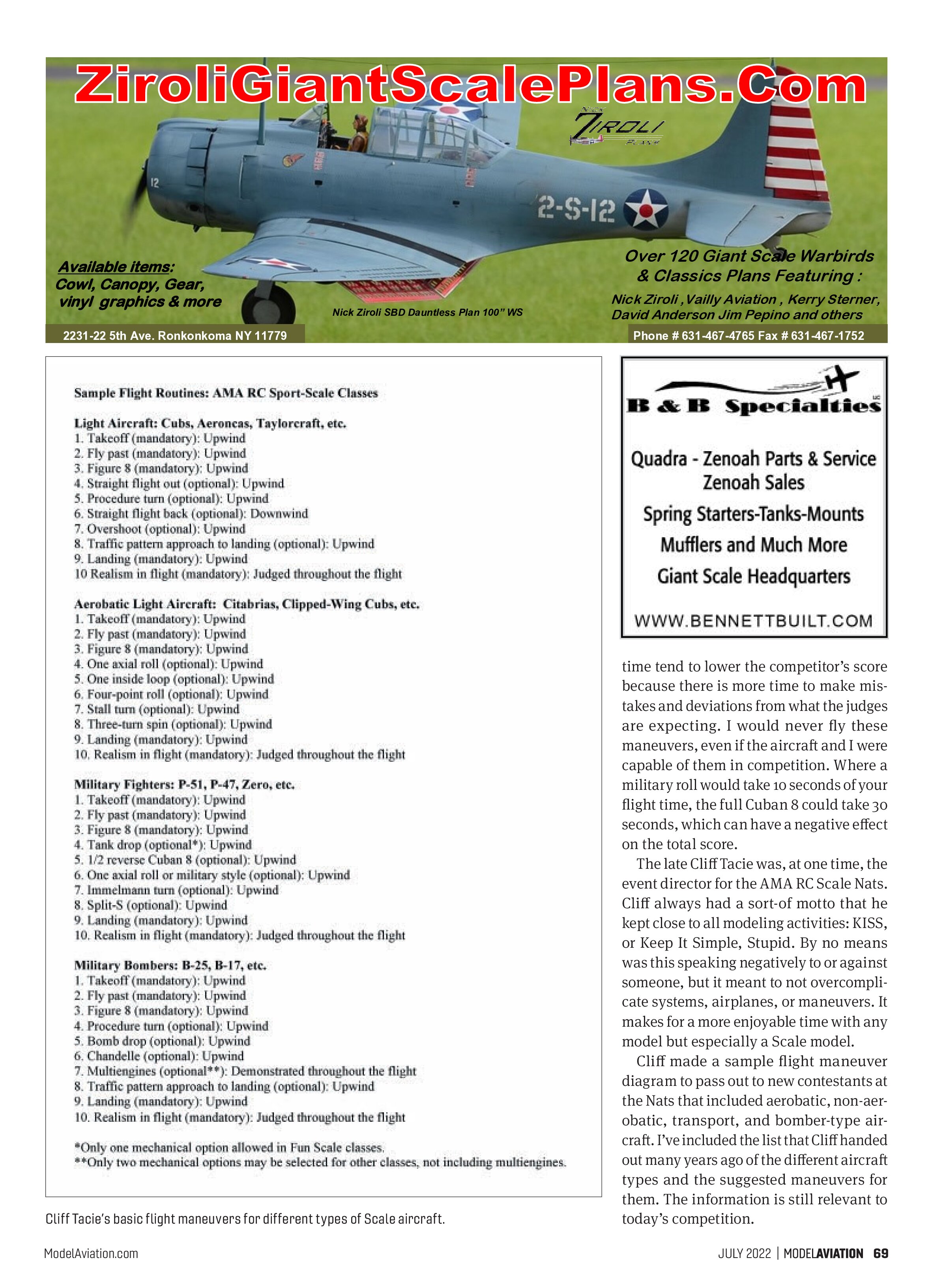
Cliff made a sample flight maneuver diagram to pass out to new contestants at the Nats that included aerobatic, non-aerobatic, transport, and bomber-type aircraft. I’ve included the list that Cliff handed out many years ago of the different aircraft types and the suggested maneuvers for them. The information is still relevant to today’s competition.


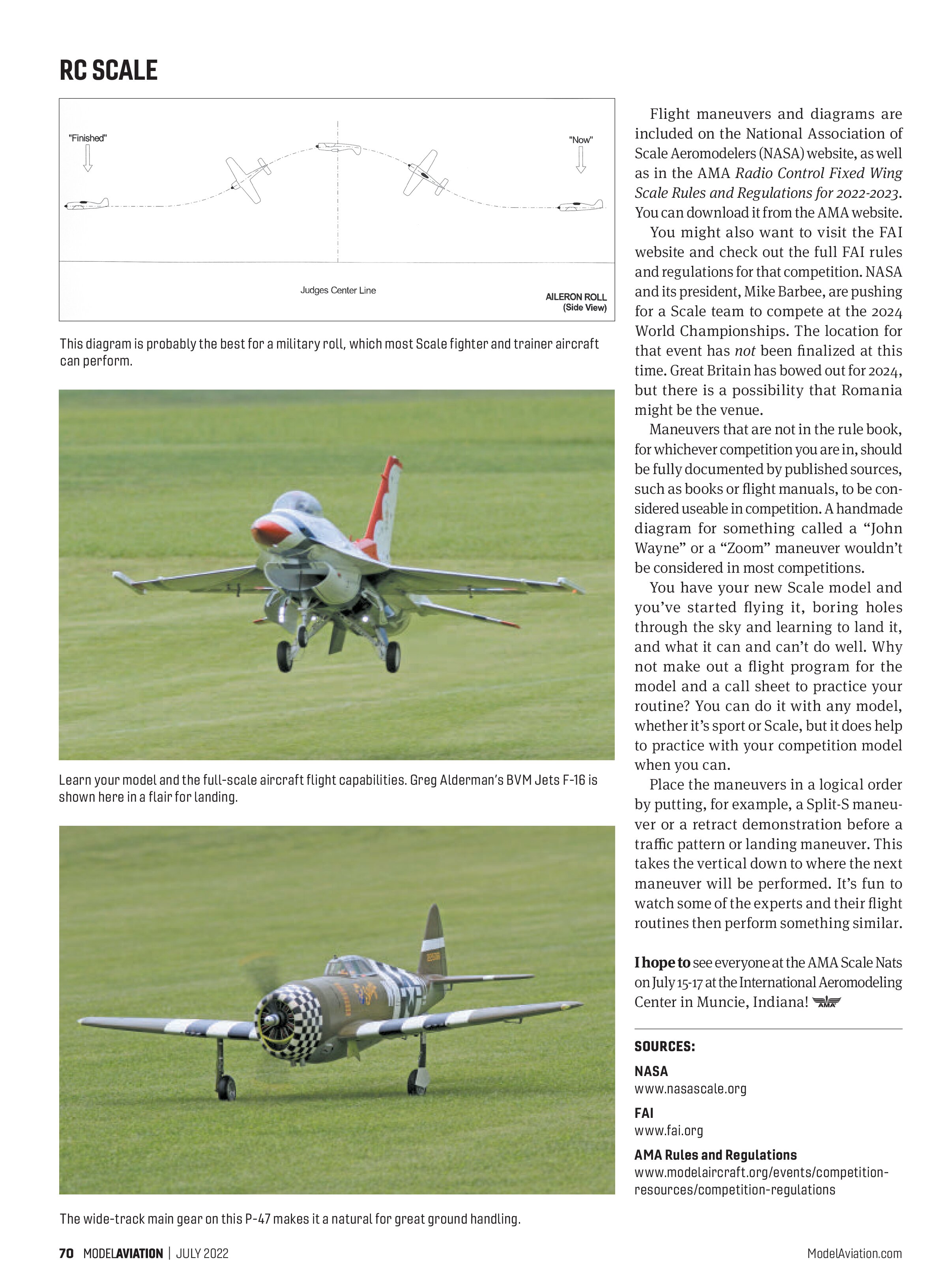
Flight maneuvers and diagrams are included on the National Association of Scale Aeromodelers (NASA) website, as well as in the AMA Radio Control Fixed Wing Scale Rules and Regulations for 2022-2023. You can download it from the AMA website.
You might also want to visit the FAI website and check out the full FAI rules and regulations for that competition. NASA and its president, Mike Barbee, are pushing for a Scale team to compete at the 2024 World Championships. The location for that event has not been finalized at this time. Great Britain has bowed out for 2024, but there is a possibility that Romania might be the venue.
Maneuvers that are not in the rule book, for whichever competition you are in, should be fully documented by published sources, such as books or flight manuals, to be considered useable in competition. A handmade diagram for something called a “John Wayne” or a “Zoom” maneuver wouldn’t be considered in most competitions.
You have your new Scale model and you’ve started flying it, boring holes through the sky and learning to land it, and what it can and can’t do well. Why not make out a flight program for the model and a call sheet to practice your routine? You can do it with any model, whether it’s sport or Scale, but it does help to practice with your competition model when you can.
Place the maneuvers in a logical order by putting, for example, a Split-S maneuver or a retract demonstration before a traffic pattern or landing maneuver. This takes the vertical down to where the next maneuver will be performed. It’s fun to watch some of the experts and their flight routines then perform something similar.
I hope to see everyone at the AMA Scale Nats on July 15-17 at the International Aeromodeling Center in Muncie, Indiana!
SOURCES:
FAI
www.fai.org
AMA Rules and Regulations
www.modelaircraft.org/events/competition-resources/competition-regulations