THE DAY OF A PYLON RACE
By Tim Lampe | tim.lampe@hotmail.com

I’D LIKE TO EVENTUALLY write about how to get into Pylon Racing, but until I compile a list of airplanes for the entry classes, I thought I’d give you a snapshot of the day of a race.
In three-pole Pylon Racing, the classes include Electric Formula 1 (EF1); two Quickie 500 (Q-500) classes: Sport Quickie/AMA Class 424 and Super Sport Quickie/AMA Class 426; and Quarter-40 (Q-40)/AMA Class 422. Conversationally, these classes are referred to as EF1, 424, 426, and 422.
EF1 and 424 are the typical entry points for Pylon Racing, but these classes are not limited to beginners. EF1 and 424 airplanes reach speeds of approximately 100 mph, which is nearly equal to any fast sport model you’ll find at your local RC flying field.
The faster Q-500 class, 426, uses virtually the same airframe as 424, with the exception of a faster engine. You’ll find a wide cross section of pilots competing in 426, including all of the fastest pilots on the circuit. This, with the facts that 426 aircraft fly at approximately 160 mph and the financial investment isn’t quite as steep as it is for the premier 422 class, means that there’s lots of close, aggressive racing.
The fastest class, Q-40/422, is composed of all-composite airframes with molded fuselages of fiberglass and carbon fiber, molded wings of balsa/fiberglass skins, and balsa/carbon-fiber spars. Q-40 aircraft fly at approximately 200 mph.
A common weekend race format is to run EF1 and 426 on Saturday and 424 and 422 on Sunday. Many competitors race two classes. With this arrangement, new pilots (who typically race in EF1 and 424) and experienced pilots (who typically race in 426 and 422) will have their weekend balanced by competing in one class each day (although some pilots race three or all four classes).
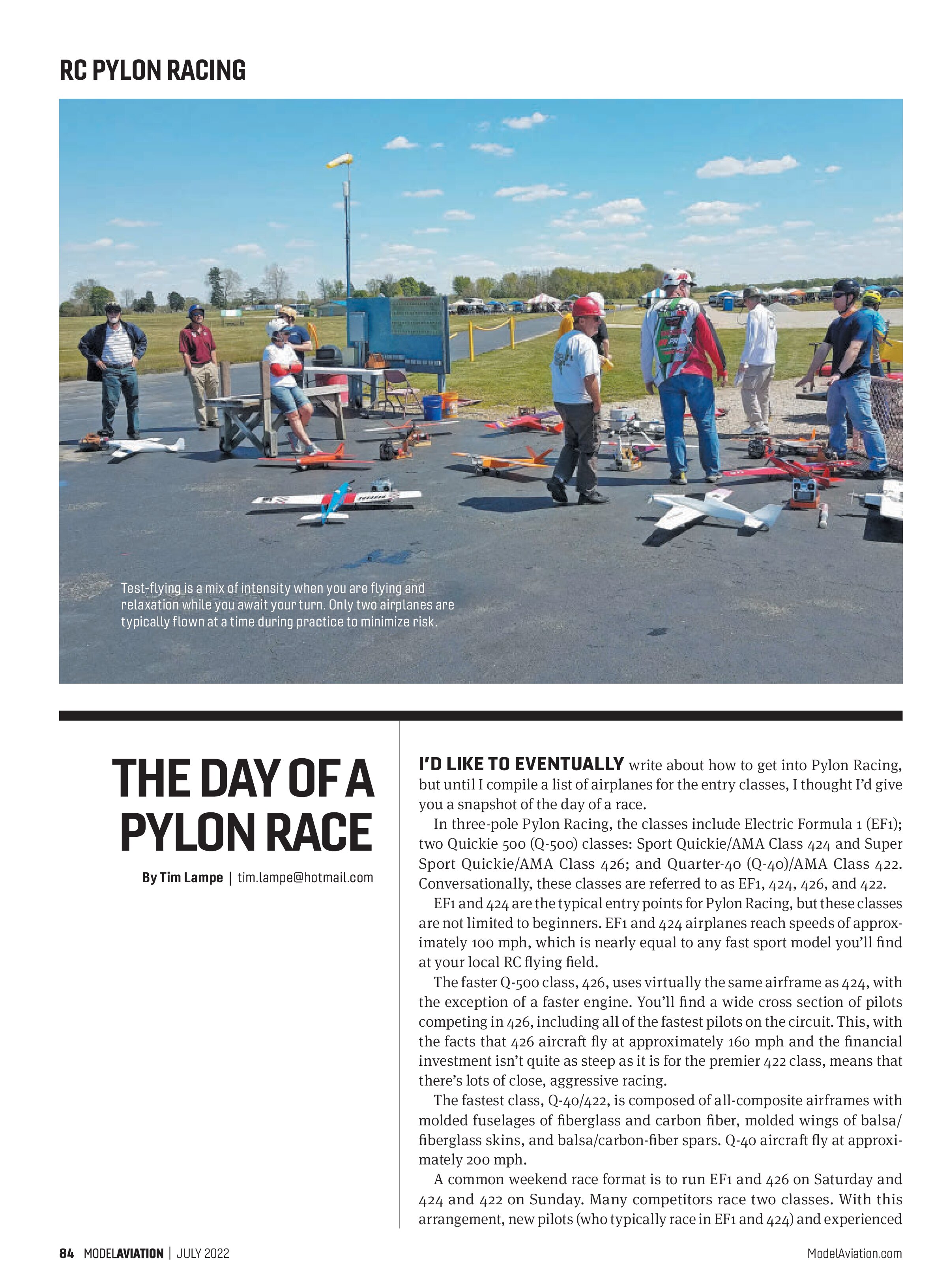
In addition to the obvious goal of winning a race or doing your best, one of the primary objectives is to get in as much flying as you can. Pylon Racing airplanes are not always suitable for your local RC club, so when you get to a venue that accommodates Pylon Racing, it’s a golden opportunity to break in a new engine, test some propellers, maiden a new model, or even just get in some practice down on the course and around the poles! The assistance and camaraderie of your fellow competitors cannot be found elsewhere.
The most enthusiastic Pylon Racing pilots will arrive a day early (when the site is usually set up for the race). They will fly all day then get in one (or two) last-minute test flights the morning before racing begins. More test flights can be made during lunch breaks and later in the afternoon after the day’s racing. A good weekend of Pylon Racing can be challenging and rewarding, but it’s also a grind!
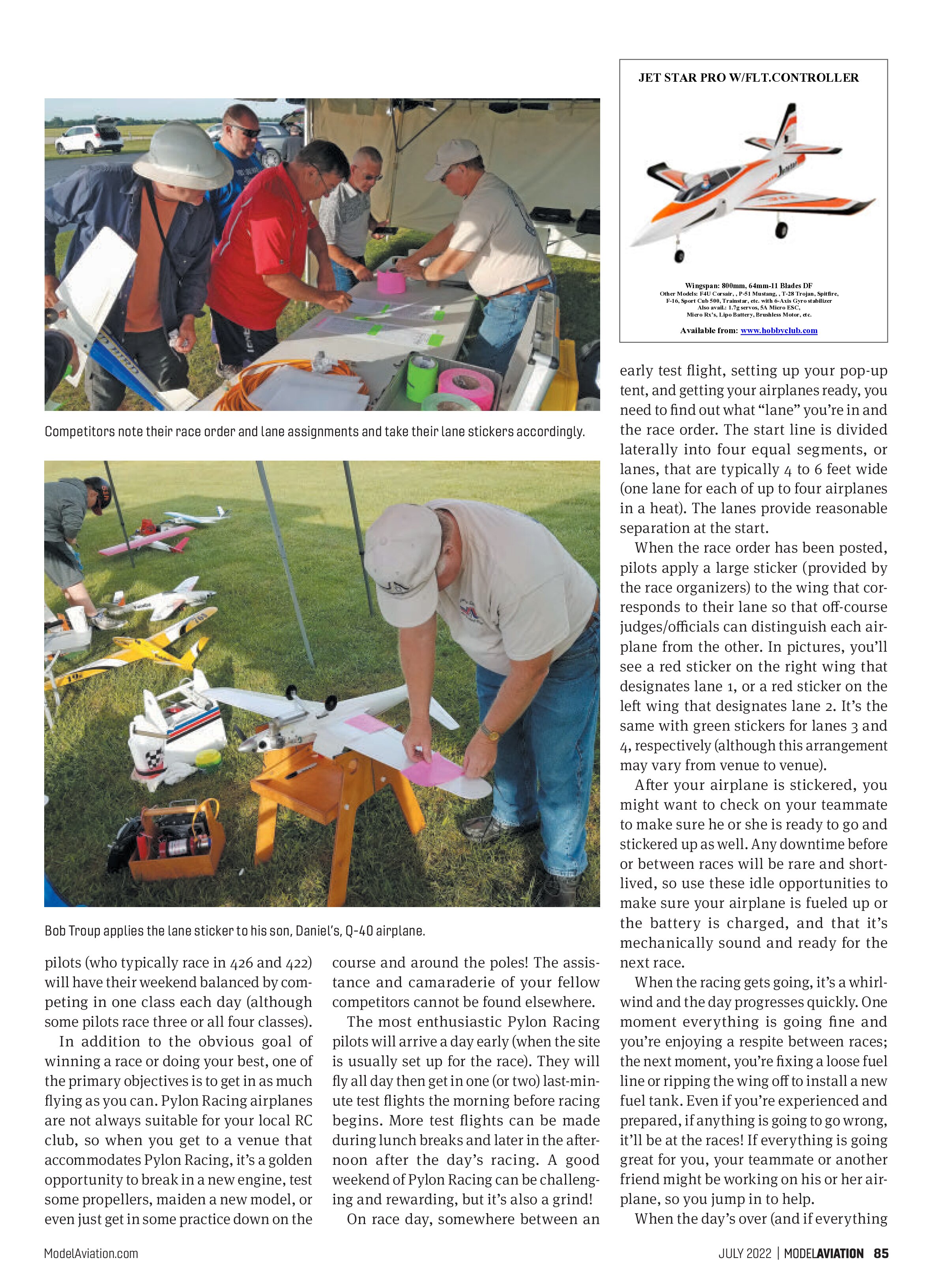
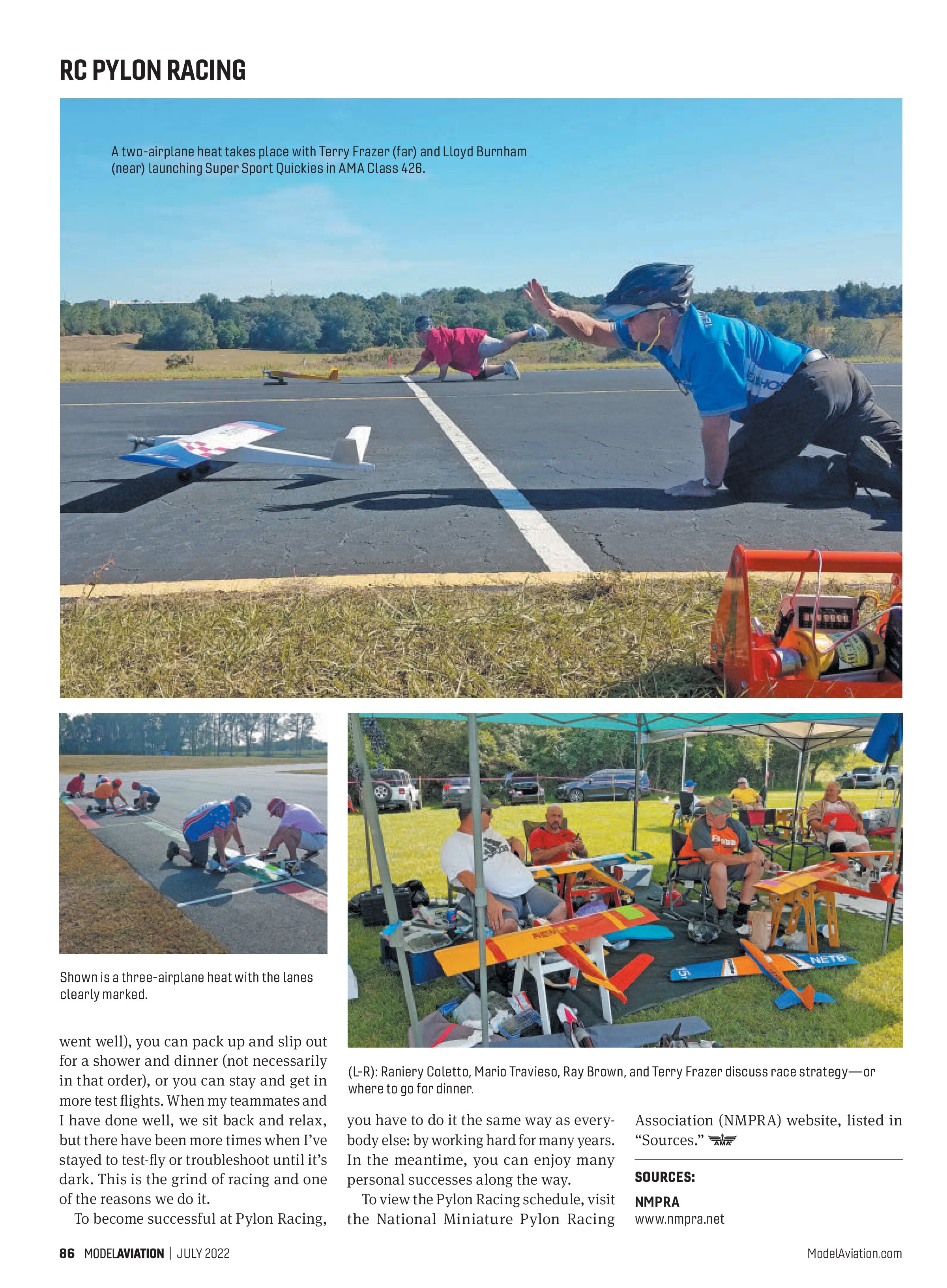
On race day, somewhere between an early test flight, setting up your pop-up tent, and getting your airplanes ready, you need to find out what “lane” you’re in and the race order. The start line is divided laterally into four equal segments, or lanes, that are typically 4 to 6 feet wide (one lane for each of up to four airplanes in a heat). The lanes provide reasonable separation at the start.
When the race order has been posted, pilots apply a large sticker (provided by the race organizers) to the wing that corresponds to their lane so that off-course judges/officials can distinguish each airplane from the other. In pictures, you’ll see a red sticker on the right wing that designates lane 1, or a red sticker on the left wing that designates lane 2. It’s the same with green stickers for lanes 3 and 4, respectively (although this arrangement may vary from venue to venue).
After your airplane is stickered, you might want to check on your teammate to make sure he or she is ready to go and stickered up as well. Any downtime before or between races will be rare and short-lived, so use these idle opportunities to make sure your airplane is fueled up or the battery is charged, and that it’s mechanically sound and ready for the next race.
When the racing gets going, it’s a whirlwind and the day progresses quickly. One moment everything is going fine and you’re enjoying a respite between races; the next moment, you’re fixing a loose fuel line or ripping the wing off to install a new fuel tank. Even if you’re experienced and prepared, if anything’s going to go wrong, it’ll be at the races! If everything is going great for you, your teammate or another friend might be working on his or her airplane, so you jump in to help.
When the day’s over (and if everything


went well), you can pack up and slip out for a shower and dinner (not necessarily in that order), or you can stay and get in more test flights. When my teammates and I have done well, we sit back and relax, but there have been more times when I’ve stayed to test-fly or troubleshoot until it’s dark. This is the grind of racing and one of the reasons we do it.
To become successful at Pylon Racing,

you have to do it the same way as everybody else: by working hard for many years. In the meantime, you can enjoy many personal successes along the way.
To view the Pylon Racing schedule, visit the National Miniature Pylon Racing Association (NMPRA) website, listed in “Sources.”
SOURCES:
NMPRA
www.nmpra.net