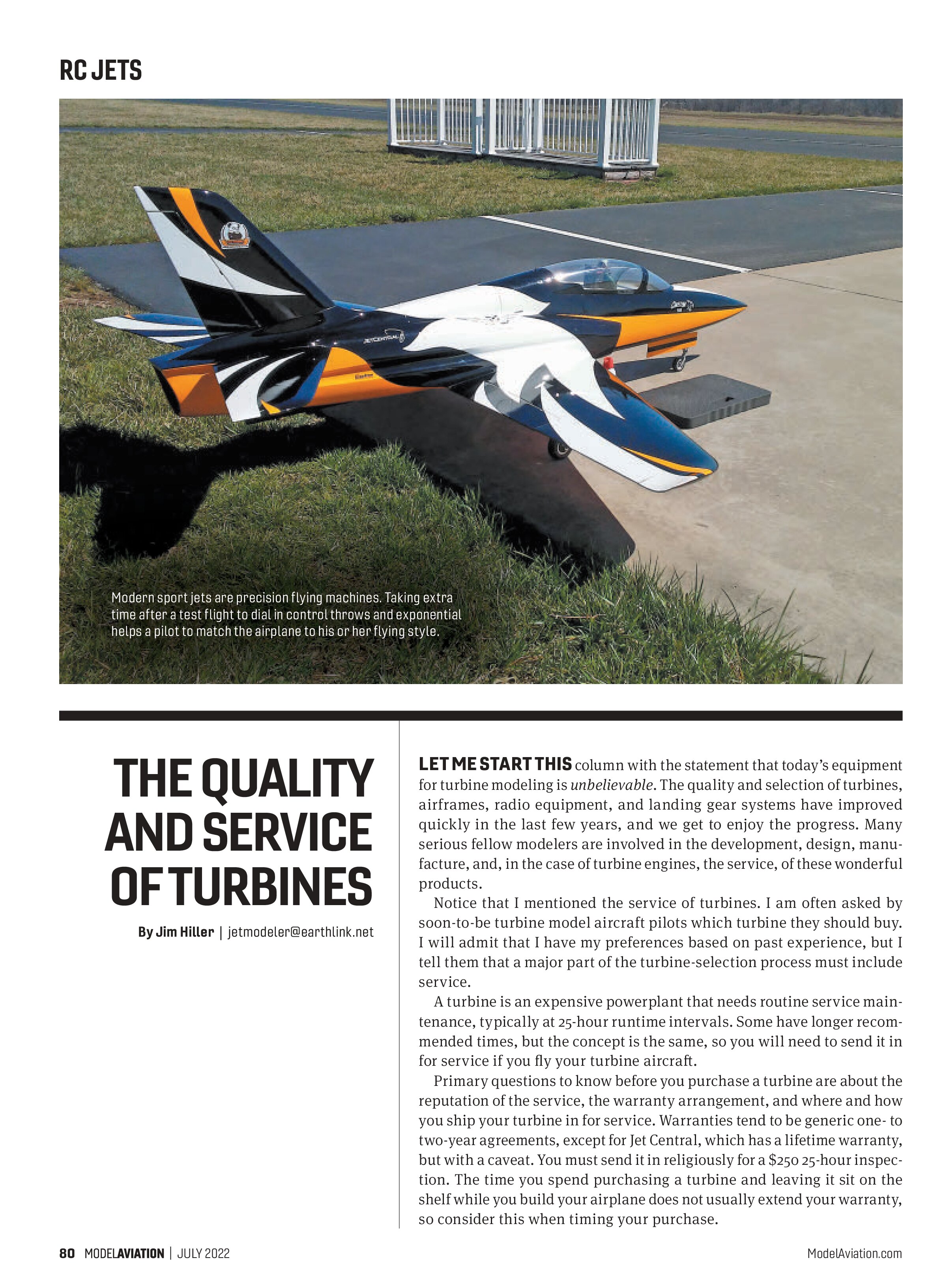
THE QUALITY
AND SERVICE
OF TURBINES
By Jim Hiller | jetmodeler@earthlink.net

LET ME START THIS column with the statement that today’s equipment for turbine modeling is unbelievable. The quality and selection of turbines, airframes, radio equipment, and landing gear systems have improved quickly in the last few years, and we get to enjoy the progress. Many serious fellow modelers are involved in the development, design, manufacture, and, in the case of turbine engines, the service, of these wonderful products.
Notice that I mentioned the service of turbines. I am often asked by soon-to-be turbine model aircraft pilots which turbine they should buy. I will admit that I have my preferences based on past experience, but I tell them that a major part of the turbine-selection process must include service.
A turbine is an expensive powerplant that needs routine service maintenance, typically at 25-hour runtime intervals. Some have longer recommended times, but the concept is the same, so you will need to send it in for service if you fly your turbine aircraft.
Primary questions to know before you purchase a turbine are about the reputation of the service, the warranty arrangement, and where and how you ship your turbine in for service. Warranties tend to be generic one- to two-year agreements, except for Jet Central, which has a lifetime warranty, but with a caveat. You must send it in religiously for a $250 25-hour inspection. The time you spend purchasing a turbine and leaving it sit on the shelf while you build your airplane does not usually extend your warranty, so consider this when timing your purchase.
How reliable are turbines? Let me tell you the story of my oldest, regularly flown turbine, a Jet Central Rabbit. This little powerhouse dates back to the initial introduction of the Rabbit turbine more than 10 years ago. When it was new, it put out 19 pounds of thrust. I have flown this turbine engine a lot—every year that I have owned it, it has flown. When the SE version of the Rabbit was developed, my turbine was upgraded to it, with 24 pounds of thrust and the latest electronics, including a PowerPack fuel pump, which is well worth the cost of the upgrade.
This turbine has served me well and without issues for hundreds of hours—that is, until a few months ago. It finally happened—a turbine blade failed. The lifetime warranty covered the repairs, although they were rather costly for Jet Central because the rotating assembly, compressor housing, and the nozzle guide vane all had to be replaced.
The real reason for this story is that a modern turbine engine can run for a long time. With good service at regular intervals, it is a remarkably reliable powerplant. Do your research when selecting your first turbine. Research not only the turbine but the support behind your new jewel. When you fly your turbine often, as I do, your ownership experience includes the lifetime support by the service repairmen.
Control Travel
I have the opportunity to fly a lot of model airplanes—not just my own but also for my friends. I have learned how important it is to fine-tune your airplane after the test flight. It makes a huge difference in how enjoyable it is to fly.
We all talk about the effects of the center of gravity (CG), but we don’t discuss control travel that much, although we really should. It affects the character of your new airplane. How much total travel and what exponential can do to improve the feel are important tools for setting up your airplane to fly the way you want it to. It can, however, be quite involved and time-consuming to dial it in to suit your flying style.
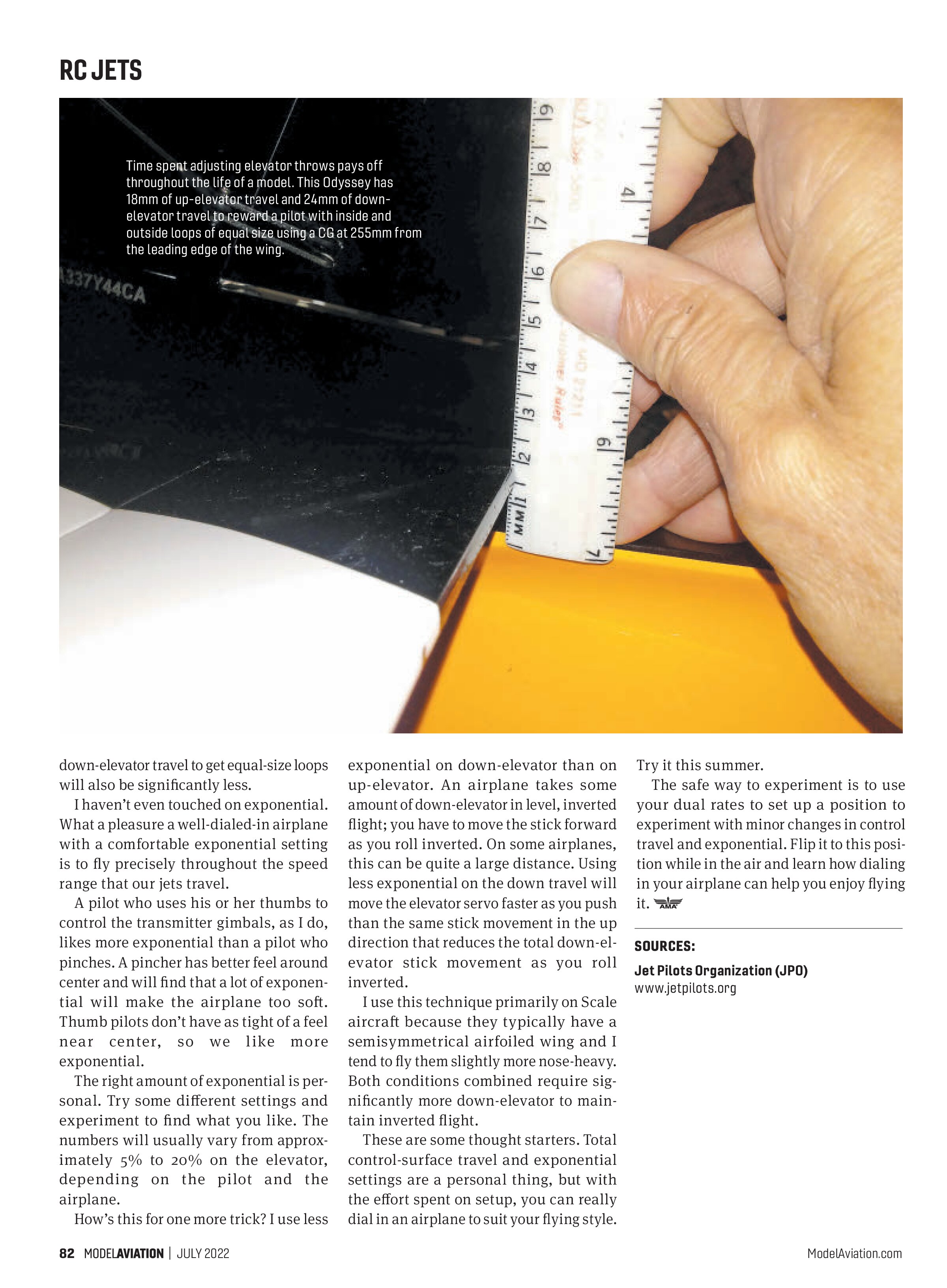
Let’s discuss the elevator. You can adjust travel both up and down separately, along with exponential. How much travel is needed? That’s a complicated question, so here are some of my thoughts for typical sport and scale aircraft.
I like full control, whether it is up-elevator or down-elevator, to just break into a stall but not deeply into a stall. I don’t like sudden surprises, such as a violent stall when I pull full up-elevator. I test the elevator travel by performing a moderate-speed loop and pulling full up-elevator across the top. If it snaps out with too much travel, reduce it when you land.
A true aerobatic pilot will do this same test with an outside loop to dial in the down-elevator travel as well. On a wing with a symmetrical airfoil, it typically takes 5% to 10% more travel. You will be rewarded with inside and outside loops of equal size, making precision aerobatic flying easier and more enjoyable.
Now things can get complicated. Can you use this same control throw for landing? That depends on a lot of things but primarily your CG. A slightly nose-heavy airplane is easier to land but typically requires a bit more up-elevator travel for landing. Use your dual rates to increase the elevator throw for landing. When the settings have been decided, I assign the elevator dual rate to the flap switch so that I always have the right elevator rate for flaps up, takeoff flaps, or landing flaps.
A tail-heavy airplane can be fun for flying aerobatics, but it takes different travels to achieve the same characteristics. It will require less elevator travel on landing to stay out of trouble. Some of the aggressive aerobatic jet pilots will surprise you with how far back their CG is when they fly. This setup technique allows the aircraft to still handle well for landing. The
down-elevator travel to get equal-size loops will also be significantly less.
I haven’t even touched on exponential. What a pleasure a well-dialed-in airplane with a comfortable exponential setting is to fly precisely throughout the speed range that our jets travel.
A pilot who uses his or her thumbs to control the transmitter gimbals, as I do, likes more exponential than a pilot who pinches. A pincher has better feel around center and will find that a lot of exponential will make the airplane too soft. Thumb pilots don’t have as tight of a feel near center, so we like more exponential.
The right amount of exponential is personal. Try some different settings and experiment to find what you like. The numbers will usually vary from approximately 5% to 20% on the elevator, depending on the pilot and the airplane.
How’s this for one more trick? I use less

exponential on down-elevator than on up-elevator. An airplane takes some amount of down-elevator in level, inverted flight; you have to move the stick forward as you roll inverted. On some airplanes, this can be quite a large distance. Using less exponential on the down travel will move the elevator servo faster as you push than the same stick movement in the up direction that reduces the total down-elevator stick movement as you roll inverted.
I use this technique primarily on Scale aircraft because they typically have a semisymmetrical airfoiled wing and I tend to fly them slightly more nose-heavy. Both conditions combined require significantly more down-elevator to maintain inverted flight.
These are some thought starters. Total control-surface travel and exponential settings are a personal thing, but with the effort spent on setup, you can really dial in an airplane to suit your flying style.
Try it this summer.
The safe way to experiment is to use your dual rates to set up a position to experiment with minor changes in control travel and exponential. Flip it to this position while in the air and learn how dialing in your airplane can help you enjoy flying it.
SOURCES:
Jet Pilots Organization (JPO)
www.jetpilots.org