RC AEROBATICS

FLYING
STRAIGHT
By Justin Wells | justinwells@mac.com
WE SPENT TIME IN my last column getting your favorite airplane flying even better or improving an airplane that you thought wasn’t flying all that well. It’s amazing what spending a few minutes can do to really dial in an aircraft.
Let’s put that hard work to the test and dip your toe into a flying session. Remember, you are starting slow and not rushing into anything; only do what you find comfortable. Use your favorite airplane to get started.
Breaking Out of the Circle
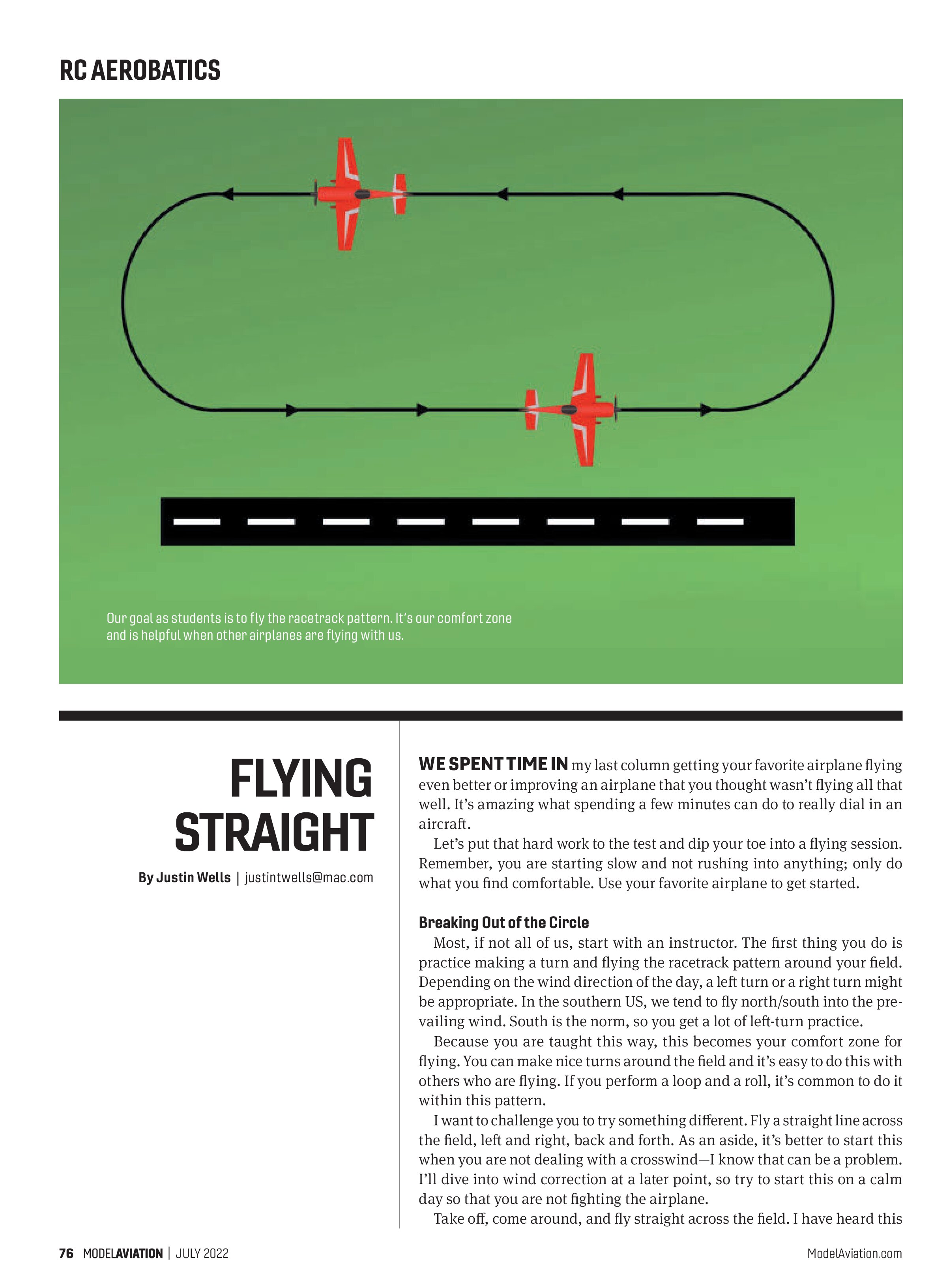
Most, if not all of us, start with an instructor. The first thing you do is practice making a turn and flying the racetrack pattern around your field. Depending on the wind direction of the day, a left turn or a right turn might be appropriate. In the southern US, we tend to fly north/south into the prevailing wind. South is the norm, so you get a lot of left-turn practice.
Because you are taught this way, this becomes your comfort zone for flying. You can make nice turns around the field and it’s easy to do this with others who are flying. If you perform a loop and a roll, it’s common to do it within this pattern.
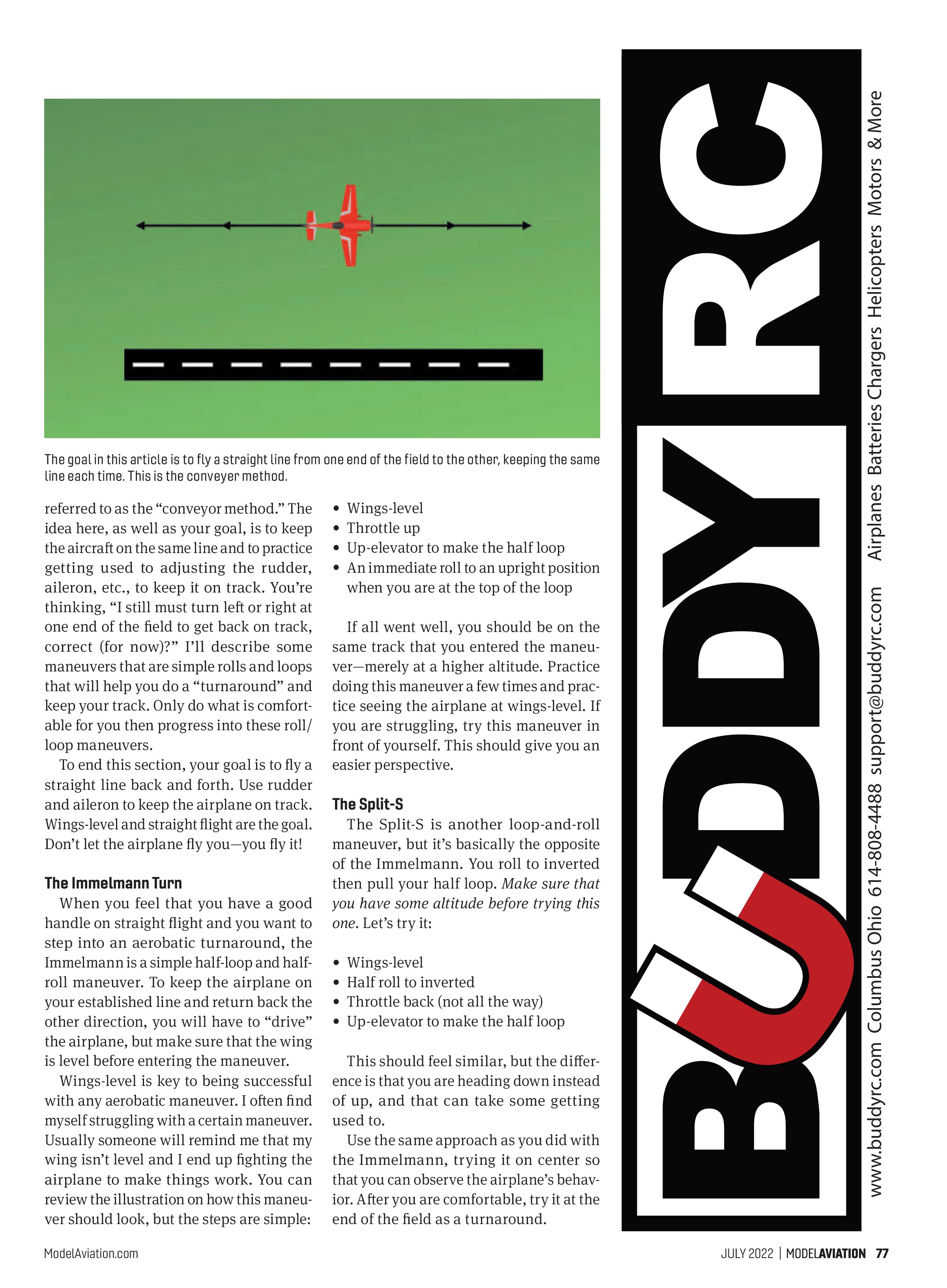
I want to challenge you to try something different. Fly a straight line across the field, left and right, back and forth. As an aside, it’s better to start this when you are not dealing with a crosswind—I know that can be a problem. I’ll dive into wind correction at a later point, so try to start this on a calm day so that you are not fighting the airplane.
Take off, come around, and fly straight across the field. I have heard this referred to as the “conveyor method.” The idea here, as well as your goal, is to keep the aircraft on the same line and to practice getting used to adjusting the rudder, aileron, etc., to keep it on track. You’re thinking, “I still must turn left or right at one end of the field to get back on track, correct (for now)?” I’ll describe some maneuvers that are simple rolls and loops that will help you do a “turnaround” and keep your track. Only do what is comfortable for you then progress into these roll/loop maneuvers.
To end this section, your goal is to fly a straight line back and forth. Use rudder and aileron to keep the airplane on track. Wings-level and straight flight are the goal. Don’t let the airplane fly you—you fly it!
The Immelmann Turn
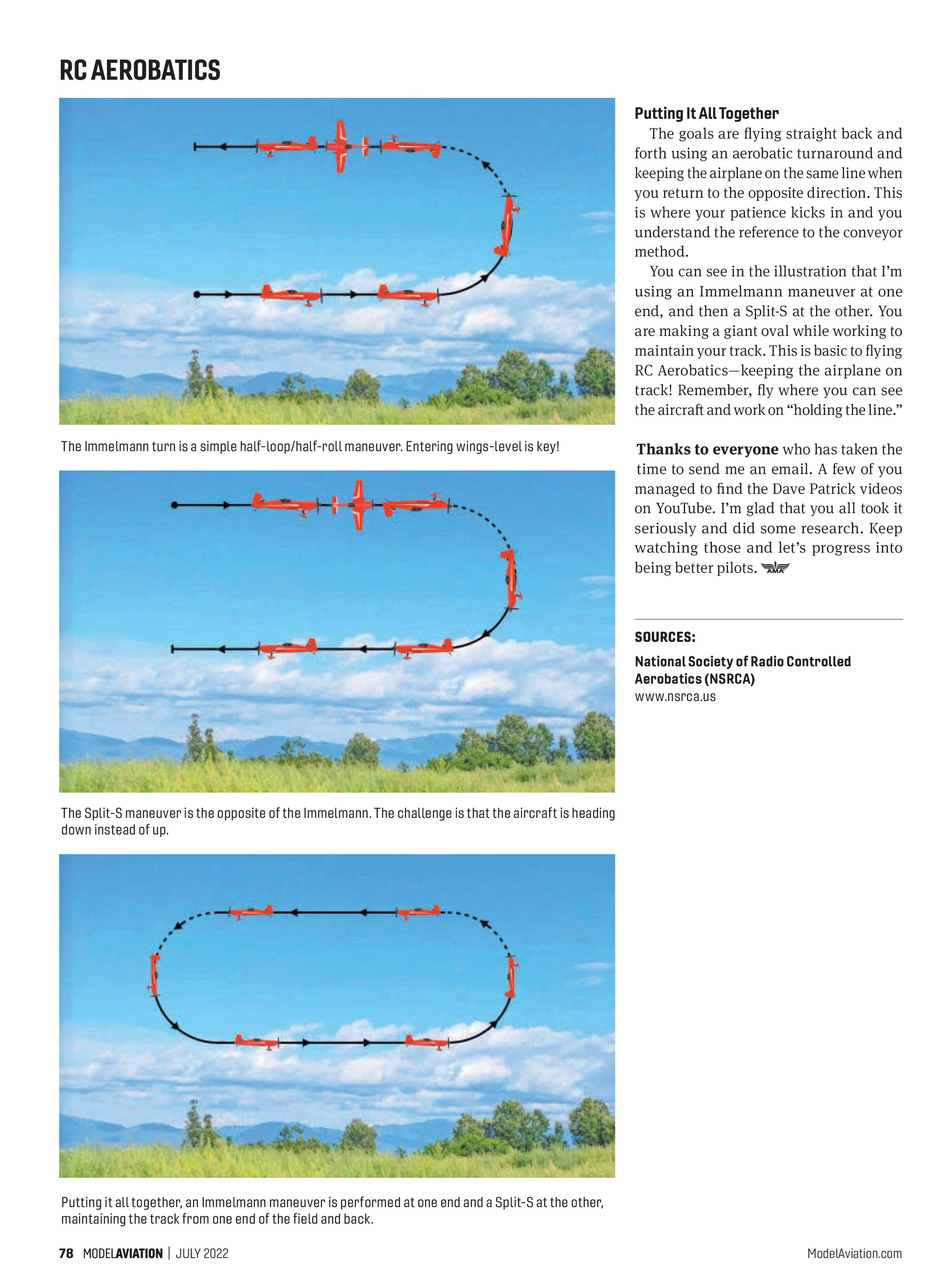
When you feel that you have a good handle on straight flight and you want to step into an aerobatic turnaround, the Immelmann is a simple half-loop and half-roll maneuver. To keep the airplane on your established line and return back the other direction, you will have to “drive” the airplane, but make sure that the wing is level before entering the maneuver.
Wings-level is key to being successful with any aerobatic maneuver. I often find myself struggling with a certain maneuver. Usually someone will remind me that my wing isn’t level and I end up fighting the airplane to make things work. You can review the illustration on how this maneuver should look, but the steps are simple:
- Wings-level
- Throttle up
- Up-elevator to make the half loop
- An immediate roll to an upright position when you are at the top of the loop
If all went well, you should be on the same track that you entered the maneuver—merely at a higher altitude. Practice doing this maneuver a few times and practice seeing the airplane at wings-level. If you are struggling, try this maneuver in front of yourself. This should give you an easier perspective.
The Split-S
The Split-S is another loop-and-roll maneuver, but it’s basically the opposite of the Immelmann. You roll to inverted then pull your half loop. Make sure that you have some altitude before trying this one. Let’s try it:
- Wings-level
- Half roll to inverted
- Throttle back (not all the way)
- Up-elevator to make the half loop
This should feel similar, but the difference is that you are heading down instead of up, and that can take some getting used to.
Use the same approach as you did with the Immelmann, trying it on center so that you can observe the airplane’s behavior. After you are comfortable, try it at the end of the field as a turnaround.


Putting It All Together
The goals are flying straight back and forth using an aerobatic turnaround and keeping the airplane on the same line when you return to the opposite direction. This is where your patience kicks in and you understand the reference to the conveyor method.
You can see in the illustration that I’m using an Immelmann maneuver at one end, and then a Split-S at the other. You are making a giant oval while working to maintain your track. This is basic to flying RC Aerobatics—keeping the airplane on track! Remember, fly where you can see the aircraft and work on “holding the line.”
Thanks to everyone who has taken the time to send me an email. A few of you managed to find the Dave Patrick videos on YouTube. I’m glad that you all took it seriously and did some research. Keep watching those and let’s progress into being better pilots.
SOURCES:
National Society of Radio Controlled Aerobatics (NSRCA)
www.nsrca.us