MODEL AIRCRAFT
PRECISION
AEROBATICS
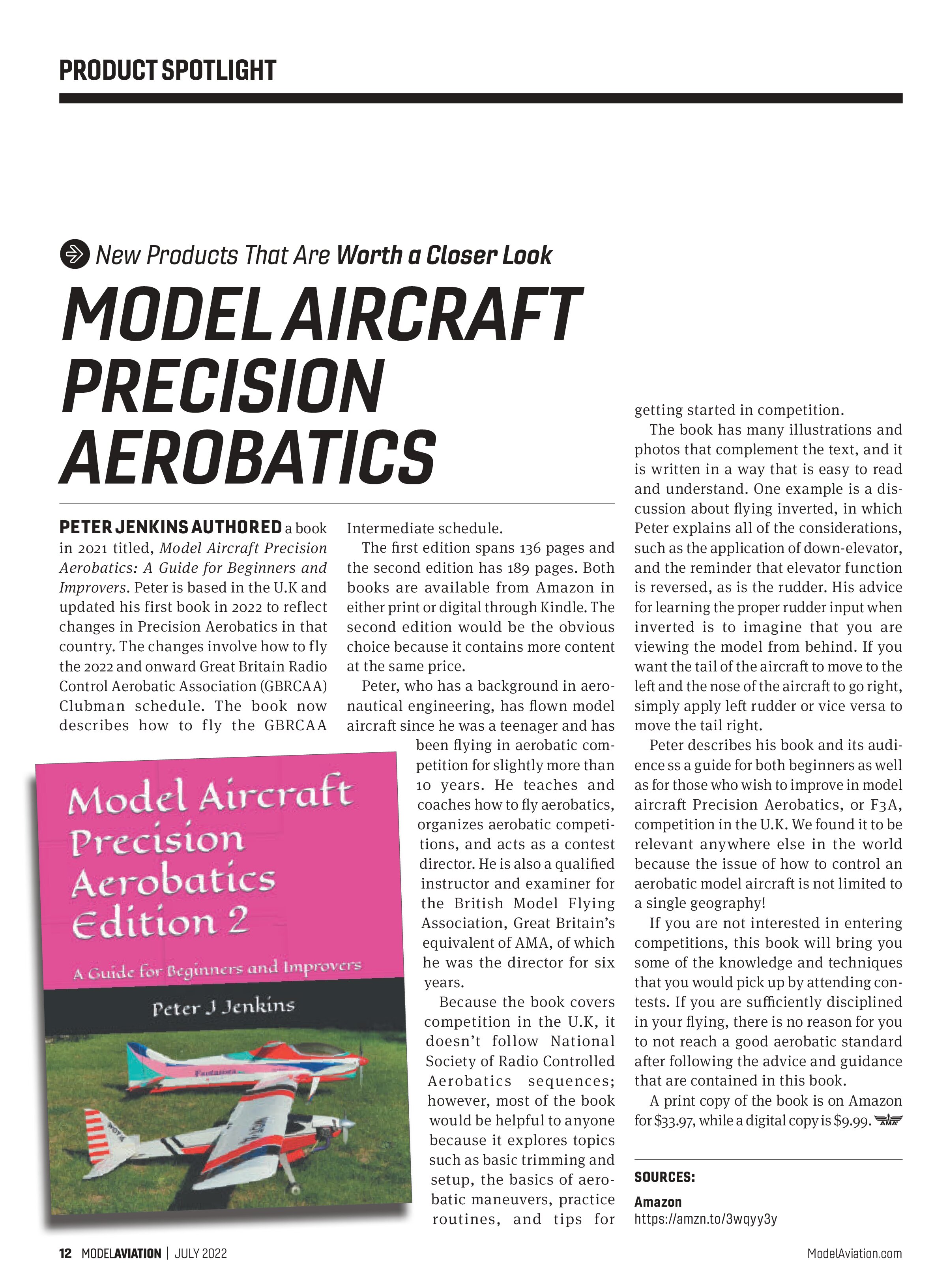
PETER JENKINS AUTHORED a book in 2021 titled, Model Aircraft Precision Aerobatics: A Guide for Beginners and Improvers. Peter is based in the U.K. and updated his first book in 2022 to reflect changes in Precision Aerobatics in that country. The changes involve how to fly the 2022 and onward Great Britain Radio Control Aerobatic Association (GBRCAA) Clubman schedule. The book now describes how to fly the GBRCAA Intermediate schedule.
The first edition spans 136 pages and the second edition has 189 pages. Both books are available from Amazon in either print or digital through Kindle. The second edition would be the obvious choice because it contains more content at the same price.
Peter, who has a background in aeronautical engineering, has flown model aircraft since he was a teenager and has been flying in aerobatic competition for slightly more than 10 years. He teaches and coaches how to fly aerobatics, organizes aerobatic competitions, and acts as a contest director. He is also a qualified instructor and examiner for the British Model Flying Association, Great Britain’s equivalent of AMA, of which he was the director for six years.

Because the book covers competition in the U.K., it doesn’t follow National Society of Radio Controlled Aerobatics sequences; however, most of the book would be helpful to anyone because it explores topics such as basic trimming and setup, the basics of aerobatic maneuvers, practice routines, and tips for getting started in competition.
The book has many illustrations and photos that complement the text, and it is written in a way that is easy to read and understand. One example is a discussion about flying inverted, in which Peter explains all of the considerations, such as the application of down-elevator, and the reminder that elevator function is reversed, as is the rudder. His advice for learning the proper rudder input when inverted is to imagine that you are viewing the model from behind. If you want the tail of the aircraft to move to the left and the nose of the aircraft to go right, simply apply left rudder or vice versa to move the tail right.
Peter describes his book and its audience as a guide for both beginners as well as for those who wish to improve in model aircraft Precision Aerobatics, or F3A, competition in the U.K. We found it to be relevant anywhere else in the world because the issue of how to control an aerobatic model aircraft is not limited to a single geography!
If you are not interested in entering competitions, this book will bring you some of the knowledge and techniques that you would pick up by attending contests. If you are sufficiently disciplined in your flying, there is no reason for you to not reach a good aerobatic standard after following the advice and guidance that are contained in this book.
A print copy of the book is on Amazon for $33.97, while a digital copy is $9.99.
New Products from the Modeler’s Mall


Ranger 30 RC Park Flyer Kit B-337 @ $69 + S&H from BMJR Models
Tel.: (321) 537-1159; website: www.bjmrmodels.com
In 1958, Carl Goldberg Models introduced the Ranger 30. With a 30-inch wingspan and all sheet balsa construction, it was intended to help a new modeler achieve success in building a model airplane that also flew well. The original kit was set up to be built for Free Flight (FF) or Control Line (CL) with a glow-power engine. The new BMJR kit is an RC park flyer that is based on the original Ranger 30.
As a park flyer, the BMJR Ranger 30 retains most of the features of the original model, while taking advantage of present-day micro-RC gear and electric power. It can also be flown with the original Cox Pee Wee .020 glow-engine setup.
Also included in the Ranger lineup and sold separately are the rubber-powered FF Ranger 21 (kit B-512) and the Ranger 28 (kit B-510), as well as the Pee Wee .020-powered Ranger 30 FF/CL model (kit B-143).
1/2A Streaker Balsa Kit with Foam Wing Cores @ $79.95 + S&H from Dick Russ Models
Tel.: (405) 470-2767; website: www.dickrussmodels.com
In 1975, Allied Hobbies Manufacturing produced the 1/2A Streaker to build and fly in the new 1/2A racing circuit. Weighing approximately 18 ounces, it was easy to build, fun to fly, and dominated the racing of the day, using a Cox .049 or .051 engine with a shorter, 33-inch wingspan. With the standard 35-inch wingspan, it was a great sport airplane for an everyday flier.
Now, after 47 years, Dick Russ has tooled up and is producing the kit. Included are the original plans, as well as detailed instructions for Cox engines or conversions to electric power. It’s a bargain to fly, using only an ounce of fuel for a 6- to 8-minute flight.
The Streaker is quick and easy to build and comes with precut balsa and plywood parts, along with a plastic turtleback canopy that forms the complete top of the airplane. The precision CNC-cut wing uses the same airfoil from 1975, and it only uses elevator and ailerons for flight control.
Hitec HS-81 micro servos are recommended.
MiG-17 @ $5,990-(TBD) + S&H from CARF-Models Trading LLC
Tel.: (207) 329-7713 or (217) 840-2535; website: www.carf-models.com
The CARF-Models MiG-17 was developed following advice from several full-scale jet pilots in the US who own restored MiG-17s, including Bill Culberson and Jason Somes. Modeled in a scale of 1:3.7, it has a wingspan of 265 cm (approximately 104 inches) and weighs less than 25 kg (55 pounds).
Fully detailed with all-composite construction, the base model is painted silver in the molds. The fuselage has front and rear parts for easy transportation, and the wing is joined with a pair of 30mm carbon-fiber tubes. The fin and stabilizer are also removable and have their servos close to the control surfaces, with linkages as hidden as possible. The scale cockpit, made by Francesco Mondinelli in Italy, includes a sliding canopy mechanism.
Lightweight scale landing gear that is made in Germany and based on Electron Retracts gear with a GS-200 controller, has been developed for this model. A spiral, reinforced, stainless steel thrust tube with a carbon intake lip has been specially designed for the MiG-17. Any turbine engine between 200 and 250 newtons works well.
CARF-Models can paint the jet in any other color, finish the scheme like the prototype in the photo or its sister aircraft (1613 or 1610), or paint any original Cold War scheme in the mold or outside of it. Aluminum-effect sanding and scale weathering at any level can also be added.