INGENUITY MARS HELICOPTER TEAM AND COLLIER TROPHY
By Thayer Syme | thayer@flying-models.com

I HAVE SOME GREAT NEWS to share this month that is rooted in our modeling community. I also want to discuss some not-so-great news that we can hopefully overcome. Let’s start off on the high note.
2021 Collier Trophy
On April 5, 2022, the National Aeronautic Association announced NASA’s Jet Propulsion Laboratory Ingenuity Mars Helicopter team as the 2021 recipient of the Robert J. Collier Trophy. The Ingenuity team was recognized for “... the first powered, controlled flight of an aircraft on another planet, thereby opening the skies of Mars and other worlds for future scientific discovery and exploration.”
As you might already know, the Collier Trophy has been awarded annually since 1911 to celebrate the greatest achievement in aeronautics or astronautics in the US during the previous year. The list of recipients represents a timeline of air and space achievements, marking major milestones in the history of flight.
Despite the concerns of many that flying a helicopter on Mars was simply not possible, those involved were confident that there was a solution and worked tirelessly for nearly a decade to realize their dream.
There are a number of obstacles to flying on Mars, not the least of which is the relatively thin atmosphere. Many of us have experienced a performance drop with our vehicles—and models—when traveling from sea level to higher elevations. The Ingenuity team was up against not just a 5- to 10,000-foot gain in altitude though. The effective altitude of the Martian atmosphere is the same as trying to fly at 120,000 feet here on Earth!
Conquering this challenge required nearly everything to be custom, along with fastidious attention to innumerable details along the way. Although I don’t have nearly the space required to fully cover such a momentous achievement, I wanted to bring it to your attention for a couple of reasons.
First, anyone who has ever worked within a large entity knows that the people who are actually rolling up their sleeves to get the job done with such an endeavor might be easily overlooked when the goal is reached and the confetti flies. On the off chance that this might happen in this case as well, I wanted to call out a couple of the people involved whom I know personally.
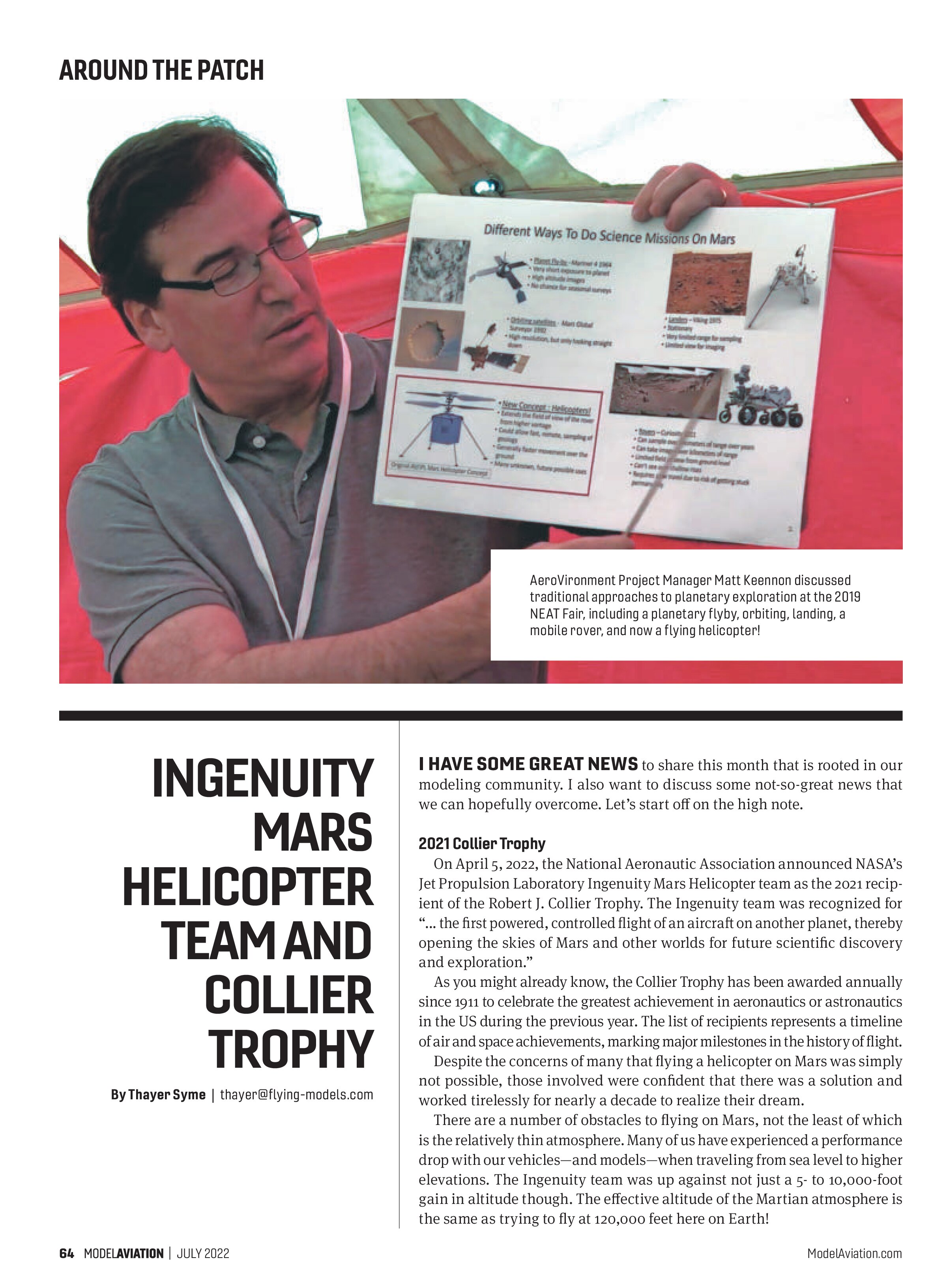
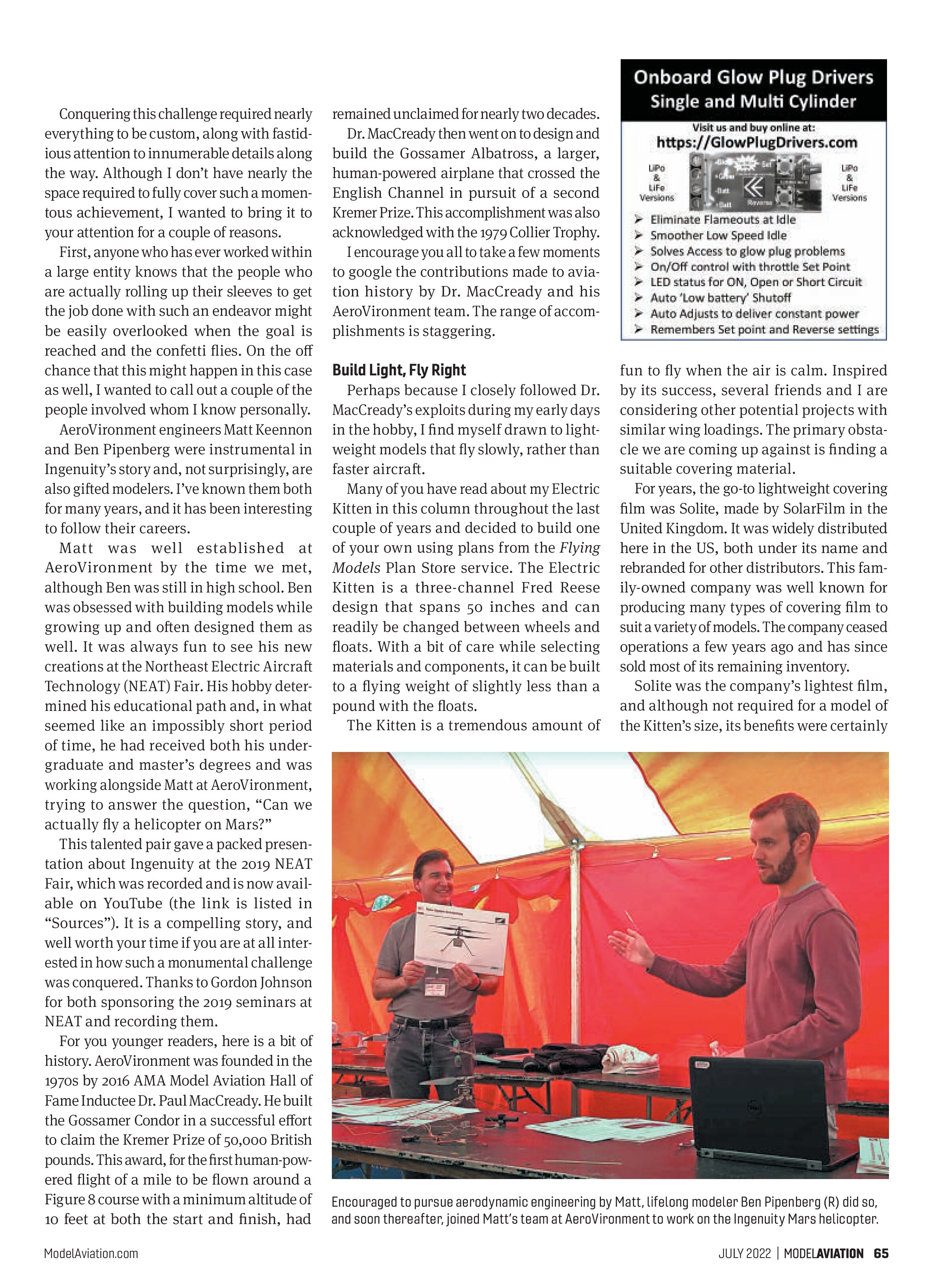
AeroVironment engineers Matt Keennon and Ben Pipenberg were instrumental in Ingenuity’s story and, not surprisingly, are also gifted modelers. I’ve known them both for many years, and it has been interesting to follow their careers.
Matt was well established at AeroVironment by the time we met, although Ben was still in high school. Ben was obsessed with building models while growing up and often designed them as well. It was always fun to see his new creations at the Northeast Electric Aircraft Technology (NEAT) Fair. His hobby determined his educational path and, in what seemed like an impossibly short period of time, he had received both his undergraduate and master’s degrees and was working alongside Matt at AeroVironment, trying to answer the question, “Can we actually fly a helicopter on Mars?”
This talented pair gave a packed presentation about Ingenuity at the 2019 NEAT Fair, which was recorded and is now available on YouTube (the link is listed in “Sources”). It is a compelling story, and well worth your time if you are at all interested in how such a monumental challenge was conquered. Thanks to Gordon Johnson for both sponsoring the 2019 seminars at NEAT and recording them.
For you younger readers, here is a bit of history. AeroVironment was founded in the 1970s by 2016 AMA Model Aviation Hall of Fame Inductee Dr. Paul MacCready. He built the Gossamer Condor in a successful effort to claim the Kremer Prize of 50,000 British pounds. This award, for the first human-powered flight of a mile to be flown around a Figure 8 course with a minimum altitude of 10 feet at both the start and finish, had remained unclaimed for nearly two decades.
Dr. MacCready then went on to design and build the Gossamer Albatross, a larger, human-powered airplane that crossed the English Channel in pursuit of a second Kremer Prize. This accomplishment was also acknowledged with the 1979 Collier Trophy.
I encourage you all to take a few moments to google the contributions made to aviation history by Dr. MacCready and his AeroVironment team. The range of accomplishments is staggering.
Build Light, Fly Right
Perhaps because I closely followed Dr. MacCready’s exploits during my early days in the hobby, I find myself drawn to lightweight models that fly slowly, rather than faster aircraft.
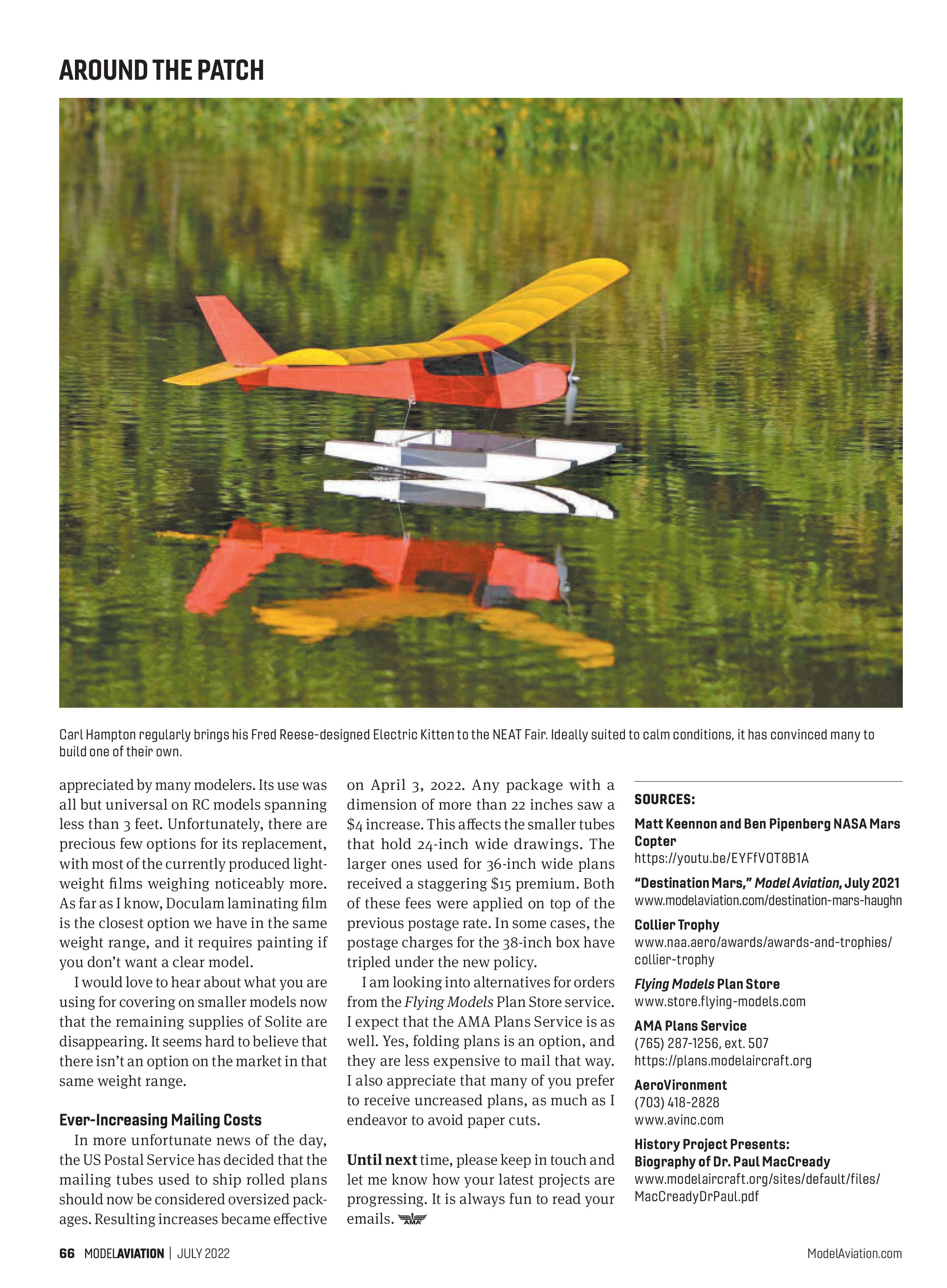
Many of you have read about my Electric Kitten in this column throughout the last couple of years and decided to build one of your own using plans from the Flying Models Plan Store service. The Electric Kitten is a three-channel Fred Reese design that spans 50 inches and can readily be changed between wheels and floats. With a bit of care while selecting materials and components, it can be built to a flying weight of slightly less than a pound with the floats.
The Kitten is a tremendous amount of fun to fly when the air is calm. Inspired by its success, several friends and I are considering other potential projects with similar wing loadings. The primary obstacle we are coming up against is finding a suitable covering material.
For years, the go-to lightweight covering film was Solite, made by SolarFilm in the United Kingdom. It was widely distributed here in the US, both under its name and rebranded for other distributors. This family-owned company was well known for producing many types of covering film to suit a variety of models. The company ceased operations a few years ago and has since sold most of its remaining inventory.
Solite was the company’s lightest film, and although not required for a model of the Kitten’s size, its benefits were certainly


appreciated by many modelers. Its use was all but universal on RC models spanning less than 3 feet. Unfortunately, there are precious few options for its replacement, with most of the currently produced lightweight films weighing noticeably more. As far as I know, Doculam laminating film is the closest option we have in the same weight range, and it requires painting if you don’t want a clear model.
I would love to hear about what you are using for covering on smaller models now that the remaining supplies of Solite are disappearing. It seems hard to believe that there isn’t an option on the market in that same weight range.
Ever-Increasing Mailing Costs
In more unfortunate news of the day, the US Postal Service has decided that the mailing tubes used to ship rolled plans should now be considered oversized packages. Resulting increases became effective on April 3, 2022. Any package with a dimension of more than 22 inches saw a $4 increase. This affects the smaller tubes that hold 24-inch wide drawings. The larger ones used for 36-inch wide plans received a staggering $15 premium. Both of these fees were applied on top of the previous postage rate. In some cases, the postage charges for the 38-inch box have tripled under the new policy.
I am looking into alternatives for orders from the Flying Models Plan Store service. I expect that the AMA Plans Service is as well. Yes, folding plans is an option, and they are less expensive to mail that way. I also appreciate that many of you prefer to receive uncreased plans, as much as I endeavor to avoid paper cuts.
Until next time
Until next time, please keep in touch and let me know how your latest projects are progressing. It is always fun to read your emails.
SOURCES:
Matt Keannnon and Ben Pipenberg NASA Mars Copter
https://youtu.be/EYFvOT8B1A
“Destination Mars,” Model Aviation, July 2021
www.modelaviation.com/destination-mars-haughn
Collier Trophy
www.nasa.aero/awards/awards-and-trophies/collier-trophy
Flying Models Plan Store
www.store.flying-models.com
AMA Plans Service
(765) 287-1256, ext. 507
https://plans.modelaircraft.org
AeroVironment
(703) 418-2828
www.avinc.com
History Project Presents: Biography of Dr. Paul MacCready
www.modelaircraft.org/sites/default/files/MacCreadyDrPaul.pdf