SKY’S THE LIMIT
PRIVATE
PILOT’S
LICENSE
TIME?
By Jennifer Reynolds | jensunshine3@gmail.com

THROUGHOUT THE PAST FEW MONTHS, I’ve spent a great deal of time seriously considering obtaining my private pilot’s license. Somehow, typing these words seems to seal in the reality behind it all. This is something I just might do! Yes, indeed, I am interested in pursuing this. Naturally, I have tons of questions and a great deal to look into, but one thing is certain: My love of flying models and my experiences with them will give me a jump-start.
I’m familiar with airplane terminology and characteristics, knowing my ailerons from my elevators and what happens when they are moved left or right, or up or down. I understand wind direction, air flow, thermals, and most of the intricacies of flight. I’m sure that most non-aviation enthusiasts also know some of these things, but I’m betting that they don’t know the particulars the way we modelers do. I know I’ll have a lot to learn, but I’m happy that my years of flying models will give me an edge.
I recall a full-scale pilot who attended a modeling event a few years ago. “I give you guys a lot of credit,” he said, as he watched RC pilots performing maneuvers. “This looks to be a lot more challenging than the flying that I do. You’re dealing with various perspectives.” He went on to explain that when he flies, left is always true left, whereas with modelers (although that is often the case), it depends on whether our airplane is going away from us or coming toward us.
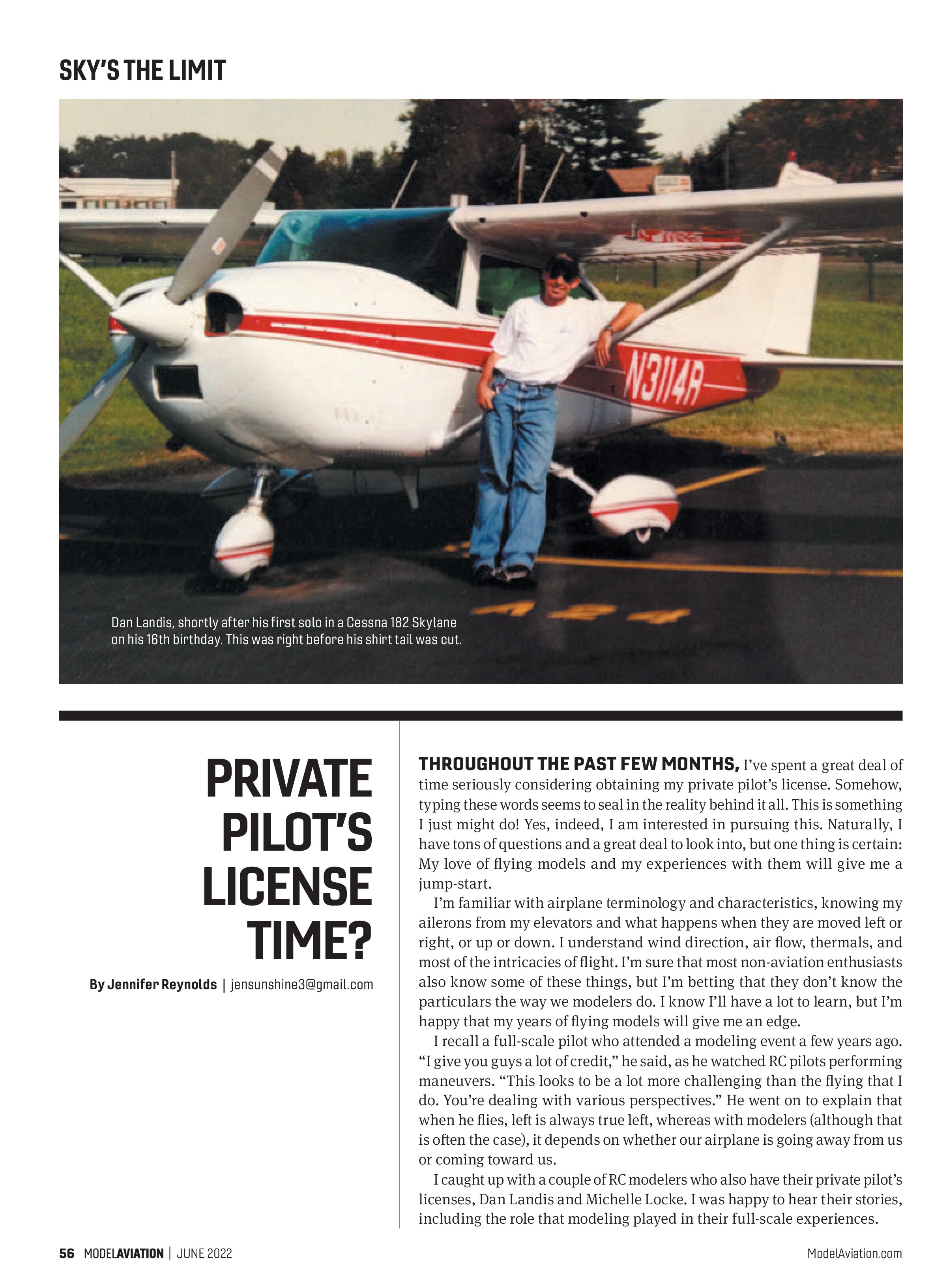
I caught up with a couple of RC modelers who also have their private pilot’s licenses, Dan Landis and Michelle Locke. I was happy to hear their stories, including the role that modeling played in their full-scale experiences.

full-scale airplanes and models with his father in the past, as well as the present. “We both fly as much as we can and always have something fun and exciting to tell each other.”

Modeling Helps Aspiring Full-Scale Pilots
I was happy to hear Dan explain that flying models does indeed help when it comes to learning to fly full-scale aircraft. “It gives you the knowledge of the parts of an airplane—how they work and what they do,” he said. He explained the similarities. For example, a little left aileron and up-elevator will make a left turn while flying models. In the full-scale airplane, it’s the same, but he said that he just adds a touch of rudder to the mix.
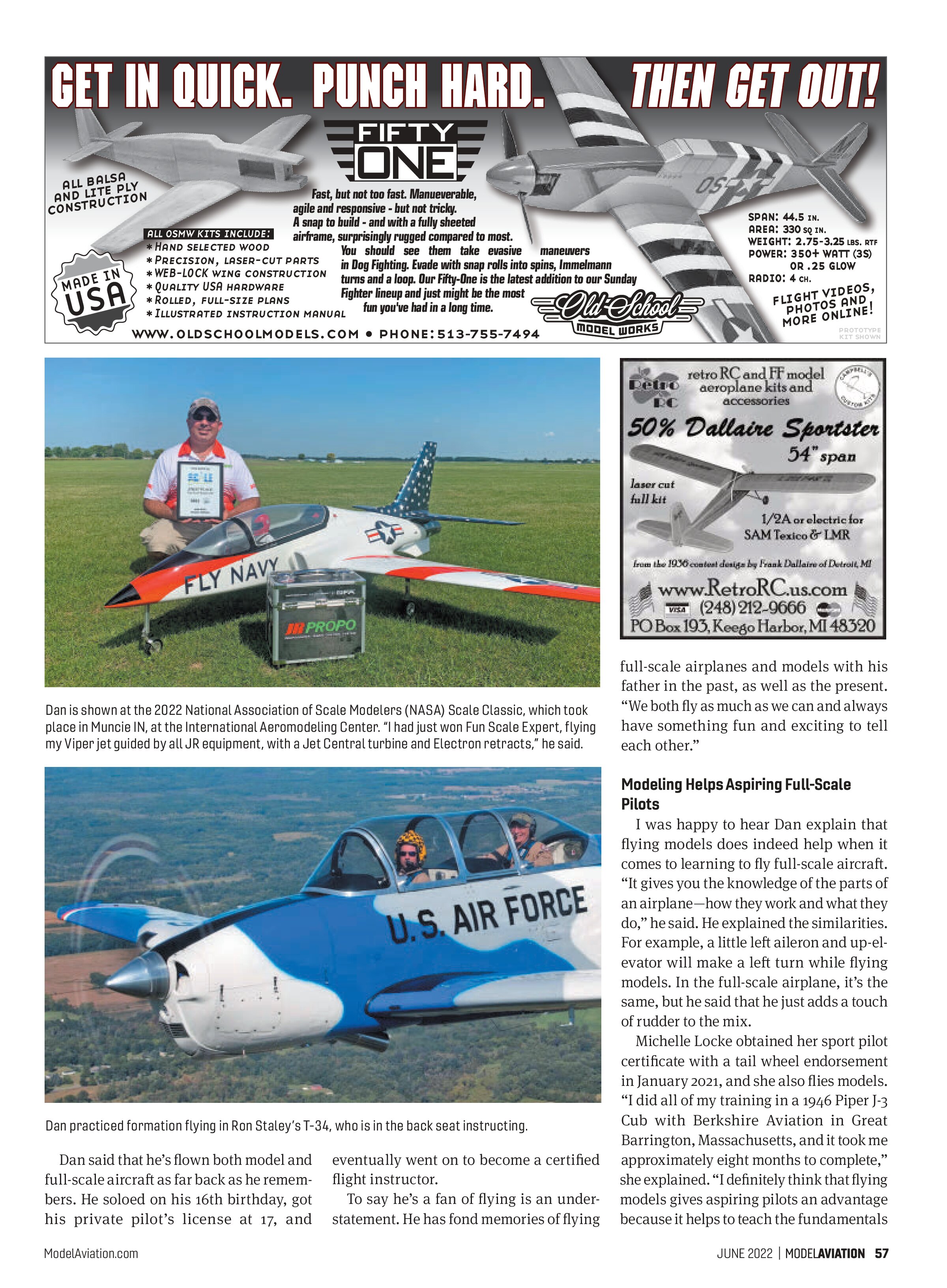
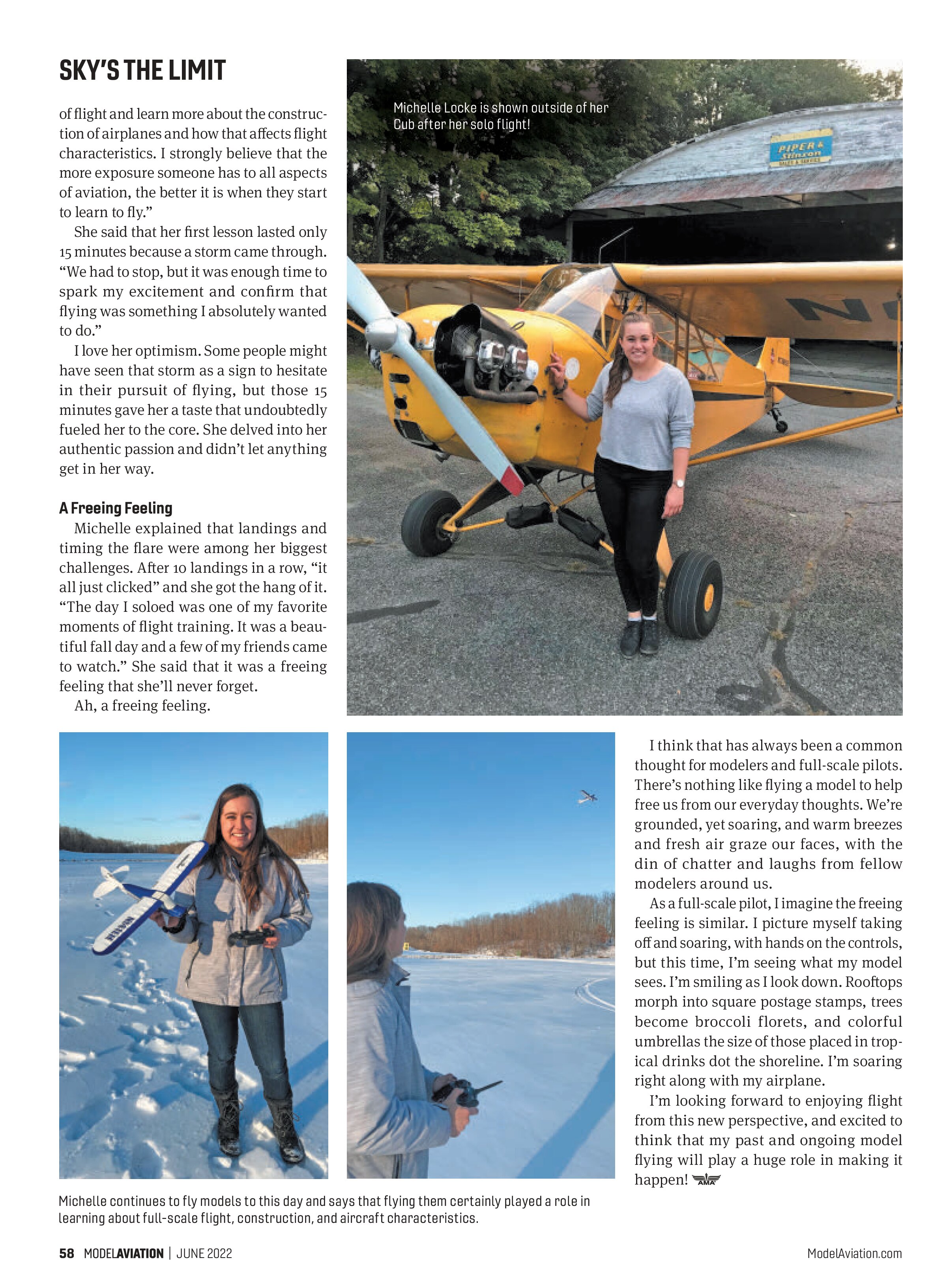
Michelle Locke obtained her sport pilot certificate with a tail wheel endorsement in January 2021, and she also flies models. “I did all of my training in a 1946 Piper J-3 Cub with Berkshire Aviation in Great Barrington, Massachusetts, and it took me approximately eight months to complete,” she explained. “I definitely think that flying models gives aspiring pilots an advantage because it helps to teach the fundamentals
of flight and learn more about the construction of airplanes and how that affects flight characteristics. I strongly believe that the more exposure someone has to all aspects of aviation, the better it is when they start to learn to fly.”
She said that her first lesson lasted only 15 minutes because a storm came through. “We had to stop, but it was enough time to spark my excitement and confirm that flying was something I absolutely wanted to do.”
I love her optimism. Some people might have seen that storm as a sign to hesitate in their pursuit of flying, but those 15 minutes gave her a taste that undoubtedly fueled her to the core. She delved into her authentic passion and didn’t let anything get in her way.
A Freeing Feeling
Michelle explained that landings and timing the flare were among her biggest challenges. After 10 landings in a row, “it all just clicked” and she got the hang of it. “The day I soloed was one of my favorite moments of flight training. It was a beautiful fall day and a few of my friends came to watch.” She said that it was a freeing feeling that she’ll never forget.
Ah, a freeing feeling.


I think that has always been a common thought for modelers and full-scale pilots. There’s nothing like flying a model to help free us from our everyday thoughts. We’re grounded, yet soaring, and warm breezes and fresh air graze our faces, with the din of chatter and laughs from fellow modelers around us.
As a full-scale pilot, I imagine the freeing feeling is similar. I picture myself taking off and soaring, with hands on the controls, but this time, I’m seeing what my model sees. I’m smiling as I look down. Rooftops morph into square postage stamps, trees become broccoli florets, and colorful umbrellas the size of those placed in tropical drinks dot the shoreline. I’m soaring right along with my airplane.
I’m looking forward to enjoying flight from this new perspective, and excited to think that my past and ongoing model flying will play a huge role in making it happen!