A LOOK AT THE
2011 F3C WORLD
CHAMPIONSHIP-
WINNING
FLYBARRED
HELICOPTER
By James Wang | heloeditor@gmail.com
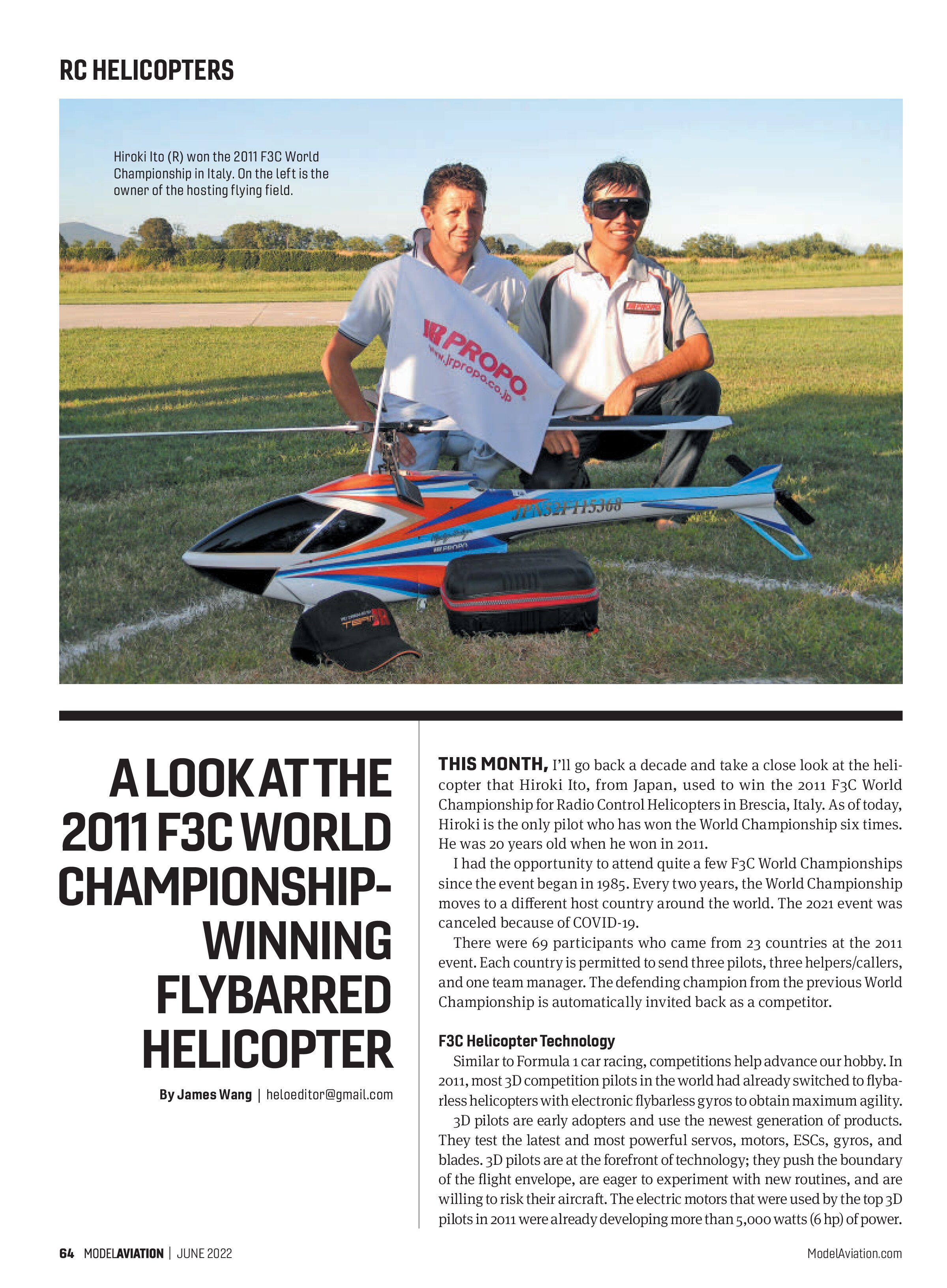
THIS MONTH, I’ll go back a decade and take a close look at the helicopter that Hiroki Ito, from Japan, used to win the 2011 F3C World Championship for Radio Control Helicopters in Brescia, Italy. As of today, Hiroki is the only pilot who has won the World Championship six times. He was 20 years old when he won in 2011.
I had the opportunity to attend quite a few F3C World Championships since the event began in 1985. Every two years, the World Championship moves to a different host country around the world. The 2021 event was canceled because of COVID-19.
There were 69 participants who came from 23 countries at the 2011 event. Each country is permitted to send three pilots, three helpers/callers, and one team manager. The defending champion from the previous World Championship is automatically invited back as a competitor.
F3C Helicopter Technology
Similar to Formula 1 car racing, competitions help advance our hobby. In 2011, most 3D competition pilots in the world had already switched to flybarless helicopters with electronic flybarless gyros to obtain maximum agility.
3D pilots are early adopters and use the newest generation of products. They test the latest and most powerful servos, motors, ESCs, gyros, and blades. 3D pilots are at the forefront of technology; they push the boundary of the flight envelope, are eager to experiment with new routines, and are willing to risk their aircraft. The electric motors that were used by the top 3D pilots in 2011 were already developing more than 5,000 watts (6 hp) of power.

F3C pilots demand reliability and precision quality in their aircraft. Their helicopters must provide repeatable control feel, flight after flight, because they always perform the same maneuvers at every F3C event. F3C aircraft help improve precision and smoothness for our helicopters.
Flybarless helicopters, with a flybarless gyro, were not allowed in F3C competition until 2015. Horace Hagen, the chief juror for F3C, said flybarless gyros were not permitted in F3C because the F3C organizing committee did not want to see F3C become a contest of who could program electronics the best. The contest should be to see who had the best piloting skills.
The 2011 World Championship marked the first contest where most pilots switched from two-stroke engines to electric power. Only a few pilots still used two-stroke glow engines. Scott Gray, from Canada, was one of the few who used an engine-powered helicopter. He said it was because he simply wanted to be different and audiences liked the stage presence from the sound and smoke.
Scott admitted that it was more work. If a carburetor was set too lean, the engine would overheat, lose power, and be damaged. If the needle was set too rich, the engine would not develop enough power to pull through aerobatics. The engine would need to be tweaked as weather changed. Scott also had to drive for hours to find a shop that sold nitro fuel when he arrived in Italy.
With electric motors, there is no need for engine blue-printing or modification. To get more power with electric, simply use a larger motor. Electric power also reduces wear and tear on models because

there is less vibration.
Contestants in 2011 with electric helicopters all used a 700-size motor, 700mm long blades, a sleek fiberglass fuselage, and ran 12S LiPo batteries and 120-amp Castle Creations or Kontronik ESCs. Hiroki used a JETI Spin 125-amp ESC from the Czech Republic. Most F3C helicopters with a fiberglass fuselage weigh 5 to 5.5 kilos (roughly 11 to 12 pounds). Hiroki also used a Scorpion HK4035-500 motor that developed only 3,400 watts of power using a Thunder Power 25C 5,000 mAh LiPo battery. By today’s standards, that is low performance.
Strangely, instead of using an ESC’s built-in governor, Hiroki chose a Curtis Youngblood ATG V3 engine governor that used a magnet on the main gear for sensing rpm.
Nowadays, top 3D and F3C pilots use 50C to 70C batteries, motors that develop 5,000 watts of power, and 200-amp ESCs. An ESC at 200 amps gives a wider temperature margin to prevent the ESC from getting too hot inside the fuselage and shutting down. However, for F3C flying, the motor never draws 200 amps. F3C pilots would previously choose 25C LiPo batteries to save weight. A set of 25C 5,000 mAh LiPos could be 15%
lighter than a set of 5,000 mAh 65C LiPos.
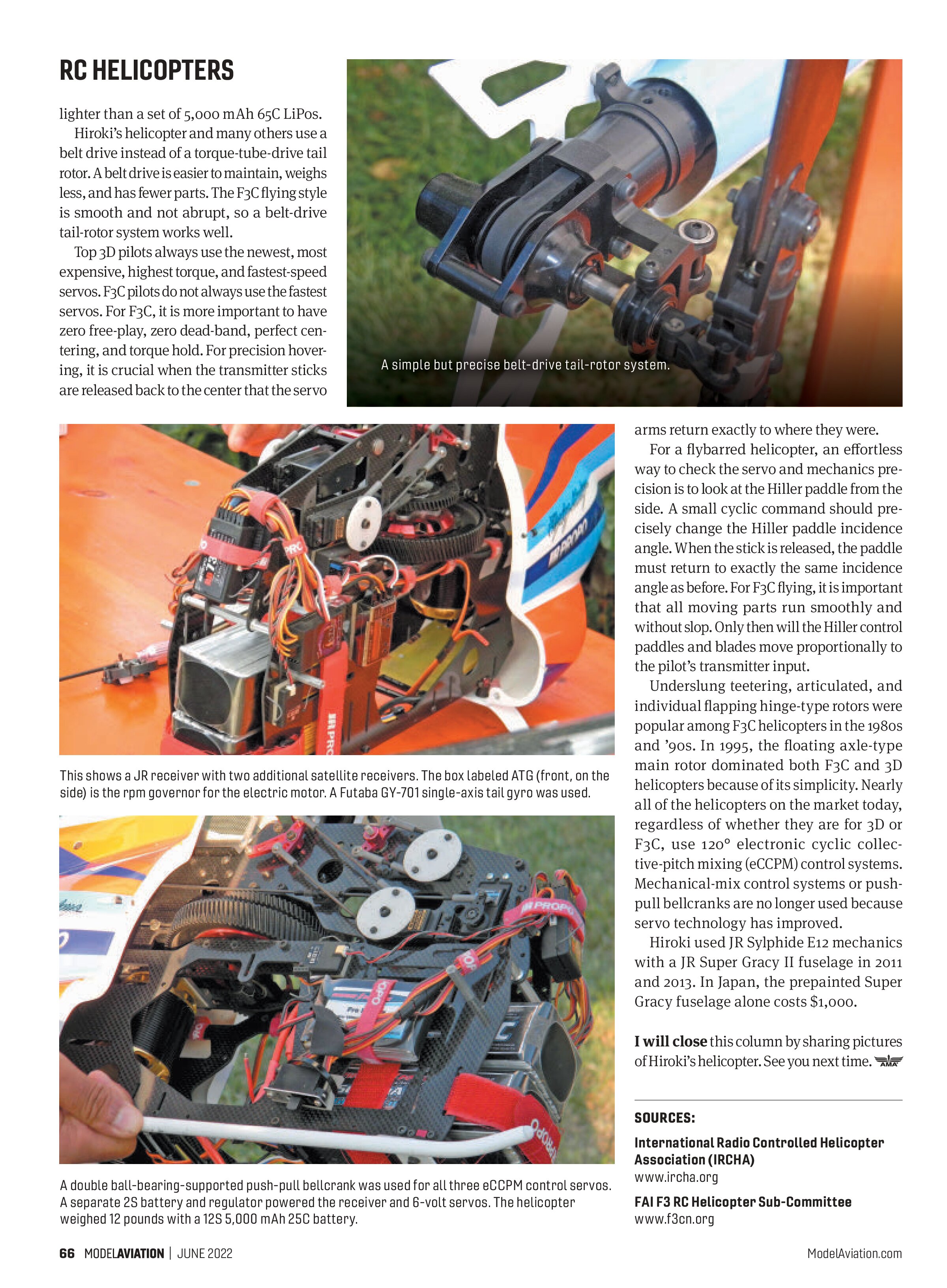
Hiroki’s helicopter and many others use a belt drive instead of a torque-tube-drive tail rotor. A belt drive is easier to maintain, weighs less, and has fewer parts. The F3C flying style is smooth and not abrupt, so a belt-drive tail-rotor system works well.

Top 3D pilots always use the newest, most expensive, highest torque, and fastest-speed servos. F3C pilots do not always use the fastest servos. For F3C, it is more important to have zero free-play, zero dead-band, perfect centering, and torque hold. For precision hovering, it is crucial when the transmitter sticks are released back to the center that the servo arms return exactly to where they were.

For a flybarred helicopter, an effortless way to check the servo and mechanics precision is to look at the Hiller paddle from the side. A small cyclic command should precisely change the Hiller paddle incidence angle. When the stick is released, the paddle must return to exactly the same incidence angle as before. For F3C flying, it is important that all moving parts run smoothly and without slop. Only then will the Hiller control paddles and blades move proportionally to the pilot’s transmitter input.
Underslung teetering, articulated, and individual flapping hinge-type rotors were popular among F3C helicopters in the 1980s and ’90s. In 1995, the floating axle-type main rotor dominated both F3C and 3D helicopters because of its simplicity. Nearly all of the helicopters on the market today, regardless of whether they are for 3D or F3C, use 120° electronic cyclic collective-pitch mixing (eCCPM) control systems. Mechanical-mix control systems or push-pull bellcranks are no longer used because servo technology has improved.
Hiroki used JR Sylphide E12 mechanics with a JR Super Gracy II fuselage in 2011 and 2013. In Japan, the prepainted Super Gracy fuselage alone costs $1,000.

I will close this column by sharing pictures of Hiroki’s helicopter. See you next time.
SOURCES:
International Radio Controlled Helicopter Association (IRCHA)
www.ircha.org
FAI F3 RC Helicopter Sub-Committee
www.f3cn.org