RC GIANT SCALE
BALSA USA
1/3-SCALE
SOPWITH
PUP SNEAK
PREVIEW
By Sal Calvagna | rcgiants@optonline.net
WELCOME BACK. Summer is right around the corner, and hopefully readers can take the time to enjoy quality flying weather at a local field or at a popular Giant Scale event.
Balsa USA has offered its ever-popular 1/3-scale Sopwith Pup kit for an astonishing 50 years. The kit was recently updated and continues to be a strong seller both here and abroad. In this month’s column, there’s a sneak preview of a nearly completed Pup. In addition, there’s an amazing kit-bash transformation of a Horizon Hobby/Hangar 9 Ki-43 Oscar ARF. I’m sure you’ll enjoy it.
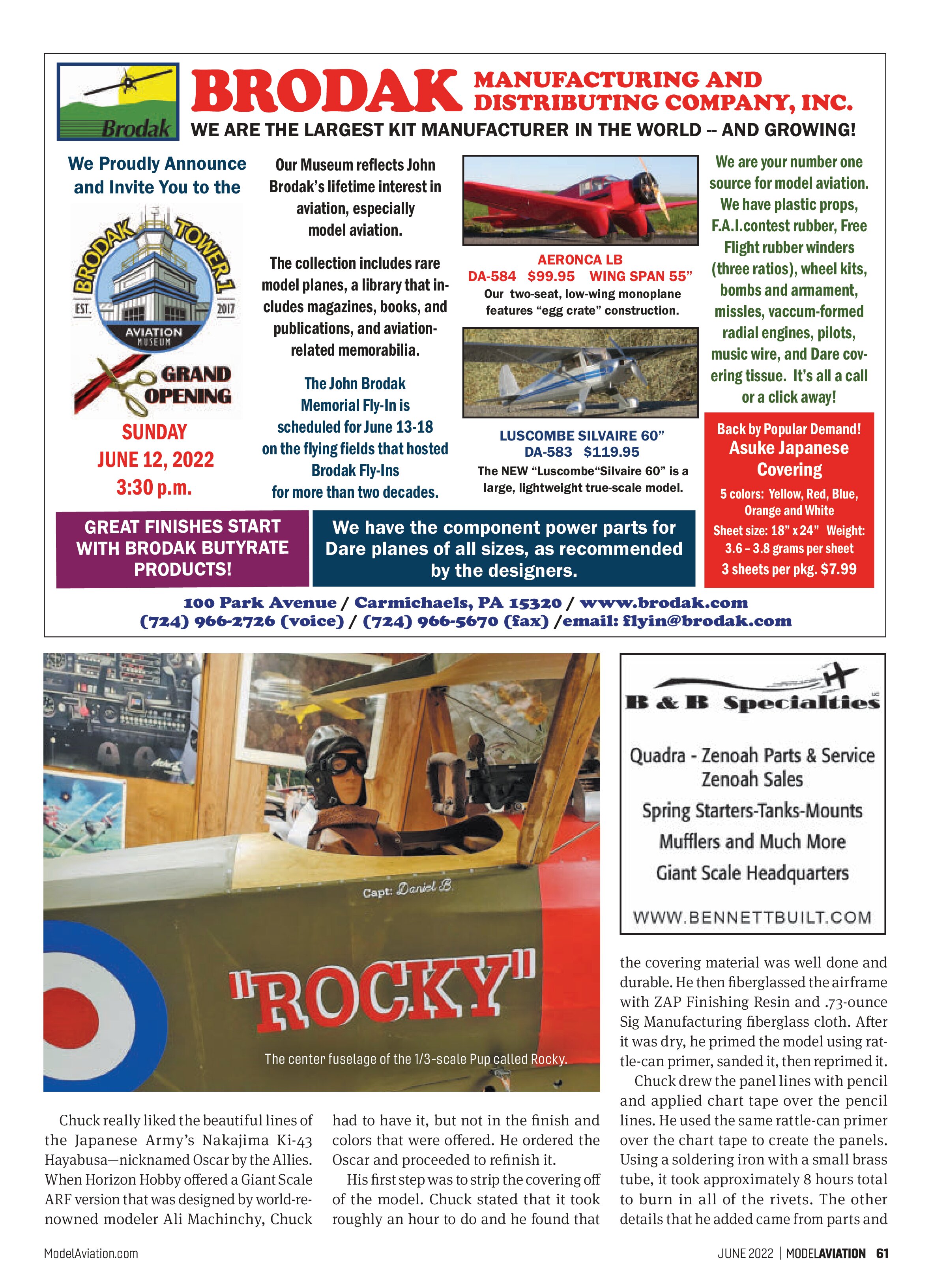
Dan Basovitch, of Staten Island, New York, has nearly completed a Balsa USA 1/3-scale Sopwith Pup. He built the Pup in slightly more than 5 months and made some minor changes during the construction, but he mostly added many scale details.
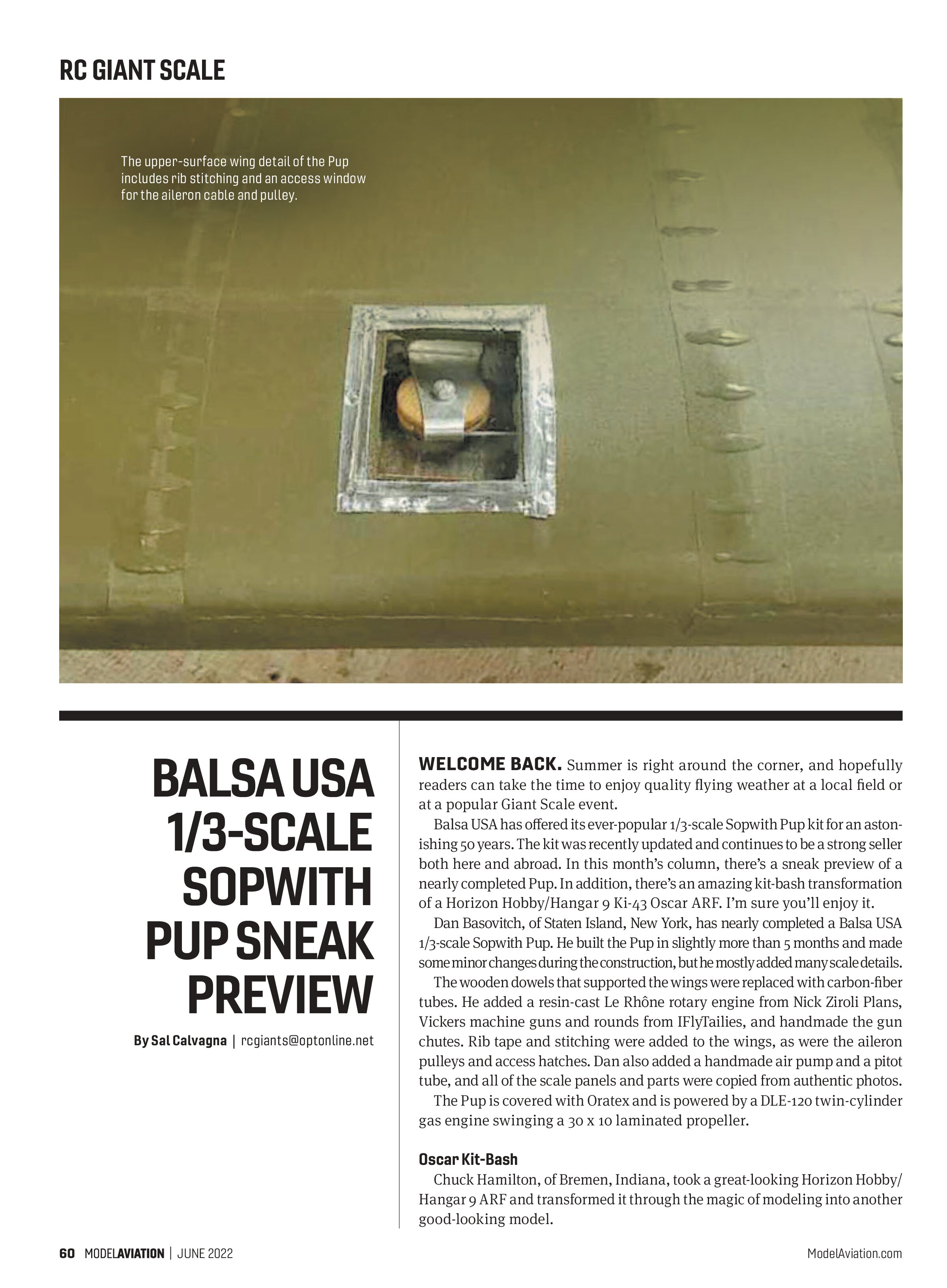
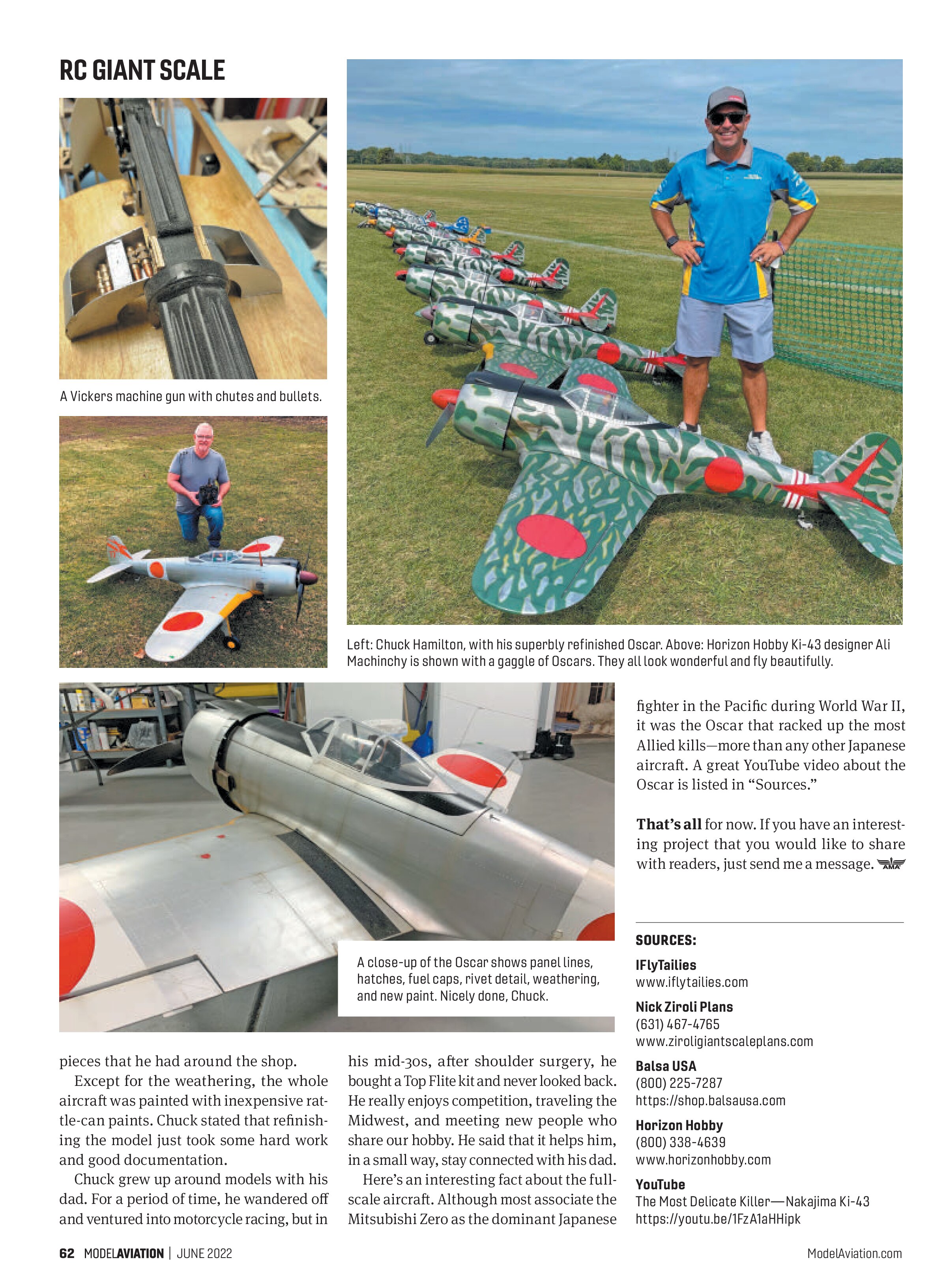
The wooden dowels that supported the wings were replaced with carbon-fiber tubes. He added a resin-cast Le Rhône rotary engine from Nick Ziroli Plans, Vickers machine guns and rounds from IFlyTailies, and handmade the gun chutes. Rib tape and stitching were added to the wings, as were the aileron pulleys and access hatches. Dan also added a handmade air pump and a pitot tube, and all of the scale panels and parts were copied from authentic photos.
The Pup is covered with Oratex and is powered by a DLE-120 twin-cylinder gas engine swinging a 30 x 10 laminated propeller.
Oscar Kit-Bash
Chuck Hamilton, of Bremen, Indiana, took a great-looking Horizon Hobby/Hangar 9 ARF and transformed it through the magic of modeling into another good-looking model.

Chuck really liked the beautiful lines of the Japanese Army’s Nakajima Ki-43 Hayabusa—nicknamed Oscar by the Allies. When Horizon Hobby offered a Giant Scale ARF version that was designed by world-renowned modeler Ali Machinchy, Chuck
had to have it, but not in the finish and colors that were offered. He ordered the Oscar and proceeded to refinish it.
His first step was to strip the covering off of the model. Chuck stated that it took roughly an hour to do and he found that
the covering material was well done and durable. He then fiberglassed the airframe with ZAP Finishing Resin and .73-ounce Sig Manufacturing fiberglass cloth. After it was dry, he primed the model using rattle-can primer, sanded it, then reprimed it.
Chuck drew the panel lines with pencil and applied chart tape over the pencil lines. He used the same rattle-can primer over the chart tape to create the panels. Using a soldering iron with a small brass tube, it took approximately 8 hours total to burn in all of the rivets. The other details that he added came from parts and


pieces that he had around the shop.
Except for the weathering, the whole aircraft was painted with inexpensive rattle-can paints. Chuck stated that refinishing the model just took some hard work and good documentation.
Chuck grew up around models with his dad. For a period of time, he wandered off and ventured into motorcycle racing, but in
his mid-30s, after shoulder surgery, he bought a Top Flite kit and never looked back. He really enjoys competition, traveling the Midwest, and meeting new people who share our hobby. He said that it helps him, in a small way, stay connected with his dad.
Here’s an interesting fact about the full-scale aircraft. Although most associate the Mitsubishi Zero as the dominant Japanese
fighter in the Pacific during World War II, it was the Oscar that racked up the most Allied kills—more than any other Japanese aircraft. A great YouTube video about the Oscar is listed in “Sources.”
That’s all for now. If you have an interesting project that you would like to share with readers, just send me a message.
SOURCES:
IFlyTailies
www.iflytailies.com
Nick Ziroli Plans
(631) 467-4765
www.ziroli giant scaleplans.com
Balsa USA
(800) 225-7287
https://shop.balsausa.com
Horizon Hobby
(800) 338-4639
www.horizonhobby.com
YouTube
The Most Delicate Killer—Nakajima Ki-43
https://youtu.be/1FZa1aHHipk