OLD-TIMERS

SAM 26, JOHN POND, AND TAFT
By Bob Angel
samrcflier@verizon.net
EARLIER THIS YEAR, I started chronicling the history of Society of Antique Modelers (SAM) Chapter 26, which is headquartered in Santa Maria, California. As the last survivor of the small group that founded the chapter, I appointed myself as historian. I later learned that Model Aviation was dedicating 2022 as the “Year of the Club.” That coincidence shouldn’t be wasted.
John Pond and Taft, California, comprise a substantial part of the club’s history. If all goes well, our SAM chapter will have conducted 47 annual John Pond Commemorative Old-Timer (OT) RC contests by the time you read this. Of those, 25 were held in Taft, often called the Free Flight (FF) capital of the world. Hundreds of other (mostly FF) model contests and championships were also held there.
Unfortunately, the land changed hands and our 2013 SAM 26 Spring Annual was the final AMA sanctioned contest at Taft. Between the 1980s and 2013, we had conducted more than 50 sanctioned contests there. Our home base is approximately 100 miles away, along a scenic, scarcely populated highway, with no stop signals for nearly 90 miles.
John LeSuer started our SAM chapter. He had helped organize the Tri-Valley club in Santa Maria, California, which thrives today. He called the first OT meetings at his home, circa the early 1970s. He wrote and distributed the first few handwritten, mimeographed newsletters.
We grew along with the national SAM organization. We’ve had only three chapter presidents throughout the many years: Ron Doig, Hardy Robinson, and currently, Dick Fischer. Each officer performed the job well, so we saw little need to change. I became newsletter editor and have written all 370 consecutively numbered Coastal Flyer newsletters (as of February 2022).
The “floppy discs” used in early word processors claimed to keep stored data forever, but they didn’t. Early newsletter data deteriorated and became unretrievable, losing lots of details about our early, well-attended fun-flys and contests during the period of our fastest growth.
John Pond (1917-2001) was the westernmost sparkplug for OT modeling. Several people and clubs were equally active in the eastern US, but all came together to form and advance the SAM national organization. SAM chapters later sprang up in Europe, Australia, New Zealand, and other countries. Today, the annual Eurochamps sees larger participation than does our annual SAM Champs weeklong gathering.
John Pond was a well-known, enthusiastic organizer. His untiring service to all modeling is well documented in the eight pages of his AMA History Project biography. A mini biography appeared in the August 2011 edition of this column.
In tribute to John’s contributions to modeling—SAM in particular—three of his friends from Northern, Southern, and Central California decided to commemorate and honor him with an annual contest, where his only duty was to fly and enjoy himself rather than run the contest. Phil Kraft donated a nice, perpetual trophy for the event. We hope that trophy might be preserved in the AMA National Model Aviation Museum someday, but for now, we’re still adding champion names to the trophy plates each year, while rapidly running out of space.
The Pond event originators wanted to locate it in Central California, so they contacted John LeSuer, who arranged with the local Tri-Valley club to hold it on the club’s field near Santa Maria. John then became co-contest director (CD), and later, the CD.
I met John Pond after first getting acquainted with his model on the morning of the 1975 initial commemorative contest. I was a contest helper when I felt a “whump” on the side of my head. It was the side of his model, which had quietly blown sideways outside of the landing zone at slow speed. There was no damage to either of us because it was chilly and I’d worn a big, furry Russian-type hat with the ear flaps down. John and I exchanged pleasantries and became friends.
After three Pond events, John LeSuer joined the staff in the aeronautics department of California Polytechnic State University (Cal Poly), a few miles north in San Luis Obispo, California. The university had a light airplane runway that was suitable for the event, so he moved it there, where he was CD for a few years. John Pond belonged to SAM 21, which was farther to the north, but SAM 26 had

inherited his commemorative contest by default because of its central location.
Adjacent to the Cal Poly field was its agricultural area with a small, deep pond in its pig enclosure. Just as a single tree becomes a magnet for models, so can almost any landscape irregularity. Sure enough, an out-of-control airplane splashed straight in with the engine running. It wasn’t John Pond’s model, but, as you might expect, the pond became known as John’s Pond.
During those formative days of SAM, rules turbulence over using modern engines resulted in there being no Pond Commemorative contest in 1983. At roughly that time, John LeSuer left Cal Poly and moved away. John Pond and his SAM 21 chapter appealed to SAM 26 to resume the event for 1984. We accepted but needed a new field and CD.
SAM 26 had held a few other well-attended events by then. Three of us worked at Vandenberg Air Force Base, where the VAFB Wingbusters had (and still have) an RC club. The club’s field was in a remote, open area of the base that was well suited for a SAM contest, assuming we could get the club’s blessing plus access to the base for “outsiders.” There was particularly high security at this base and, of course, even more so today.
SAM 26 President Ron Doig knew most of the Wingbusters’ members, who were willing and eager to lend their field and help. I was assigned as the CD, mainly to work out base-access details. I expected some bureaucratic hurdles, but a straightforward process was in place for holding special events. It just required filling out a single, two-sided form and getting the base commander’s okay and signature. That became a ticket for getting additional base support.
We required preregistration so that we could furnish the gate guards with a list of names to check against their driver’s licenses before entry. The field was a couple of miles inside the base, so direction signs were placed at every turn.
The base entrance had a large, winglike covering over the guard station that read, “Strategic Air Command.” Above that was another marquee-type sign reading, “Welcome John Pond Commemorative Participants.” John was so impressed that he ran a picture of that entrance in the lead article about the event in his January 1985 “Plug Sparks” column in Model Builder magazine.
The contest ran smoothly, but on day two, a shear wind at high altitude swept two models off course, where they went down approximately a quarter of a mile north in a grove of eucalyptus trees. It paralleled a swampy stream that was
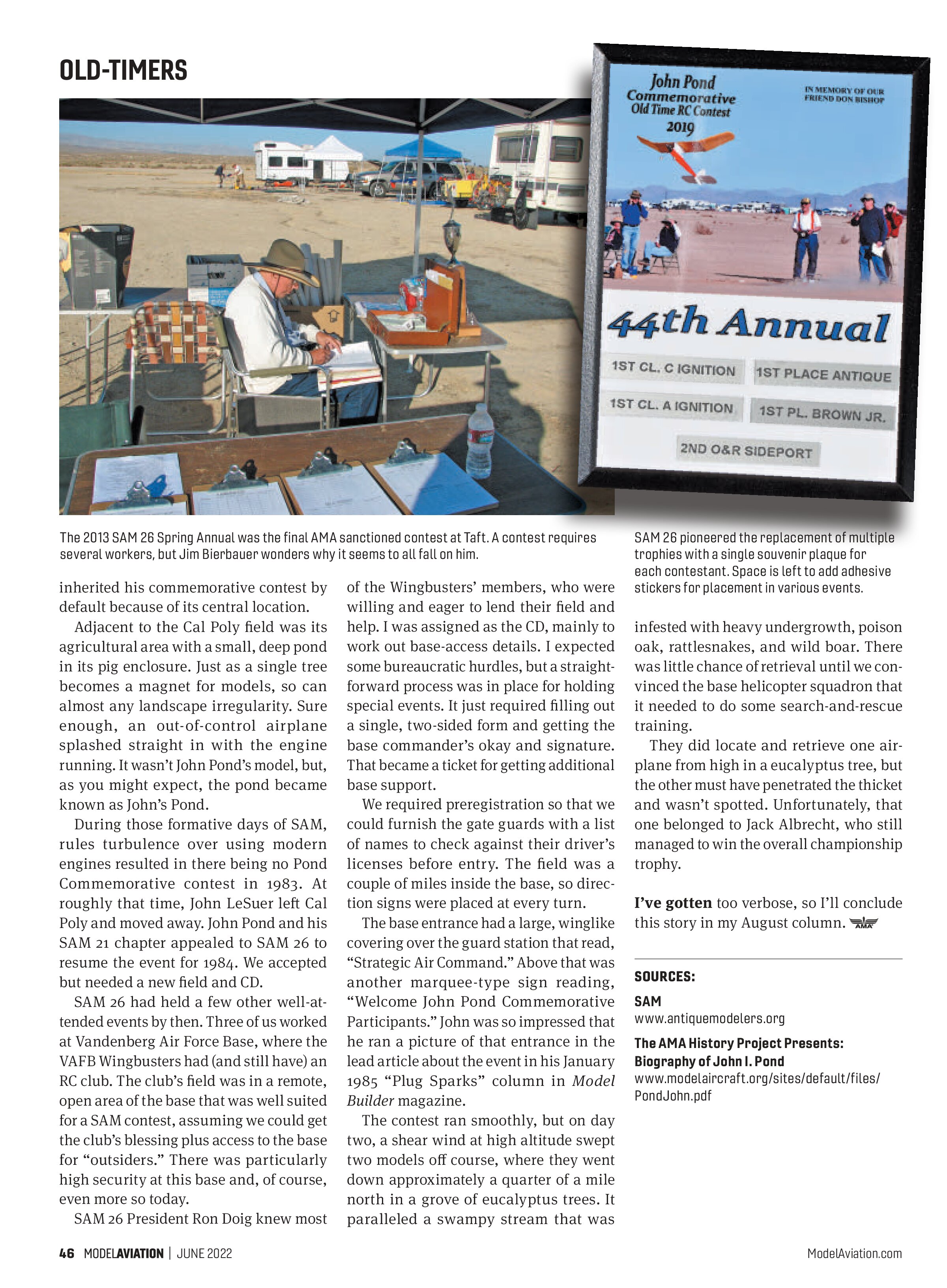
SAM 26 pioneered the replacement of multiple trophies with a single souvenir plaque for each contestant. Space is left to add adhesive stickers for placement in various events.
infested with heavy undergrowth, poison oak, rattlesnakes, and wild boar. There was little chance of retrieval until we convinced the base helicopter squadron that it needed to do some search-and-rescue training.
They did locate and retrieve one airplane from high in a eucalyptus tree, but the other must have penetrated the thicket and wasn’t spotted. Unfortunately, that one belonged to Jack Albrecht, who still managed to win the overall championship trophy.
I’ve gotten too verbose, so I’ll conclude this story in my August column.
SOURCES:
The AMA History Project Presents:
Biography of John I. Pond
www.modelaircraft.org/sites/default/files/PondJohn.pdf