Focal Point
Interested in sharing your handiwork? Visit ModelAviation.com for submission guidelines.
Return to Building

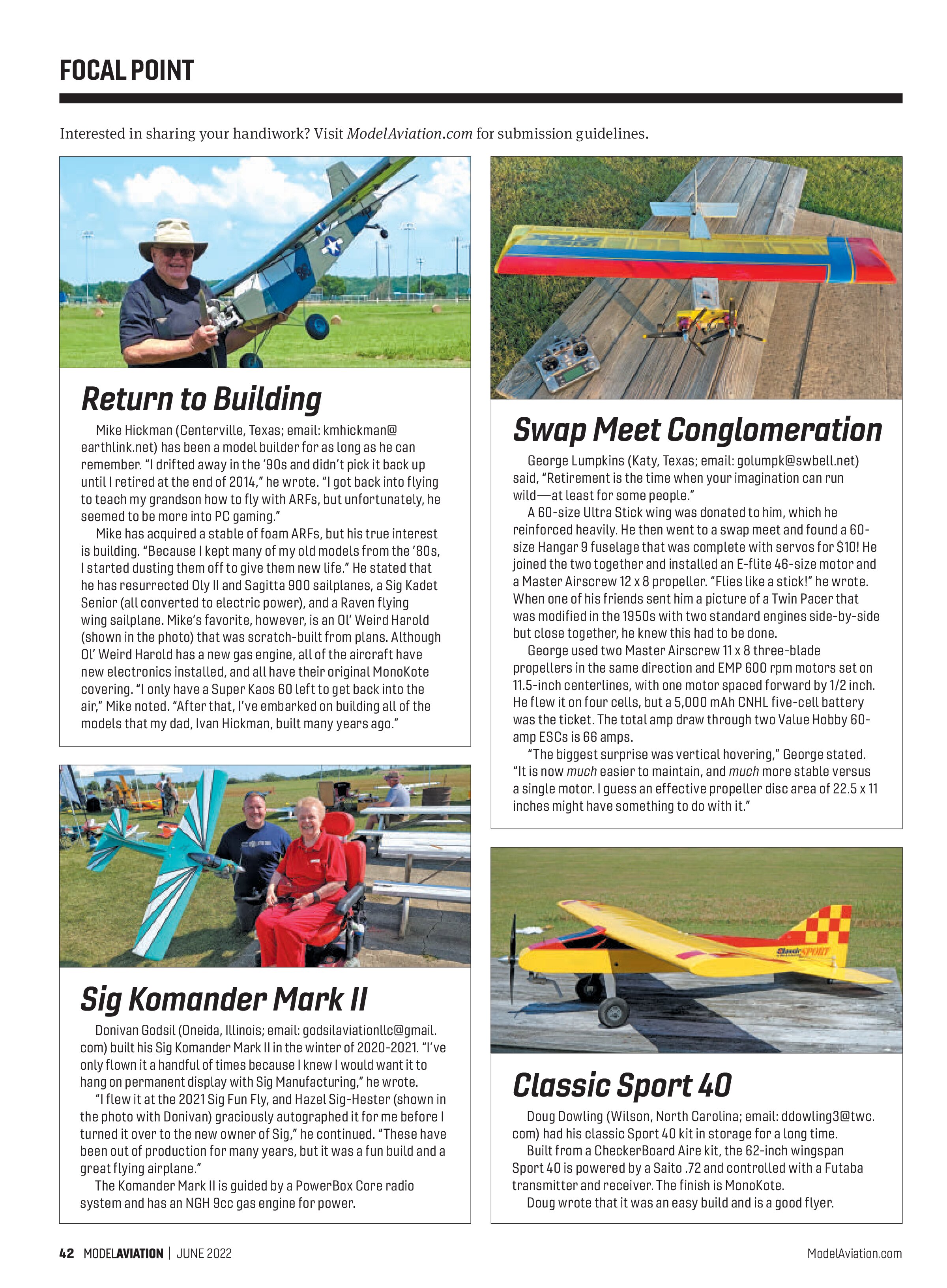
Mike Hickman (Centerville, Texas; email: kmhickman@earthlink.net) has been a model builder for as long as he can remember. “I drifted away in the ’90s and didn’t pick it back up until I retired at the end of 2014,” he wrote. “I got back into flying to teach my grandsons how to fly with ARFs, but unfortunately, he seemed to be more into PC gaming.”
Mike has acquired a stable of foam ARFs, but his true interest is building. “Because I kept many of my old models from the ’80s, I started dusting them off to give them new life.” He stated that he has resurrected Oly II and Sagitta 900 sailplanes, a Sig Kadet Senior (all converted to electric power), and a Raven flying wing sailplane. Mike’s favorite, however, is an Ol’ Weird Harold (shown in the photo) that was scratch-built from plans. Although Ol’ Weird Harold has a new gas engine, all of the aircraft have new electronics installed, and all have their original MonoKote covering. “I only have a Super Kaos 60 left to get back into the air,” Mike noted. “After that, I’ve embarked on building all of the models that my dad, Ivan Hickman, built many years ago.”
Sig Komander Mark II

Donivan Godsil (Oneida, Illinois; email: godsilaviationllc@gmail.com) built his Sig Komander Mark II in the winter of 2020-2021. “I’ve only flown it a handful of times because I knew I would want it to hang on permanent display with Sig Manufacturing,” he wrote.
“I flew it at the 2021 Sig Fun Fly, and Hazel Sig-Hester (shown in the photo with Donivan) graciously autographed it for me before I turned it over to the new owner of Sig,” he continued. “These have been out of production for many years, but it was a fun build and a great flying airplane.”
The Komander Mark II is guided by a PowerBox Core radio system and has an NGH 9cc gas engine for power.
Swap Meet Conglomeration

George Lumpkins (Katy, Texas; email: golumpk@swbell.net) said, “Retirement is the time when your imagination can run wild—at least for some people.”
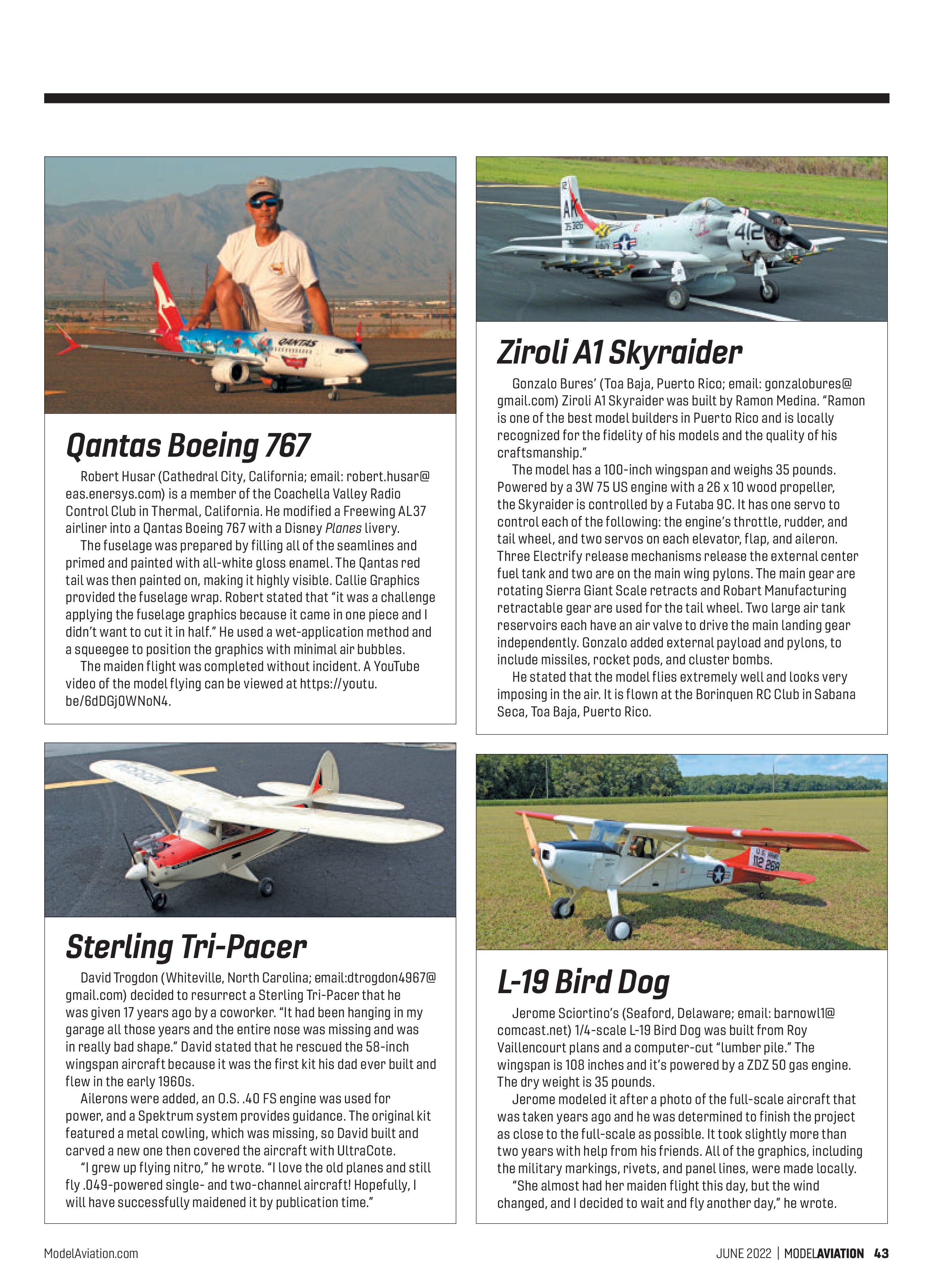
A 60-size Ultra Stick wing was donated to him, which he reinforced heavily. He then went to a swap meet and found a 60-size Hangar 9 fuselage that was complete with servos for $10! He joined the two together and installed an E-flite 46-size motor and a Master Airscrew 12 x 8 propeller. “Flies like a stick!” he wrote. When one of his friends sent him a picture of a Twin Pacer that was modified in the 1950s with two standard engines side-by-side but close together, he knew this had to be done.
George used two Master Airscrew 11 x 8 three-blade propellers in the same direction and EMP 600 rpm motors set on 11.5-inch centerlines, with one motor spaced forward by 1/2 inch. He flew it on four cells, but a 5,000 mAh CNHL five-cell battery was the ticket. The total amp draw through two Value Hobby 60-amp ESCs is 66 amps.
“The biggest surprise was vertical hovering,” George stated. “It is now much easier to maintain, and much more stable versus a single motor. I guess an effective propeller disc area of 22.5 x 11 inches might have something to do with it.”
Classic Sport 40

Doug Dowling (Wilson, North Carolina; email: ddowling3@twc.com) had his classic Sport 40 kit in storage for a long time.
Built from a CheckerBoard Aire kit, the 62-inch wingspan Sport 40 is powered by a Saito .72 and controlled with a Futaba transmitter and receiver. The finish is MonoKote.
Doug wrote that it was an easy build and is a good flyer.
Qantas Boeing 767

Robert Husar (Cathedral City, California; email: robert.husar@eas.enersys.com) is a member of the Coachella Valley Radio Control Club in Thermal, California. He modified a Freewing AL37 airliner into a Qantas Boeing 767 with a Disney Planes livery.
The fuselage was prepared by filling all of the seamlines and primed and painted with all-white gloss enamel. The Qantas red tail was then painted on, making it highly visible. Callie Graphics provided the fuselage wrap. Robert stated that “it was a challenge applying the fuselage graphics because it came in one piece and I didn’t want to cut it in half.” He used a wet-application method and a squeegee to position the graphics with minimal air bubbles.
The maiden flight was completed without incident. A YouTube video of the model flying can be viewed at https://youtu.be/6dDGjOWN0N4.
Sterling Tri-Pacer

David Trogdon (Whiteville, North Carolina; email:dtrogdon4967@gmail.com) decided to resurrect a Sterling Tri-Pacer that he was given 17 years ago by a coworker. “It had been hanging in my garage all those years and the entire nose was missing and was in really bad shape.” David stated that he rescued the 58-inch wingspan aircraft because it was the first kit his dad ever built and flew in the early 1960s.
Ailerons were added, an O.S. .40 FS engine was used for power, and a Spektrum system provides guidance. The original kit featured a metal cowling, which was missing, so David built and carved a new one then covered the aircraft with UltraCote.
“I grew up flying nitro,” he wrote. “I love the old planes and still fly .049-powered single- and two-channel aircraft! Hopefully, I will have successfully maidened it by publication time.”
Ziroli A1 Skyraider

Gonzalo Bures’ (Toa Baja, Puerto Rico; email: gonzalobures@gmail.com) Ziroli A1 Skyraider was built by Ramon Medina. “Ramon is one of the best model builders in Puerto Rico and is locally recognized for the fidelity of his models and the quality of his craftsmanship.”
The model has a 100-inch wingspan and weighs 35 pounds. Powered by a 3W 75 US engine with a 26 x 10 wood propeller, the Skyraider is controlled by a Futaba 9C. It has one servo to control each of the following: the engine’s throttle, rudder, and tail wheel, and two servos on each elevator, flap, and aileron. Three Electrify release mechanisms release the external center fuel tank and two are on the main wing pylons. The main gear are rotating Sierra Giant Scale retracts and Robart Manufacturing retractable gear are used for the tail wheel. Two large air tank reservoirs each have an air valve to drive the main landing gear independently. Gonzalo added external payload and pylons, to include missiles, rocket pods, and cluster bombs.
He stated that the model flies extremely well and looks very imposing in the air. It is flown at the Borinquen RC Club in Sabana Seca, Toa Baja, Puerto Rico.
L-19 Bird Dog

Jerome Sciortino’s (Seaford, Delaware; email: barnowl1@comcast.net) 1/4-scale L-19 Bird Dog was built from Roy Vaillencourt plans and a computer-cut “lumber pile.” The wingspan is 108 inches and it’s powered by a ZDZ 50 gas engine. The dry weight is 35 pounds.
Jerome modeled it after a photo of the full-scale aircraft that was taken years ago and he was determined to finish the project as close to the full-scale as possible. It took slightly more than two years with help from his friends. All of the graphics, including the military markings, rivets, and panel lines, were made locally.
“She almost had her maiden flight this day, but the wind changed, and I decided to wait and fly another day,” he wrote.