CONTROL LINE NAVY CARRIER

NOTES ON AN EXPERIMENT AND HISTORY
By John Vlna | flyclcarrier@yahoo.com
MY EMAIL ADDRESS WAS incorrect in the December 2021 column, but it is correct this time. My apologies to those who had to go through AMA to reach me recently. If you have not heard back from me, please resend your email to the correct address: flyclcarrier@yahoo.com.
In this column, I’ll drift away a bit from strictly models into some interesting history.
MO-HO Crow Experiment and Nostalgia
I had hoped to have some test data for this issue, but between weather, holidays, and events that were beyond my control, I have not had a chance to fly. Actually, the modifications to my MO-HO are not complete. It turned out to be a bigger job than I thought. The airplane needed repairs that I did not know about, and I have converted it to electric power. I hope to have flight results in the December 2022 issue. The MO-HO is a Nostalgia Class airplane, but with the electric conversion, it will no longer be legal for the event.
Nostalgia-class airplanes get bonus points for designs that were published before 1978. Bonus points are also awarded for non-schnuerle engines. The original rules required plain bearing engines. The flight rules are those used before the change that allows 60° hanging in slow flight.
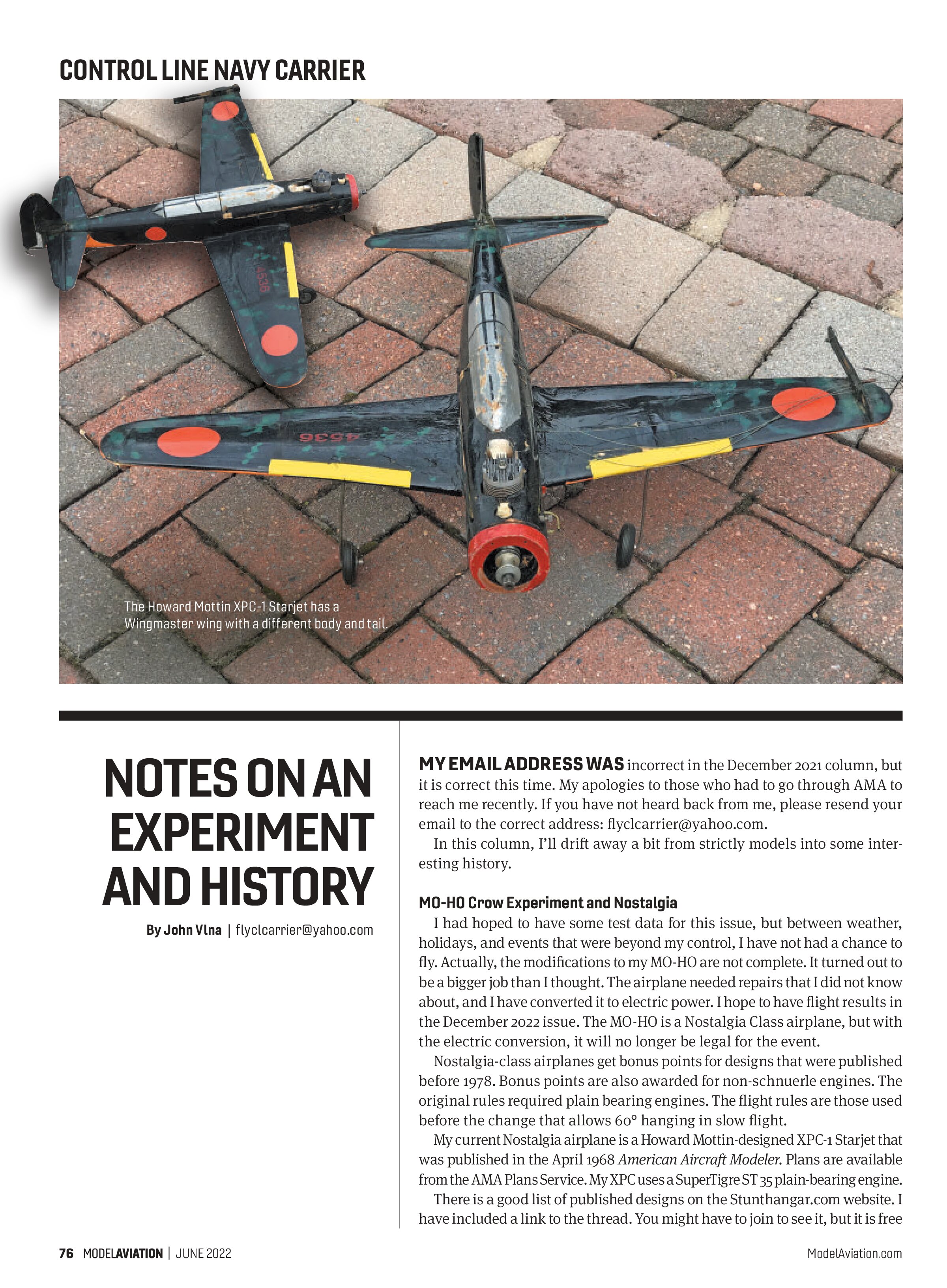
My current Nostalgia airplane is a Howard Mottin-designed XPC-1 Starjet that was published in the April 1968 American Aircraft Modeler. Plans are available from the AMA Plans Service. My XPC uses a SuperTigre ST 35 plain-bearing engine.
There is a good list of published designs on the Stunthangar.com website. I have included a link to the thread. You might have to join to see it, but it is free and a great Control Line (CL) website.
Of course, kitted or personal designs are also given bonus points, as long as the original designs can be shown to have flown before 1977.
North American Ryan L-17B Navion
As far as I know, the Navion was not used on carriers, but a number of years ago at a contest, someone asked about it and said that they had seen pictures of one on a carrier. Indeed, there is a picture of one apparently launching from the USS Leyte (CV-32) in 1950. Many light airplanes could fly on and off carriers, but none were configured for carrier operation with a hook, to my knowledge.
Sterling made a Profile kit of the aircraft (Kit #S-9) and today, Dare makes a reproduction kit that is available from Brodak Manufacturing. The model is legal for Nostalgia Profile because it was kitted before 1952 (it is also Old-Time Stunt legal). I also seem to remember that Larry Richards sold a reproduction kit.
I built one of the Sterling kits in the early 1960s. In 1966, I was assigned overseas, removed the wing, and mailed it via the Army Post Office. I flew it as a sport Stunt airplane overseas then shipped it home, giving it to my brother in the 1970s.
If you do a Google search on the Sterling Navion, you will find information about it.
I have included a link in “Sources” to the picture of the one on the USS Leyte.
Lockheed P2V
The P2V as a Carrier airplane? Well, maybe. In the book The History of US Naval Air Power, edited by Robert L. Lawson and published by The Military Press, the author is quoted as saying that a P2V was tested with a hook. “The concept was proven by Hayward making 128 landings into the short-field gear at Patuxent. He also made approaches and a touch-and-go landing aboard Franklin D. Roosevelt. No arrested landings were actually made aboard ship.”
He also stated that, “One Neptune (BuNo 122969) was equipped with a tailhook. Field arrestment tests were conducted by Lockheed at Burbank and Hayward at Patuxent River.”
I recently watched a program on the History Channel called Superpower Aircraft Bombers. In the opening scenes, a P2V is landing on a carrier and it certainly looks like it stops quickly—too quickly for brakes alone—so maybe they did try carrier landings.
Stripped-down P2Vs were evaluated as nuclear bombers in the late 1940s and early ’50s to give the Navy a nuclear capability. These would have been one-way trips with either ditching or landing somewhere, such as what was done with the Doolittle Raid. So, build one, go to a contest, and see if you can get bonus points.


1941: A Tale of Two Contests
The year 1941 will, of course, always be remembered for December 7, the day that the Japanese attacked Pearl Harbor and the US entered World War II. But in Cleveland, Ohio, there was a CL contest. I was too young to attend; however, I lived a few blocks from the contest site at the time. I don’t know what events ran, but it is safe to say that Navy Carrier was not one of them.
Fifty years later (in 1991), there was an anniversary contest that did include Carrier among the events. Cleveland had a great field, with eight circles near the airport. It even had a control tower and, as I recall, a snack bar. Sadly, it is now a parking lot for the airport.
The contest was like a small Nats with
Stunt, Combat, Speed, and, of course, Carrier, throughout a two-day weekend. It was cold with a bit of snow on lightly frozen ground, which made the circles without a concrete center pad very slippery. I flew in Carrier, Old-Time Stunt, and Combat.
In Carrier, I had my Class I and II Myrt, and for Profile, I had an MO-1. Configured for Class II, the Myrt slider snapped on takeoff. It did a loop over the deck and came down hard, surprisingly with slight damage, and was still flyable.
I recall some fliers with Seamew Class Is, which they also could fly in Formula 40 Speed. Because of the slippery ground, there were many interesting falls and crashes. One can only imagine what it was like in 1941.
SOURCES:
Navy Carrier Society (NCS)
www.navycarriersociety.org
Navion History
www.navion.com/history.html
AMA Plans Service
(765) 287-1256, ext. 507
https://plans.modelaircraft.org
Brodak Manufacturing
(724) 966-2726
www.brodak.com
Hatwing 1 History
https://web.cortland.edu/woosterK/hatwing1.html
Stunthangar.com
www.stunthangar.com