Southwest Regional FF Championships
History of the Southwest Regionals
By Don DeLoach
ddeloach@comcast.net
Photos by the author

Some years are better than others at the Southwest Regional Free Flight Championships (SWR) in Eloy, Arizona. One afternoon in 2006 was pure misery, as a freak squall line with 30 mph gusts and a choking dust cloud moved through the flightline during a flyoff round. The next saw a morning low temperature of 20°—the coldest day in Phoenix in 18 years. But, enough of the rare exceptions. Most years, the weather at the SWR is sublime—so sublime that is regularly draws Free Flight (FF) lovers from as far away as Europe for midwinter fun.
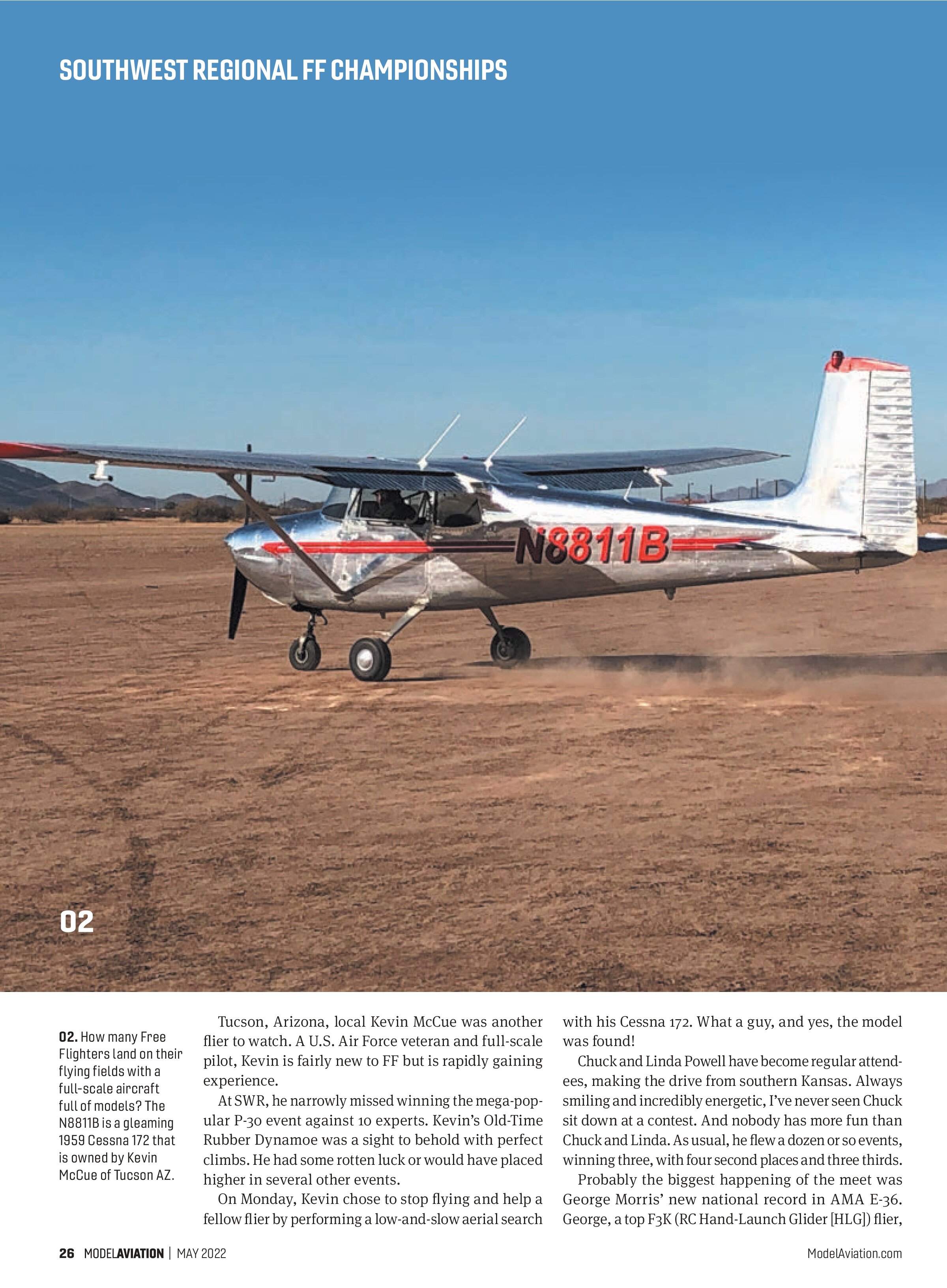
Normal weather for southern Arizona in mid-January is approximately 40° in the morning, warming to roughly 70° by noon. If there’s a better place to be for air-minded people in mid-winter, I haven’t found it. Even cloudy days at SWR are comfortable and enjoyable.
Southwest Regionals History
The following history was written by the late Al Lidberg in 2004. Al attended nearly all of the SWRs from the beginning and was contest director for the contest for roughly 30 years, until his death from cancer in 2017. For his many years of service, Al was inducted into the FF Hall of Fame shortly before his death.
In 1934, Gaylord Webster started his hobby business with a capital investment of $2.52. This was in the form of balsa wood he kept in a box under his bed. The business was called Cacti Model Supplies. Later that year, he started the Cacti Modelers Club. Gaylord’s business eventually became that of a hobby wholesaler. The Cacti Modelers Club and a club known as the Copperclad Eagles merged into the Phoenix Model Airplane Club (PMAC).
Gaylord’s brother, Quentin, started a retail hobby shop known as Webster’s Hobby Shop. For decades, Quentin Webster was instrumental in support and management of the club by providing guidance, a meeting spot, and a darn good hobby shop for modelers!
In the 1930s, model flying took place at Sky Harbor Airport, a sleepy, grass field east of town. Arch Harlan told us that flying at Sky Harbor ended when someone crashed his gas model into a doctor’s Stinson! After that, models were flown in the area of 19th Avenue and Thomas Road, the future site of West High School, which was built in approximately 1949.
PMAC eventually acquired permission to use the Cactus Airport, at the corner of Cave Creek and Cactus, for a flying and contest site. This small airport served crop dusters and little else, but it boasted a paved circle for Control Line (CL) fliers and a lot of space for FF.
The first few Southwest Regional Model Airplane Championships (SWR) took place at the Cactus site in 1951. SWR, in those days, had events for FF, CL, and RC, and the events were organized and sponsored by PMAC. Throughout the years, SWR events evolved, but the constant element every year was FF. After Cactus, the PMAC club flying took place at 32nd Street and Cactus [now the site of a large subdivision, as is Cactus Airport]; Dynamite Boulevard and Cave Creek [now the site of a veteran’s cemetery]; and 38th Avenue and Pinnacle Peak Road [now another subdivision].
Locations for SWR have included Cactus Airport, Luke Auxiliary Field #3 (northwest of Phoenix), the Buckeye Airport, and, most recently, two locations near Eloy, Arizona. Eventually, the SWR was taken over by a group called the Southwest Regionals Modelers Association, Inc. (SWRMA), which represents the interests of all concerned modelers, although SWRMA is not directly connected with PMAC.
Funding was obtained that will permit the SWR to continue indefinitely. Considering that 2004 marked the 54th annual SWR, chances are good that the contest can and will continue for many years.
In recognition of the years of service by the Websters, our flying site is known as Webster’s field, and we were fortunate to have Quentin Webster and his wife, Nancy, at a recent SWR, handing out awards.
—Al Lidberg
Because it’s a simple, 12-hour drive out of cold Colorado into the warmth and sunshine, SWR is an easy “yes” for me. Contestants come from much farther away than Colorado. This year, one came from Pennsylvania. In past years, a pair of British fliers made the flight across the Atlantic Ocean. Other states represented this year included Texas, Utah, Oklahoma, Kansas, California, Oregon, Nevada, and, of course, Arizona.
The turnout this year was slightly lighter than normal because of a number of factors, most prominent being the high number of COVID-19 cases in the US. At least three local fliers tested positive and were unable to attend their own club’s marquee event. Thankfully, all recovered fully a week or so afterward.
But enough about the weather. How was the flying? It’s no surprise that it was top class, as it always is at the SWR. Forty-nine events were offered throughout the three days, and most contests had three to six fliers in each.
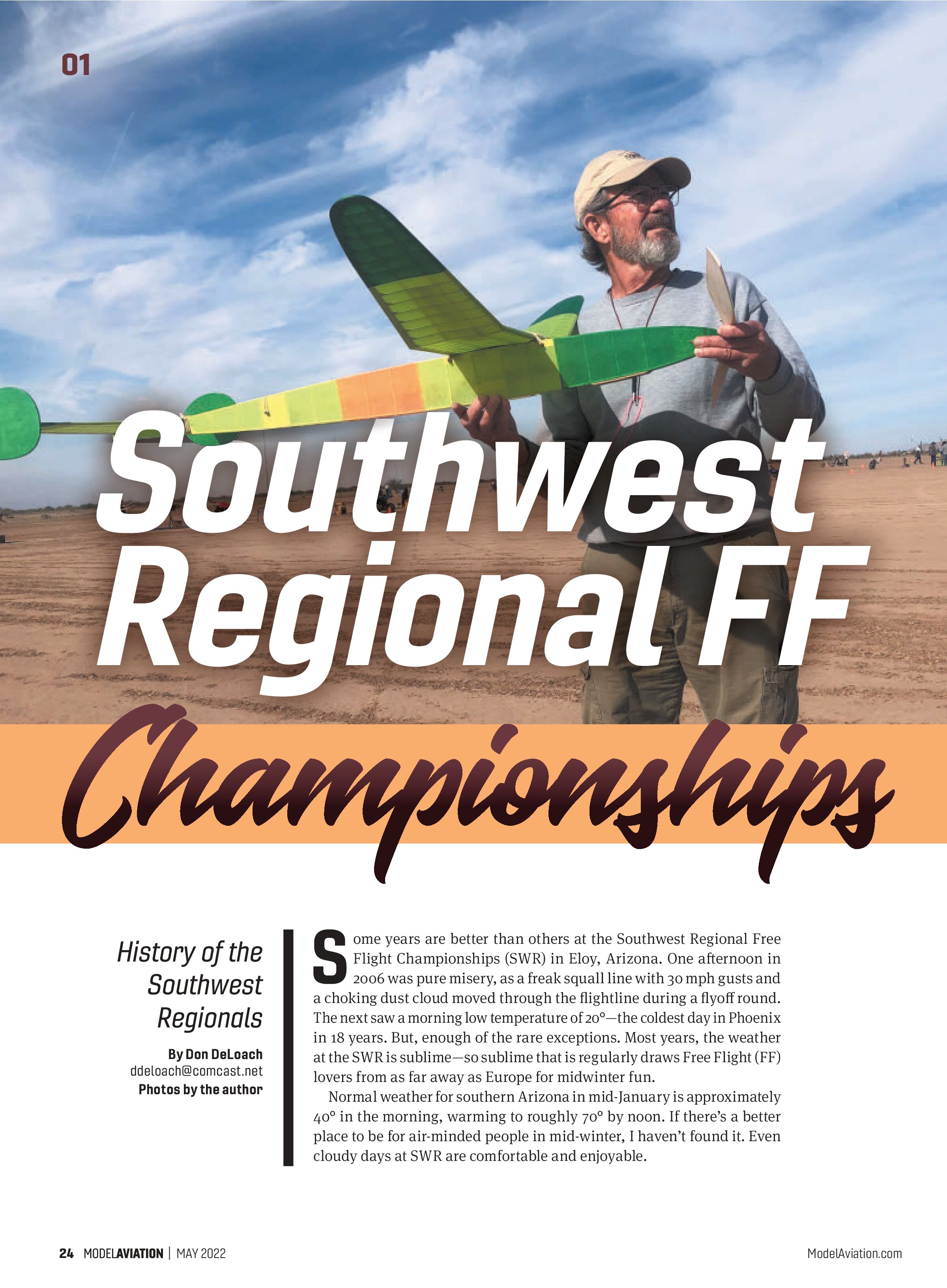
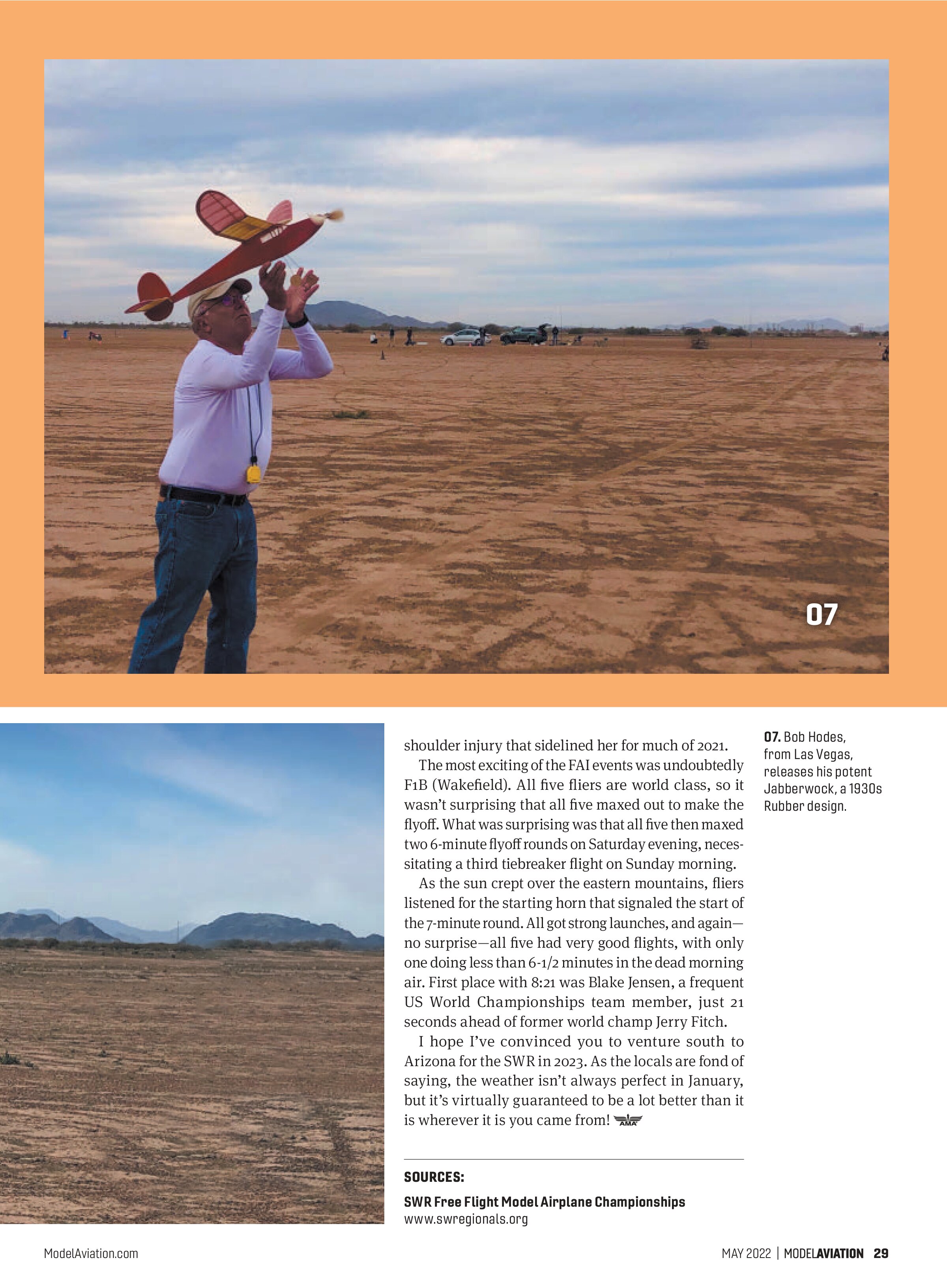
Rich Adams is a recently retired Texas transplant who is now located in the Phoenix area, and he has taken to FF at Eloy with aplomb. He started with FF in his youth, switched to RC (where he became a master Scale modeler), then switched back to FF approximately 20 years ago. His mastery of scale detailing is evident on his models. At this meet, he wowed the crowd with 90-second flights of his highly detailed Pilatus Porter floatplane, which narrowly missed winning the Modern Civil Scale event.
Another crowd-pleaser was Rich’s large and beautifully constructed B-52 Scale Catapult glider. Rich’s best finish in the competition was first place in Small Old-Time Rubber Stick. In other events, he scored five second-place finishes and a third-place finish.

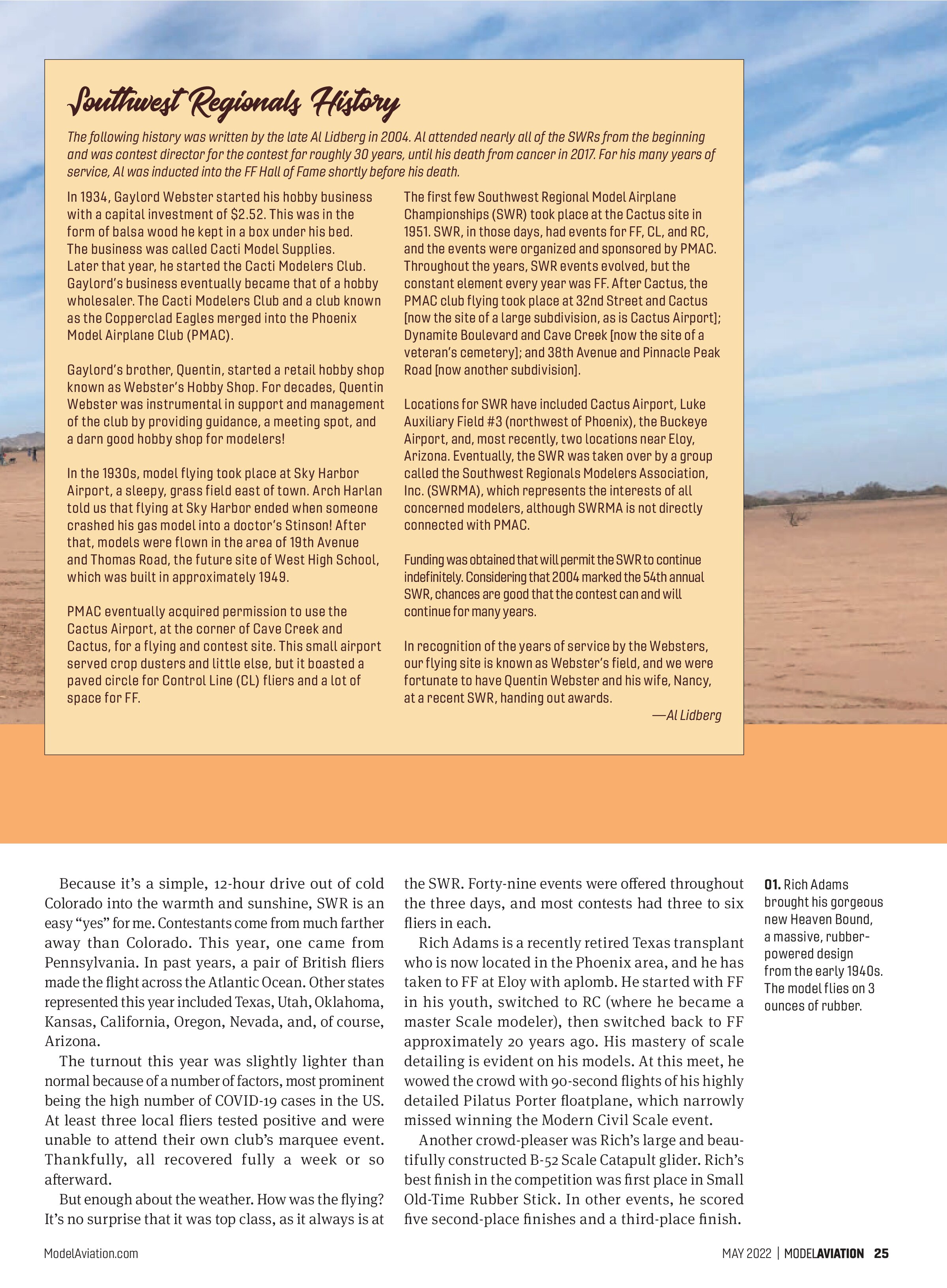
Tucson, Arizona, local Kevin McCue was another flier to watch. A U.S. Air Force veteran and full-scale pilot, Kevin is fairly new to FF but is rapidly gaining experience.
At SWR, he narrowly missed winning the mega-popular P-30 event against 10 experts. Kevin’s Old-Time Rubber Dynamoe was a sight to behold with perfect climbs. He had some rotten luck or would have placed higher in several other events.
On Monday, Kevin chose to stop flying and help a fellow flier by performing a low-and-slow aerial search with his Cessna 172. What a guy, and yes, the model was found!
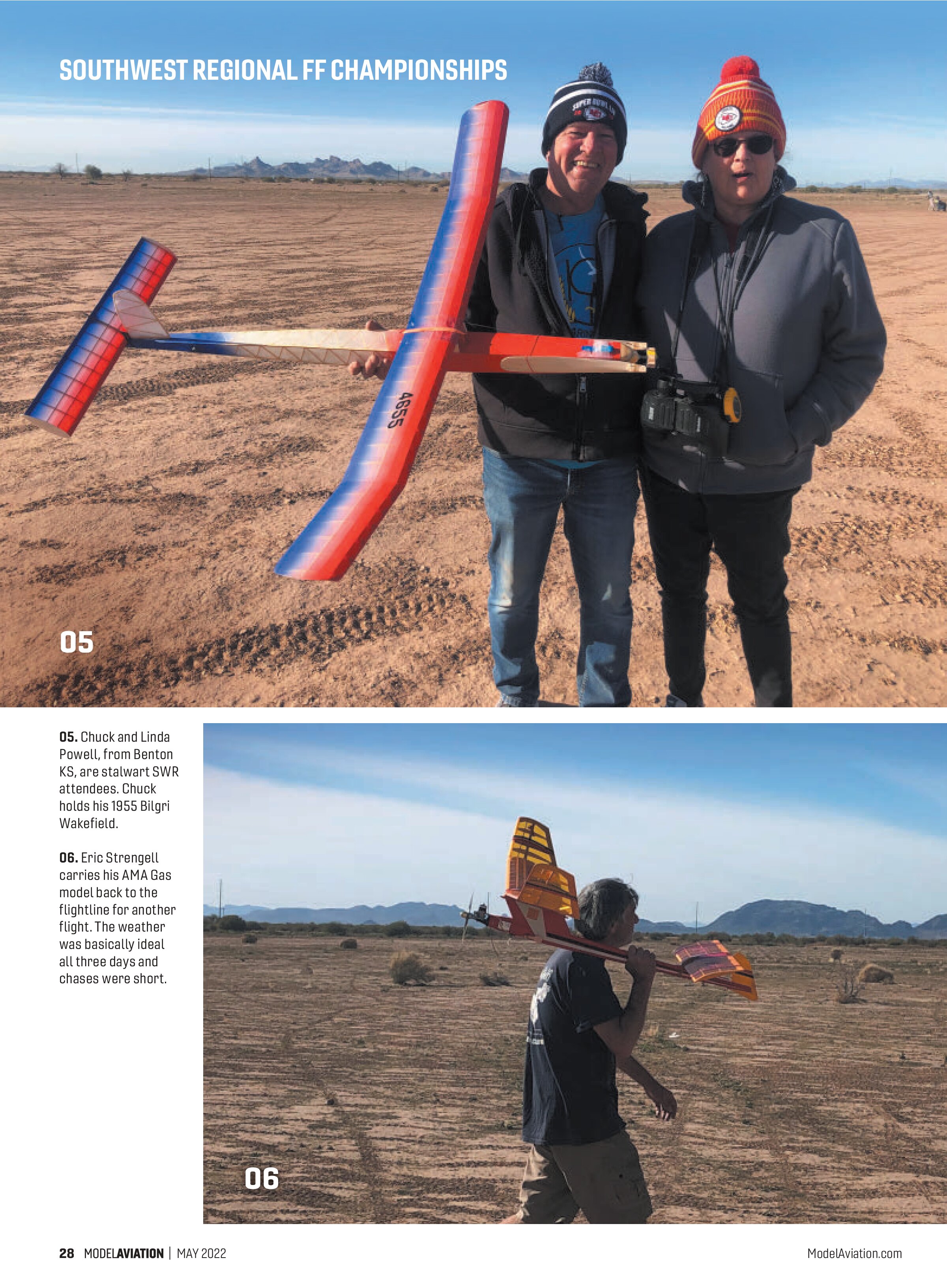
Chuck and Linda Powell have become regular attendees, making the drive from southern Kansas. Always smiling and incredibly energetic, I’ve never seen Chuck sit down at a contest. And nobody has more fun than Chuck and Linda. As usual, he flew a dozen or so events, winning three, with four second places and three thirds.
Probably the biggest happening of the meet was George Morris’ new national record in AMA E-36. George, a top F3K (RC Hand-Launch Glider [HLG]) flier,


returned to his FF roots in 2016, flying Glider, Electric, and AMA Gas events. He has seemingly done it so easily, winning club championships, smashing AMA records, and humoring everyone with his laid-back approach to everything.
At SWR 22, George had a new, extremely lightweight Super Pearl 222 E (see Model Aviation, June 2021 “Super Pearl 222-E”) that easily won E-36 in regulation with 10 2-minute maxes. After a brief rest and the awards ceremony, George continued flying for the record right up until sunset. In barely 45 minutes, he added eight more maxes for a total score of 2,160 seconds. He also won four other highly contested events at SWR. Amazing!
On the FAI flightline, a number of world-class fliers were present, including 2005 world champion Mike McKeever, who was second this time in F1A. The 2021 America’s Cup F1A winner, Arizona local Enes Pecenkovic, was flying, along with his wife, Jasna, who also flies F1A. Winning F1A this time was Californian Shlomi Rosenzweig, in a double 6-minute flyoff. There were nine total fliers in F1A.
In F1G, Oregon flier Tiffany O’Dell, a frequent America’s Cup winner, returned to the SWR after a year’s absence and summarily dominated the field of five. We were all happy to see her back to 100% after a


shoulder injury that sidelined her for much of 2021.
The most exciting of the FAI events was undoubtedly F1B (Wakefield). All five fliers are world class, so it wasn’t surprising that all five maxed out to make the flyoff. What was surprising was that all five then maxed two 6-minute flyoff rounds on Saturday evening, necessitating a third tiebreaker flight on Sunday morning.
As the sun crept over the eastern mountains, fliers listened for the starting horn that signaled the start of the 7-minute round. All got strong launches, and again—no surprise—all five had very good flights, with only one doing less than 6-1/2 minutes in the dead morning air. First place with 8:21 was Blake Jensen, a frequent US World Championships team member, just 21 seconds ahead of former world champ Jerry Fitch.
I hope I’ve convinced you to venture south to Arizona for the SWR in 2023. As the locals are fond of saying, the weather isn’t always perfect in January, but it’s virtually guaranteed to be a lot better than it is wherever it is you came from!
SOURCES:
SWR Free Flight Model Airplane Championships
www.swregionals.org