TAXI VS. TOTE
By Dave Gee | safetycolumn@cs.com
MY FIRST VISIT TO an RC flying field took place long ago. Seeing those beautiful, old gas-powered airplanes being prepared, started, and flown hooked me for life. Radio Control had become more reliable by then, and the model airplanes could taxi out for takeoff “just like the real ones.” How cool!
At the time, I didn’t realize that it was actually much safer for the pilot to walk along behind than to try and carry a gas model with the engine running. One stumble or fumble, and real trouble had arrived!
Nowadays, there are more electric-powered models than gas-powered ones, but pilots can still taxi them out if the field is set up that way. Many pilots use a motor-disconnect feature, either on the aircraft or on the transmitter. This deactivates the propeller but leaves the control system working, so the aircraft can get a thorough preflight inspection with no worries that the propeller will come alive.
Sometimes the motor doesn’t get connected until the model has been wheeled to the flightline. Other times, it is activated and tested before a taxi run. How you handle these things matters because having a solid routine is key to safe flight operations. Do it right, do it the same each time, and avoid surprises.
Lightweight, smaller, park flyer models sometimes have no landing gear and need to be carried to a hand-launch site after being readied for flight. Savvy pilots get a helper to hold either the radio or the model because bumped transmitters can cause problems when the power system is live. Too many fliers have learned this the hard way.
Recordkeeping
I’ve met modelers who have 3 x 5 cards with data and a checklist for each of their aircraft, especially if the airplanes use a shared transmitter. When you fly different types of models, it’s not a bad idea. To accommodate the changed ground and flight characteristics, the pilot’s brain needs to be reset along with the radio.
I recently had the bittersweet task of helping dispose of a friend’s hobby equipment after he passed away. As his daughters and I swapped upbeat stories about the departed modeler, I found that he was an exceptionally versatile builder. His fleet included everything from Indoor Free Flight (FF) Duration models to large, gas-powered, Old-Timer aircraft that were converted to RC.
This man had a reputation as a meticulous and skilled modeler. He had each type of model stored in a separate box (some of them were very big!) with data and special tools inside. When shifting gears from FF to RC, or from electric to gas power, he could refresh his memory with information about power settings, duration, adjustments, and repairs for each aircraft. No wonder he was so successful at contests!
His friends adopted many of the airplanes, and thanks to such good record-keeping, most of the models will take to the sky again.
π Sn
When I disassemble something that has tiny screws, my concentration is usually on the task and not the fasteners. Sometimes those screws make a break for it when I’m not looking, or I accidentally brush them off of the table with my elbow.
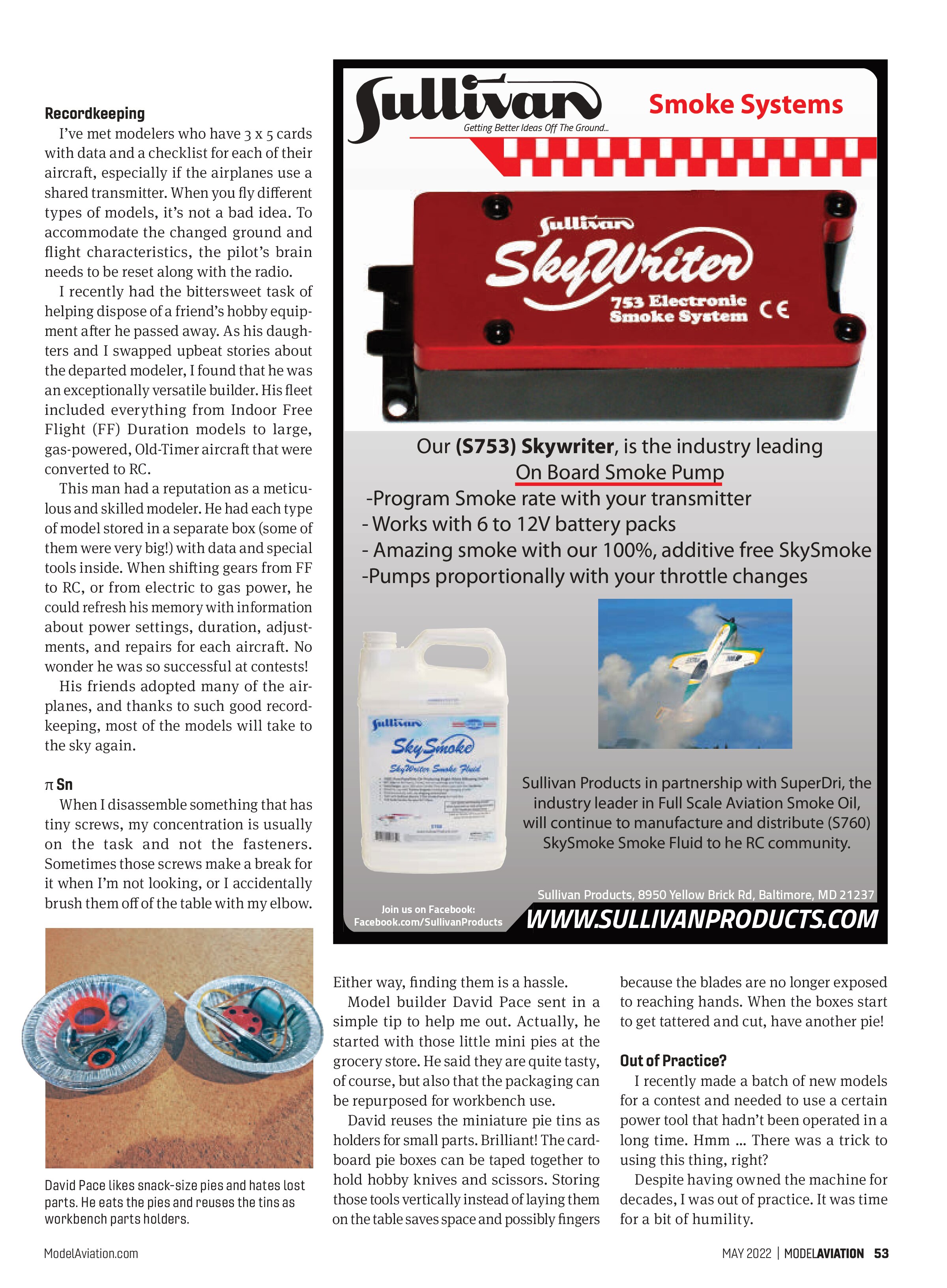
Either way, finding them is a hassle. Model builder David Pace sent in a simple tip to help me out. Actually, he started with those little mini pies at the grocery store. He said they are quite tasty, of course, but also that the packaging can be repurposed for workbench use.
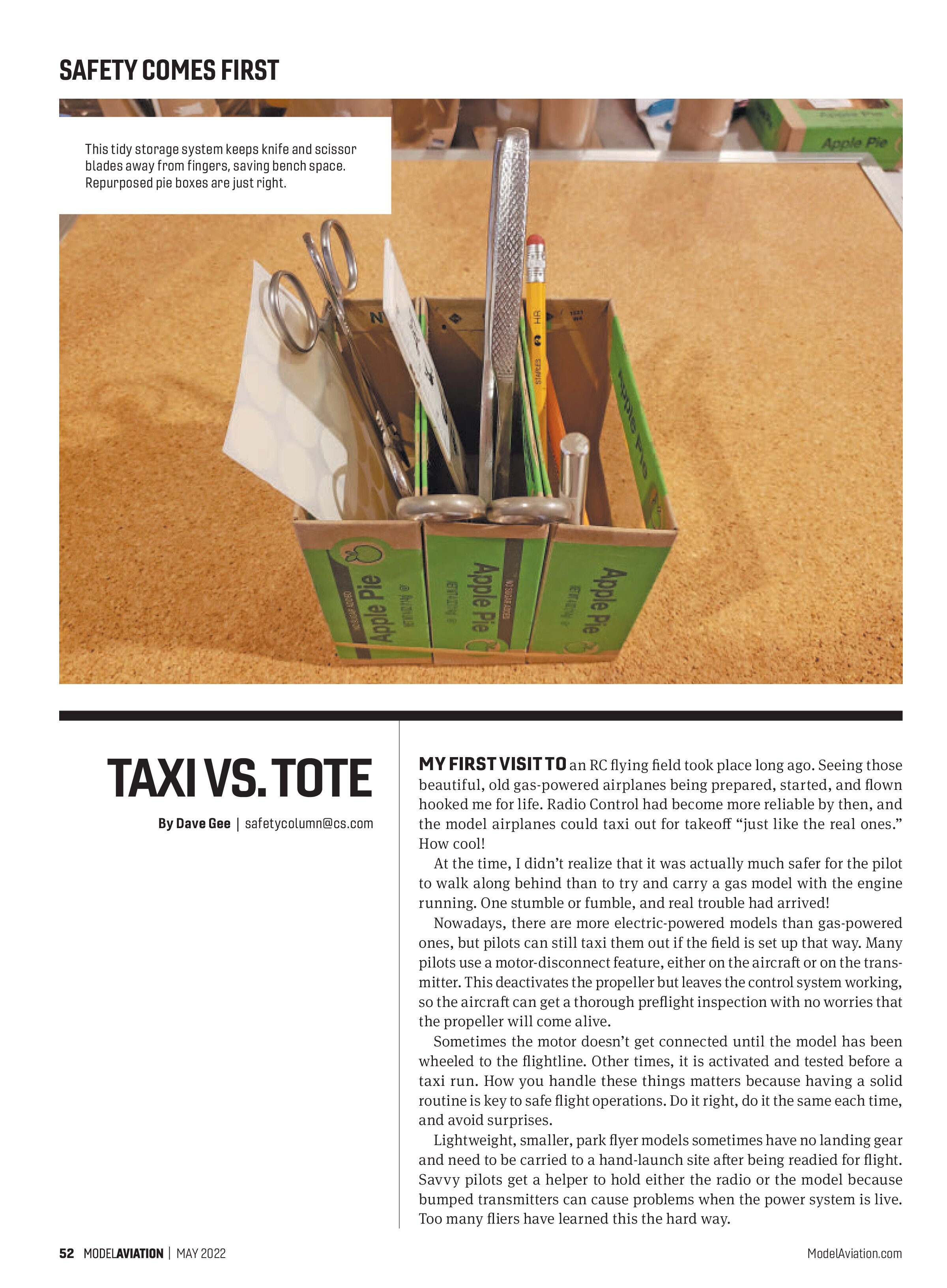
David reuses the miniature pie tins as holders for small parts. Brilliant! The cardboard pie boxes can be taped together to hold hobby knives and scissors. Storing those tools vertically instead of laying them on the table saves space and possibly fingers because the blades are no longer exposed to reaching hands. When the boxes start to get tattered and cut, have another pie!

Out of Practice?
I recently made a batch of new models for a contest and needed to use a certain power tool that hadn’t been operated in a long time. Hmm ... There was a trick to using this thing, right?
Despite having owned the machine for decades, I was out of practice. It was time for a bit of humility.

I dug out the owner’s manual and did a little refresher course before plugging the gadget in. Many builders have one or more pieces of equipment in his or her shop that see only occasional use. If it’s been a while since you last ran the bandsaw/grinder/drill press/finger nipper, perhaps a moment spent rereading the directions would help prevent trouble. With my luck, I’d get a papercut from the booklet.

Mystery Airplane
Readers of this column can’t agree about my mystery airplane puzzle choices. Some say they are too easy, while others struggle and make guesses and look up the tail numbers, which is actually not cheating.
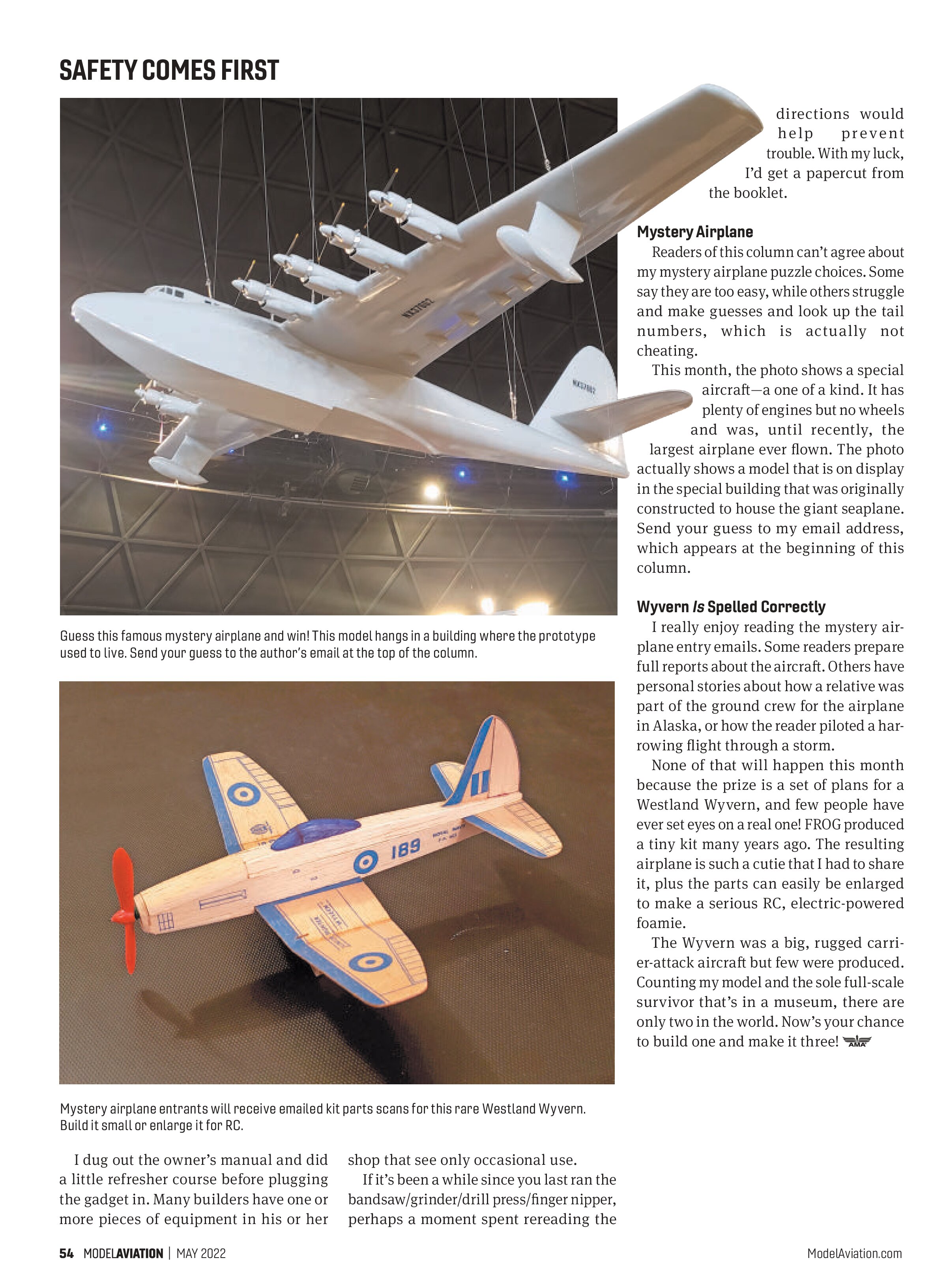
This month, the photo shows a special aircraft—a one of a kind. It has plenty of engines but no wheels and was, until recently, the largest airplane ever flown. The photo actually shows a model that is on display in the special building that was originally constructed to house the giant seaplane. Send your guess to my email address, which appears at the beginning of this column.

Wyvern Is Spelled Correctly
I really enjoy reading the mystery airplane entry emails. Some readers prepare full reports about the aircraft. Others have personal stories about how a relative was part of the ground crew for the airplane in Alaska, or how the reader piloted a harrowing flight through a storm.
None of that will happen this month because the prize is a set of plans for a Westland Wyvern, and few people have ever set eyes on a real one! FROG produced a tiny kit many years ago. The resulting airplane is such a cutie that I had to share it, plus the parts can easily be enlarged to make a serious RC, electric-powered foamie.
The Wyvern was a big, rugged carrier-attack aircraft but few were produced. Counting my model and the sole full-scale survivor that’s in a museum, there are only two in the world. Now’s your chance to build one and make it three!