MERRILL BRADY'S SCRATCH-BUILT TAYLORCRAFT TG-6

By Gordon Buckland | gordon@gatorf3b.com
MY FRIEND, MERRILL BRADY, is a talented builder and completed an awesome scale sailplane last year. Here is my conversation with him.
Gordon Buckland: When did you start flying RC?
Merrill Brady: In 1979, my stepfather was a flight instructor, and he had a friend who flew RC models, so I started with powered models in the form of an Ugly Stik.
GB: Did you fly full-scale sailplanes?
MB: Yes, I have flown in various sailplanes.
GB: Why build a Taylorcraft TG-6?
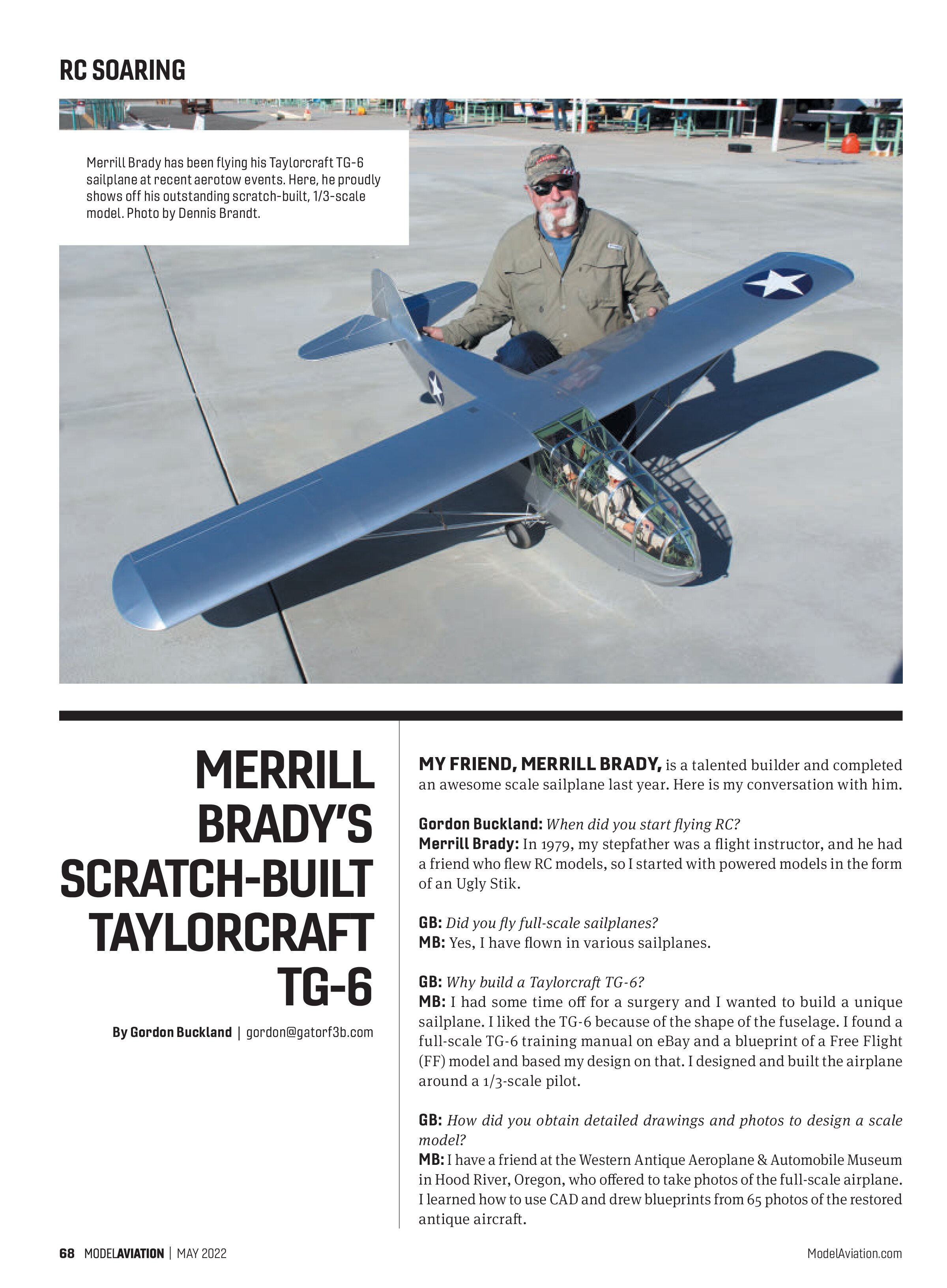
MB: I had some time off for a surgery and I wanted to build a unique sailplane. I liked the TG-6 because of the shape of the fuselage. I found a full-scale TG-6 training manual on eBay and a blueprint of a Free Flight (FF) model and based my design on that. I designed and built the airplane around a 1/3-scale pilot.
GB: How did you obtain detailed drawings and photos to design a scale model?
MB: I have a friend at the Western Antique Aeroplane & Automobile Museum in Hood River, Oregon, who offered to take photos of the full-scale airplane. I learned how to use CAD and drew blueprints from 65 photos of the restored antique aircraft.
GB: What materials did you use?
MB: I used mostly hard balsa wood and basswood, and most of the internal frame of the fuselage is brass to increase the weight. I joined the brass tube with silver solder. I used UltraCote silver to cover it and painted it with Mission Models zinc chromate.
GB: Tell us a little about the cockpit detail.
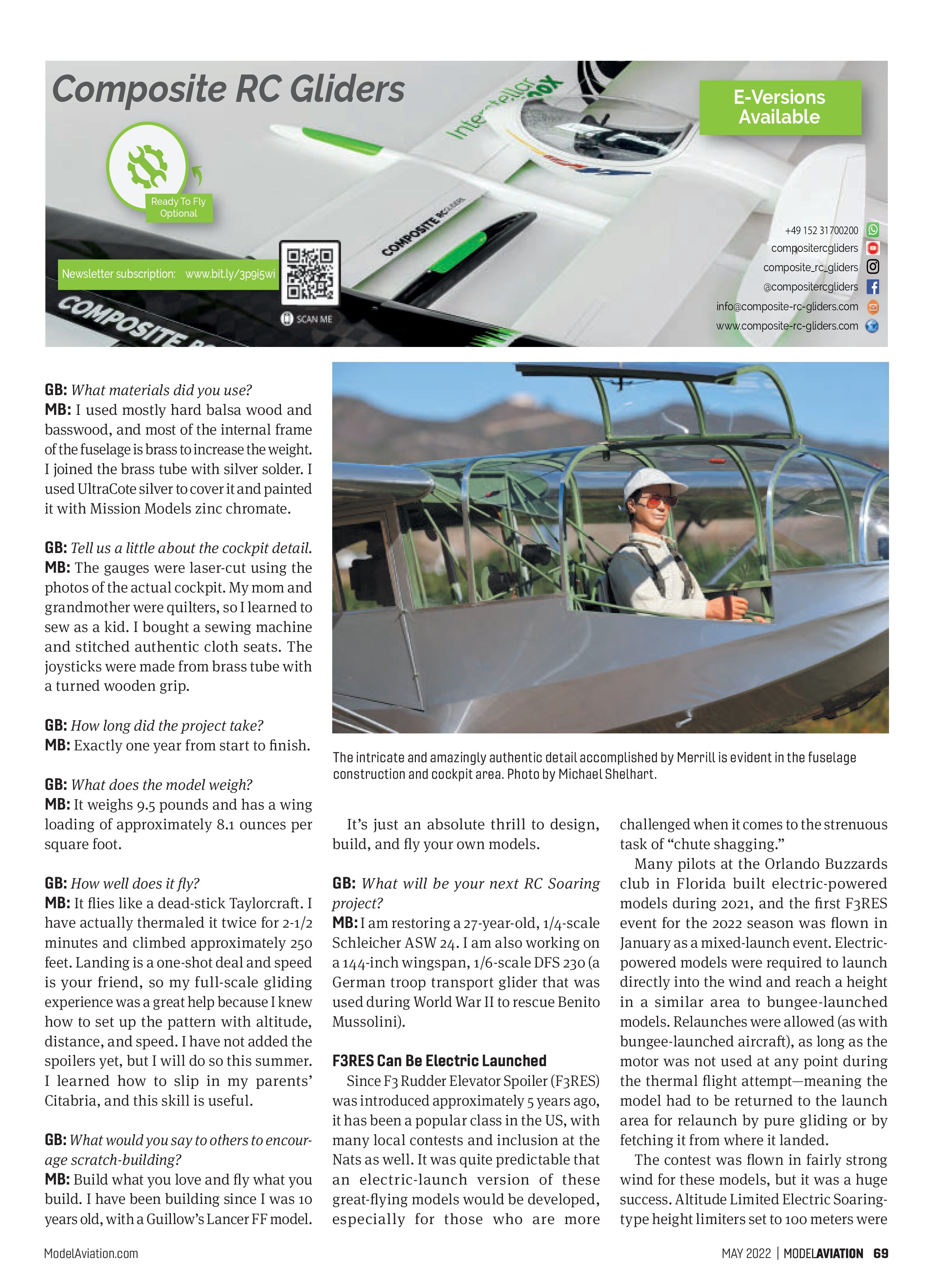
MB: The gauges were laser-cut using the photos of the actual cockpit. My mom and grandmother were quilters, so I learned to sew as a kid. I bought a sewing machine and stitched authentic cloth seats. The joysticks were made from brass tube with a turned wooden grip.
GB: How long did the project take?
MB: Exactly one year from start to finish.
GB: What does the model weigh?
MB: It weighs 9.5 pounds and has a wing loading of approximately 8.1 ounces per square foot.
GB: How well does it fly?
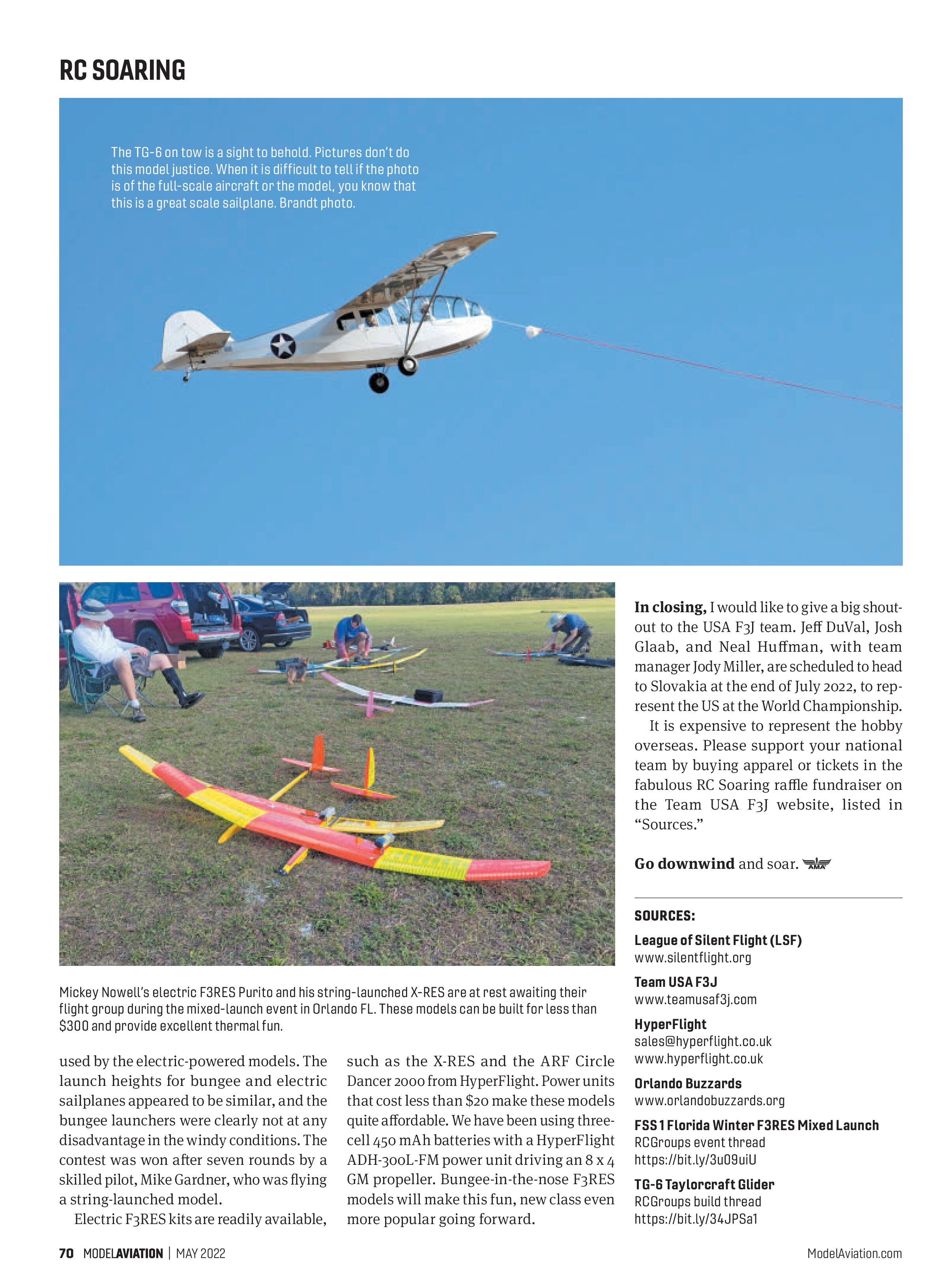
MB: It flies like a dead-stick Taylorcraft. I have actually thermaled it twice for 2-1/2 minutes and climbed approximately 250 feet. Landing is a one-shot deal and speed is your friend, so my full-scale gliding experience was a great help because I knew how to set up the pattern with altitude, distance, and speed. I have not added the spoilers yet, but I will do so this summer. I learned how to slip in my parents’ Citabria, and this skill is useful.
GB: What would you say to others to encourage scratch-building?
MB: Build what you love and fly what you build. I have been building since I was 10 years old, with a Guilllow’s Lancer FF model.
GB: What will be your next RC Soaring project?
MB: I am restoring a 27-year-old, 1/4-scale Schleicher ASW 24. I am also working on a 144-inch wingspan, 1/6-scale DFS 230 (a German troop transport glider that was used during World War II to rescue Benito Mussolini).
It’s just an absolute thrill to design, build, and fly your own models.

F3RES Can Be Electric Launched
Since F3 Rudder Elevator Spoiler (F3RES) was introduced approximately 5 years ago, it has been a popular class in the US, with many local contests and inclusion at the Nats as well. It was quite predictable that an electric-launch version of these great-flying models would be developed, especially for those who are more challenged when it comes to the strenuous task of “chute snagging.”
Many pilots at the Orlando Buzzards club in Florida built electric-powered models during 2021, and the first F3RES event for the 2022 season was flown in January as a mixed-launch event. Electric-powered models were required to launch directly into the wind and reach a height in a similar area to bungee-launched models. Relaunches were allowed (as with bungee-launched aircraft), as long as the motor was not used at any point during the thermal flight attempt—meaning the model had to be returned to the launch area for relaunch by pure gliding or by fetching it from where it landed.
The contest was flown in fairly strong wind for these models, but it was a huge success. Altitude Limited Electric Soaring-type height limiters set to 100 meters were


used by the electric-powered models. The launch heights for bungee and electric sailplanes appeared to be similar, and the bungee launchers were clearly not at any disadvantage in the windy conditions. The contest was won after seven rounds by a skilled pilot, Mike Gardner, who was flying a string-launched model.
Electric F3RES kits are readily available, such as the X-RES and the ARF Circle Dancer 2000 from HyperFlight. Power units that cost less than $20 make these models quite affordable. We have been using three-cell 450 mAh batteries with a HyperFlight ADH-300L-FM power unit driving an 8 x 4 GM propeller. Bungee-in-the-nose F3RES models will make this fun, new class even more popular going forward.
In closing, I would like to give a big shout-out to the USA F3J team. Jeff DuVal, Josh Glaab, and Neal Huffman, with team manager Jody Miller, are scheduled to head to Slovakia at the end of July 2022, to represent the US at the World Championship.
It is expensive to represent the hobby overseas. Please support your national team by buying apparel or tickets in the fabulous RC Soaring raffle fundraiser on the Team USA F3J website, listed in “Sources.”
Go downwind and soar.
SOURCES:
League of Silent Flight (LSF)
www.silentflight.org
Team USA F3J
www.teamusaf3j.com
HyperFlight
sales@hyperflight.co.uk
www.hyperflight.co.uk
Orlando Buzzards
www.orlandobuzzards.org
FSS1 Florida Winter F3RES Mixed Launch
RCGroups event thread
https://bit.ly/3u09uiU
TG-6 Taylorcraft Glider
RCGroups build thread
https://bit.ly/34JPSa1