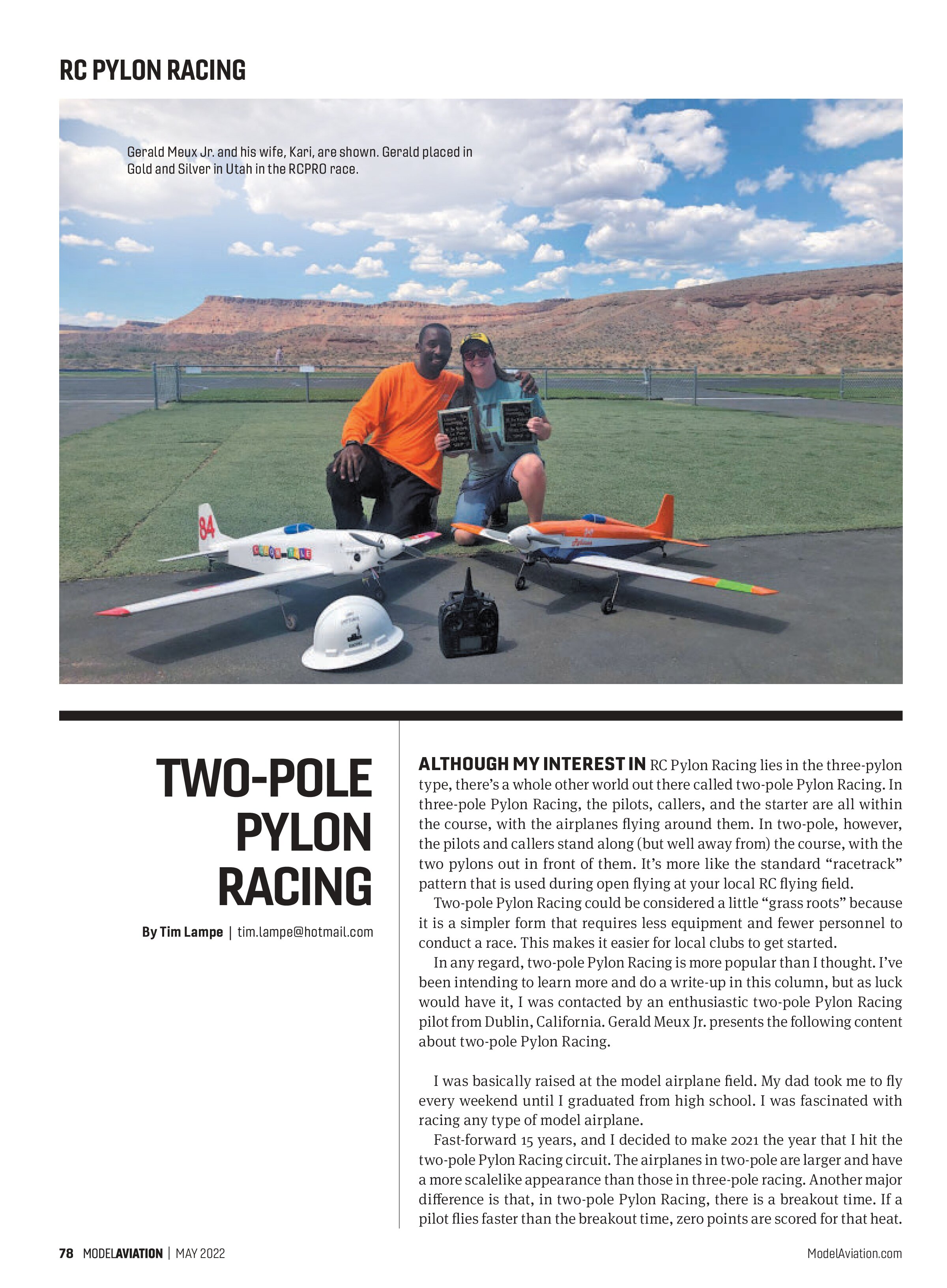
RC PYLON RACING

TWO-POLE
PYLON
RACING
By Tim Lampe | tim.lampe@hotmail.com
ALTHOUGH MY INTEREST IN RC Pylon Racing lies in the three-pylon type, there’s a whole other world out there called two-pole Pylon Racing. In three-pole Pylon Racing, the pilots, callers, and the starter are all within the course, with the airplanes flying around them. In two-pole, however, the pilots and callers stand along (but well away from) the course, with the two pylons out in front of them. It’s more like the standard “racetrack” pattern that is used during open flying at your local RC flying field.
Two-pole Pylon Racing could be considered a little “grass roots” because it is a simpler form that requires less equipment and fewer personnel to conduct a race. This makes it easier for local clubs to get started.
In any regard, two-pole Pylon Racing is more popular than I thought. I’ve been intending to learn more and do a write-up in this column, but as luck would have it, I was contacted by an enthusiastic two-pole Pylon Racing pilot from Dublin, California. Gerald Meux Jr. presents the following content about two-pole Pylon Racing.
I was basically raised at the model airplane field. My dad took me to fly every weekend until I graduated from high school. I was fascinated with racing any type of model airplane.
Fast-forward 15 years, and I decided to make 2021 the year that I hit the two-pole Pylon Racing circuit. The airplanes in two-pole are larger and have a more scalelike appearance than those in three-pole racing. Another major difference is that, in two-pole Pylon Racing, there is a breakout time. If a pilot flies faster than the breakout time, zero points are scored for that heat.