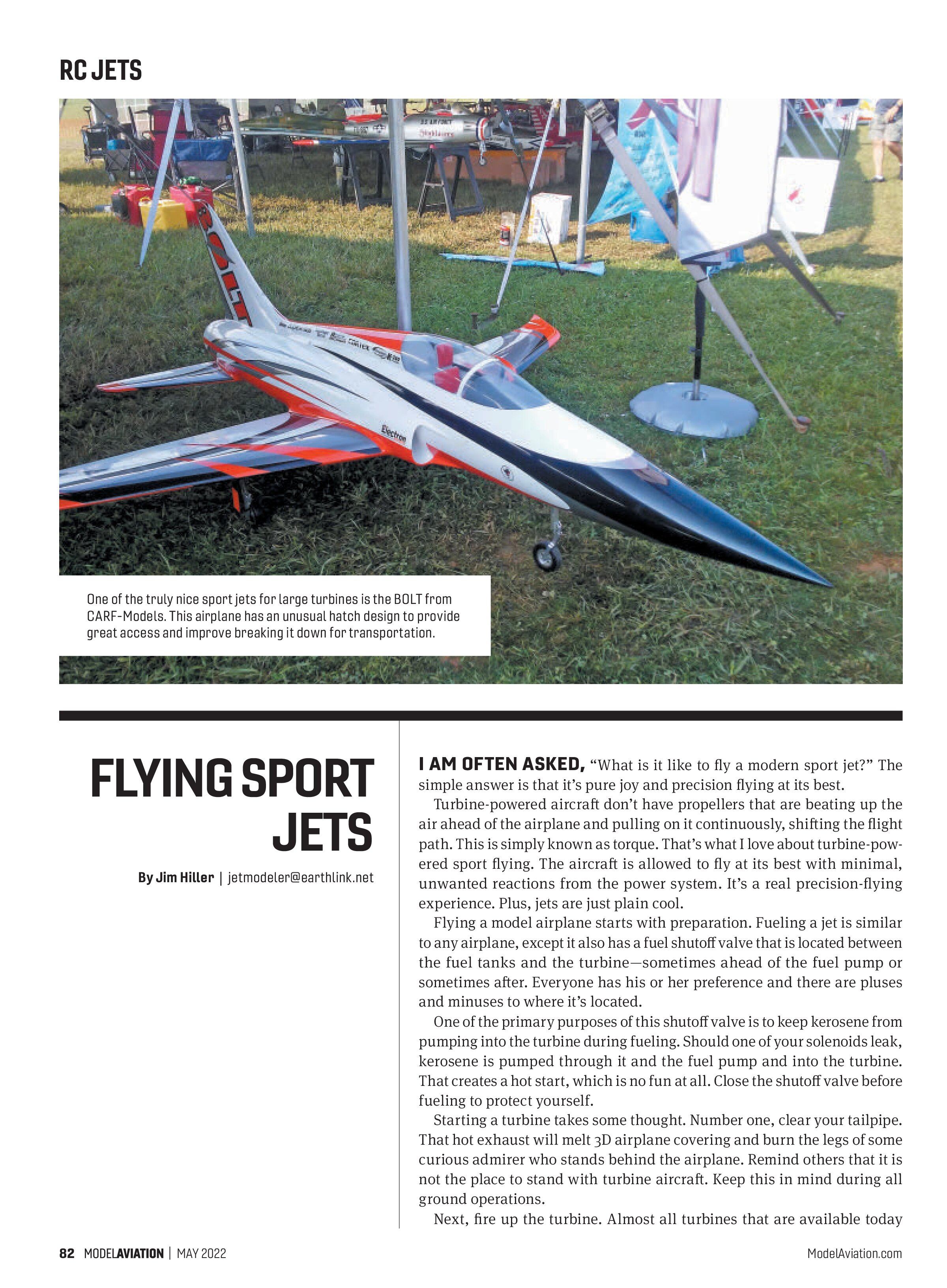
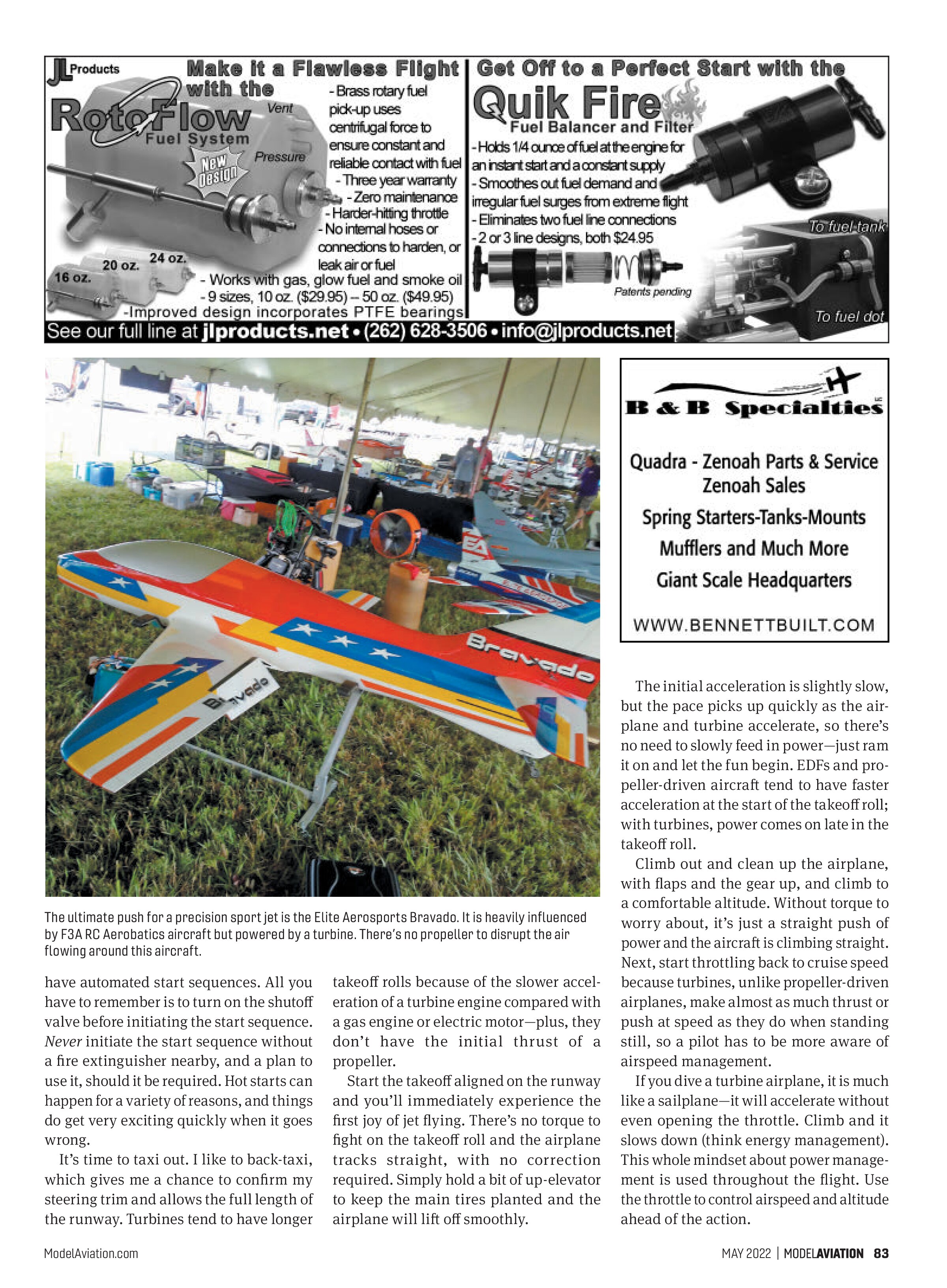
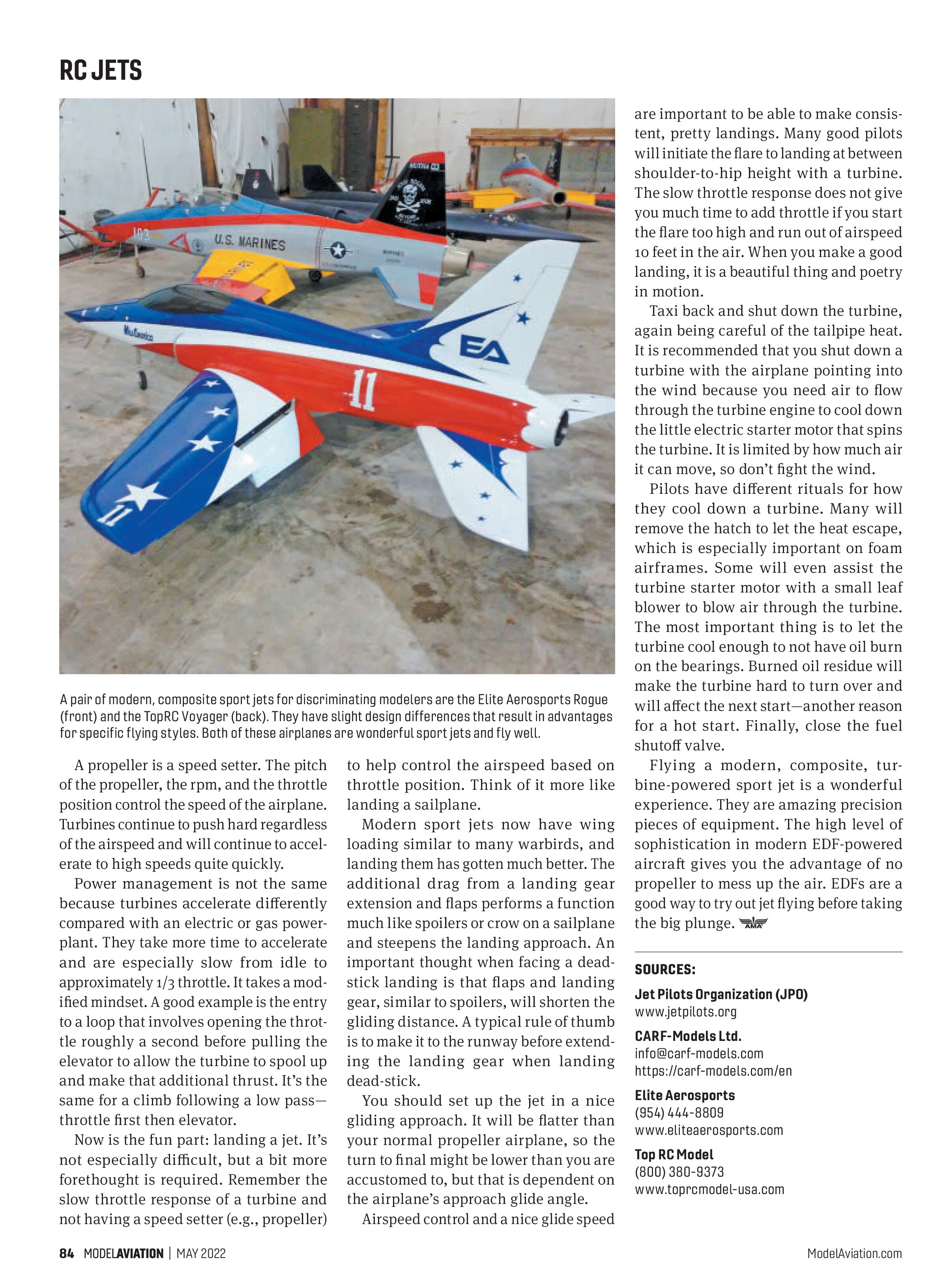
FLYING SPORT JETS
By Jim Hiller | jetmodeler@earthlink.net

I AM OFTEN ASKED, “What is it like to fly a modern sport jet?” The simple answer is that it’s pure joy and precision flying at its best.
Turbine-powered aircraft don’t have propellers that are beating up the air ahead of the airplane and pulling on it continuously, shifting the flight path. This is simply known as torque. That’s what I love about turbine-powered sport flying. The aircraft is allowed to fly at its best with minimal, unwanted reactions from the power system. It’s a real precision-flying experience. Plus, jets are just plain cool.
Flying a model airplane starts with preparation. Fueling a jet is similar to any airplane, except it also has a fuel shutoff valve that is located between the fuel tanks and the turbine—sometimes ahead of the fuel pump or sometimes after. Everyone has his or her preference and there are pluses and minuses to where it’s located.
One of the primary purposes of this shutoff valve is to keep kerosene from pumping into the turbine during fueling. Should one of your solenoids leak, kerosene is pumped through it and the fuel pump and into the turbine. That creates a hot start, which is no fun at all. Close the shutoff valve before fueling to protect yourself.
Starting a turbine takes some thought. Number one, clear your tailpipe. That hot exhaust will melt 3D airplane covering and burn the legs of some curious admirer who stands behind the airplane. Remind others that it is not the place to stand with turbine aircraft. Keep this in mind during all ground operations.
Next, fire up the turbine. Almost all turbines that are available today have automated start sequences. All you have to remember is to turn on the shutoff valve before initiating the start sequence. Never initiate the start sequence without a fire extinguisher nearby, and a plan to use it, should it be required. Hot starts can happen for a variety of reasons, and things do get very exciting quickly when it goes wrong.

It’s time to taxi out. I like to back-taxi, which gives me a chance to confirm my steering trim and allows the full length of the runway. Turbines tend to have longer takeoff rolls because of the slower acceleration of a turbine engine compared with a gas engine or electric motor—plus, they don’t have the initial thrust of a propeller.
Start the takeoff aligned on the runway and you’ll immediately experience the first joy of jet flying. There’s no torque to fight on the takeoff roll and the airplane tracks straight, with no correction required. Simply hold a bit of up-elevator to keep the main tires planted and the airplane will lift off smoothly.
The initial acceleration is slightly slow, but the pace picks up quickly as the airplane and turbine accelerate, so there’s no need to slowly feed in power—just ram it on and let the fun begin. EDFs and propeller-driven aircraft tend to have faster acceleration at the start of the takeoff roll; with turbines, power comes on late in the takeoff roll.
Climb out and clean up the airplane, with flaps and the gear up, and climb to a comfortable altitude. Without torque to worry about, it’s just a straight push of power and the aircraft is climbing straight. Next, start throttling back to cruise speed because turbines, unlike propeller-driven airplanes, make almost as much thrust or push at speed as they do when standing still, so a pilot has to be more aware of airspeed management.
If you dive a turbine airplane, it is much like a sailplane—it will accelerate without even opening the throttle. Climb and it slows down (think energy management). This whole mindset about power management is used throughout the flight. Use the throttle to control airspeed and altitude ahead of the action.

A propeller is a speed setter. The pitch of the propeller, the rpm, and the throttle position control the speed of the airplane. Turbines continue to push hard regardless of the airspeed and will continue to accelerate to high speeds quite quickly.
Power management is not the same because turbines accelerate differently compared with an electric or gas powerplant. They take more time to accelerate and are especially slow from idle to approximately 1/3 throttle. It takes a modified mindset. A good example is the entry to a loop that involves opening the throttle roughly a second before pulling the elevator to allow the turbine to spool up and make that additional thrust. It’s the same for a climb following a low pass—throttle first then elevator.
Now is the fun part: landing a jet. It’s not especially difficult, but a bit more forethought is required. Remember the slow throttle response of a turbine and not having a speed setter (e.g., propeller) to help control the airspeed based on throttle position. Think of it more like landing a sailplane.
Modern sport jets now have wing loading similar to many warbirds, and landing them has gotten much better. The additional drag from a landing gear extension and flaps performs a function much like spoilers or crow on a sailplane and steepens the landing approach. An important thought when facing a dead-stick landing is that flaps and landing gear, similar to spoilers, will shorten the gliding distance. A typical rule of thumb is to make it to the runway before extending the landing gear when landing dead-stick.
You should set up the jet in a nice gliding approach. It will be flatter than your normal propeller airplane, so the turn to final might be lower than you are accustomed to, but that is dependent on the airplane’s approach glide angle.
Airspeed control and a nice glide speed are important to be able to make consistent, pretty landings. Many good pilots will initiate the flare to landing at between shoulder-to-hip height with a turbine. The slow throttle response does not give you much time to add throttle if you start the flare too high and run out of airspeed 10 feet in the air. When you make a good landing, it is a beautiful thing and poetry in motion.
Taxi back and shut down the turbine, again being careful of the tailpipe heat. It is recommended that you shut down a turbine with the airplane pointing into the wind because you need air to flow through the turbine engine to cool down the little electric starter motor that spins the turbine. It is limited by how much air it can move, so don’t fight the wind.
Pilots have different rituals for how they cool down a turbine. Many will remove the hatch to let the heat escape, which is especially important on foam airframes. Some will even assist the turbine starter motor with a small leaf blower to blow air through the turbine. The most important thing is to let the turbine cool enough to not have oil burn on the bearings. Burned oil residue will make the turbine hard to turn over and will affect the next start—another reason for a hot start. Finally, close the fuel shutoff valve.
Flying a modern, composite, turbine-powered sport jet is a wonderful experience. They are amazing precision pieces of equipment. The high level of sophistication in modern EDF-powered aircraft gives you the advantage of no propeller to mess up the air. EDFs are a good way to try out jet flying before taking the big plunge.
SOURCES:
Jet Pilots Organization (JPO)
www.jetpilots.org
CARF-Models Ltd.
info@carf-models.com
https://carf-models.com/en
Elite Aerosports
(954) 444-8809
www.eliteaerosports.com
Top RC Model
(800) 380-9373
www.toprcmodel-usa.com