Micro-Flying

CAREERS IN COMMERCIAL FLYING
By Joe Malinchak | joemal@echoes.net
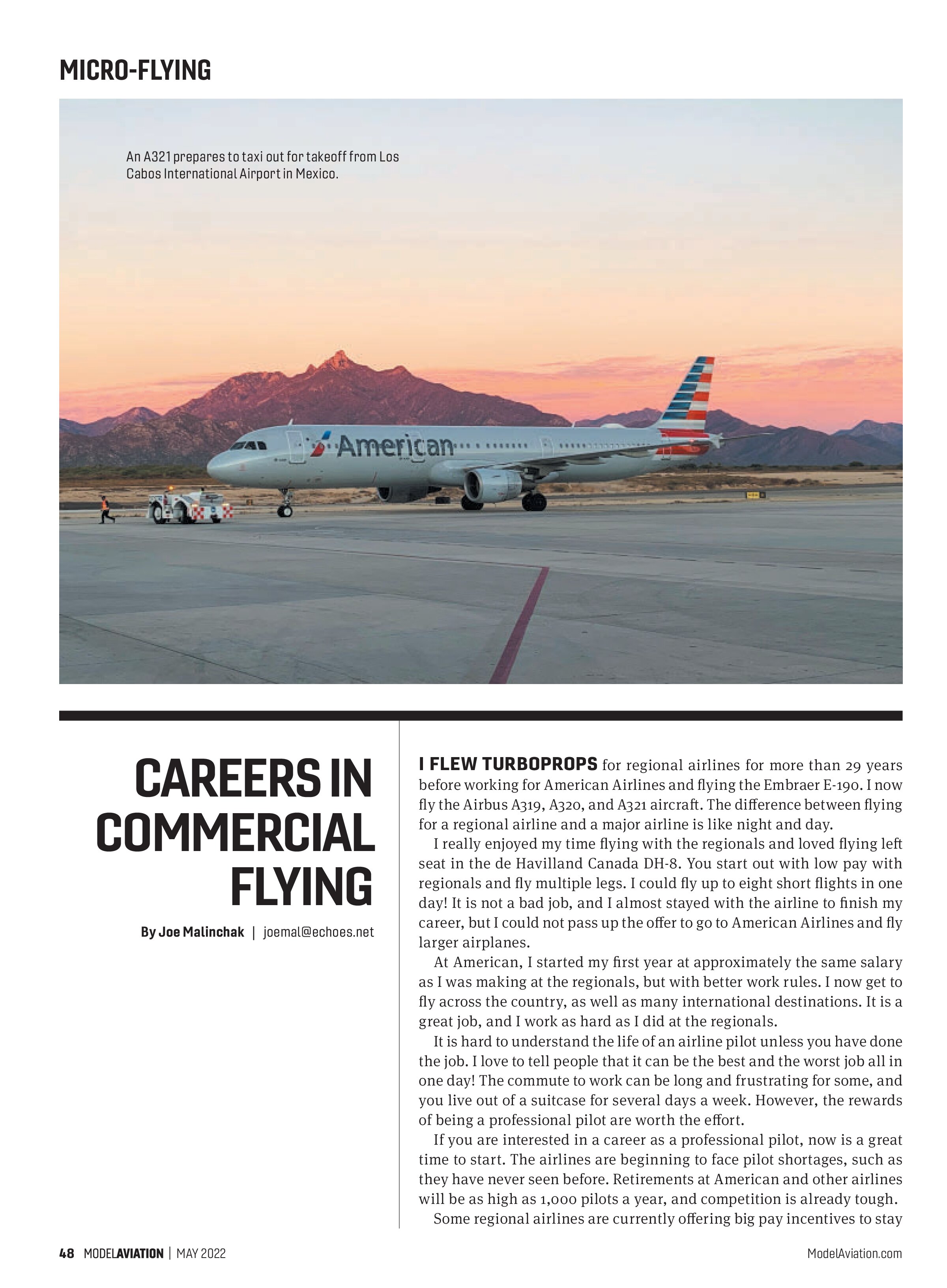
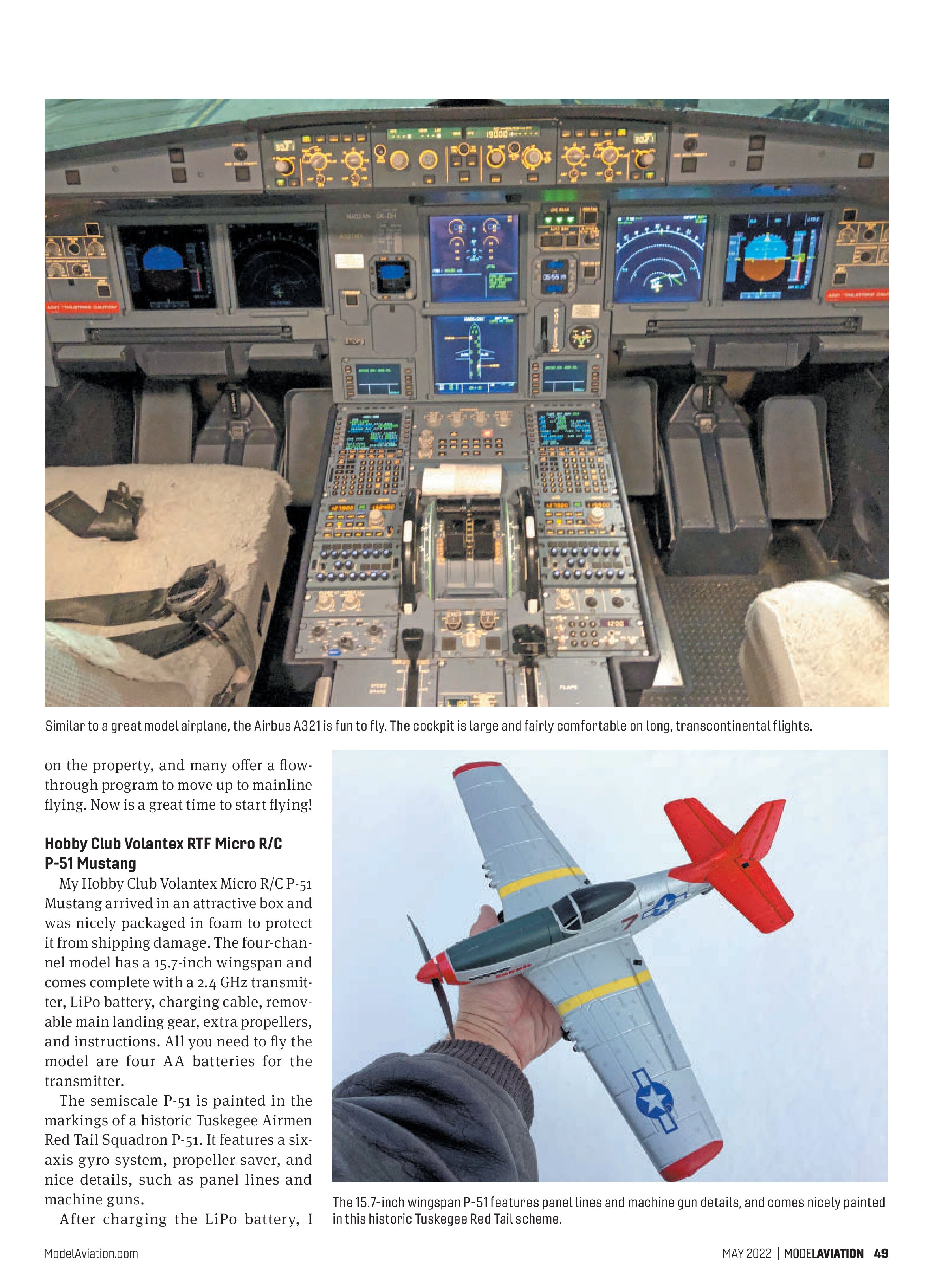
I FLEW TURBOPROPS for regional airlines for more than 29 years before working for American Airlines and flying the Embraer E-190. I now fly the Airbus A319, A320, and A321 aircraft. The difference between flying for a regional airline and a major airline is like night and day.
I really enjoyed my time flying with the regionals and loved flying left seat in the de Havilland Canada DH-8. You start out with low pay with regionals and fly multiple legs. I could fly up to eight short flights in one day! It is not a bad job, and I almost stayed with the airline to finish my career, but I could not pass up the offer to go to American Airlines and fly larger airplanes.
At American, I started my first year at approximately the same salary as I was making at the regionals, but with better work rules. I now get to fly across the country, as well as many international destinations. It is a great job, and I work as hard as I did at the regionals.
It is hard to understand the life of an airline pilot unless you have done the job. I love to tell people that it can be the best and the worst job all in one day! The commute to work can be long and frustrating for some, and you live out of a suitcase for several days a week. However, the rewards of being a professional pilot are worth the effort.
If you are interested in a career as a professional pilot, now is a great time to start. The airlines are beginning to face pilot shortages, such as they have never seen before. Retirements at American and other airlines will be as high as 1,000 pilots a year, and competition is already tough.
Some regional airlines are currently offering big pay incentives to stay

Hobby Club Volantex RTF Micro R/C P-51 Mustang
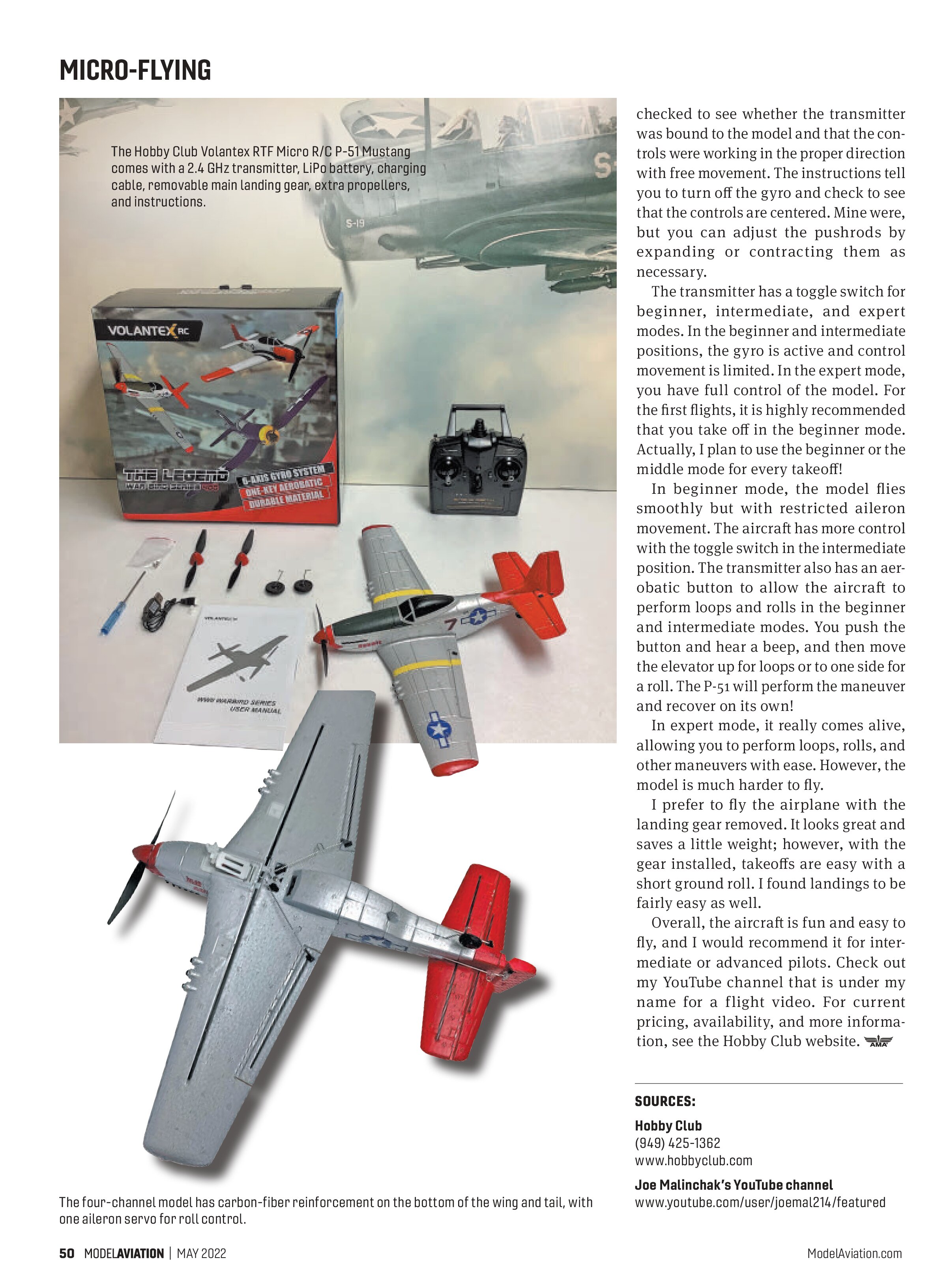
My Hobby Club Volantex Micro R/C P-51 Mustang arrived in an attractive box and was nicely packaged in foam to protect it from shipping damage. The four-channel model has a 15.7-inch wingspan and comes complete with a 2.4 GHz transmitter, LiPo battery, charging cable, removable main landing gear, extra propellers, and instructions. All you need to fly the model are four AA batteries for the transmitter.
The semiscale P-51 is painted in the markings of a historic Tuskegee Airmen Red Tail Squadron P-51. It features a six-axis gyro system, propeller saver, and nice details, such as panel lines and machine guns.
After charging the LiPo battery, I


checked to see whether the transmitter was bound to the model and that the controls were working in the proper direction with free movement. The instructions tell you to turn off the gyro and check to see that the controls are centered. Mine were, but you can adjust the pushrods by expanding or contracting them as necessary.
The transmitter has a toggle switch for beginner, intermediate, and expert modes. In the beginner and intermediate positions, the gyro is active and control movement is limited. In the expert mode, you have full control of the model. For the first flights, it is highly recommended that you take off in the beginner mode. Actually, I plan to use the beginner or the middle mode for every takeoff!
In beginner mode, the model flies smoothly but with restricted aileron movement. The aircraft has more control with the toggle switch in the intermediate position. The transmitter also has an aerobatic button to allow the aircraft to perform loops and rolls in the beginner and intermediate modes. You push the button and hear a beep, and then move the elevator up for loops or to one side for a roll. The P-51 will perform the maneuver and recover on its own!
In expert mode, it really comes alive, allowing you to perform loops, rolls, and other maneuvers with ease. However, the model is much harder to fly.
I prefer to fly the airplane with the landing gear removed. It looks great and saves a little weight; however, with the gear installed, takeoffs are easy with a short ground roll. I found landings to be fairly easy as well.
Overall, the aircraft is fun and easy to fly, and I would recommend it for intermediate or advanced pilots. Check out my YouTube channel that is under my name for a flight video. For current pricing, availability, and more information, see the Hobby Club website.
SOURCES:
Hobby Club
(949) 425-1362
www.hobbyclub.com
Joe Malinchak's YouTube channel
www.youtube.com/user/joemal214/featured