Focal Point
Interested in sharing your handiwork? Visit www.ModelAviation.com/focalpoint for submission guidelines.
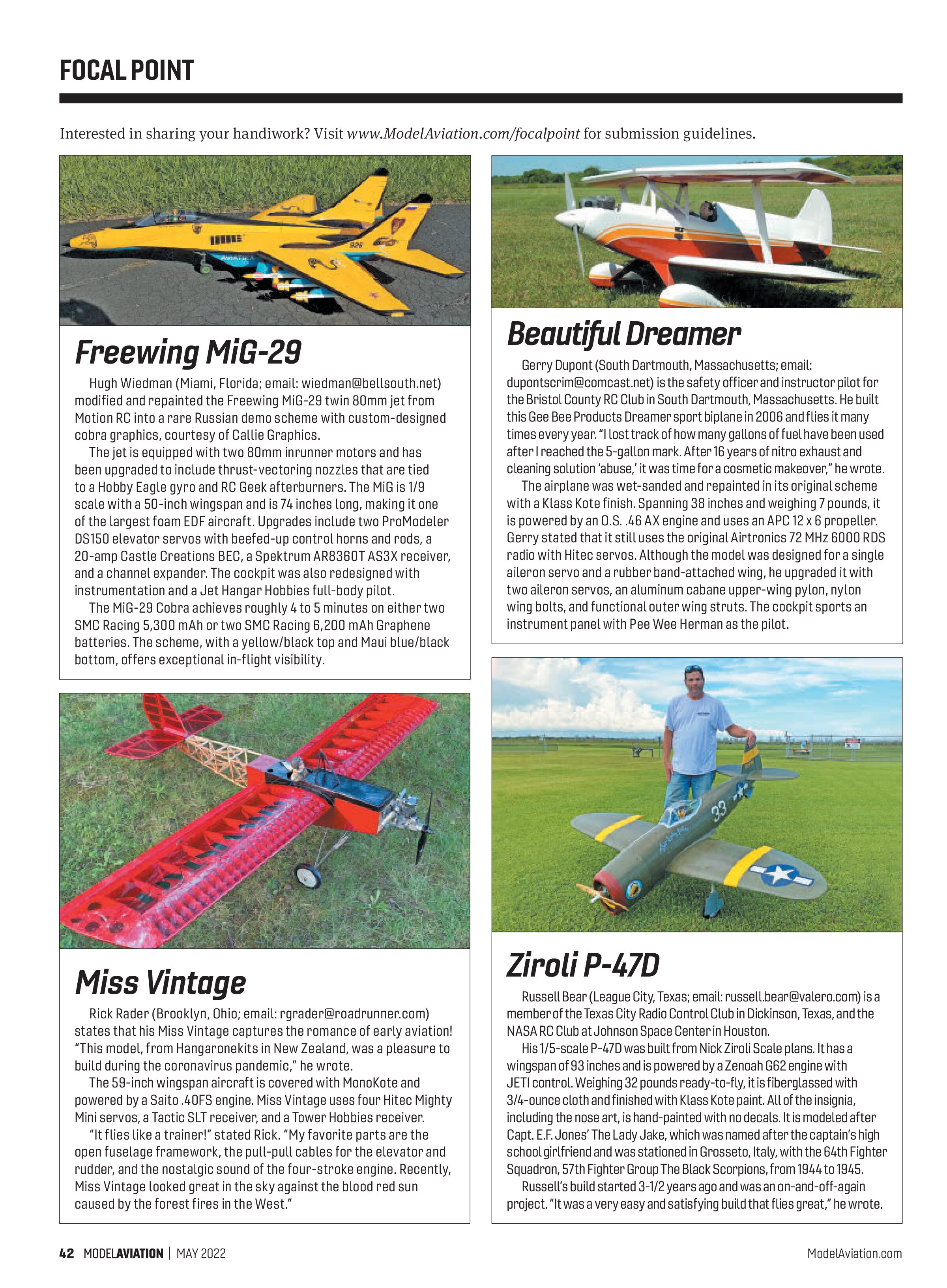
Freewing MiG-29

Hugh Wiedman (Miami, Florida; email: wiedman@bellsouth.net) modified and repainted the Freewing MiG-29 twin 80mm jet from Motion RC into a rare Russian demo scheme with custom-designed cobra graphics, courtesy of Callie Graphics.
The jet is equipped with two 80mm inrunner motors and has been upgraded to include thrust-vectoring nozzles that are tied to a Hobby Eagle gyro and RC Geek afterburners. The MiG is 1/9 scale with a 50-inch wingspan and is 74 inches long, making it one of the largest foam EDF aircraft. Upgrades include two ProModeler DS150 elevator servos with beefed-up control horns and rods, a 20-amp Castle Creations BEC, a Spektrum AR8360T AS3X receiver, and a channel expander. The cockpit was also redesigned with instrumentation and a Jet Hangar Hobbies full-body pilot.
The MiG-29 Cobra achieves roughly 4 to 5 minutes on either two SMC Racing 5,300 mAh or two SMC Racing 6,200 mAh Graphene batteries. The scheme, with a yellow/black top and Maui blue/black bottom, offers exceptional in-flight visibility.
Miss Vintage

Rick Rader (Brooklyn, Ohio; email: rgrader@roadrunner.com) states that his Miss Vintage captures the romance of early aviation! “This model, from Hangaronekits in New Zealand, was a pleasure to build during the coronavirus pandemic,” he wrote.
The 59-inch span aircraft is covered with MonoKote and powered by a Saito .40FS engine. Miss Vintage uses four Hitec Mighty Mini servos, a Tactic SLT receiver, and a Tower Hobbies receiver.
“It flies like a trainer!” stated Rick. “My favorite parts are the open fuselage framework, the pull-pull cables for the elevator and rudder, and the nostalgic sound of the four-stroke engine. Recently, Miss Vintage looked great in the sky against the blood red sun caused by the forest fires in the West.”
Beautiful Dreamer

Gerry Dupont (South Dartmouth, Massachusetts; email: dupontscrim@comcast.net) is the safety officer and instructor pilot for the Bristol County RC Club in South Dartmouth, Massachusetts. He built this Gee Bee Products Dreamer sport biplane in 2006 and flies it many times every year. “I lost track of how many gallons of fuel have been used after I reached the 5-gallon mark. After 16 years of nitro exhaust and cleaning solution ‘abuse,’ it was time for a cosmetic makeover,” he wrote.
The airplane was wet-sanded and repainted in its original scheme with a Klass Kote finish. Spanning 38 inches and weighing 7 pounds, it is powered by an O.S. .46 AX engine and uses an APC 12 X 6 propeller. Gerry stated that it still uses the original Airtronics 72 MHz 6000 RDS radio with Hitec servos. Although the model was designed for a single aileron servo and a rubber band-attached wing, he upgraded it with two aileron servos, an aluminum cabane upper-wing pylon, nylon wing bolts, and functional outer wing struts. The cockpit sports an instrument panel with Pee Wee Herman as the pilot.
Ziroli P-47D

Russell Bear (League City, Texas; email: russell.bear@valero.com) is a member of the Texas City Radio Control Club in Dickinson, Texas, and the NASA RC Club at Johnson Space Center in Houston.
His 1/5-scale P-47D was built from Nick Ziroli Scale plans. It has a wingspan of 93 inches and is powered by a Zenoah G62 engine with JETI control. Weighing 32 pounds ready-to-fly, it is fiberglassed with 3/4-ounce cloth and finished with Klass Kote paint. All of the insignia, including the nose art, is hand-painted with no decals. It is modeled after Capt. E.F. Jones’ The Lady Jake, which was named after the captain’s high school girlfriend and was stationed in Grosseto, Italy, with the 64th Fighter Squadron, 57th Fighter Group The Black Scorpions, from 1944 to 1945.
Russell’s build started 3-1/2 years ago and was an on-and-off-again project. “It was a very easy and satisfying build that flies great,” he wrote.
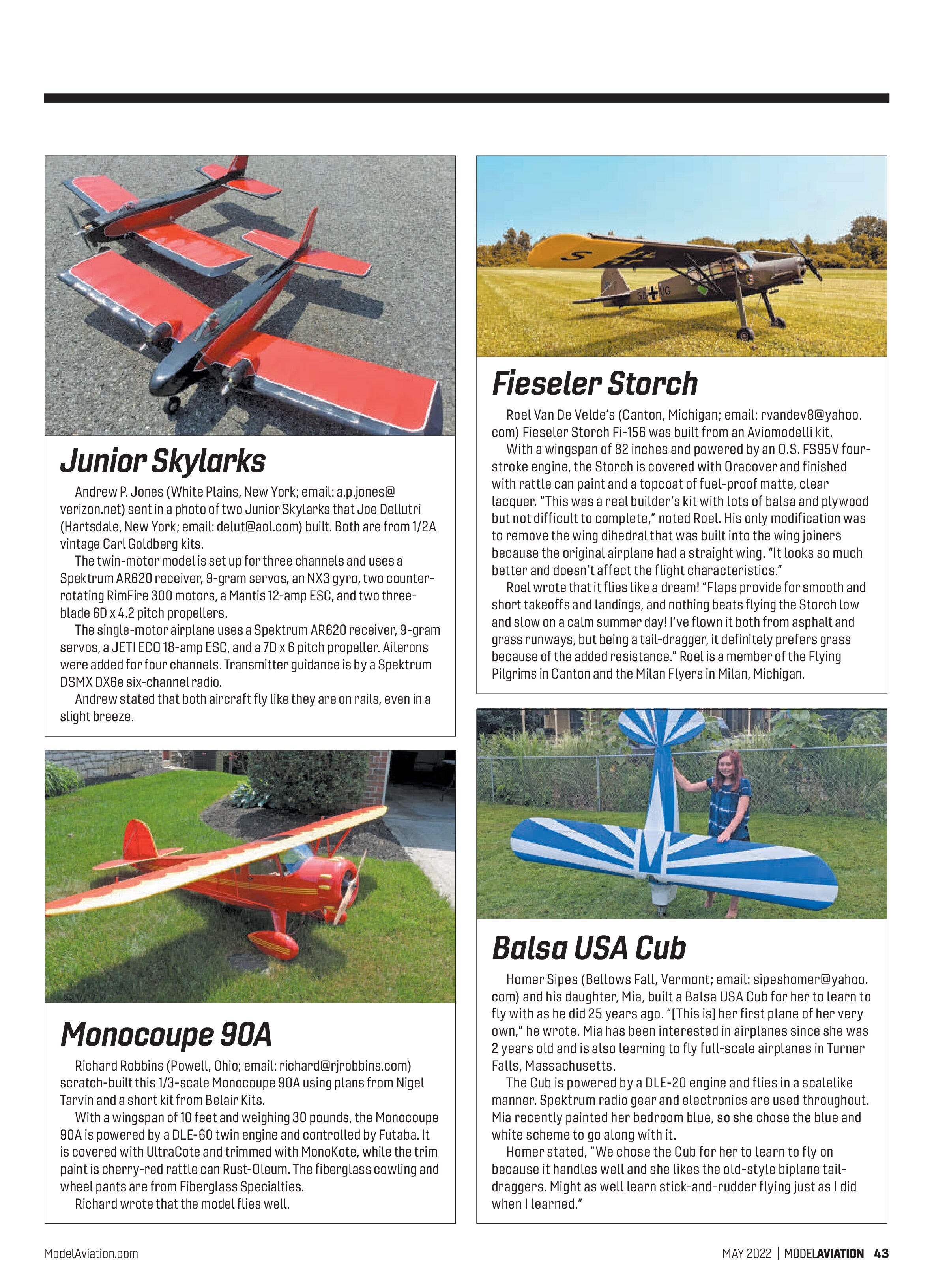
Junior Skylarks

Andrew P. Jones (White Plains, New York; email: a.p.jones@verizon.net) sent in a photo of two Junior Skylarks that Joe Dellutri (Hartsdale, New York; email: delut@aol.com) built. Both are from 1/2A vintage Carl Goldberg kits.
The twin-motor model is set up for three channels and uses a Spektrum AR620 receiver, 9-gram servos, an NX3 gyro, two counter-rotating RimFire 300 motors, a Mantis 12-amp ESC, and two three-blade 6D x 4.2 pitch propellers.
The single-motor airplane uses a Spektrum AR620 receiver, 9-gram servos, a JETI ECO 18-amp ESC, and a 7D x 6 pitch propeller. Ailerons were added for four channels. Transmitter guidance is by a Spektrum DSMX DX6e six-channel radio.
Andrew stated that both aircraft fly like they are on rails, even in a slight breeze.
Monocoupe 90A

Richard Robbins (Powell, Ohio; email: richard@jrobbins.com) scratch-built this 1/3-scale Monocoupe 90A using plans from Nigel Tarvin and a short kit from Belair Kits.
With a wingspan of 10 feet and weighing 30 pounds, the Monocoupe 90A is powered by a DLE-60 twin engine and controlled by Futaba. It is covered with UltraCote and trimmed with MonoKote, while the trim paint is cherry-red rattle can Rust-Oleum. The fiberglass cowling and wheel pants are from Fiberglass Specialties.
Richard wrote that the model flies well.
Fieseler Storch

Roel Van De Velde’s (Canton, Michigan; email: randev8@yahoo.com) Fieseler Storch Fi-156 was built from an Aviomodelli kit.
With a wingspan of 82 inches and powered by an O.S. FS95V four-stroke engine, the Storch is covered with Oracover and finished with rattle can paint and a topcoat of fuel-proof matte, clear lacquer. “This was a real builder’s kit with lots of balsa and plywood but not difficult to complete,” noted Roel. His only modification was to remove the wing dihedral that was built into the wing joiners because the original airplane had a straight wing. “It looks so much better and doesn’t affect the flight characteristics.”
Roel wrote that it flies like a dream! “Flaps provide for smooth and short takeoffs and landings, and nothing beats flying the Storch low and slow on a calm summer day! I’ve flown it both from asphalt and grass runways, but being a tail-dragger, it definitely prefers grass because of the added resistance.” Roel is a member of the Flying Pilgrims in Canton and the Milan Flyers in Milan, Michigan.
Balsa USA Cub

Homer Sipes (Bellows Fall, Vermont; email: sipeshomer@yahoo.com) and his daughter, Mia, built a Balsa USA Cub for her to learn to fly with as he did 25 years ago. “ [This is] her first plane of her very own,” he wrote. Mia has been interested in airplanes since she was 2 years old and is also learning to fly full-scale airplanes in Turner Falls, Massachusetts.
The Cub is powered by a DLE-20 engine and flies in a scalelike manner. Spektrum radio gear and electronics are used throughout. Mia recently painted her bedroom blue, so she chose the blue and white scheme to go along with it.
Homer stated, “We chose the Cub for her to learn to fly on because it handles well and she likes the old-style biplane tail-draggers. Might as well learn stick-and-rudder flying just as I did when I learned.”