BUILDING WITH DEPRON
By Thayer Syme | thayer@flying-models.com
IT HAS BEEN SEVERAL MONTHS since the Northeast Electric Aircraft Technology (NEAT) Fair was held in September 2021, and the friends who joined me for our W.29 group build are still talking about how much fun we had.
Unfortunately, I haven’t been able to share that fun with the rest of you. A few factors have contributed to that—not the least of which was my inability to source the 6mm Depron foam that makes up most of the airframe.
In an unexpected coincidence, RCDepron ran out of stock last fall, at approximately the same time that I was trying to accommodate those who have reached out for W.29 kits. The good news is that RCDepron owner, Greg Tanous, is committed to keeping US modelers well supplied with foam, and recently received his latest shipment from Germany.
Greg and I had an interesting phone discussion about his business. In addition to assuring me that my order would be in hand shortly, he also mentioned that he has added 9mm Depron to his inventory. It is only slightly more expensive than 6mm stock, and the thicker foam offers some intriguing possibilities for larger models, as well as more contouring. It will be interesting to see how Depron fans exploit this new option.
Although I do most of my building with balsa, it is hard to ignore the advantages that Depron can offer for some projects. It is lighter weight and less expensive than balsa, making it an ideal material for those quick, fun projects that might be smaller or more experimental in nature. And it is inherently waterproof. This combination made it an obvious choice for the W.29 project and a few other designs that we are now considering.
If you haven’t built with Depron yet, I suggest you give it a try. Greg offers a sample case for $39.95, with free shipping. It includes 14 sheets of 3mm stock that measure slightly more than 15 x 24 inches each. This works out to slightly above $1 per square foot. I have been seeing 1/8-inch balsa priced lately as much as six times that amount—and more—at retail craft outlets.
Boeing 314
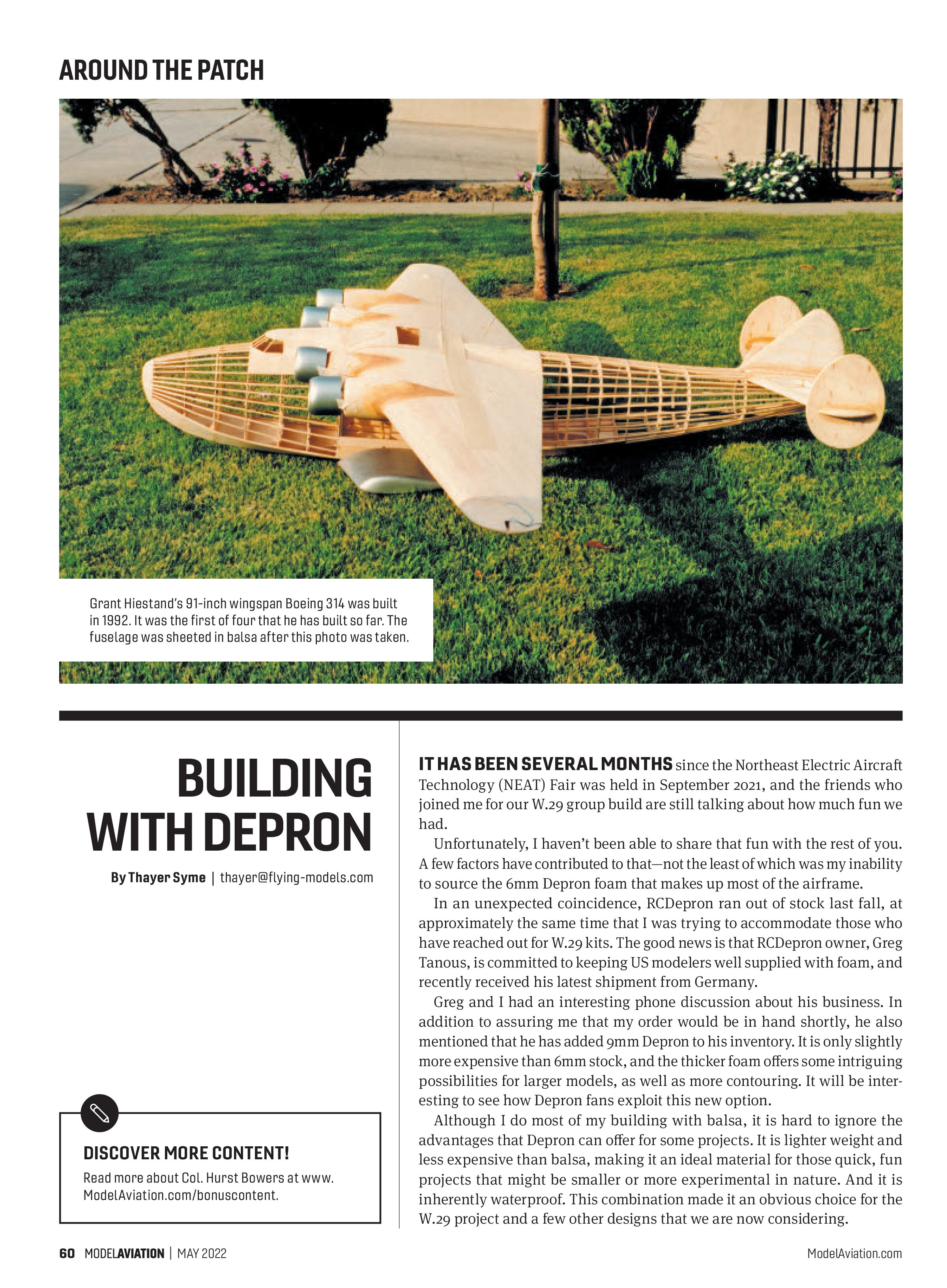
Speaking of balsa and seaplanes, I would be remiss to not share the dramatic bare-bones shot of the Boeing 314 that was recently sent in by Indiana Control Line (CL) flier Grant Hiestand.
Grant has built four 314s in the past 30 years, starting with this 91-inch wingspan version in 1992. He bought a plastic model, cut it into sections, and derived the fuselage stations by video-taping each slice and tracing them off of a CRT monitor. Ah, the good old days!
His second 314 was built from foam at the same scale and flown off of water at a regional CL event in Roseburg, Oregon. The next two were much smaller, spanning only 36 inches.
Boeing’s 314 has long been a favorite of mine, and I look forward to further news from him about his next version. The 30th year of AMA Nats CL competition for Grant and a group of his friends will be marked in 2023, and it sounds as though they are planning to celebrate that anniversary in style. Stay tuned for details!

Modeling History and Inspiration
I’m not sure whether it is the ongoing COVID pandemic or just my advancing age, but I have been thinking more lately about those who have inspired my modeling throughout the last 40-plus years.
Like many whom I know, the Flyline Models ads always caught my teenage attention as I pored through the latest model airplane magazines each month. Their combination of rarely modeled Golden Age prototypes and smaller model sizes with pricing just out of my reach made the Flyline catalog more compelling than the Sears Christmas Wish Book—at least in my eyes!
The late Col. Hurst Bowers founded Flyline Models, Inc. in the early 1970s to offer a unique mix of high-quality Free Flight (FF) and RC kits. I’m embarrassed to say that I only built one Flyline kit back in the day, his 40-inch Great Lakes Trainer biplane design, which I still have. That was all my budget allowed then.

Although occasionally available, Flyline kits are highly collected these days. eBay is currently showing only seven offerings. I do have a couple of other kits on my shelf now though, and building from plans remains an option.
In addition to those designs that made it into the famous Flyline boxes, Hurst published numerous designs in the modeling press. Both the AMA and Flying Models plans services offer several examples.
Regular readers of this column will be aware that I have an enlarged version of his Heinkel HE 18 monoplane underway. It appeared in the November 1991 issue of Model Aviation as an electric FF model that spans 28 inches, and plans are still available. I haven’t made much progress
on my Heinkel lately, but it hangs next to my workbench, so it will get more attention soon.
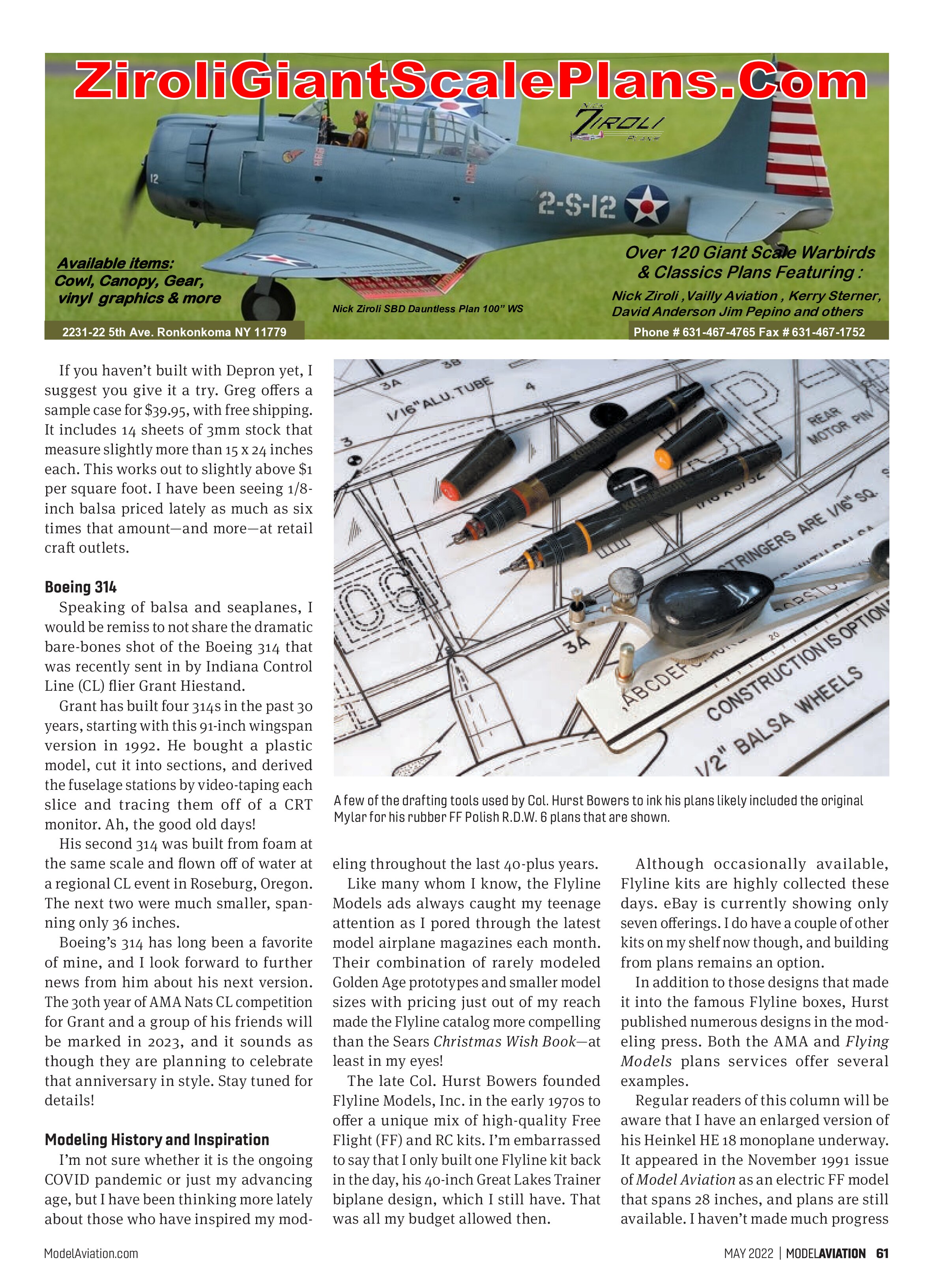
Ray Rankow, from Virginia, counted Hurst among his friends. He recently offered—and I immediately accepted—some of the drawing pens and lettering guides that Hurst used to ink his final plans. Nearly all of my own design work is digital, and these artifacts cannot replace the convenience of CAD. That noted, I have long wanted to ink a set of plans by hand, and Hurst’s pens and lettering guides bring me that much closer to my goal.
Additionally, the opportunity to ink a few markings on the Heinkel and other future projects with the same tools that drew the original plans was not one I could ignore. I did not, however, anticipate that Ray would offer a bonus extra when I stopped by to pick up the pens.
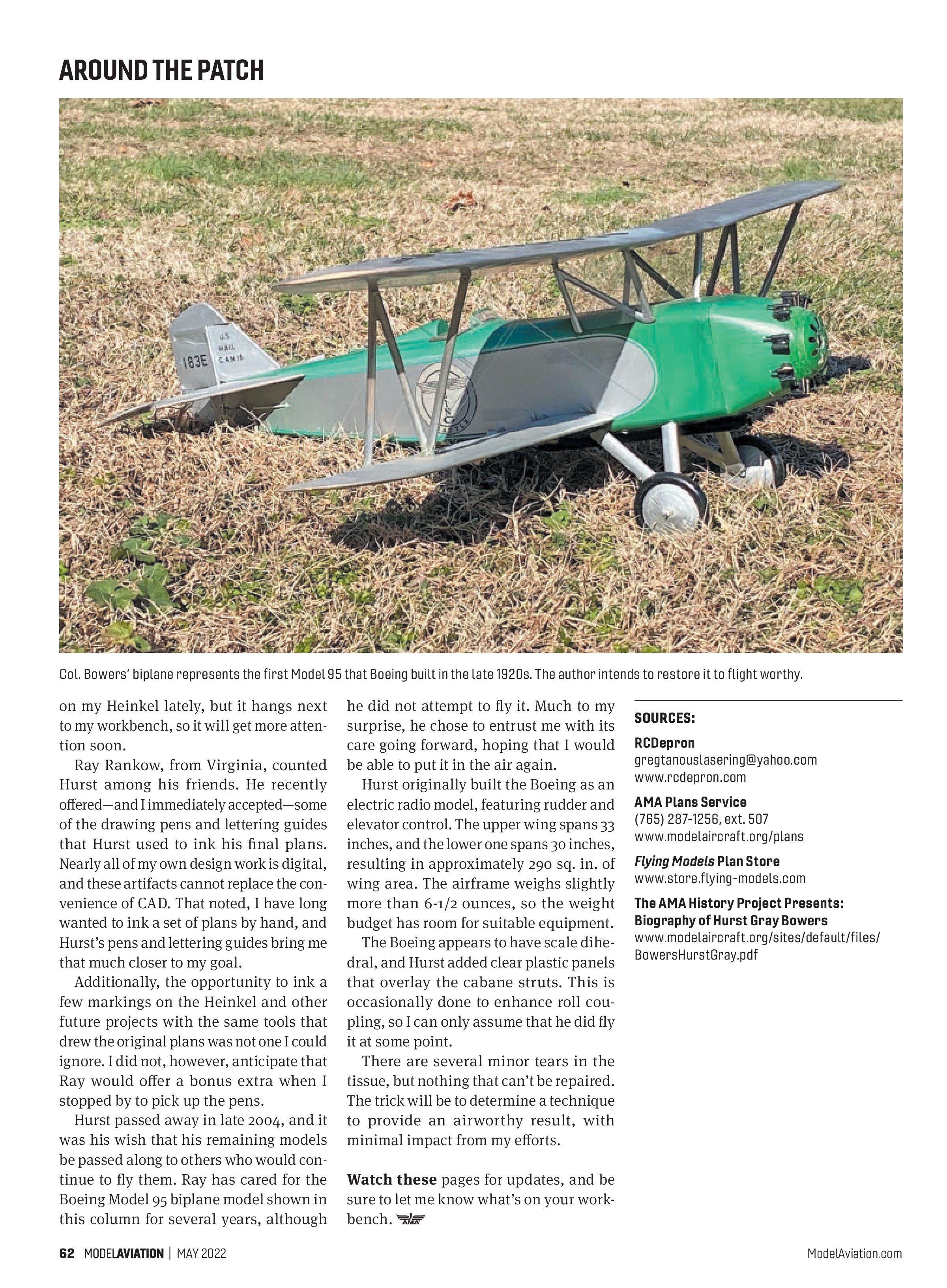
Hurst passed away in late 2004, and it was his wish that his remaining models be passed along to others who would continue to fly them. Ray has cared for the Boeing Model 95 biplane model shown in this column for several years, although

he did not attempt to fly it. Much to my surprise, he chose to entrust me with its care going forward, hoping that I would be able to put it in the air again.
Hurst originally built the Boeing as an electric radio model, featuring rudder and elevator control. The upper wing spans 33 inches, and the lower one spans 30 inches, resulting in approximately 290 sq. in. of wing area. The airframe weighs slightly more than 6-1/2 ounces, so the weight budget has room for suitable equipment.
The Boeing appears to have scale dihedral, and Hurst added clear plastic panels that overlay the cabane struts. This is occasionally done to enhance roll coupling, so I can only assume that he did fly it at some point.
There are several minor tears in the tissue, but nothing that can’t be repaired. The trick will be to determine a technique to provide an airworthy result, with minimal impact from my efforts.
Watch these pages for updates, and be sure to let me know what’s on your workbench.
SOURCES:
RCDepron
gregtanouglasering@yahoo.com
www.rcdepron.com
AMA Plans Service
(765) 287-1256, ext. 507
www.modelaircraft.org/plans
Flying Models Plan Store
www.store.flying-models.com
The AMA History Project Presents: Biography of Hurst Gray Bowers
www.modelaircraft.org/sites/default/files/BowersHurstGray.pdf