ADVANCED FLIGHT TECHNOLOGIES

AVIATION SIMULATION RENDERED IN MINIATURE
By Patrick Sherman
lucidity@roswellflighttestcrew.com
SIMULATORS HAVE BEEN USED to train pilots nearly from the beginning of aviation itself. In France, before the outbreak of World War I, pilot trainees guided a Blériot monoplane with a foreshortened wing across the practice grounds. The machine could briefly “hop” into the air, but it returned safely to the ground within just a few seconds—an approach described as the “penguin system,” after the flightless Antarctic bird.
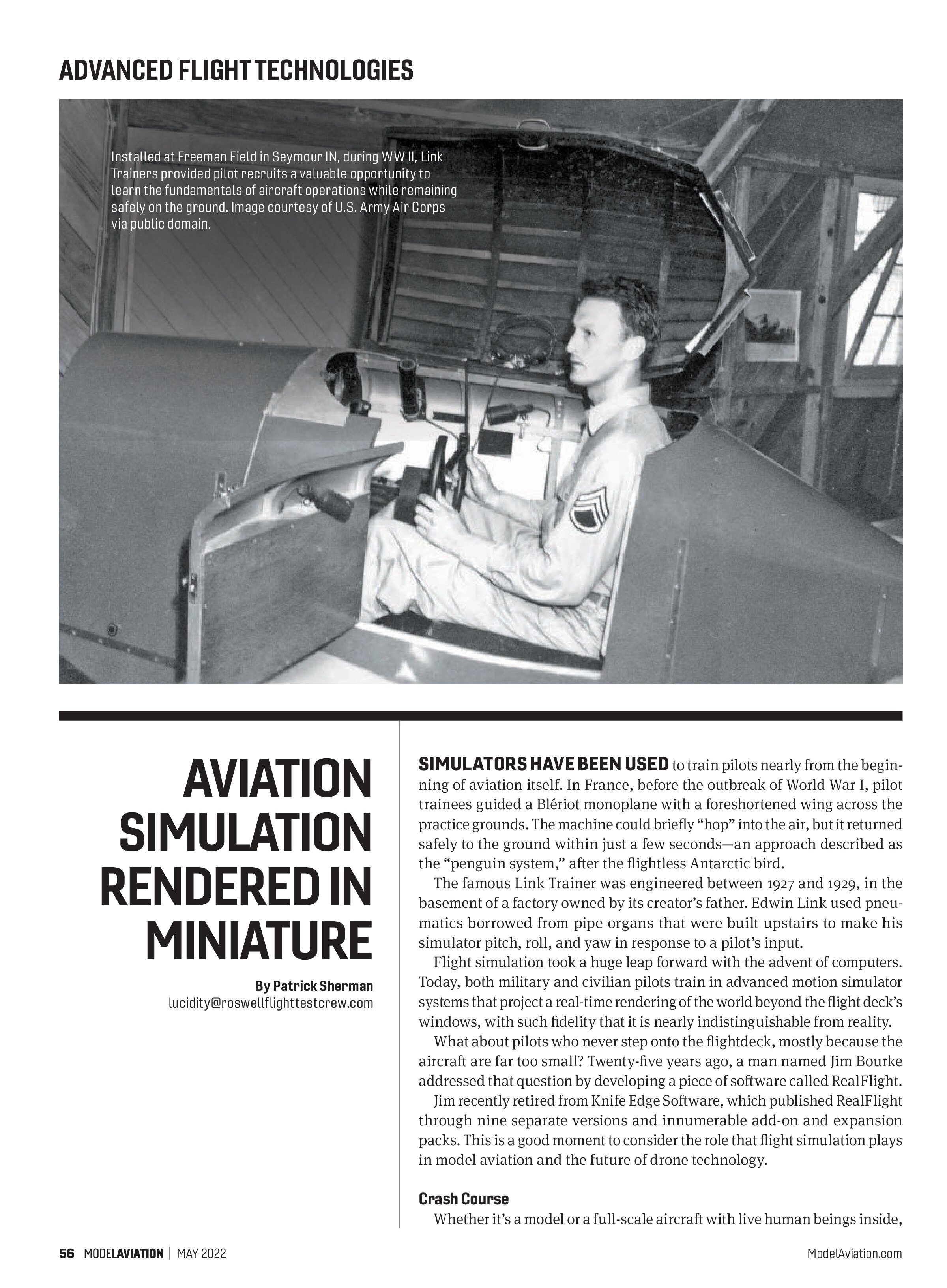
The famous Link Trainer was engineered between 1927 and 1929, in the basement of a factory owned by its creator’s father. Edwin Link used pneumatics borrowed from pipe organs that were built upstairs to make his simulator pitch, roll, and yaw in response to a pilot’s input.
Flight simulation took a huge leap forward with the advent of computers. Today, both military and civilian pilots train in advanced motion simulator systems that project a real-time rendering of the world beyond the flight deck’s windows, with such fidelity that it is nearly indistinguishable from reality.
What about pilots who never step onto the flightdeck, mostly because the aircraft are far too small? Twenty-five years ago, a man named Jim Bourke addressed that question by developing a piece of software called RealFlight.
Jim recently retired from Knife Edge Software, which published RealFlight through nine separate versions and innumerable add-on and expansion packs. This is a good moment to consider the role that flight simulation plays in model aviation and the future of drone technology.
Crash Course
Whether it’s a model or a full-scale aircraft with live human beings inside,

the appeal of flight simulators is the same: The price of making a mistake is zero. Run a real airplane into the ground and you risk serious injury—or death—for everyone on board, not to mention catastrophic damage to the hardware that can cost millions. Clearly, that is an outcome to be avoided under all circumstances.
To be sure, the stakes are (usually) quite a bit lower in model aviation, but the last time I checked, my neighborhood hobby shop wasn’t giving airplanes away for free. One bad choice with a radio in your hands can have the same effect as tossing hundreds of dollars into a roaring fire.
In either case, if you’re flying a simulator, you push one button and everything is instantly restored to the way it was a few minutes before you demonstrated that experience is what you get when you don’t get what you want. That’s a bargain in anybody’s book, except for a few hard-headed individuals who insist on learning things the most difficult, expensive, and painful way possible. I’m sorry to say that I’m among them.
I started my RC career flying drones, but before you snicker at the thought of how easy drones are to fly with GPS position-hold and a suite of advanced sensors, including automatic collision-avoidance systems, recognize this one fact. I’ve been flying drones for 12 years—since 2010. Back then, we had to build our own flight control systems using parts scavenged from video-game controllers.
The closest analog to early aircraft in service today are FPV racing drones, which don’t even have auto-leveling capability.
For someone who had never even touched a radio before, that’s a tough way to learn how to fly. The breakage was piling up so quickly that I ordered replacement parts in bulk directly from China just to keep a machine in the air.
Plan B
There was an alternative available: RealFlight. However, because the software at that time did not include multirotors, I would have none of it. Never mind that it included a plethora of RC helicopters that had the same basic handling characteristics as multirotors. That wasn’t the same thing, I insisted, persuading nobody but myself.
Eventually, I relented. I picked up a copy of RealFlight, spent approximately 40 hours flying helicopters, then headed back out to the field, where my piloting skills had miraculously improved. Who would have thought? A century of aviators who
had come before me knew something I didn’t. Simulators work, even if they aren’t a perfect match for what you are trying to accomplish in real life.
The moral of my story is to be like professional military and civilian pilots by taking advantage of simulators whenever possible. Your wallet will be grateful to you in the long-term. If you are new to RC flying or thinking about getting started, please go pick up a copy of RealFlight before you start buying (and wrecking) airplanes. I always tell my students that it is inevitable that you will crash while learning to fly RC. The only choice you have is how much each crash will cost you.
Other than their potential to save lives—or at the very least, money—simulators have another interesting characteristic: Their popularity always surges when there is a pressing need to rapidly train new pilots. Note that the “penguin method” emerged ahead of WWI, the first war that would see the widespread use of fixed-wing aircraft by combatants on all sides.
Although it first “flew” in 1930, the Link Trainer came into its own ahead of World War II, when the technology was applied
to full, working mockups of military aircraft flight decks so that new pilots could learn not only the basics of stick-and-rudder flying but complexities associated with variable-pitch propellers, retractable landing gear, and other advances in aviation technology that occurred between the wars.
The muscle memory associated with operating these systems could be learned in complete safety before trainees attempted to implement these same skills while hurtling through the sky at 300 mph.
History Repeating Itself
As it happens, we are fast approaching another such moment in the history of aviation—two, actually. First, as you might have heard, drones are officially a “thing” now, so there is real-world demand for qualified pilots. To be sure, there is a lot more to commercial sUAS operations than skill with the sticks, including managing autonomous operations, understanding airspace, conducting risk assessments, and mitigating hazards. Simulations have an important role to play in developing all of these abilities in new pilots.
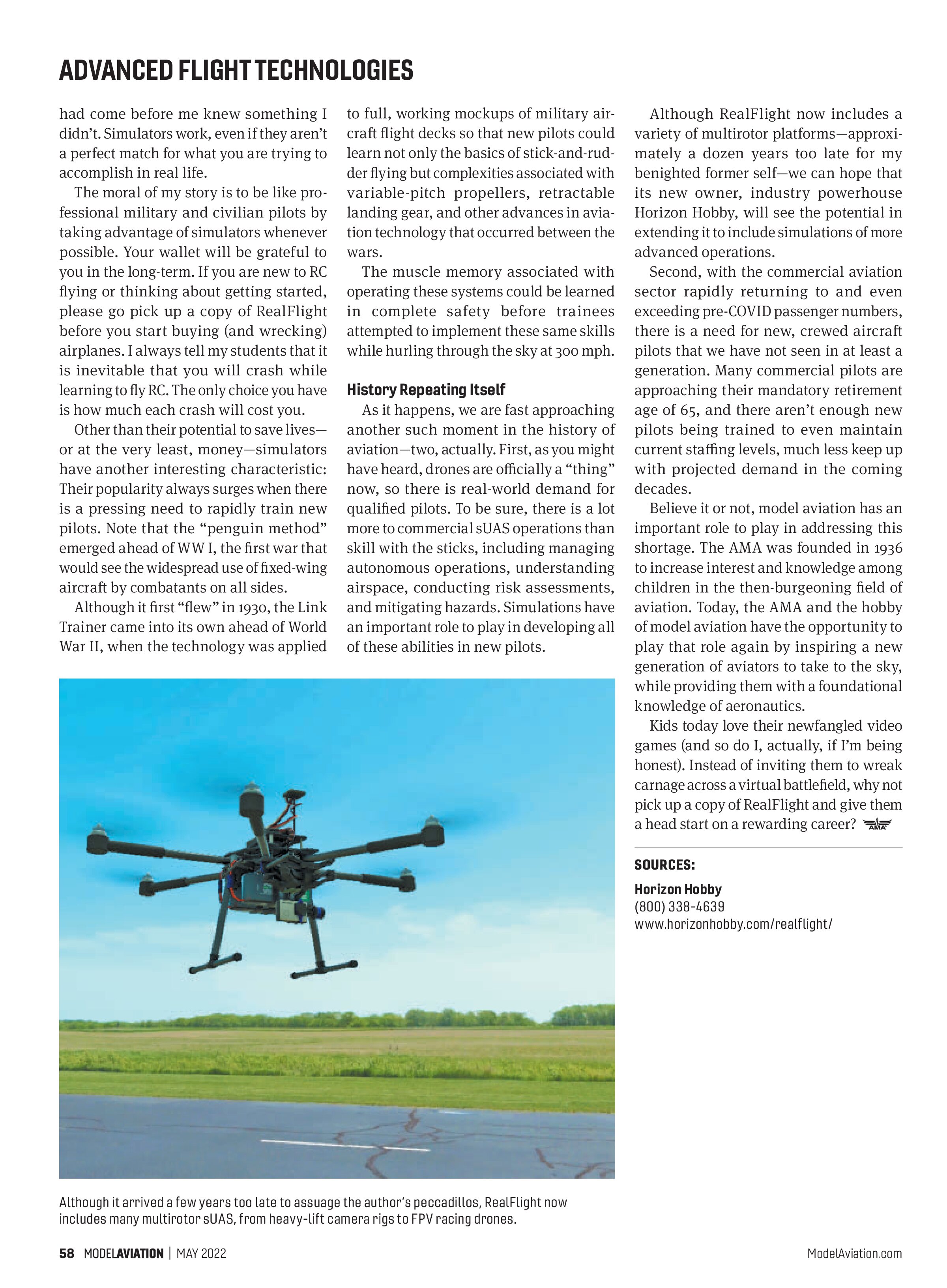
Although RealFlight now includes a variety of multirotor platforms—approximately a dozen years too late for my benighted former self—we can hope that its new owner, industry powerhouse Horizon Hobby, will see the potential in extending it to include simulations of more advanced operations.
Second, with the commercial aviation sector rapidly returning to and even exceeding pre-COVID passenger numbers, there is a need for new, crewed aircraft pilots that we have not seen in at least a generation. Many commercial pilots are approaching their mandatory retirement age of 65, and there aren’t enough new pilots being trained to even maintain current staffing levels, much less keep up with projected demand in the coming decades.
Believe it or not, model aviation has an important role to play in addressing this shortage. The AMA was founded in 1936 to increase interest and knowledge among children in the then-burgeoning field of aviation. Today, the AMA and the hobby of model aviation have the opportunity to play that role again by inspiring a new generation of aviators to take to the sky, while providing them with a foundational knowledge of aeronautics.
Kids today love their newfangled video games (and so do I, actually, if I’m being honest). Instead of inviting them to wreak carnage across a virtual battlefield, why not pick up a copy of RealFlight and give them a head start on a rewarding career?

SOURCES:
Horizon Hobby
(800) 338-4639
www.horizonhobby.com/realflight/