FIRST VISIT TO
SNOHOMISH RADIO
AERO CLUB

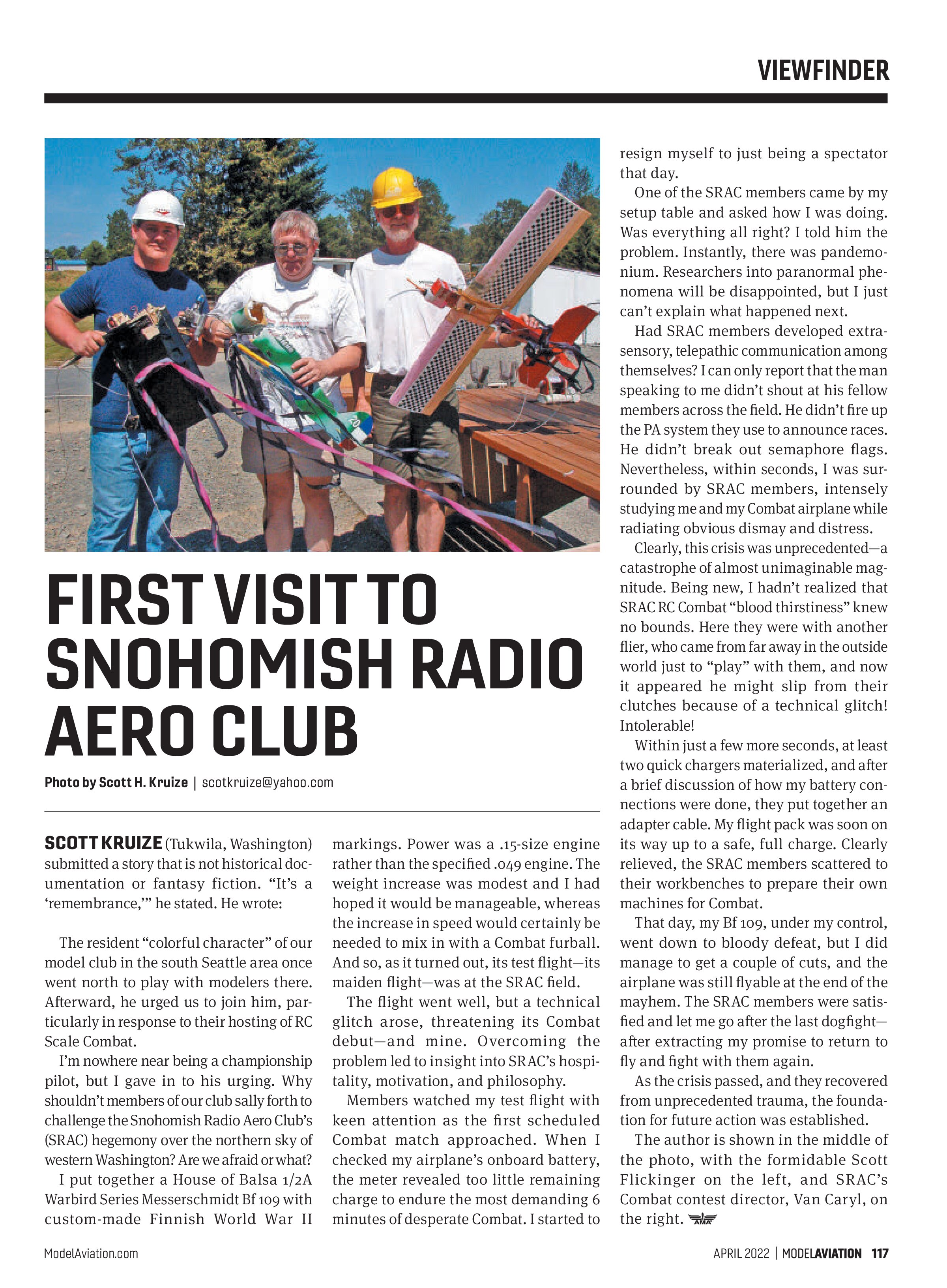
SCOTT KRUIZE (Tukwila, Washington) submitted a story that is not historical documentation or fantasy fiction. “It’s a ‘remembrance,’” he stated. He wrote:
The resident “colorful character” of our model club in the south Seattle area once went north to play with modelers there. Afterward, he urged us to join him, particularly in response to their hosting of RC Scale Combat.
I’m nowhere near being a championship pilot, but I gave in to his urging. Why shouldn’t members of our club sally forth to challenge the Snohomish Radio Aero Club’s (SRAC) hegemony over the northern sky of western Washington? Are we afraid or what?
I put together a House of Balsa 1/2A Warbird Series Messerschmitt Bf 109 with custom-made Finnish World War II markings. Power was a .15-size engine rather than the specified .049 engine. The weight increase was modest and I had hoped it would be manageable, whereas the increase in speed would certainly be needed to mix in with a Combat furball. And so, as it turned out, its test flight—its maiden flight—was at the SRAC field.
The flight went well, but a technical glitch arose, threatening its Combat debut—and mine. Overcoming the problem led to insight into SRAC’s hospitality, motivation, and philosophy.
Members watched my test flight with keen attention as the first scheduled Combat match approached. When I checked my airplane’s onboard battery, the meter revealed too little remaining charge to endure the most demanding 6 minutes of desperate Combat. I started to resign myself to just being a spectator that day.
One of the SRAC members came by my setup table and asked how I was doing. Was everything all right? I told him the problem. Instantly, there was pandemonium. Researchers into paranormal phenomena will be disappointed, but I just can’t explain what happened next.
Had SRAC members developed extrasensory, telepathic communication among themselves? I can only report that the man speaking to me didn’t shout at his fellow members across the field. He didn’t fire up the PA system they use to announce races. He didn’t break out semaphore flags. Nevertheless, within seconds, I was surrounded by SRAC members, intensely studying me and my Combat airplane while radiating obvious dismay and distress.
Clearly, this crisis was unprecedented—a catastrophe of almost unimaginable magnitude. Being new, I hadn’t realized that SRAC RC Combat “blood thirstiness” knew no bounds. Here they were with another flier, who came from far away in the outside world just to “play” with them, and now it appeared he might slip from their clutches because of a technical glitch! Intolerable!
Within just a few more seconds, at least two quick chargers materialized, and after a brief discussion of how my battery connections were done, they put together an adapter cable. My flight pack was soon on its way up to a safe, full charge. Clearly relieved, the SRAC members scattered to their workbenches to prepare their own machines for Combat.
That day, my Bf 109, under my control, went down to bloody defeat, but I did manage to get a couple of cuts, and the airplane was still flyable at the end of the mayhem. The SRAC members were satisfied and let me go after the last dogfight—after extracting my promise to return to fly and fight with them again.
As the crisis passed, and they recovered from unprecedented trauma, the foundation for future action was established.
RED TAILS FLYING CLUB
Photos by Lowell Carrington, president
rcman4u2@yahoo.com
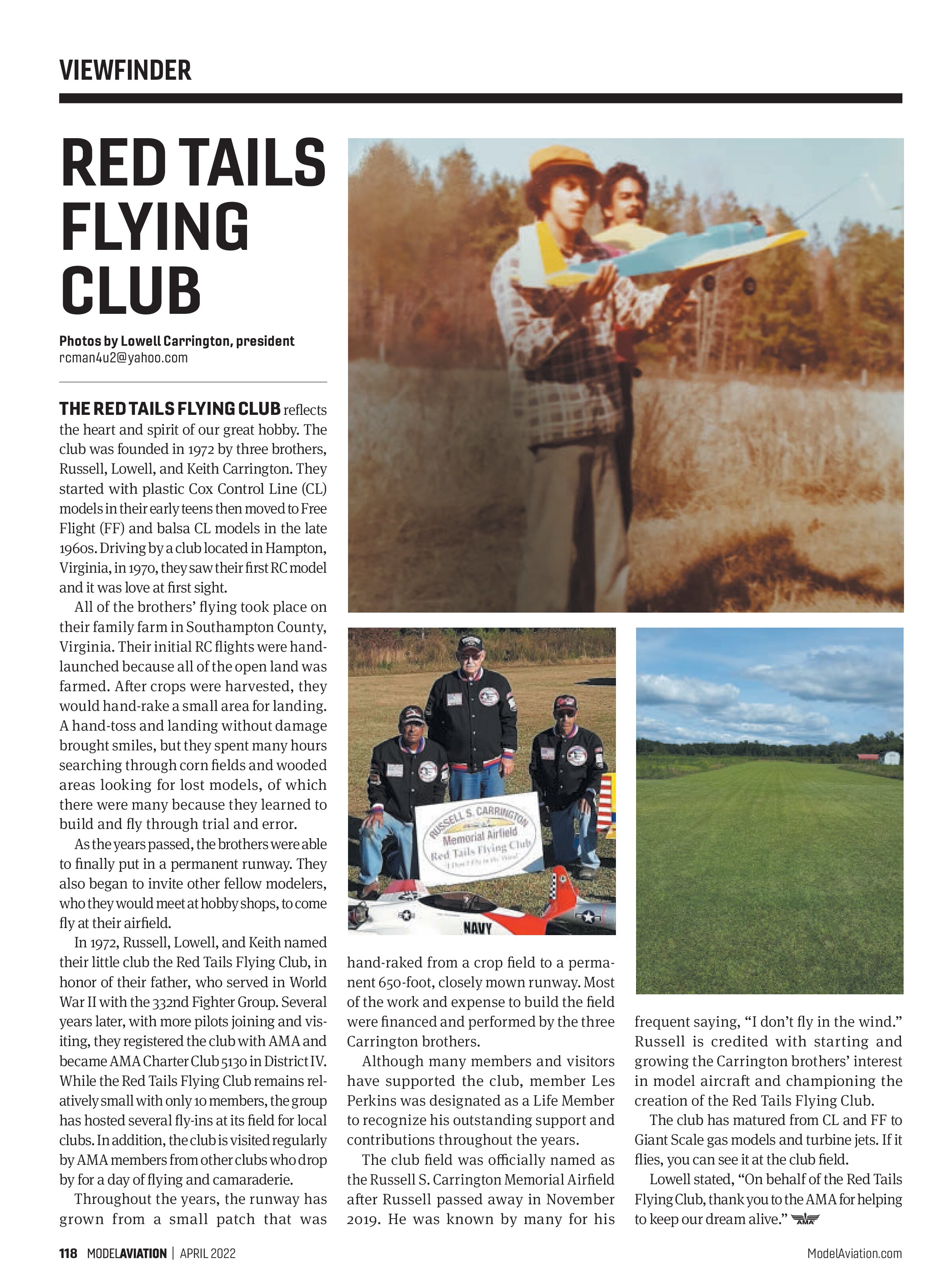
THE RED TAILS FLYING CLUB reflects the heart and spirit of our great hobby. The club was founded in 1972 by three brothers, Russell, Lowell, and Keith Carrington. They started with plastic Cox Control Line (CL) models in their early teens then moved to Free Flight (FF) and balsa CL models in the late 1960s. Driving by a club located in Hampton, Virginia, in 1970, they saw their first RC model and it was love at first sight.
All of the brothers’ flying took place on their family farm in Southampton County, Virginia. Their initial RC flights were hand-launched because all of the open land was farmed. After crops were harvested, they would hand-rake a small area for landing. A hand-toss and landing without damage brought smiles, but they spent many hours searching through corn fields and wooded areas looking for lost models, of which there were many because they learned to build and fly through trial and error.
As the years passed, the brothers were able to finally put in a permanent runway. They also began to invite other fellow modelers, who they would meet at hobby shops, to come fly at their airfield.
In 1972, Russell, Lowell, and Keith named their little club the Red Tails Flying Club, in honor of their father, who served in World War II with the 332nd Fighter Group. Several years later, with more pilots joining and visiting, they registered the club with AMA and became AMA Charter Club 5130 in District IV. While the Red Tails Flying Club remains relatively small with only 10 members, the group has hosted several fly-ins at its field for local clubs. In addition, the club is visited regularly by AMA members from other clubs who drop by for a day of flying and camaraderie.
Throughout the years, the runway has grown from a small patch that was


Although many members and visitors have supported the club, member Les Perkins was designated as a Life Member to recognize his outstanding support and contributions throughout the years.
The club field was officially named as the Russell S. Carrington Memorial Airfield after Russell passed away in November 2019. He was known by many for his frequent saying, “I don’t fly in the wind.” Russell is credited with starting and growing the Carrington brothers’ interest in model aircraft and championing the creation of the Red Tails Flying Club.
The club has matured from CL and FF to Giant Scale gas models and turbine jets. If it flies, you can see it at the club field.
Lowell stated, “On behalf of the Red Tails Flying Club, thank you to the AMA for helping to keep our dream alive.”
FAVORITE T-28
Photo by Robert Angstadt | rcman4u2@yahoo.com
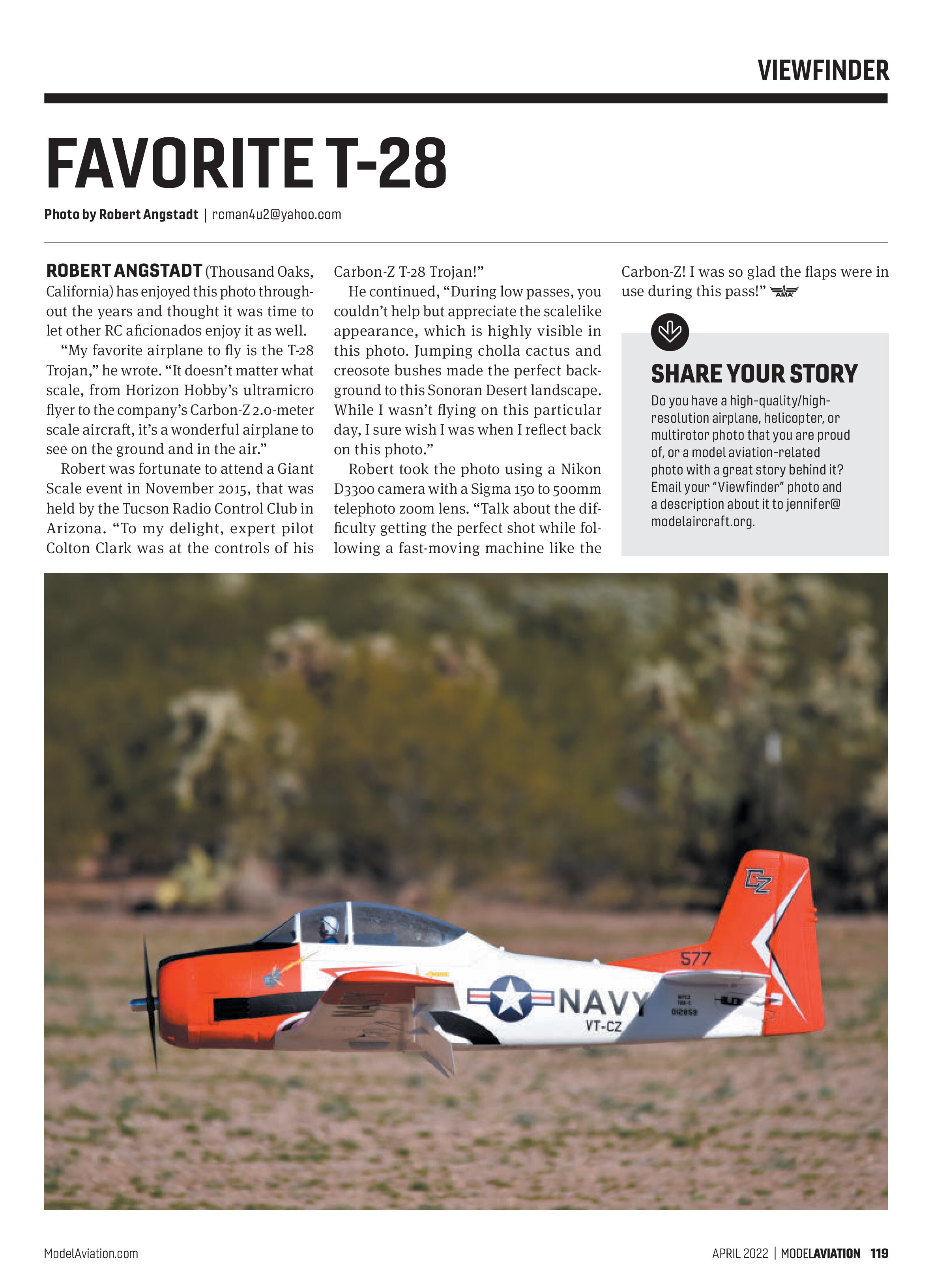
ROBERT ANGSTADT (Thousand Oaks, California) has enjoyed this photo throughout the years and thought it was time to let other RC aficionados enjoy it as well.
“My favorite airplane to fly is the T-28 Trojan,” he wrote. “It doesn’t matter what scale, from Horizon Hobby’s ultramicro flyer to the company’s Carbon-Z 2.0-meter scale aircraft, it’s a wonderful airplane to see on the ground and in the air.”
Robert was fortunate to attend a Giant Scale event in November 2015, that was held by the Tucson Radio Control Club in Arizona. “To my delight, expert pilot Colton Clark was at the controls of his Carbon-Z T-28 Trojan!”
He continued, “During low passes, you couldn’t help but appreciate the scalelike appearance, which is highly visible in this photo. Jumping cholla cactus and creosote bushes made the perfect background to this Sonoran Desert landscape. While I wasn’t flying on this particular day, I sure wish I was when I reflect back on this photo.”
Robert took the photo using a Nikon D3300 camera with a Sigma 150 to 500mm telephoto zoom lens. “Talk about the difficulty getting the perfect shot while following a fast-moving machine like the Carbon-Z! I was so glad the flaps were in use during this pass!”
SHARE YOUR STORY
Do you have a high-quality/high-resolution airplane, helicopter, or multirotor photo that you are proud of, or a model aviation-related photo with a great story behind it? Email your “viewfinder” photo and a description about it to jennifer@modelaircraft.org.