SMALL-FIELD FLYING
THE RIGHT TOOL FOR THE JOB
By Pat Tritle | patscustommodels@gmail.com

WITH THE WINTER BUILDING season winding down, spring flying is right around the corner. Looking back on many building seasons throughout the years, I’ve found that, on several occasions, I’ve needed a tool for a specific job that’s either not available or is so specific to the individual need that the chance of it ever being commercially available is highly unlikely.
As modelers, that doesn’t have to be a deterrent. If you can build an entire airplane, you can definitely make a simple tool. After all, isn’t making things what modelers do?
In my 63 years at the bench, a lot of things have cropped up where a special tool for that special job would be ideal, and with most being too specific for the mass market to undertake, making them is really the only viable option. Simple jigs and holding fixtures can also be a big help when an extra pair of hands isn’t an option. With a little creative thinking, a few scraps, and a bit of ingenuity, anything is possible.
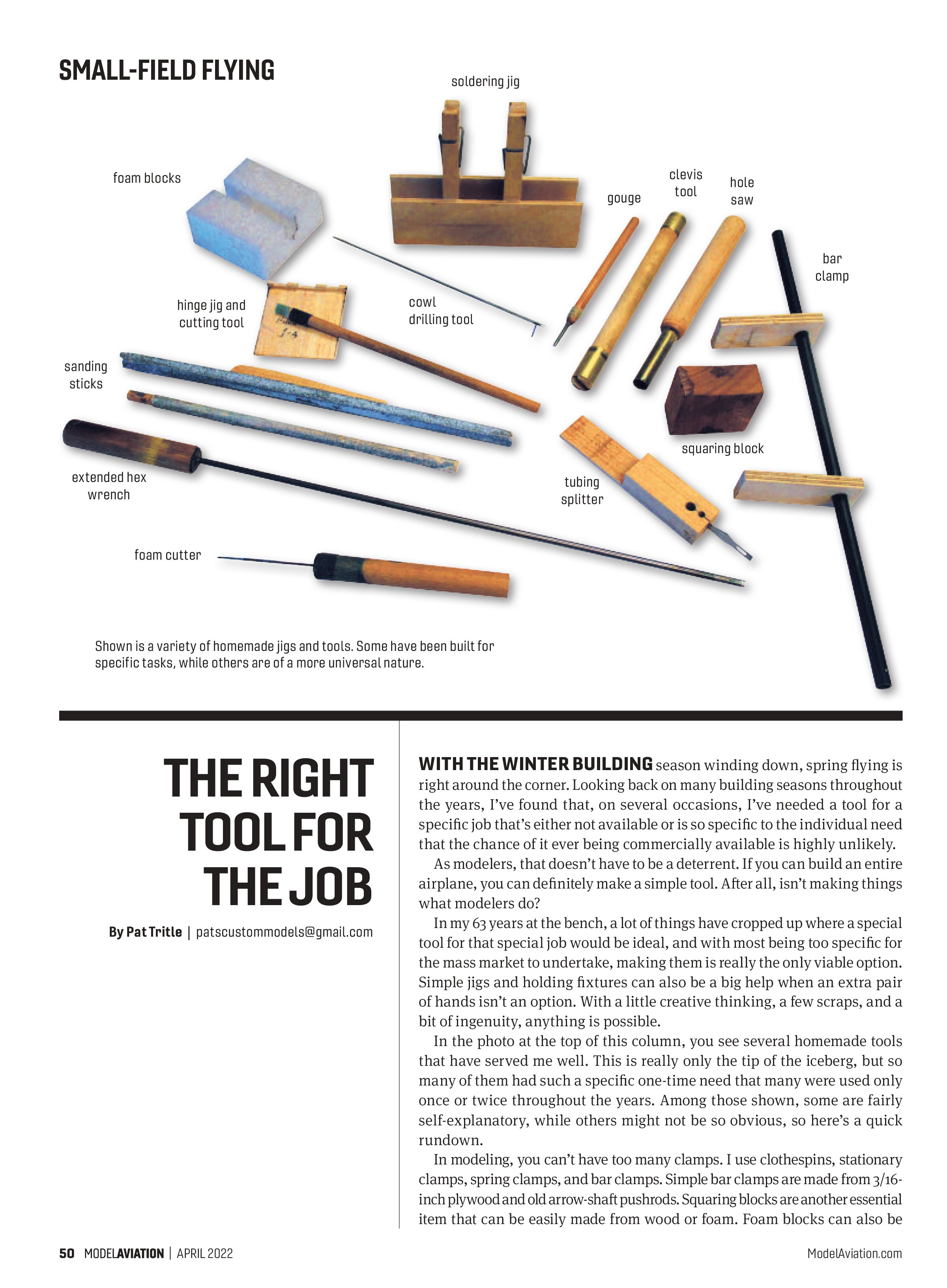
In the photo at the top of this column, you see several homemade tools that have served me well. This is really only the tip of the iceberg, but so many of them had such a specific one-time need that many were used only once or twice throughout the years. Among those shown, some are fairly self-explanatory, while others might not be so obvious, so here’s a quick rundown.
In modeling, you can’t have too many clamps. I use clothespins, stationary clamps, spring clamps, and bar clamps. Simple bar clamps are made from 3/16-inch plywood and old arrow-shaft pushrods. Squaring blocks are another essential item that can be easily made from wood or foam. Foam blocks can also be made for any number of tasks where support is needed during construction.
Sanding blocks are a must and can be sized and shaped for any number of specific tasks. Flexible blocks can even be made from old gardening kneepads. Gouges for slotting balsa and basswood were made up in several sizes from dowel rods and music wire. I also made a nylon clevis-installing tool from dowel and brass tube. The ends are cut to fit both large and small devices. Hole saws are invaluable and easily made from dowel rods and brass tube in any size you might need for the task at hand.
Where smaller and lighter-weight park flyers are concerned, cutting hinge slots is always a challenge. The tool and spacing jig that was made from scrap balsa, dowel rod, and brass has served me well for years. For models with open cockpits, splitting the tubing to make the combing is easy by using the simple tube-splitting tool that is made from scrap maple landing gear mount blocks. The soldering jig that is made from wood clothespins and light plywood is a tool that’s hard to live without when end-joining electrical wiring.
For rough-shaping foam blocks, the foam cutter was made from flat steel that was taken from old windshield-wiper blades. The “knife” is heated with a small torch to do the actual cutting. Extended hex wrenches are made from dowel rod, wire, and cutoffs from the appropriate-size Allen wrench; however, unless they’re used in extremely light-duty applications, the tips need to be silver-soldered in place.
Finally, the cowling drilling tool is used to locate the holes in the mount blocks on an opaque cowling to accurately locate and drill the mating holes.


coat of nitrate dope, and finished with latex house paint. To get the aged effect, a coat of thinned primer was brushed on, followed by a thin coat of color to produce the look of translucent linen.
Power is a Cobra 2212-26 950 Kv brushless outrunner motor with an APC 10 x 4.7SF propeller and an 800 mAh 3S LiPo battery. The pilot figures are handmade, with goggles bent from thin solder.
In keeping with the Pioneer Aviation era, the DH.1 is a good flyer, but it does have its quirks and, like anything from that era, it must be flown accordingly.
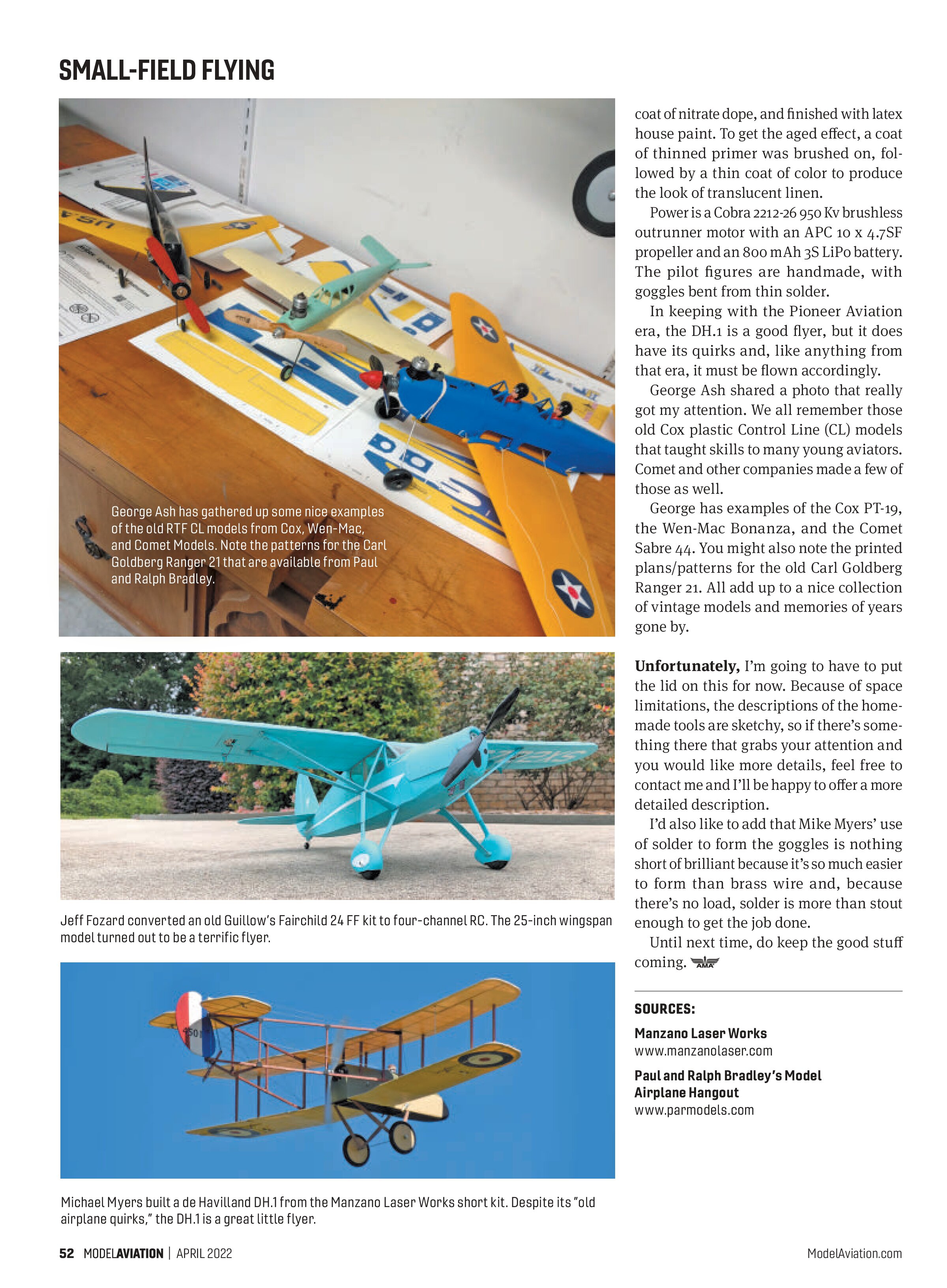
George Ash shared a photo that really got my attention. We all remember those old Cox plastic Control Line (CL) models that taught skills to many young aviators. Comet and other companies made a few of those as well.
George has examples of the Cox PT-19, the Wen-Mac Bonanza, and the Comet Sabre 44. You might also note the printed plans/patterns for the old Carl Goldberg Ranger 21. All add up to a nice collection of vintage models and memories of years gone by.
Unfortunately, I’m going to have to put the lid on this for now. Because of space limitations, the descriptions of the homemade tools are sketchy, so if there’s something there that grabs your attention and you would like more details, feel free to contact me and I’ll be happy to offer a more detailed description.
I’d also like to add that Mike Myers’ use of solder to form the goggles is nothing short of brilliant because it’s so much easier to form than brass wire and, because there’s no load, solder is more than stout enough to get the job done.
Until next time, do keep the good stuff coming.
SOURCES:
Manzano Laser Works
www.manzanolaser.com
Paul and Ralph Bradley’s Model Airplane Hangout
www.parmodels.com