RC SLOPE SOARING

TRADITIONS
By Greg Schutte | gshouty@yahoo.com
THERE ARE A COUPLE OF flying traditions that I have acquired throughout the years. One is flying during the last days of the old year and the first days of the new. That might not sound out of the ordinary, but when you work in North Dakota and live in Idaho, it means that you have colder temperatures to deal with. Most of my fellow pilots take a hard pass when I invite them to fly.
This year, I worked most of December, but I had Christmas Day off. Working in North Dakota meant that I spent the morning on the phone with my family to celebrate Christmas. After that, I had the rest of the day to myself. I checked the weather and I was off to the hill.
The wind was not blowing, so I hiked to one of my local hills and took a speed wing flight to the bottom. It was a brisk hike and fly. The air temperature was 5°. I had to get in the truck to unfreeze the face mask from my face, but I left with a smile and no permanent damage. Half of my tradition had been completed.
With the new year, I had another couple of days off. January 2 rolled around and I checked the weather again. This time, the wind was blowing 10 mph, so I loaded my freshly charged Cons cendo and off I went.
Upon arriving, I noticed that the wind was not blowing hard. I grabbed my Cons cendo, plugged it in, and checked the servos—left was left and up was up. All was good there. Standing on the edge and getting ready to launch, I realized that the wind had completely died and was now starting to come over the backside. That was not good. I pushed the throttle stick forward to get the propulsion device on the nose working—and nothing. What was going on? I double-checked everything and there was still no throttle.
Not wanting to hike the hill, I walked back to the truck with disappointment on my face. I rechecked the weather and, sure enough, the wind had switched. Did I mention that the temperature was -17°? I am quite sure that the cold LiPo battery was not in the mood to fly.
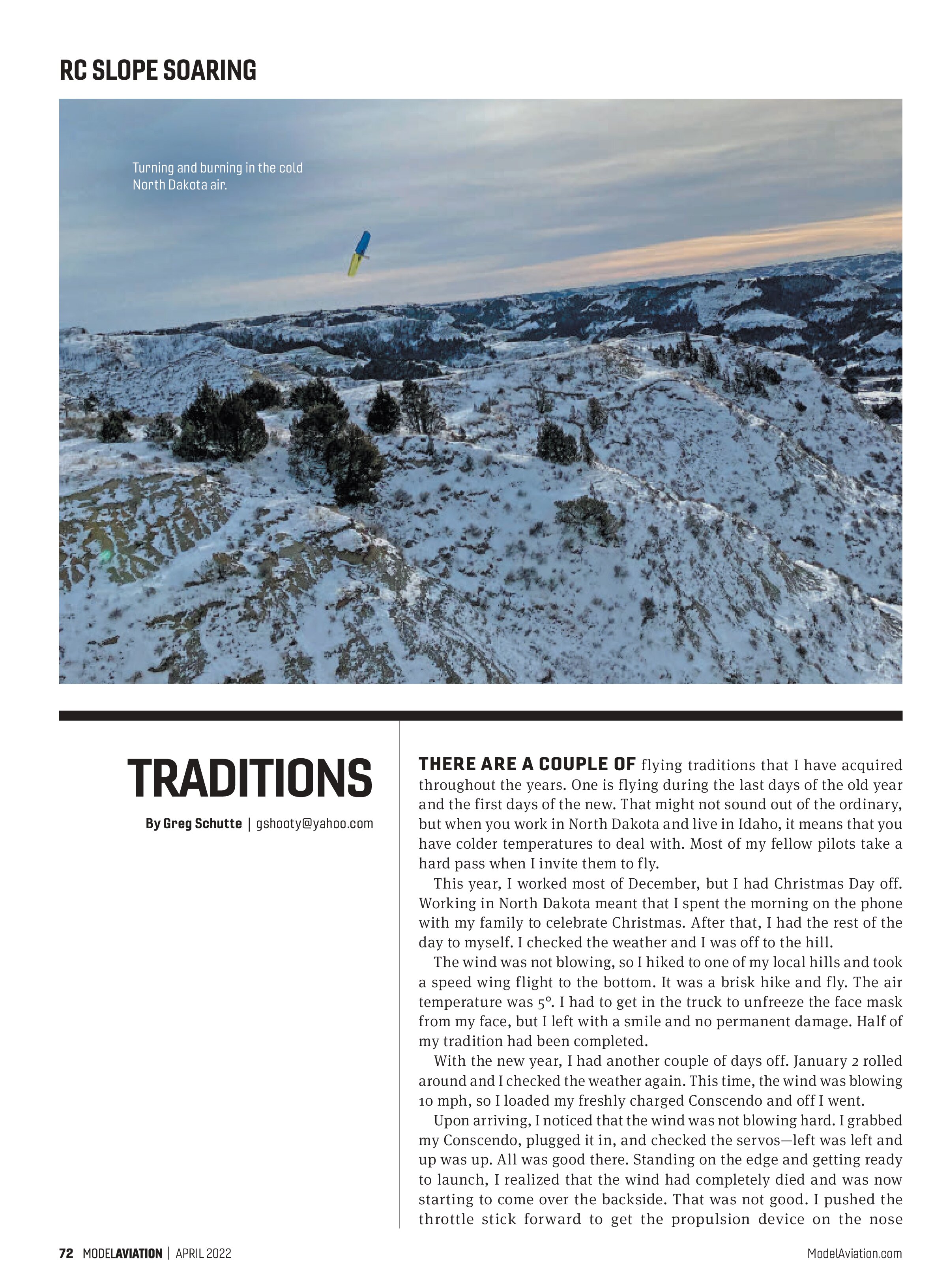
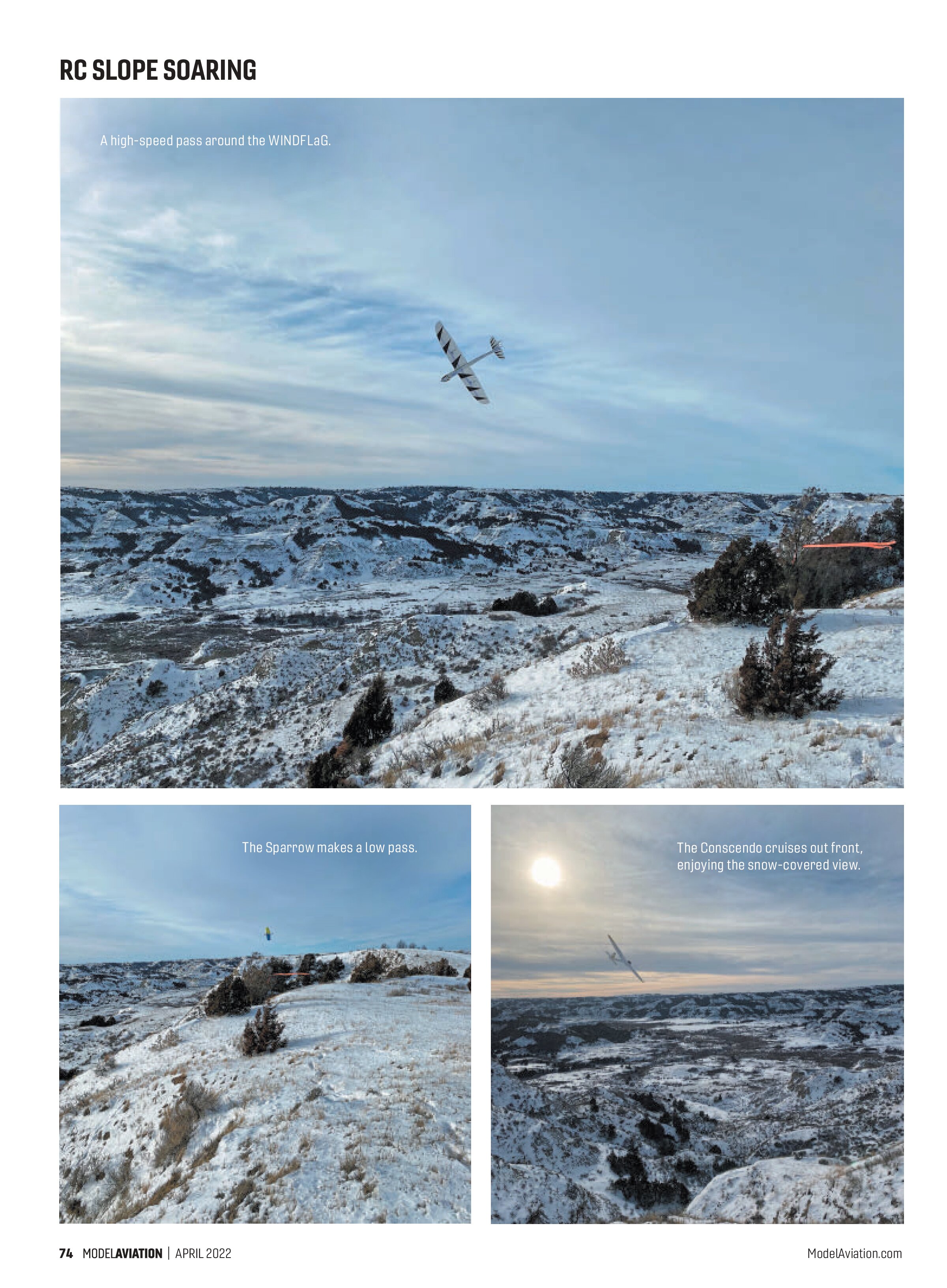
January 3 looked like it was going to be the day. The wind was blowing 12 mph out of the southwest. With the batteries charged on both airplanes and a smile on my face, I headed out to a new site that I had discovered a couple of months earlier. As I got closer, the wind appeared to be getting stronger. I pulled up to the site and might have been drooling with excitement. I put out my WINDFLaG and took a wind reading—20 to 25 mph, gusting to 30 mph, and coming straight in. I checked the temperature. It was 27°. That is shorts weather during this time of year in North Dakota. Perfect!
It was time to break in the new ridge. The Sparrow was the first to evaluate the air. It was dancing out there without a care in the world. My Sparrow always has fun exploring unfamiliar places and lift, but I did notice that the strong gusts were throwing it around. It was time for something larger.
This time, the Cons cendo did all the beeps, whistles, and blinky-light things it is supposed to do when plugged in. Left was left, up was up, and the throttle made the propeller spin. It was time to see if aviation was in my Cons cendo’s future.
I walked up to the edge and let it go. It tracked out straight and away it went. My Cons cendo flies like a champion in 20 to 25 mph wind. It was carving and burning holes in the sky. It was rock solid compared with my lightweight, little Sparrow. I had two nice flights. This site is going to be a wonderful place to fly.
With the cold temperatures, I only fly for 10 minutes at a time at the most. My fingers get numb, and the airplane does not respond as fast as it usually does. With my toes getting cold, I decided it was time to call it a day. I had fulfilled my tradition and could go home with a smile on my face. Another impressive day of flying!
When flying in winter conditions such as these, there are some safety concerns that I would like to address. The most important is that when you fly by yourself, always let somebody know where you are going and drop them a pin with accurate GPS coordinates. Make sure your mode of transportation is up to the challenge. The road to this new site requires a 4 x 4 vehicle in the winter. The road had previously been driven on, but there were still parts where the snow had drifted the tracks closed.
Carry stuff to dig yourself out in case you get stuck, such as a shovel and a tow strap. Include warm clothes, extra food, and drinks as well. A sleeping bag is also handy to have. You never know when your vehicle could stop running. The heater is useless.
Have your cellphone fully charged and have a charger with you. I also decided that if I lost one of my airplanes on the side of the hill, I would not retrieve it. The side of the hill was frozen hard and covered with snow. One slip and you are having a difficult day.
I also limit my time outside when flying. Flying short flights will keep you warm. The cold is not nice to batteries, and they drain fast. There is nothing worse than losing control of your airplane and seeing it fly away or crater into the ground. Plan to fly earlier in the day. Digging yourself out or having somebody find you is easier when it’s daylight. Knowing where to attach a pull strap to your vehicle can also keep a trip to the mechanic from happening.
With a new flying season here and a new site to explore, this year is going to be a good one.
Fly safely!
SOURCES:
League of Silent Flight (LSF)
www.silentflight.org