MODEL HELICOPTER COMPETITION
ISN’T FOR
EVERYONE. IS
IT FOR YOU?
By Tim DiPeri | timdperi@caseco-inc.com
IF YOU HAVEN’T HEARD, your helicopter community—the International Radio Controlled Helicopter Association (IRCHA) and AMA—is planning to host the 2023 F3C and F3N World Championships for Model Helicopters at the International Aeromodeling Center in Muncie, Indiana. This is the first time since 2009 that the US has held this event, and it is expected to be the best-attended championships in years!
Although 2023 seems far away, the 2022 AMA Nats will begin in a few short months. During the Nats, there is an opportunity to compete for a spot on the 2023 US World Championship team!
When most modelers think about model helicopters, they are typically funneled into several categories of pilots, not unlike airplanes (Pattern, Pylon Racing, Scale, sailplanes, etc.). The main difference is that helicopters are usually packaged into one box, and we all have our space in that box, with IRCHA as the Special Interest Group for all of it.
The IRCHA founder and many of the original officers were competition minded. I am amazed at the number of people who shy away from competition when they have never even tried it! If you talk with nearly any of the seasoned contest pilots in the country, you will find that many of the primary reasons for why they are involved in competition do not exclusively consist of trying to win an event.
Some of the longest, nonfamily relationships that I have are inside of the competition circle. We help one another to become better (none of the pilots want to do well because someone else did poorly), and we have lots of fun. Competition pilots want to improve their skills. It’s why we help one another out—to raise the level of competency for all pilots.

part would be expected to do.
A pilot can participate in one, two, or even all three of these events at the Nats! The rules and regulations are in the Competition Regulations on the AMA website.
Is competition for you? The statistics say no … but the statistics also say this:
- Those who participate in competitions stay in the hobby longer.
- Most competition pilots improve their skills faster.
- Most of the F3C champions have had international success in other model helicopter disciplines.
- Most new competitors fully immerse themselves and all aspects of the hobby improve!

What is involved in helicopter competition? There are several helicopter competitions in the US. The Nats (which is held at the beginning of the week of the IRCHA Jamboree) is a great place to give it a shot.
Because I am discussing the 2022 Nats, I’ll mention that there are three categories of competition styles:
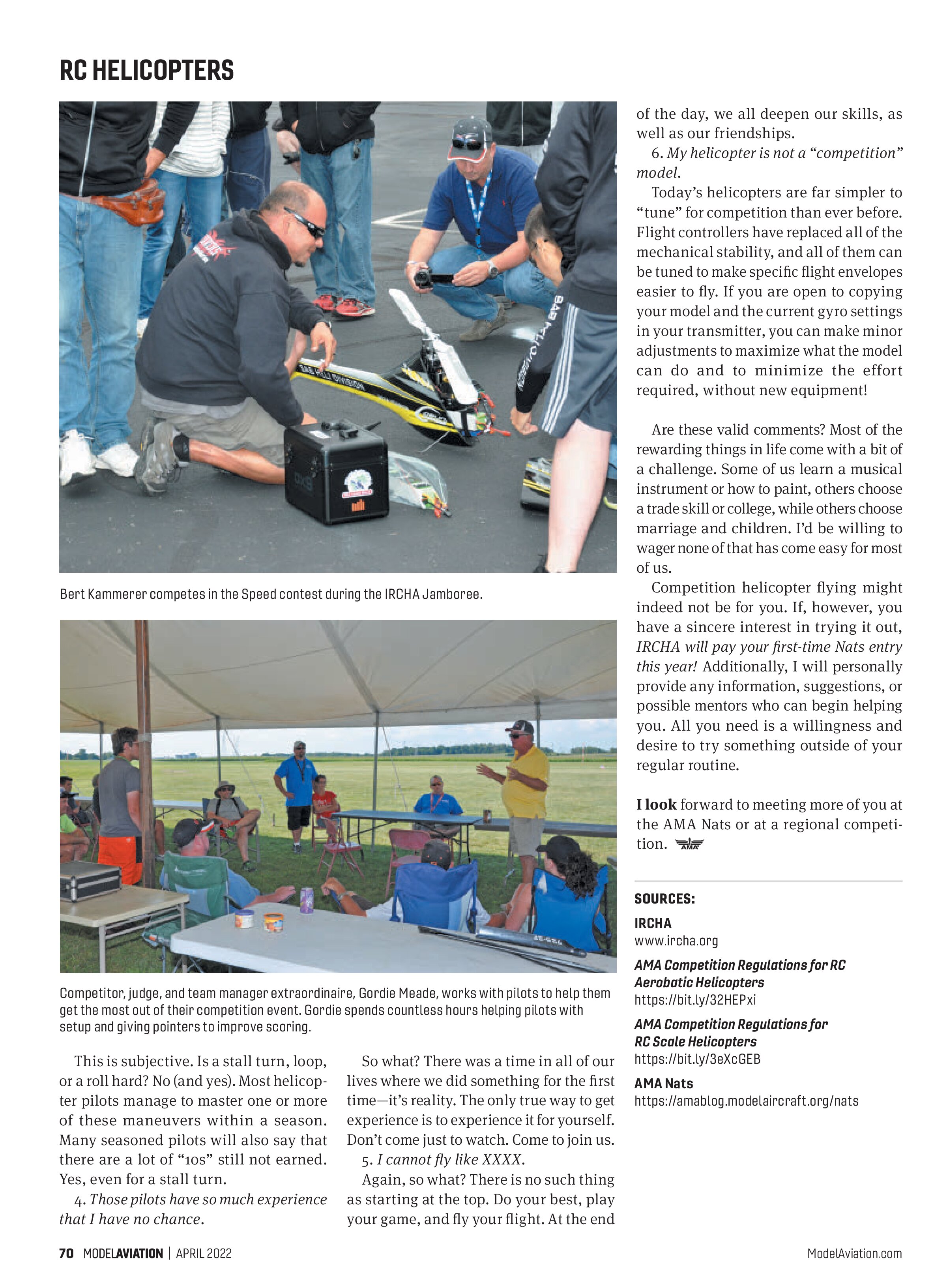
1. Precision (F3C) or “big air” flying. F3C is what many define this type of flying as, but there are four classes of competition for this discipline. Each competitor’s comfort in orientation (example: no nose-in maneuvers) will help determine the best class in which to participate.
Each class is composed of two hovering maneuvers and several aerobatic maneuvers followed by a landing. Each maneuver is judged (from zero to 10), and not all competitors perform all maneuvers (and take a zero for that maneuver).
2. 3D (F3N) or “Freestyle.” F3N is actually offered in two categories at the AMA Nats. The Sportsman’s variant allows a selection of maneuvers that have been identified as Sportsman. These maneuvers (all inside of the F3N rules) tend to be less complex 3D maneuvers to appeal to a larger competition audience.
For the 3D (F3N) competition, there are three areas that are performed, with all being judged:
- A group of chosen maneuvers.
- Freestyle flying of the pilot’s choice.
- Freestyle with choreographed music.
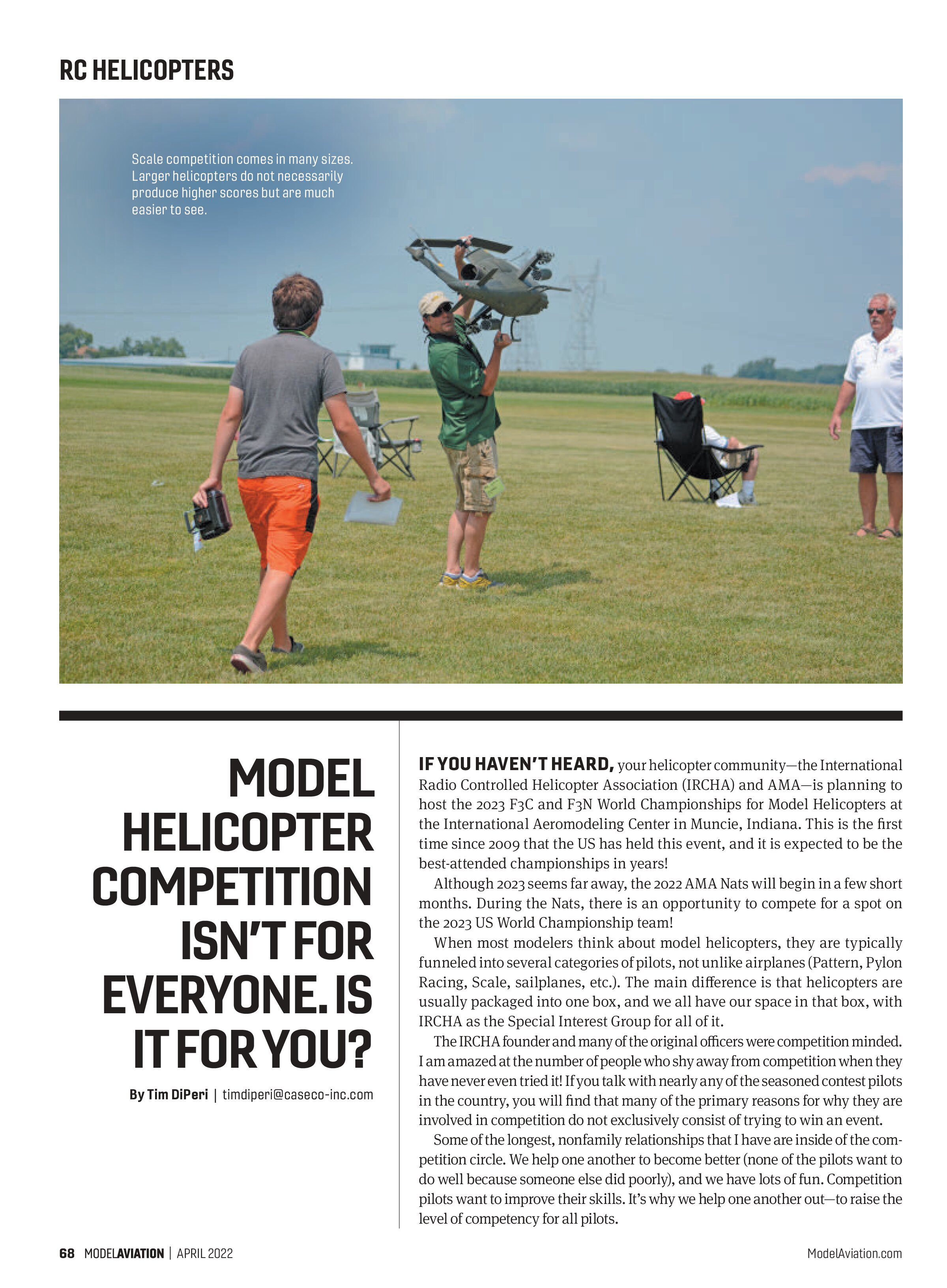
3. Scale. This is another class that has multiple options inside of it: traditional, Sport Scale, and Team Scale. Models are judged for an accurate depiction of the full-scale helicopter and the same flying maneuvers as what its full-scale counter-
It’s not for everyone! I read about pilots (on social media) who are “practicing” for the new season all the time. Most of them won’t compete, so why do they practice? I’ve heard:
- Hovering is boring. Why would I want to do that?
I think this needs to be discovered in the eyes of the pilot. In golf, the term “drive for show, putt for dough” is relevant. The prime function that separates helicopters from other aircraft is to hover. I get it. Hovering is not for you. How about F3N?
- I don’t do 3D.
Our hobby focuses a great deal on 3D flying. It’s exciting and tends to be an area where a good number of pilots enter the helicopter conduit. Some (perhaps coming from a fixed-wing background) prefer to do “big air” maneuvers. F3C is a place you can call home.
- F3C/F3N maneuvers are too hard.


This is subjective. Is a stall turn, loop, or a roll hard? No (and yes). Most helicopter pilots manage to master one or more of these maneuvers within a season. Many seasoned pilots will also say that there are a lot of “10s” still not earned. Yes, even for a stall turn.
4. Those pilots have so much experience that I have no chance.
So what? There was a time in all of our lives where we did something for the first time—it’s reality. The only true way to get experience is to experience it for yourself. Don’t come just to watch. Come to join us.
5. I cannot fly like XXXX.
Again, so what? There is no such thing as starting at the top. Do your best, play your game, and fly your flight. At the end of the day, we all deepen our skills, as well as our friendships.
6. My helicopter is not a “competition” model.
Today’s helicopters are far simpler to “tune” for competition than ever before. Flight controllers have replaced all of the mechanical stability, and all of them can be tuned to make specific flight envelopes easier to fly. If you are open to copying your model and the current gyro settings in your transmitter, you can make minor adjustments to maximize what the model can do and to minimize the effort required, without new equipment!
Are these valid comments? Most of the rewarding things in life come with a bit of a challenge. Some of us learn a musical instrument or how to paint, others choose a trade skill or college, while others choose marriage and children. I’d be willing to wager none of that has come easy for most of us.
Competition helicopter flying might indeed not be for you. If, however, you have a sincere interest in trying it out, IRCHA will pay your first-time Nats entry this year! Additionally, I will personally provide any information, suggestions, or possible mentors who can begin helping you. All you need is a willingness and desire to try something outside of your regular routine.
I look forward to meeting more of you at the AMA Nats or at a regional competition.
SOURCES:
IRCHA
www.ircha.org
AMA Competition Regulations for RC Aerobatic Helicopters
https://bit.ly/32HEPxi
AMA Competition Regulations for RC Scale Helicopters
https://bit.ly/3eXcGEB