FREE FLIGHT SPORT

SMALL AND SIMPLE
By Don DeLoach | ddeloach@comcast.net
SINCE THE 1930S, rubber-powered Free Flight (FF) has been dominated by serious competition models with 4- to 5-foot wingspans and weighing 8 ounces or more. These models were difficult to handle for an average flier and required large motors and much support equipment. Worst of all, they required large flying sites for flights that averaged 5-plus minutes.
During World War II, the French realized that a smaller, more practical class was needed, so they developed Coupe d’Hiver. These were the first “formula” models that were intended for smaller flying fields and shorter flights. Rubber was limited to 10 grams, and the models only flew approximately 1-1/2 to 2 minutes. The downside was that most had folding propellers. In time, Coupes evolved into higher-performance models that were still slightly too complex for novices who were entering rubber flying.
By the early 1970s, it was clear that rubber-powered flying was on a path to ever-increasing complexity and even higher performance. Many who were in serious competition circles enjoyed the challenge, but a large percentage of average fliers still felt left behind by the latest trends.
P-30
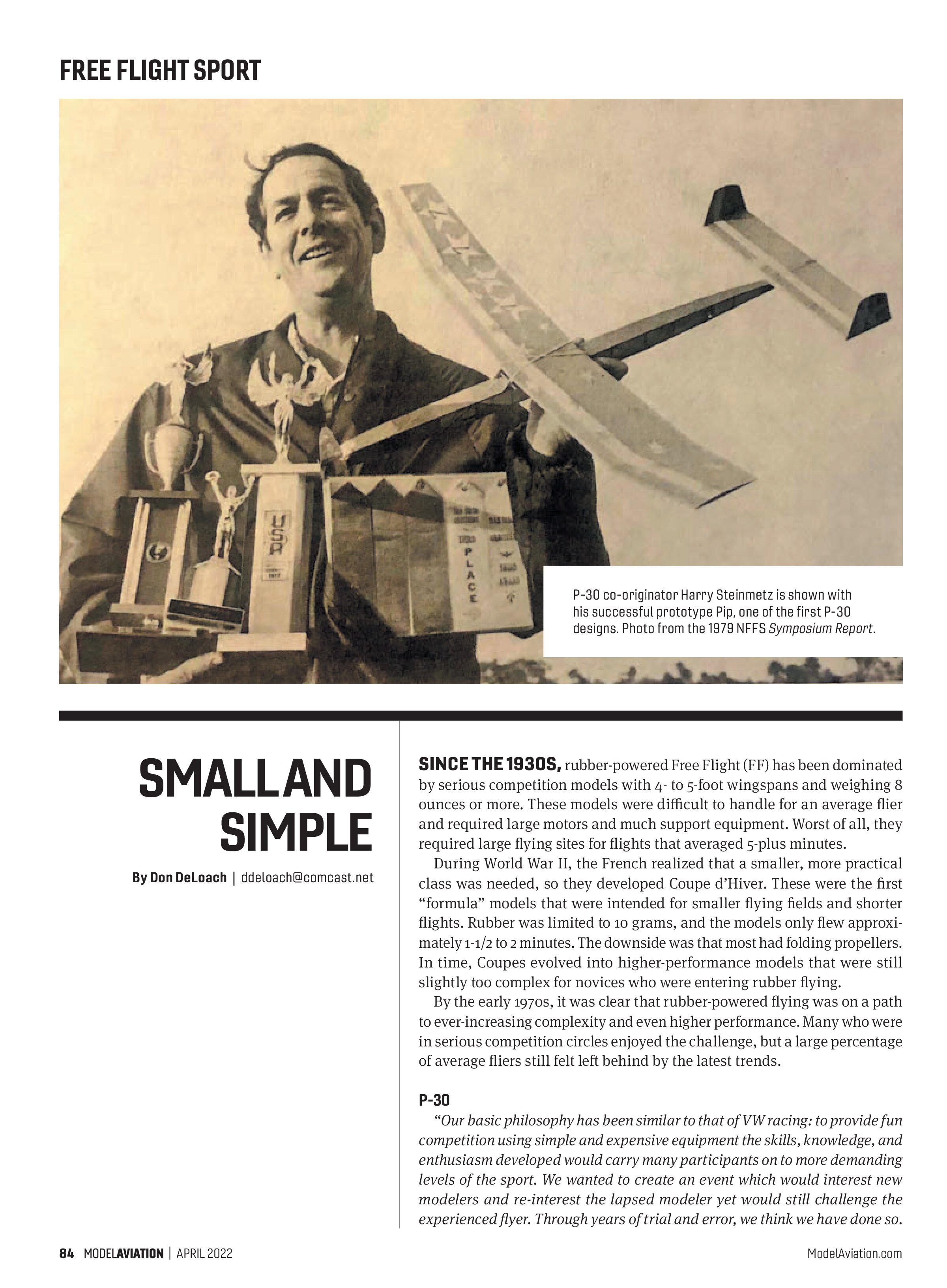
“Our basic philosophy has been similar to that of VW racing: to provide fun competition using simple and inexpensive equipment the skills, knowledge, and enthusiasm developed would carry many participants on to more demanding levels of the sport. We wanted to create an event which would interest new modelers and re-interest the lapsed modeler yet would still challenge the experienced flyer. Through years of trial and error, we think we have done so.
The rules have been expanded and refined as insight has been gained through thousands of flights and hundreds of happy hangar sessions.”
—P-30 co-originator Harry Steinmetz, in the 1979 National Free Flight Society’s (NFFS) Symposium Report
In 1974, Harry Steinmetz and John Oldenkamp, of the San Diego Orbiteers Club, hatched an idea for a simple formula event called P-30. The rules were simple: a 30-inch maximum wingspan and length, an unmodified 9-1/2-inch plastic free-wheeling propeller, and 10 grams of rubber. It would be a competition event, but the focus was on ease and simplicity, not pushing the envelope of performance.
The concept was at first scoffed at by “serious” rubber fliers. In Harry’s words, experts were mad that P-30 fliers “weren’t having to work hard enough to have their fun.” Eventually, the same experts could not resist building and flying their own P-30s. By 1976, the P-30 formula had earned broad appeal in California and a few other states.
After a bit more refinement, P-30 came of age in 1977. There was a nationwide Postal meet that drew 45 fliers. Two kits were offered: the Square Eagle and One Nite 28 (both of which are still in production). The event was contested at the US FF Championships in Taft, California, and the AMA Nats in Riverside, California. By 1980, P-30 was an official AMA event, with the addition of a 40-gram minimum weight. Within a decade, it was one of the three most popular events at FF contests across the country.
Forty-eight years after its creation, P-30 continues to thrive in the US and around the world. More than two dozen kits are in production for approximately $20 to $50 each.
P-30s are perfect platforms for crossover to or from sport or competition flying. A rank novice can have one in the air in a matter of days. They trim out easily and can be flown for fun on small, local sites. The P-30’s popularity is proof that there will always be demand for small and simple model airplanes that are built with traditional materials.
Bustard One-Design
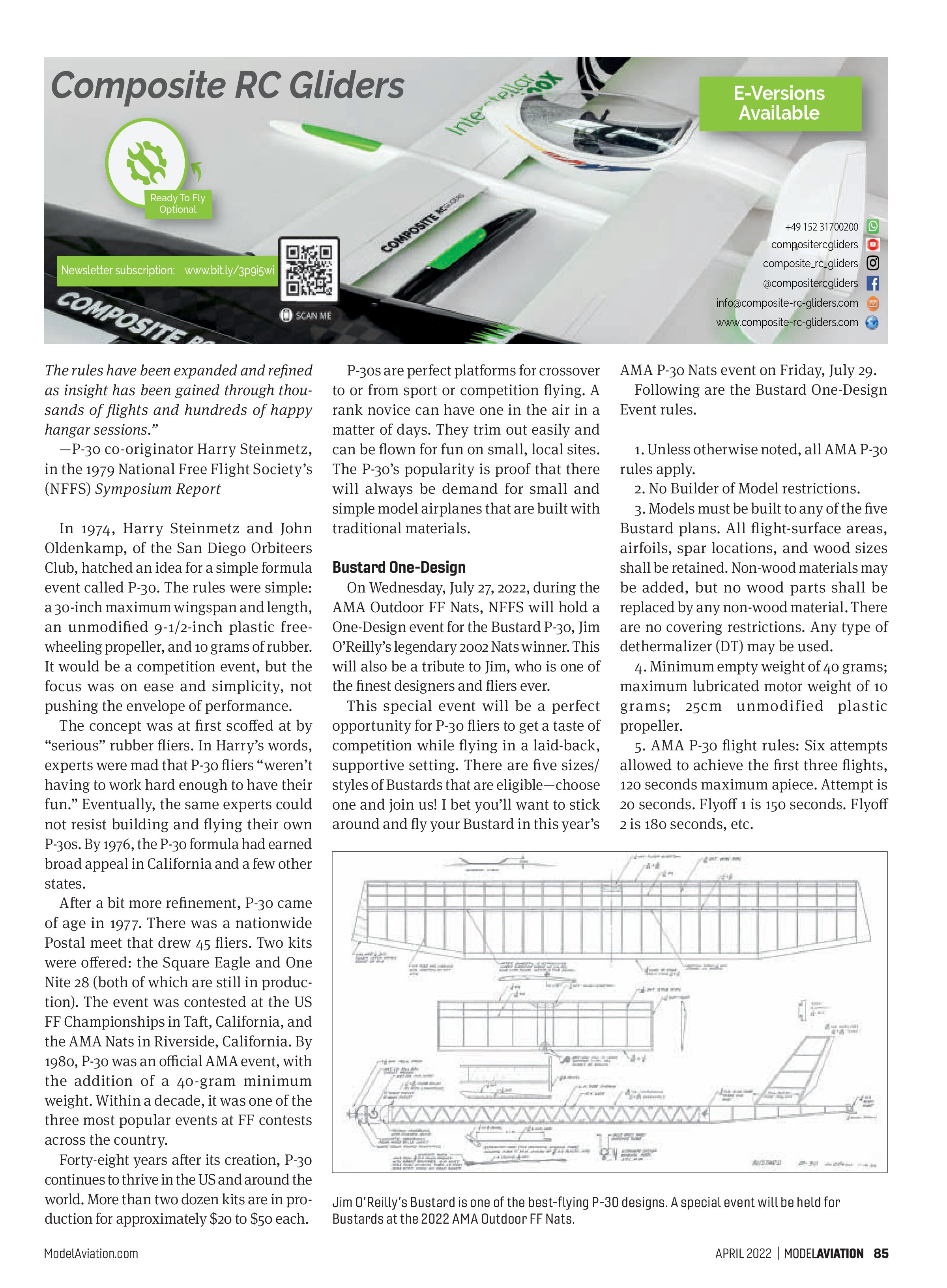
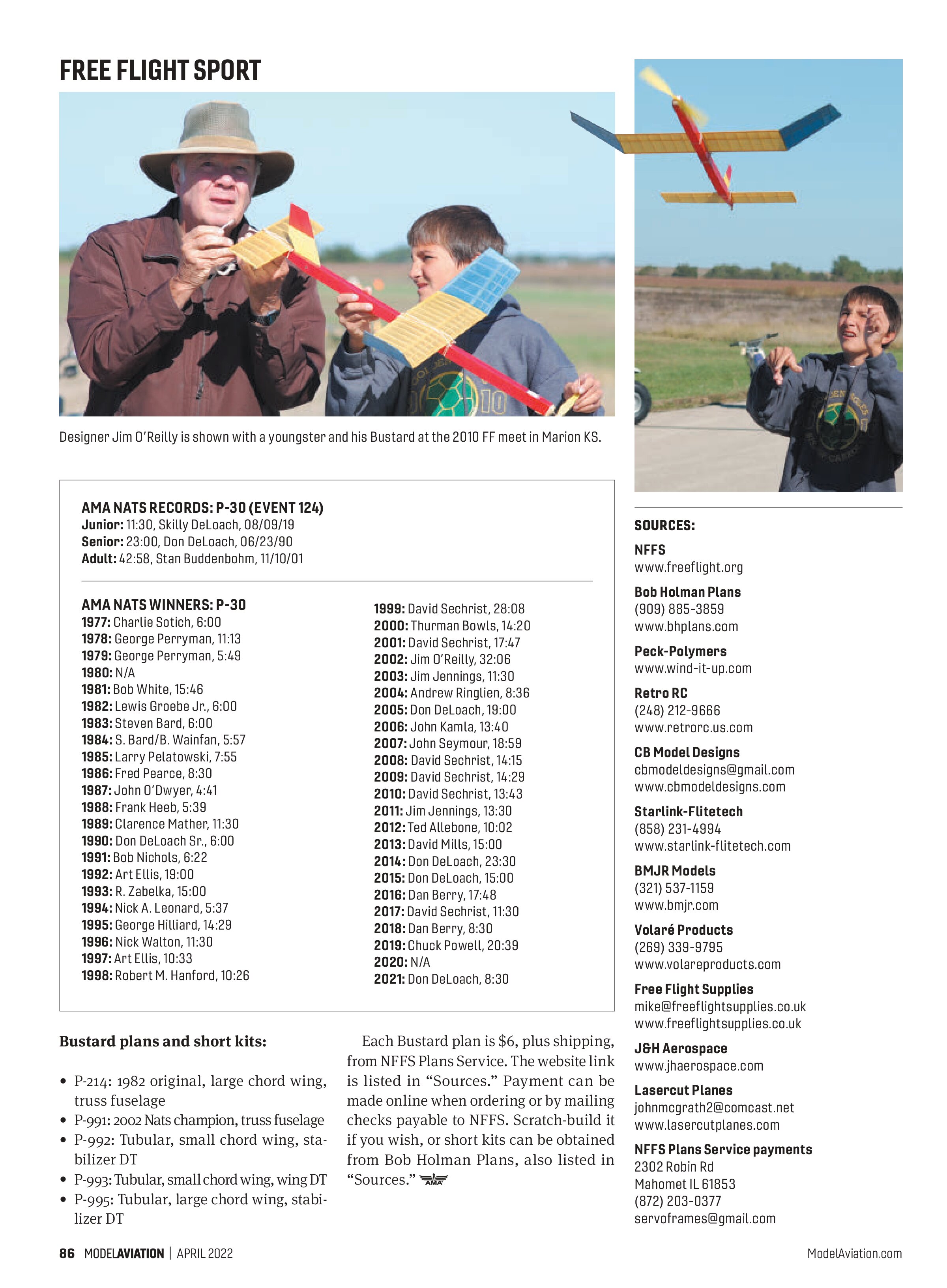
On Wednesday, July 27, 2022, during the AMA Outdoor FF Nats, NFFS will hold a One-Design event for the Bustard P-30, Jim O’Reilly’s legendary 2002 Nats winner. This will also be a tribute to Jim, who is one of the finest designers and fliers ever.
This special event will be a perfect opportunity for P-30 fliers to get a taste of competition while flying in a laid-back, supportive setting. There are five sizes/styles of Bustards that are eligible—choose one and join us! I bet you’ll want to stick around and fly your Bustard in this year’s AMA P-30 Nats event on Friday, July 29. Following are the Bustard One-Design Event rules.
- Unless otherwise noted, all AMA P-30 rules apply.
- No Builder of Model restrictions.
- Models must be built to any of the five Bustard plans. All flight-surface areas, airfoils, spar locations, and wood sizes shall be retained. Non-wood materials may be added, but no wood parts shall be replaced by any non-wood material. There are no covering restrictions. Any type of dethermalizer (DT) may be used.
- Minimum empty weight of 40 grams; maximum lubricated motor weight of 10 grams; 25cm unmodified plastic propeller.
- AMA P-30 flight rules: Six attempts allowed to achieve the first three flights, 120 seconds maximum apiece. Attempt is 20 seconds. Flyoff 1 is 150 seconds. Flyoff 2 is 180 seconds, etc.


AMA NATS RECORDS: P-30 (EVENT 124)
Junior: 11:30, Skilly DeLoach, 08/09/19
Senior: 23:00, Don DeLoach, 06/23/90
Adult: 42:58, Stan Buddenbohm, 11/10/01
AMA NATS WINNERS: P-30
1977: Charlie Sotich, 6:00
1978: George Perryman, 11:13
1979: George Perryman, 5:49
1980: N/A
1981: Bob White, 15:46
1982: Lewis Groebe Jr., 6:00
1983: Steven Bard, 6:00
1984: S. Bard/B. Wainfan, 5:57
1985: Larry Pelatowski, 7:55
1986: Fred Pearce, 8:30
1987: John O’Dwyer, 4:41
1988: Frank Heeb, 5:39
1989: Clarence Mather, 11:30
1990: Don DeLoach Sr., 6:00
1991: Bob Nichols, 6:22
1992: Art Ellis, 19:00
1993: R. Zabelka, 15:00
1994: Nick A. Leonard, 5:37
1995: George Hilliard, 14:29
1996: Nick Walton, 11:30
1997: Art Ellis, 10:33
1998: Robert M. Hanford, 10:26
1999: David Sechrist, 28:08
2000: Thurman Bowls, 14:20
2001: David Sechrist, 17:47
2002: Jim O’Reilly, 32:06
2003: Jim Jennings, 11:30
2004: Andrew Ringlien, 8:36
2005: Don DeLoach, 19:00
2006: John Kamla, 13:40
2007: John Seymour, 18:59
2008: David Sechrist, 14:15
2009: David Sechrist, 14:29
2010: David Sechrist, 13:43
2011: Jim Jennings, 13:30
2012: Ted Allebone, 10:02
2013: David Mills, 15:00
2014: Don DeLoach, 23:30
2015: Don DeLoach, 15:00
2016: Dan Berry, 17:48
2017: David Sechrist, 11:30
2018: Dan Berry, 8:30
2019: Chuck Powell, 20:39
2020: N/A
2021: Don DeLoach, 8:30
Bustard plans and short kits:
- P-214: 1982 original, large chord wing, truss fuselage
- P-991: 2002 Nats champion, truss fuselage
- P-992: Tubular, small chord wing, stabilizer DT
- P-993: Tubular, small chord wing, wing DT
- P-995: Tubular, large chord wing, stabilizer DT
Each Bustard plan is $6, plus shipping, from NFFS Plans Service. The website link is listed in “Sources.” Payment can be made online when ordering or by mailing checks payable to NFFS. Scratch-build it if you wish, or short kits can be obtained from Bob Holman Plans, also listed in “Sources.”
SOURCES:
Bob Holman Plans
(909) 885-3859
www.bhplans.com
Peck-Polymers
www.wind-it-up.com
Retro RC
(248) 212-9666
www.retrorc.us.com
CB Model Designs
cbmodeldesigns@gmail.com
www.cbmodeldesigns.com
Starlink-Flitetech
(858) 231-4994
www.starlink-flitetech.com
BMJR Models
(321) 537-1159
www.bmjr.com
Volaré Products
(269) 339-9795
www.volareproducts.com
Free Flight Supplies
mike@freeflightsupplies.co.uk
www.freeflightsupplies.co.uk
J&H Aerospace
www.jhaerospace.com
Lasercut Planes
johnmcgrath2@comcast.net
www.lasercutplanes.com
NFFS Plans Service payments
2302 Robin Rd
Mahomet IL 61853
(872) 203-0377
servoframes@gmail.com