FOCAL POINT
Interested in sharing your handiwork? Visit www.ModelAviation.com for submission guidelines.
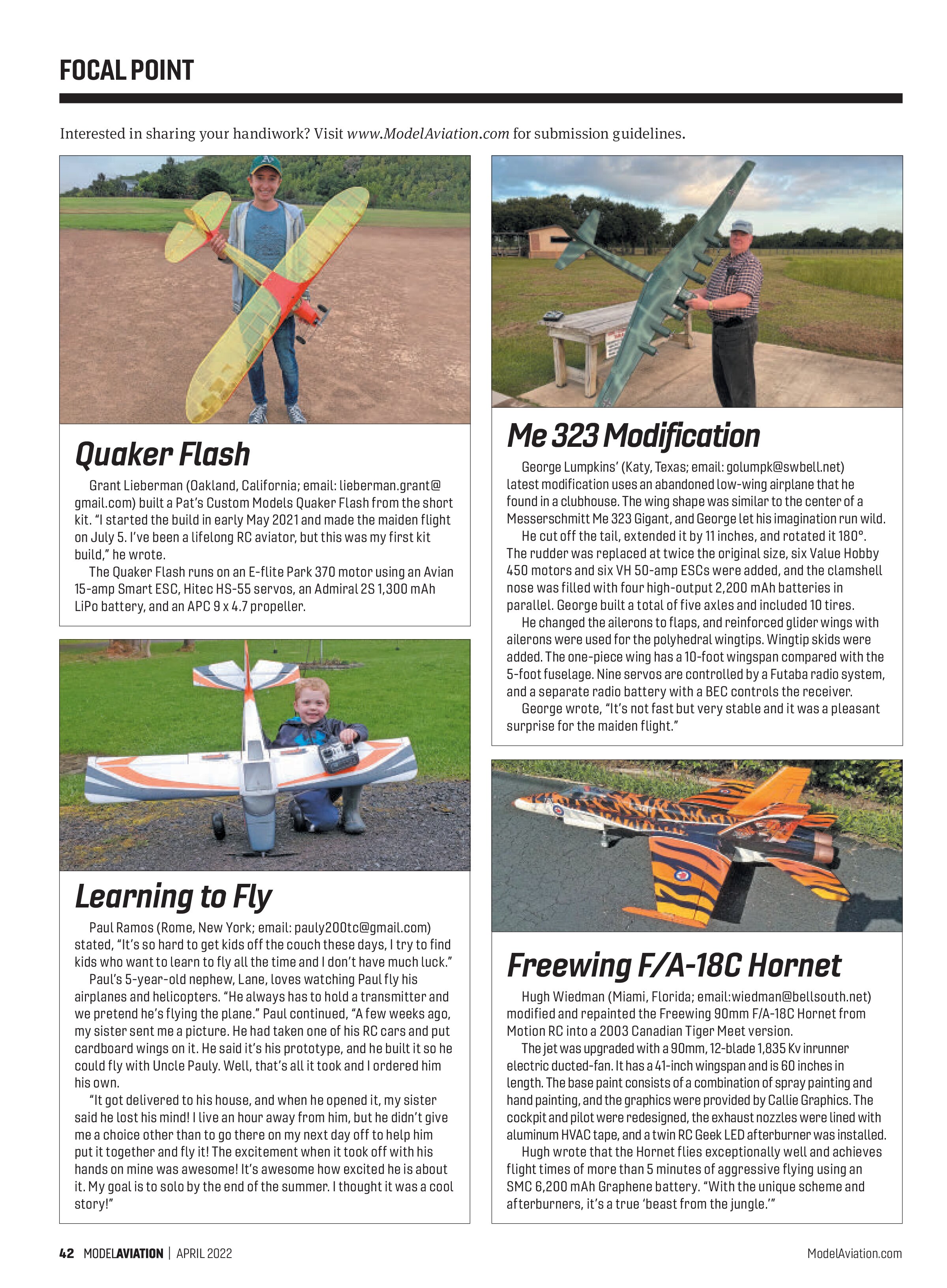
Quaker Flash

Grant Lieberman (Oakland, California; email: lieberman.grant@gmail.com) built a Pat’s Custom Models Quaker Flash from the short kit. “I started the build in early May 2021 and made the maiden flight on July 5. I’ve been a lifelong RC aviator, but this was my first kit build,” he wrote.
The Quaker Flash runs on an E-flite Park 370 motor using an Avian 15-amp Smart ESC, Hitec HS-55 servos, an Admiral 2S 1,300 mAh LiPo battery, and an APC 9 x 4.7 propeller.
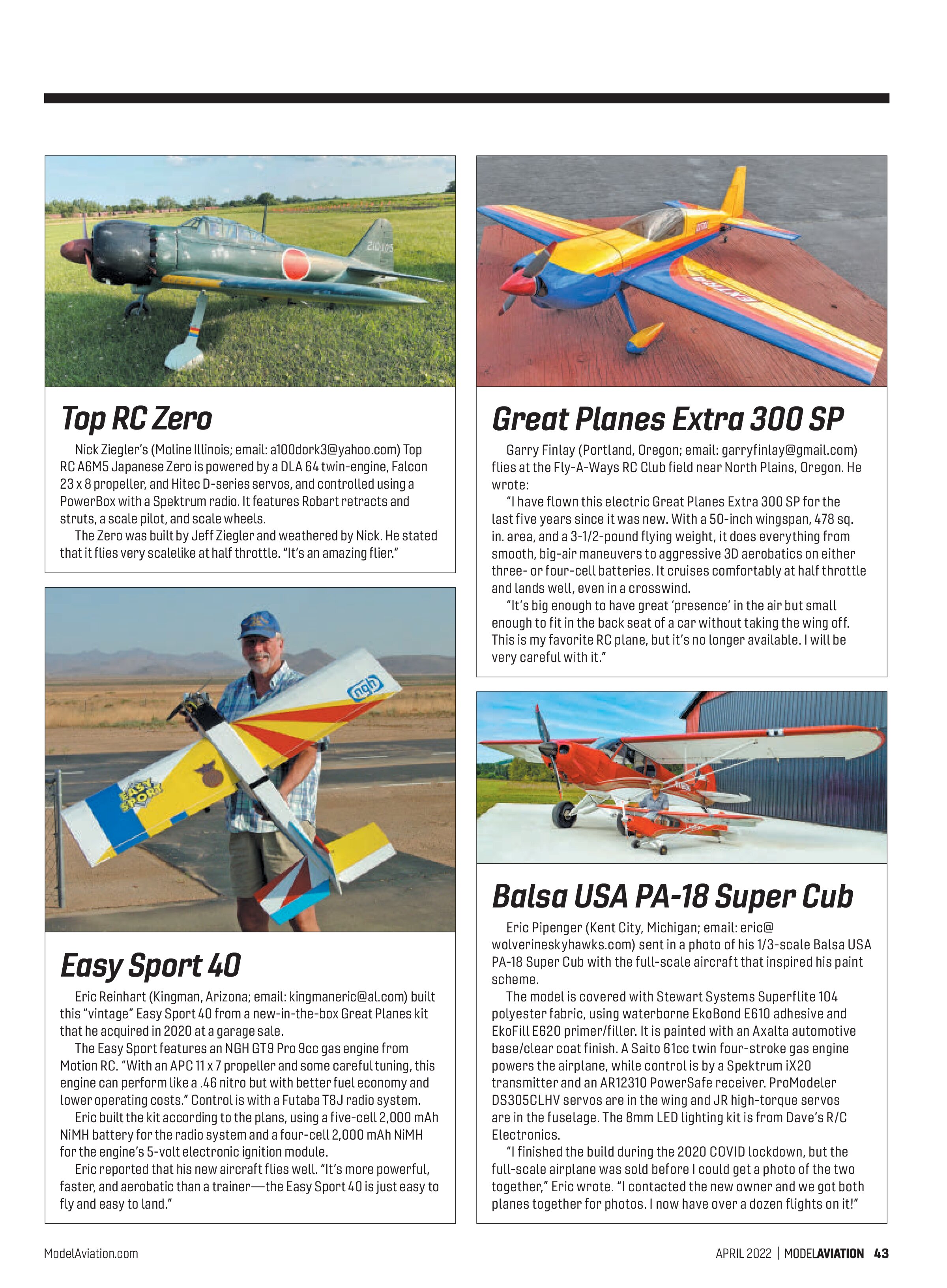
Learning to Fly

Paul Ramos (Rome, New York; email: pauly200tc@gmail.com) stated, “It’s so hard to get kids off the couch these days, I try to find kids who want to learn to fly all the time and I don’t have much luck.”
Paul’s 5-year-old nephew, Lane, loves watching Paul fly his airplanes and helicopters. “He always has to hold a transmitter and we pretend he’s flying the plane.” Paul continued, “A few weeks ago, my sister sent me a picture. He had taken one of his RC cars and put cardboard wings on it. He said it’s his prototype, and he built it so he could fly with Uncle Pauly. Well, that’s all it took and I ordered him his own.
“It got delivered to his house, and when he opened it, my sister said he lost his mind! I live an hour away from him, but he didn’t give me a choice other than to go there on my next day off to help him put it together and fly it! The excitement when it took off with his hands on mine was awesome! It’s awesome how excited he is about it. My goal is to solo by the end of the summer. I thought it was a cool story!”
Me 323 Modification

George Lumpkins’ (Katy, Texas; email: golumpk@swbell.net) latest modification uses an abandoned low-wing airplane that he found in a clubhouse. The wing shape was similar to the center of a Messerschmitt Me 323 Gigant, and George let his imagination run wild.
He cut off the tail, extended it by 11 inches, and rotated it 180°. The rudder was replaced at twice the original size, six Value Hobby 450 motors and six VH 50-amp ESCs were added, and the clamshell nose was filled with four high-output 2,200 mAh batteries in parallel. George built a total of five axles and included 10 tires.
He changed the ailerons to flaps, and reinforced glider wings with ailerons were used for the polyhedral wingtips. Wingtip skids were added. The one-piece wing has a 10-foot wingspan compared with the 5-foot fuselage. Nine servos are controlled by a Futaba radio system, and a separate radio battery with a BEC controls the receiver.
George wrote, “It’s not fast but very stable and it was a pleasant surprise for the maiden flight.”
Freewing F/A-18C Hornet

Hugh Wiedman (Miami, Florida; email: wiedman@bellsouth.net) modified and repainted the Freewing 90mm F/A-18C Hornet from Motion RC into a 2003 Canadian Tiger Meet version.
The jet was upgraded with a 90mm, 12-blade 1,835 Kv inrunner electric ducted-fan. It has a 41-inch wingspan and is 60 inches in length. The base paint consists of a combination of spray painting and hand painting, and the graphics were provided by Callie Graphics. The cockpit and pilot were redesigned, the exhaust nozzles were lined with aluminum HVAC tape, and a twin RC Geek LED afterburner was installed.
Hugh wrote that the Hornet flies exceptionally well and achieves flight times of more than 5 minutes of aggressive flying using an SMC 6,200 mAh Graphene battery. “With the unique scheme and afterburners, it’s a true ‘beast from the jungle.’”
Top RC Zero

Nick Ziegler’s (Moline Illinois; email: a100dork3@yahoo.com) Top RC A6M5 Japanese Zero is powered by a DLA 64 twin-engine, Falcon 23 x 8 propeller, and Hitec D-series servos, and controlled using a PowerBox with a Spektrum radio. It features Robart retracts and struts, a scale pilot, and scale wheels.
The Zero was built by Jeff Ziegler and weathered by Nick. He stated that it flies very scalelike at half throttle. “It’s an amazing flier.”
Easy Sport 40

Eric Reinhart (Kingman, Arizona; email: kingmaneric@aol.com) built this “vintage” Easy Sport 40 from a new-in-the-box Great Planes kit that he acquired in 2020 at a garage sale.
The Easy Sport features an NGH GT9 Pro 9cc gas engine from Motion RC. “With an APC 11 x 7 propeller and some careful tuning, this engine can perform like a .46 nitro but with better fuel economy and lower operating costs.” Control is with a Futaba T8J radio system.
Eric built the kit according to the plans, using a five-cell 2,000 mAh NiMH battery for the radio system and a four-cell 2,000 mAh NiMH for the engine’s 5-volt electronic ignition module.
Eric reported that his new aircraft flies well. “It’s more powerful, faster, and aerobatic than a trainer—the Easy Sport 40 is just easy to fly and easy to land.”
Great Planes Extra 300 SP

Garry Finlay (Portland, Oregon; email: garryfinlay@gmail.com) flies at the Fly-A-Ways RC Club field near North Plains, Oregon. He wrote:
“I have flown this electric Great Planes Extra 300 SP for the last five years since it was new. With a 50-inch wingspan, 478 sq. in. area, and a 3-1/2-pound flying weight, it does everything from smooth, big-air maneuvers to aggressive 3D aerobatics on either three- or four-cell batteries. It cruises comfortably at half throttle and lands well, even in a crosswind.
“It’s big enough to have great ‘presence’ in the air but small enough to fit in the back seat of a car without taking the wing off. This is my favorite RC plane, but it’s no longer available. I will be very careful with it.”
Balsa USA PA-18 Super Cub

Eric Pipenger (Kent City, Michigan; email: eric@wolverineskyhawks.com) sent in a photo of his 1/3-scale Balsa USA PA-18 Super Cub with the full-scale aircraft that inspired his paint scheme.
The model is covered with Stewart Systems Superflite 104 polyester fabric, using waterborne EkoBond E610 adhesive and EkoFill E620 primer/filler. It is painted with an Axalta automotive base/clear coat finish. A Saito 61cc twin four-stroke gas engine powers the airplane, while control is by a Spektrum iX20 transmitter and an AR12130 PowerSafe receiver. ProModeler DS305CLHV servos are in the wing and JR high-torque servos are in the fuselage. The 8mm LED lighting kit is from Dave’s R/C Electronics.
“I finished the build during the 2020 COVID lockdown, but the full-scale airplane was sold before I could get a photo of the two together,” Eric wrote. “I contacted the new owner and we got both planes together for photos. I now have over a dozen flights on it!”